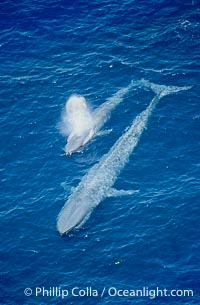
Two blue whales, a mother and her calf, swim through the open ocean in this aerial photograph. The calf is blowing (spouting, exhaling) with a powerful column of spray. The blue whale is the largest animal ever to live on Earth.
Species: Blue whale, Balaenoptera musculus
Location: San Diego, California
Image ID: 02304
Species: Blue whale, Balaenoptera musculus
Location: San Diego, California
Image ID: 02304
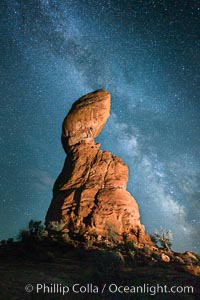
Balanced Rock and Milky Way stars at night.
Location: Balanced Rock, Arches National Park, Utah
Image ID: 27835
Location: Balanced Rock, Arches National Park, Utah
Image ID: 27835
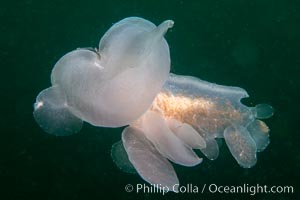
Hooded Nudibranch Melibe leonina swimming in mid water column, Browning Pass, Vancouver Island, Canada.
Species: Hooded nudibranch, Melibe leonina
Location: British Columbia, Canada
Image ID: 35316
Species: Hooded nudibranch, Melibe leonina
Location: British Columbia, Canada
Image ID: 35316
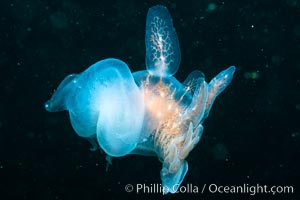
Hooded Nudibranch Melibe leonina swimming in mid water column, Browning Pass, Vancouver Island, Canada.
Species: Hooded nudibranch, Melibe leonina
Location: British Columbia, Canada
Image ID: 35319
Species: Hooded nudibranch, Melibe leonina
Location: British Columbia, Canada
Image ID: 35319
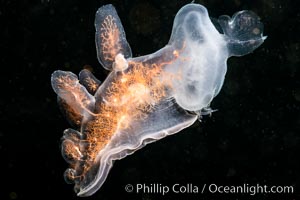
Hooded Nudibranch Melibe leonina swimming in mid water column, Browning Pass, Vancouver Island, Canada.
Species: Hooded nudibranch, Melibe leonina
Location: British Columbia, Canada
Image ID: 35320
Species: Hooded nudibranch, Melibe leonina
Location: British Columbia, Canada
Image ID: 35320
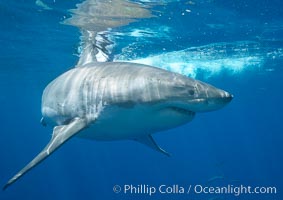
A great white shark is countershaded, with a dark gray dorsal color and light gray to white underside, making it more difficult for the shark's prey to see it as approaches from above or below in the water column. The particular undulations of the countershading line along its side, where gray meets white, is unique to each shark and helps researchers to identify individual sharks in capture-recapture studies. Guadalupe Island is host to a relatively large population of great white sharks who, through a history of video and photographs showing their countershading lines, are the subject of an ongoing study of shark behaviour, migration and population size.
Species: Great white shark, Carcharodon carcharias
Location: Guadalupe Island (Isla Guadalupe), Baja California, Mexico
Image ID: 19468
Species: Great white shark, Carcharodon carcharias
Location: Guadalupe Island (Isla Guadalupe), Baja California, Mexico
Image ID: 19468
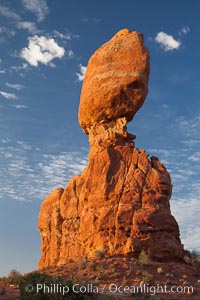
Balanced Rock, a narrow sandstone tower, appears poised to topple.
Location: Balanced Rock, Arches National Park, Utah
Image ID: 27839
Location: Balanced Rock, Arches National Park, Utah
Image ID: 27839
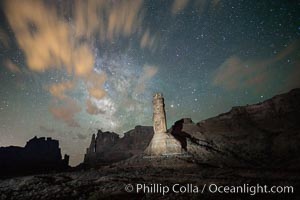
Stone columns rising in the night sky, milky way and stars and clouds filling the night sky overhead.
Location: Arches National Park, Utah
Image ID: 27848
Location: Arches National Park, Utah
Image ID: 27848
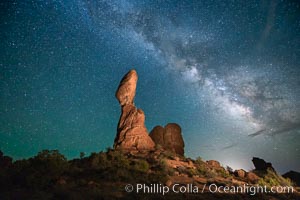
Balanced Rock and Milky Way stars at night.
Location: Balanced Rock, Arches National Park, Utah
Image ID: 27831
Location: Balanced Rock, Arches National Park, Utah
Image ID: 27831

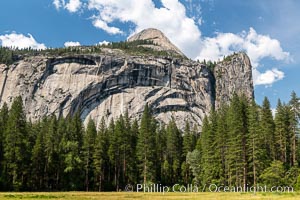
Royal Arches and Washington Column, in Yosemite National Park.
Location: Yosemite National Park, California
Image ID: 36375
Location: Yosemite National Park, California
Image ID: 36375
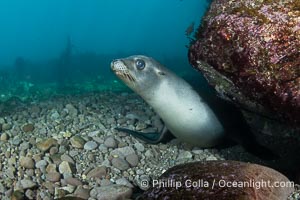
Young California Sea Lion Pup On the Cobblestone Patch, Looking at the Underwater Camera Taking Its Photograph, in the Coronado Islands, Baja, Mexico. Young sea lions will often play with the cobblestones seen here, lifting them into the water column before letting them sink back down, all the while keeping them just out of reach of the divers they are taunting.
Species: California sea lion, Zalophus californianus
Location: Coronado Islands (Islas Coronado), Baja California, Mexico
Image ID: 39977
Species: California sea lion, Zalophus californianus
Location: Coronado Islands (Islas Coronado), Baja California, Mexico
Image ID: 39977
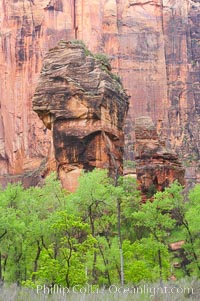
The Preacher and the Pulpit, a pair of freestanding sandstone columns in the Temple of Sinawava, are surrounded by cottonwoods with their deep green spring foliage. Zion Canyon.
Location: Zion National Park, Utah
Image ID: 12501
Location: Zion National Park, Utah
Image ID: 12501
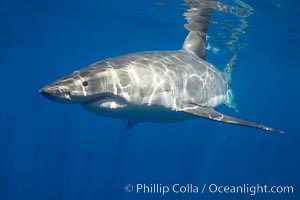
A great white shark is countershaded, with a dark gray dorsal color and light gray to white underside, making it more difficult for the shark's prey to see it as approaches from above or below in the water column. The particular undulations of the countershading line along its side, where gray meets white, is unique to each shark and helps researchers to identify individual sharks in capture-recapture studies. Guadalupe Island is host to a relatively large population of great white sharks who, through a history of video and photographs showing their countershading lines, are the subject of an ongoing study of shark behaviour, migration and population size.
Species: Great white shark, Carcharodon carcharias
Location: Guadalupe Island (Isla Guadalupe), Baja California, Mexico
Image ID: 19455
Species: Great white shark, Carcharodon carcharias
Location: Guadalupe Island (Isla Guadalupe), Baja California, Mexico
Image ID: 19455
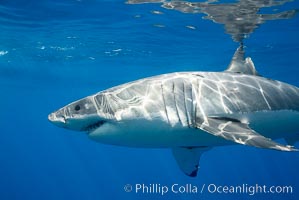
A great white shark is countershaded, with a dark gray dorsal color and light gray to white underside, making it more difficult for the shark's prey to see it as approaches from above or below in the water column. The particular undulations of the countershading line along its side, where gray meets white, is unique to each shark and helps researchers to identify individual sharks in capture-recapture studies. Guadalupe Island is host to a relatively large population of great white sharks who, through a history of video and photographs showing their countershading lines, are the subject of an ongoing study of shark behaviour, migration and population size.
Species: Great white shark, Carcharodon carcharias
Location: Guadalupe Island (Isla Guadalupe), Baja California, Mexico
Image ID: 19456
Species: Great white shark, Carcharodon carcharias
Location: Guadalupe Island (Isla Guadalupe), Baja California, Mexico
Image ID: 19456
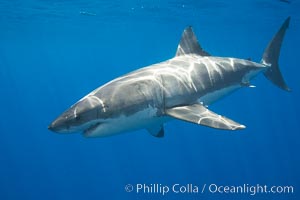
A great white shark is countershaded, with a dark gray dorsal color and light gray to white underside, making it more difficult for the shark's prey to see it as approaches from above or below in the water column. The particular undulations of the countershading line along its side, where gray meets white, is unique to each shark and helps researchers to identify individual sharks in capture-recapture studies. Guadalupe Island is host to a relatively large population of great white sharks who, through a history of video and photographs showing their countershading lines, are the subject of an ongoing study of shark behaviour, migration and population size.
Species: Great white shark, Carcharodon carcharias
Location: Guadalupe Island (Isla Guadalupe), Baja California, Mexico
Image ID: 19458
Species: Great white shark, Carcharodon carcharias
Location: Guadalupe Island (Isla Guadalupe), Baja California, Mexico
Image ID: 19458
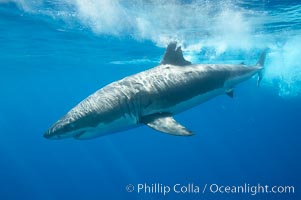
A great white shark is countershaded, with a dark gray dorsal color and light gray to white underside, making it more difficult for the shark's prey to see it as approaches from above or below in the water column. The particular undulations of the countershading line along its side, where gray meets white, is unique to each shark and helps researchers to identify individual sharks in capture-recapture studies. Guadalupe Island is host to a relatively large population of great white sharks who, through a history of video and photographs showing their countershading lines, are the subject of an ongoing study of shark behaviour, migration and population size.
Species: Great white shark, Carcharodon carcharias
Location: Guadalupe Island (Isla Guadalupe), Baja California, Mexico
Image ID: 19459
Species: Great white shark, Carcharodon carcharias
Location: Guadalupe Island (Isla Guadalupe), Baja California, Mexico
Image ID: 19459
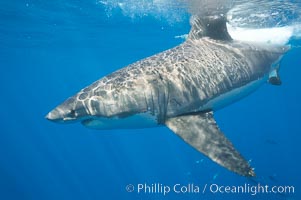
A great white shark is countershaded, with a dark gray dorsal color and light gray to white underside, making it more difficult for the shark's prey to see it as approaches from above or below in the water column. The particular undulations of the countershading line along its side, where gray meets white, is unique to each shark and helps researchers to identify individual sharks in capture-recapture studies. Guadalupe Island is host to a relatively large population of great white sharks who, through a history of video and photographs showing their countershading lines, are the subject of an ongoing study of shark behaviour, migration and population size.
Species: Great white shark, Carcharodon carcharias
Location: Guadalupe Island (Isla Guadalupe), Baja California, Mexico
Image ID: 19460
Species: Great white shark, Carcharodon carcharias
Location: Guadalupe Island (Isla Guadalupe), Baja California, Mexico
Image ID: 19460
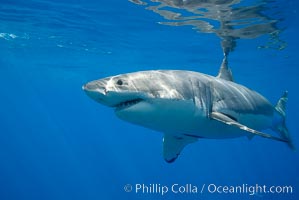
A great white shark is countershaded, with a dark gray dorsal color and light gray to white underside, making it more difficult for the shark's prey to see it as approaches from above or below in the water column. The particular undulations of the countershading line along its side, where gray meets white, is unique to each shark and helps researchers to identify individual sharks in capture-recapture studies. Guadalupe Island is host to a relatively large population of great white sharks who, through a history of video and photographs showing their countershading lines, are the subject of an ongoing study of shark behaviour, migration and population size.
Species: Great white shark, Carcharodon carcharias
Location: Guadalupe Island (Isla Guadalupe), Baja California, Mexico
Image ID: 19463
Species: Great white shark, Carcharodon carcharias
Location: Guadalupe Island (Isla Guadalupe), Baja California, Mexico
Image ID: 19463
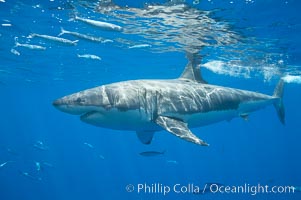
A great white shark is countershaded, with a dark gray dorsal color and light gray to white underside, making it more difficult for the shark's prey to see it as approaches from above or below in the water column. The particular undulations of the countershading line along its side, where gray meets white, is unique to each shark and helps researchers to identify individual sharks in capture-recapture studies. Guadalupe Island is host to a relatively large population of great white sharks who, through a history of video and photographs showing their countershading lines, are the subject of an ongoing study of shark behaviour, migration and population size.
Species: Great white shark, Carcharodon carcharias
Location: Guadalupe Island (Isla Guadalupe), Baja California, Mexico
Image ID: 19464
Species: Great white shark, Carcharodon carcharias
Location: Guadalupe Island (Isla Guadalupe), Baja California, Mexico
Image ID: 19464
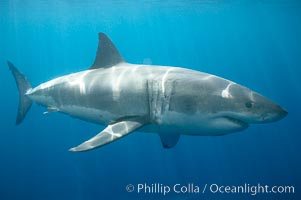
A great white shark is countershaded, with a dark gray dorsal color and light gray to white underside, making it more difficult for the shark's prey to see it as approaches from above or below in the water column. The particular undulations of the countershading line along its side, where gray meets white, is unique to each shark and helps researchers to identify individual sharks in capture-recapture studies. Guadalupe Island is host to a relatively large population of great white sharks who, through a history of video and photographs showing their countershading lines, are the subject of an ongoing study of shark behaviour, migration and population size.
Species: Great white shark, Carcharodon carcharias
Location: Guadalupe Island (Isla Guadalupe), Baja California, Mexico
Image ID: 19467
Species: Great white shark, Carcharodon carcharias
Location: Guadalupe Island (Isla Guadalupe), Baja California, Mexico
Image ID: 19467
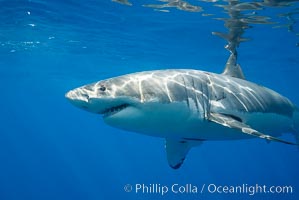
A great white shark is countershaded, with a dark gray dorsal color and light gray to white underside, making it more difficult for the shark's prey to see it as approaches from above or below in the water column. The particular undulations of the countershading line along its side, where gray meets white, is unique to each shark and helps researchers to identify individual sharks in capture-recapture studies. Guadalupe Island is host to a relatively large population of great white sharks who, through a history of video and photographs showing their countershading lines, are the subject of an ongoing study of shark behaviour, migration and population size.
Species: Great white shark, Carcharodon carcharias
Location: Guadalupe Island (Isla Guadalupe), Baja California, Mexico
Image ID: 19471
Species: Great white shark, Carcharodon carcharias
Location: Guadalupe Island (Isla Guadalupe), Baja California, Mexico
Image ID: 19471
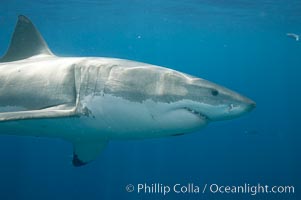
A great white shark is countershaded, with a dark gray dorsal color and light gray to white underside, making it more difficult for the shark's prey to see it as approaches from above or below in the water column. The particular undulations of the countershading line along its side, where gray meets white, is unique to each shark and helps researchers to identify individual sharks in capture-recapture studies. Guadalupe Island is host to a relatively large population of great white sharks who, through a history of video and photographs showing their countershading lines, are the subject of an ongoing study of shark behaviour, migration and population size.
Species: Great white shark, Carcharodon carcharias
Location: Guadalupe Island (Isla Guadalupe), Baja California, Mexico
Image ID: 19474
Species: Great white shark, Carcharodon carcharias
Location: Guadalupe Island (Isla Guadalupe), Baja California, Mexico
Image ID: 19474
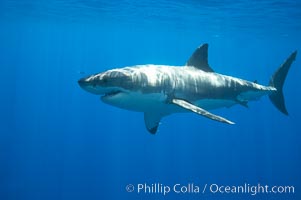
A great white shark is countershaded, with a dark gray dorsal color and light gray to white underside, making it more difficult for the shark's prey to see it as approaches from above or below in the water column. The particular undulations of the countershading line along its side, where gray meets white, is unique to each shark and helps researchers to identify individual sharks in capture-recapture studies. Guadalupe Island is host to a relatively large population of great white sharks who, through a history of video and photographs showing their countershading lines, are the subject of an ongoing study of shark behaviour, migration and population size.
Species: Great white shark, Carcharodon carcharias
Location: Guadalupe Island (Isla Guadalupe), Baja California, Mexico
Image ID: 19481
Species: Great white shark, Carcharodon carcharias
Location: Guadalupe Island (Isla Guadalupe), Baja California, Mexico
Image ID: 19481
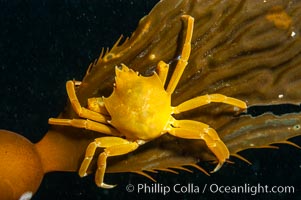
Northern kelp crab crawls amidst kelp blades and stipes, midway in the water column (below the surface, above the ocean bottom) in a giant kelp forest.
Species: Northern kelp crab, Macrocystis pyrifera, Pugettia producta
Location: San Nicholas Island, California
Image ID: 10218
Species: Northern kelp crab, Macrocystis pyrifera, Pugettia producta
Location: San Nicholas Island, California
Image ID: 10218
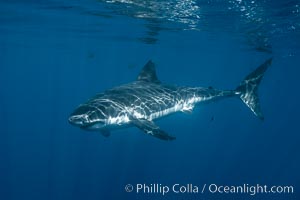
Great white shark, research identification photograph. A great white shark is countershaded, with a dark gray dorsal color and light gray to white underside, making it more difficult for the shark's prey to see it as approaches from above or below in the water column. The particular undulations of the countershading line along its side, where gray meets white, is unique to each shark and helps researchers to identify individual sharks in capture-recapture studies. Guadalupe Island is host to a relatively large population of great white sharks who, through a history of video and photographs showing their countershading lines, are the subject of an ongoing study of shark behaviour, migration and population size.
Species: Great white shark, Carcharodon carcharias
Location: Guadalupe Island (Isla Guadalupe), Baja California, Mexico
Image ID: 28768
Species: Great white shark, Carcharodon carcharias
Location: Guadalupe Island (Isla Guadalupe), Baja California, Mexico
Image ID: 28768
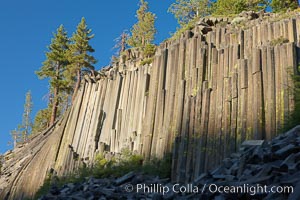
Devil's Postpile, a spectacular example of columnar basalt. Once molten and under great pressure underground, the lava that makes up Devil's Postpile cooled evenly and slowly, contracting and fracturing into polygonal-sided columns. The age of the formation is estimated between 100 and 700 thousand years old. Sometime after the basalt columns formed, a glacier passed over the formation, cutting and polishing the tops of the columns. The columns have from three to seven sides, varying because of differences in how quickly portions of the lava cooled.
Location: Devils Postpile National Monument, California
Image ID: 23266
Location: Devils Postpile National Monument, California
Image ID: 23266
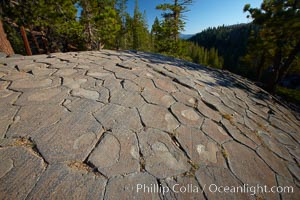
Devil's Postpile, a spectacular example of columnar basalt. Once molten and under great pressure underground, the lava that makes up Devil's Postpile cooled evenly and slowly, contracting and fracturing into polygonal-sided columns. The age of the formation is estimated between 100 and 700 thousand years old. Sometime after the basalt columns formed, a glacier passed over the formation, cutting and polishing the tops of the columns. The columns have from three to seven sides, varying because of differences in how quickly portions of the lava cooled.
Location: Devils Postpile National Monument, California
Image ID: 23267
Location: Devils Postpile National Monument, California
Image ID: 23267
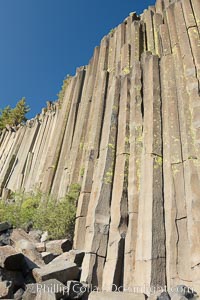
Devil's Postpile, a spectacular example of columnar basalt. Once molten and under great pressure underground, the lava that makes up Devil's Postpile cooled evenly and slowly, contracting and fracturing into polygonal-sided columns. The age of the formation is estimated between 100 and 700 thousand years old. Sometime after the basalt columns formed, a glacier passed over the formation, cutting and polishing the tops of the columns. The columns have from three to seven sides, varying because of differences in how quickly portions of the lava cooled.
Location: Devils Postpile National Monument, California
Image ID: 23285
Location: Devils Postpile National Monument, California
Image ID: 23285
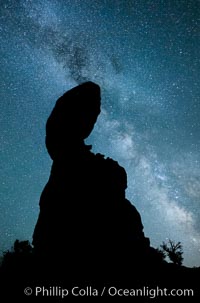
Balanced Rock and Milky Way stars at night.
Location: Balanced Rock, Arches National Park, Utah
Image ID: 27833
Location: Balanced Rock, Arches National Park, Utah
Image ID: 27833