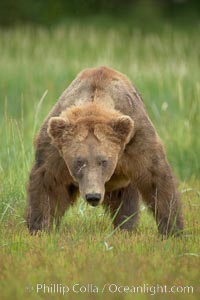
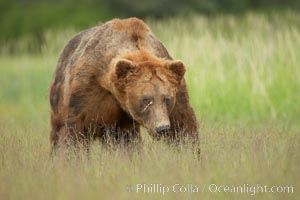
Full grown, mature male coastal brown bear boar (grizzly bear) in sedge grass meadows.
Species: Brown bear, Ursus arctos
Location: Lake Clark National Park, Alaska
Image ID: 19134
Species: Brown bear, Ursus arctos
Location: Lake Clark National Park, Alaska
Image ID: 19134
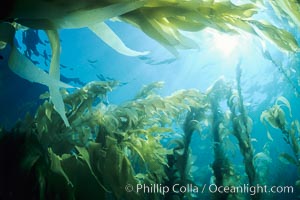
A kelp forest, with sunbeams passing through kelp fronds. Giant kelp, the fastest growing plant on Earth, reaches from the rocky bottom to the ocean's surface like a submarine forest.
Species: Giant kelp, Macrocystis pyrifera
Location: San Clemente Island, California
Image ID: 02411
Species: Giant kelp, Macrocystis pyrifera
Location: San Clemente Island, California
Image ID: 02411
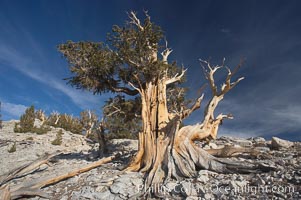
Bristlecone pine displays its characteristic gnarled, twisted form as it rises above the arid, dolomite-rich slopes of the White Mountains at 11000-foot elevation. Patriarch Grove, Ancient Bristlecone Pine Forest.
Species: Bristlecone Pine, Pinus longaeva
Location: White Mountains, Inyo National Forest, California
Image ID: 17475
Species: Bristlecone Pine, Pinus longaeva
Location: White Mountains, Inyo National Forest, California
Image ID: 17475
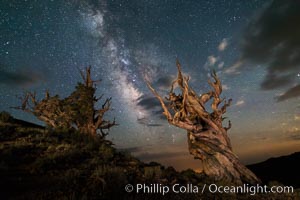
Stars and the Milky Way over ancient bristlecone pine trees, in the White Mountains at an elevation of 10,000' above sea level. These are some of the oldest trees in the world, some exceeding 4000 years in age.
Species: Bristlecone pine, Pinus longaeva
Location: Ancient Bristlecone Pine Forest, White Mountains, Inyo National Forest, California
Image ID: 29407
Species: Bristlecone pine, Pinus longaeva
Location: Ancient Bristlecone Pine Forest, White Mountains, Inyo National Forest, California
Image ID: 29407
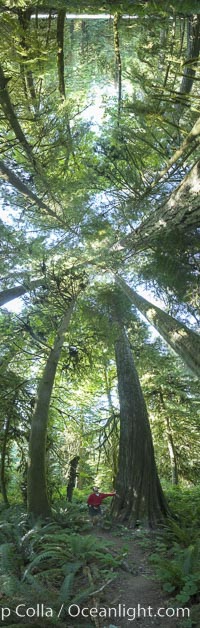
Ancient Douglas fir trees in Cathedral Grove. Cathedral Grove is home to huge, ancient, old-growth Douglas fir trees. About 300 years ago a fire killed most of the trees in this grove, but a small number of trees survived and were the originators of what is now Cathedral Grove. Western redcedar trees grow in adundance in the understory below the taller Douglas fir trees.
Species: Douglas fir tree, Pseudotsuga menziesii
Location: Cathedral Grove, MacMillan Provincial Park, Vancouver Island, British Columbia, Canada
Image ID: 22456
Panorama dimensions: 9702 x 3043
Species: Douglas fir tree, Pseudotsuga menziesii
Location: Cathedral Grove, MacMillan Provincial Park, Vancouver Island, British Columbia, Canada
Image ID: 22456
Panorama dimensions: 9702 x 3043
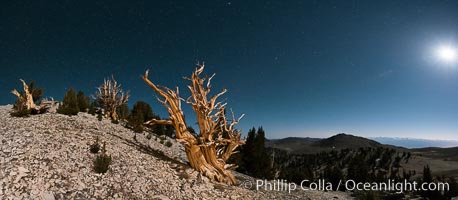
Ancient bristlecone pine trees at night, under a clear night sky full of stars, lit by a full moon, near Patriarch Grove.
Species: Ancient bristlecone pine, Pinus longaeva
Location: White Mountains, Inyo National Forest, California
Image ID: 28533
Panorama dimensions: 5144 x 11788
Species: Ancient bristlecone pine, Pinus longaeva
Location: White Mountains, Inyo National Forest, California
Image ID: 28533
Panorama dimensions: 5144 x 11788
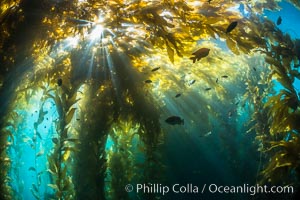
Sunlight streams through giant kelp forest. Giant kelp, the fastest growing plant on Earth, reaches from the rocky reef to the ocean's surface like a submarine forest.
Species: Giant kelp, Macrocystis pyrifera
Location: Catalina Island, California
Image ID: 33433
Species: Giant kelp, Macrocystis pyrifera
Location: Catalina Island, California
Image ID: 33433
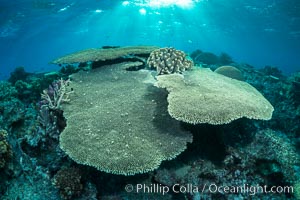
Sunset light and acropora table coral on pristine tropical reef. Table coral competes for space on the coral reef by growing above and spreading over other coral species keeping them from receiving sunlight.
Location: Wakaya Island, Lomaiviti Archipelago, Fiji
Image ID: 31315
Location: Wakaya Island, Lomaiviti Archipelago, Fiji
Image ID: 31315
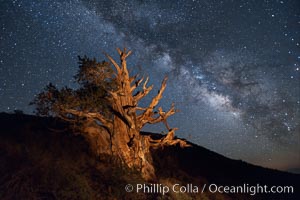
Stars and the Milky Way rise above ancient bristlecone pine trees, in the White Mountains at an elevation of 10,000' above sea level. These are some of the oldest trees in the world, reaching 4000 years in age.
Species: Bristlecone pine, Pinus longaeva
Location: Ancient Bristlecone Pine Forest, White Mountains, Inyo National Forest, California
Image ID: 27772
Species: Bristlecone pine, Pinus longaeva
Location: Ancient Bristlecone Pine Forest, White Mountains, Inyo National Forest, California
Image ID: 27772
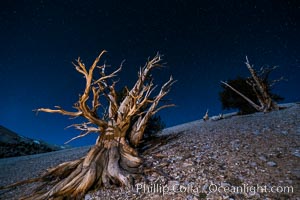
Ancient bristlecone pine trees at night, under a clear night sky full of stars, lit by a full moon, near Patriarch Grove.
Species: Ancient bristlecone pine, Pinus longaeva
Location: White Mountains, Inyo National Forest, California
Image ID: 28535
Species: Ancient bristlecone pine, Pinus longaeva
Location: White Mountains, Inyo National Forest, California
Image ID: 28535
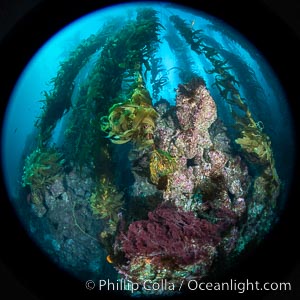
The Kelp Forest and Rocky Reef of San Clemente Island. Giant kelp grows rapidly, up to 2' per day, from the rocky reef on the ocean bottom to which it is anchored, toward the ocean surface where it spreads to form a thick canopy. Myriad species of fishes, mammals and invertebrates form a rich community in the kelp forest. Lush forests of kelp are found throughout California's Southern Channel Islands.
Species: Giant kelp, Macrocystis pyrifera
Location: San Clemente Island, California
Image ID: 38494
Species: Giant kelp, Macrocystis pyrifera
Location: San Clemente Island, California
Image ID: 38494
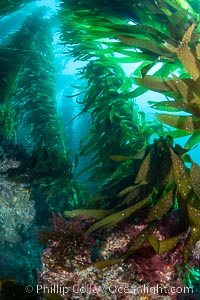
The Kelp Forest and Rocky Reef of San Clemente Island. Giant kelp grows rapidly, up to 2' per day, from the rocky reef on the ocean bottom to which it is anchored, toward the ocean surface where it spreads to form a thick canopy. Myriad species of fishes, mammals and invertebrates form a rich community in the kelp forest. Lush forests of kelp are found throughout California's Southern Channel Islands.
Species: Giant kelp, Macrocystis pyrifera
Location: San Clemente Island, California
Image ID: 38495
Species: Giant kelp, Macrocystis pyrifera
Location: San Clemente Island, California
Image ID: 38495
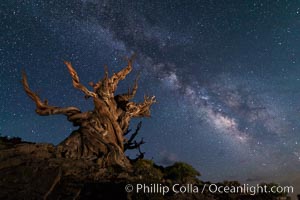
Stars and the Milky Way over ancient bristlecone pine trees, in the White Mountains at an elevation of 10,000' above sea level. These are the oldest trees in the world, some exceeding 4000 years in age.
Species: Bristlecone pine, Pinus longaeva
Location: Ancient Bristlecone Pine Forest, White Mountains, Inyo National Forest, California
Image ID: 29406
Species: Bristlecone pine, Pinus longaeva
Location: Ancient Bristlecone Pine Forest, White Mountains, Inyo National Forest, California
Image ID: 29406
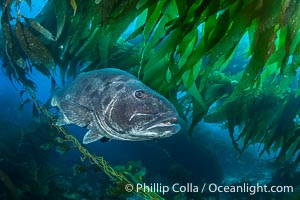
Giant Black Sea Bass with Distinctive Identifying Black Spots that allow researchers to carry out sight/resight studies on the animals distributions and growth. Black sea bass can reach 500 pounds and 8 feet in length.
Species: Giant black sea bass, Stereolepis gigas
Location: Catalina Island, California
Image ID: 39433
Species: Giant black sea bass, Stereolepis gigas
Location: Catalina Island, California
Image ID: 39433
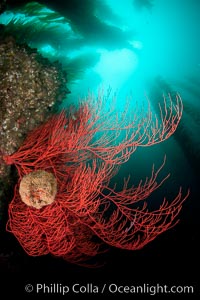
Bryozoan grows on a red gorgonian on rocky reef, below kelp forest, underwater. The red gorgonian is a filter-feeding temperate colonial species that lives on the rocky bottom at depths between 50 to 200 feet deep. Gorgonians are oriented at right angles to prevailing water currents to capture plankton drifting by.
Species: Red gorgonian, Leptogorgia chilensis, Lophogorgia chilensis
Location: San Clemente Island, California
Image ID: 25395
Species: Red gorgonian, Leptogorgia chilensis, Lophogorgia chilensis
Location: San Clemente Island, California
Image ID: 25395
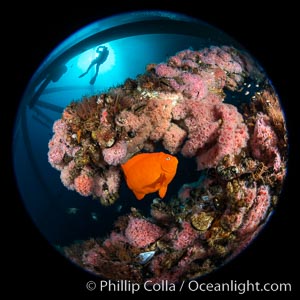
Oil Rig Ellen and Elly with invertebrate life growing on it and fish swimming around.
Species: Strawberry Anemone, Garibaldi, Corynactis californica, Hypsypops rubicundus
Location: Long Beach, California
Image ID: 34654
Species: Strawberry Anemone, Garibaldi, Corynactis californica, Hypsypops rubicundus
Location: Long Beach, California
Image ID: 34654
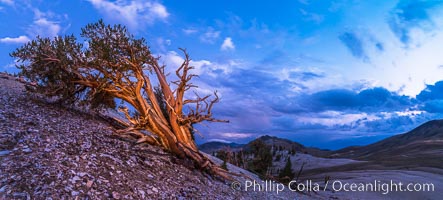
Ancient Bristlecone Pine Tree at sunset, panorama, with storm clouds passing over the White Mountains. The eastern Sierra Nevada is just visible in the distance.
Species: Ancient bristlecone pine, Pinus longaeva
Location: Ancient Bristlecone Pine Forest, White Mountains, Inyo National Forest, California
Image ID: 28781
Panorama dimensions: 4549 x 10085
Species: Ancient bristlecone pine, Pinus longaeva
Location: Ancient Bristlecone Pine Forest, White Mountains, Inyo National Forest, California
Image ID: 28781
Panorama dimensions: 4549 x 10085
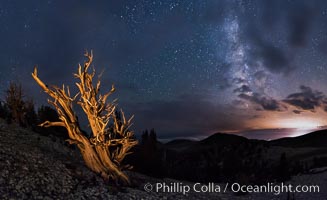
Ancient Bristlecone Pine Tree at night, stars and the Milky Way galaxy visible in the evening sky, near Patriarch Grove.
Species: Ancient bristlecone pine, Pinus longaeva
Location: Ancient Bristlecone Pine Forest, White Mountains, Inyo National Forest, California
Image ID: 28782
Panorama dimensions: 5237 x 8556
Species: Ancient bristlecone pine, Pinus longaeva
Location: Ancient Bristlecone Pine Forest, White Mountains, Inyo National Forest, California
Image ID: 28782
Panorama dimensions: 5237 x 8556
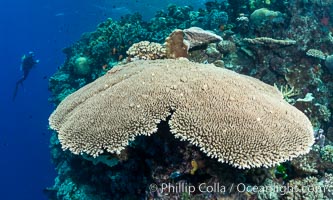
Acropora table coral on pristine tropical reef. Table coral competes for space on the coral reef by growing above and spreading over other coral species keeping them from receiving sunlight.
Location: Vatu I Ra Passage, Bligh Waters, Viti Levu Island, Fiji
Image ID: 31331
Location: Vatu I Ra Passage, Bligh Waters, Viti Levu Island, Fiji
Image ID: 31331
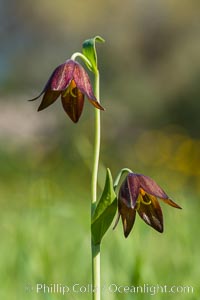
Chocolate lily growing among grasses on oak-covered hillsides. The chocolate lily is a herbaceous perennial monocot that is increasingly difficult to find in the wild due to habitat loss. The flower is a striking brown color akin to the color of chocolate.
Location: Santa Rosa Plateau Ecological Reserve, Murrieta, California
Image ID: 33151
Location: Santa Rosa Plateau Ecological Reserve, Murrieta, California
Image ID: 33151
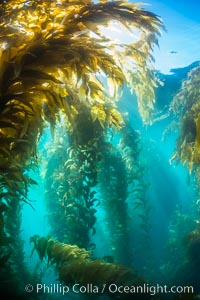
Sunlight streams through giant kelp forest. Giant kelp, the fastest growing plant on Earth, reaches from the rocky reef to the ocean's surface like a submarine forest.
Species: Giant kelp, Macrocystis pyrifera
Location: Catalina Island, California
Image ID: 33434
Species: Giant kelp, Macrocystis pyrifera
Location: Catalina Island, California
Image ID: 33434
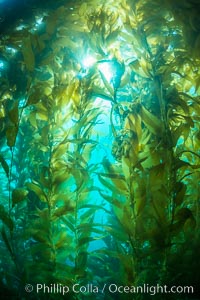
Sunlight streams through giant kelp forest. Giant kelp, the fastest growing plant on Earth, reaches from the rocky reef to the ocean's surface like a submarine forest.
Species: Giant kelp, Macrocystis pyrifera
Location: Catalina Island, California
Image ID: 33435
Species: Giant kelp, Macrocystis pyrifera
Location: Catalina Island, California
Image ID: 33435
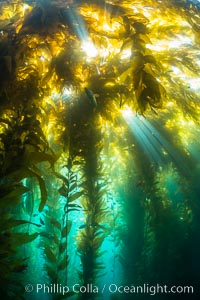
Sunlight streams through giant kelp forest. Giant kelp, the fastest growing plant on Earth, reaches from the rocky reef to the ocean's surface like a submarine forest.
Species: Giant kelp, Macrocystis pyrifera
Location: Catalina Island, California
Image ID: 33436
Species: Giant kelp, Macrocystis pyrifera
Location: Catalina Island, California
Image ID: 33436
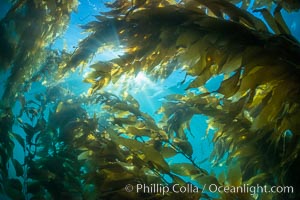
Sunlight streams through giant kelp forest. Giant kelp, the fastest growing plant on Earth, reaches from the rocky reef to the ocean's surface like a submarine forest.
Species: Giant kelp, Macrocystis pyrifera
Location: Catalina Island, California
Image ID: 33437
Species: Giant kelp, Macrocystis pyrifera
Location: Catalina Island, California
Image ID: 33437
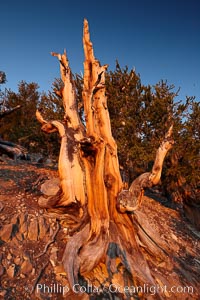
Ancient bristlecone pine tree, rising above the arid, dolomite-rich slopes of the Schulman Grove in the White Mountains at an elevation of 9500 above sea level, along the Methuselah Walk. The oldest bristlecone pines in the world are found in the Schulman Grove, some of them over 4700 years old. Ancient Bristlecone Pine Forest.
Species: Bristlecone pine, Pinus longaeva
Location: White Mountains, Inyo National Forest, California
Image ID: 23233
Species: Bristlecone pine, Pinus longaeva
Location: White Mountains, Inyo National Forest, California
Image ID: 23233
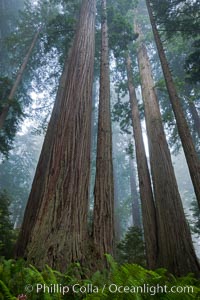
Giant redwood, Lady Bird Johnson Grove, Redwood National Park. The coastal redwood, or simply 'redwood', is the tallest tree on Earth, reaching a height of 379' and living 3500 years or more. It is native to coastal California and the southwestern corner of Oregon within the United States, but most concentrated in Redwood National and State Parks in Northern California, found close to the coast where moisture and soil conditions can support its unique size and growth requirements.
Species: California redwood, Coast redwood, Giant redwood, Sequoia sempervirens
Location: Redwood National Park, California
Image ID: 25795
Species: California redwood, Coast redwood, Giant redwood, Sequoia sempervirens
Location: Redwood National Park, California
Image ID: 25795
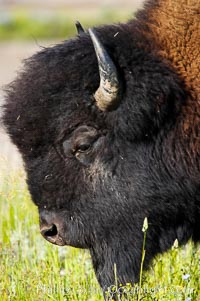
The bisons massive head is its most characteristic feature. Its forehead bulges because of its convex-shaped frontal bone. Its shoulder hump, dwindling bowlike to the haunches, is supported by unusually long spinal vertebrae. Over powerful neck and shoulder muscles grows a great shaggy coat of curly brown fur, and over the head, like an immense hood, grows a shock of black hair. Its forequarters are higher and much heavier than its haunches. A mature bull stands about 6 1/2 feet (2 meters) at the shoulder and weighs more than 2,000 pounds (900 kilograms). The bisons horns are short and black. In the male they are thick at the base and taper abruptly to sharp points as they curve outward and upward; the females horns are more slender.
Species: American bison, Bison bison
Location: Yellowstone National Park, Wyoming
Image ID: 13120
Species: American bison, Bison bison
Location: Yellowstone National Park, Wyoming
Image ID: 13120
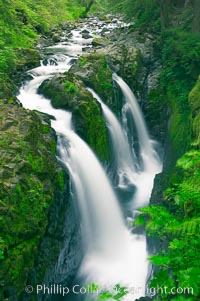
Sol Duc Falls. Sol Duc Falls is one of the largest and most beautiful waterfalls in Olympic National Park, seen here from a bridge that crosses the canyon just below the falls. Surrounding the falls is an old-growth forest of hemlocks and douglas firs, some of which are three hundred years in age.
Location: Sol Duc Springs, Olympic National Park, Washington
Image ID: 13747
Location: Sol Duc Springs, Olympic National Park, Washington
Image ID: 13747
Full grown, mature male coastal brown bear boar (grizzly bear) in sedge grass meadows.
Species: Brown bear, Ursus arctos
Location: Lake Clark National Park, Alaska
Image ID: 19151
Species: Brown bear, Ursus arctos
Location: Lake Clark National Park, Alaska
Image ID: 19151
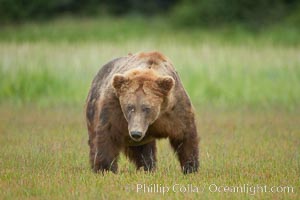
Full grown, mature male coastal brown bear boar (grizzly bear) in sedge grass meadows.
Species: Brown bear, Ursus arctos
Location: Lake Clark National Park, Alaska
Image ID: 19161
Species: Brown bear, Ursus arctos
Location: Lake Clark National Park, Alaska
Image ID: 19161