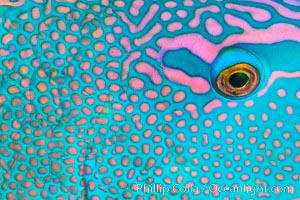
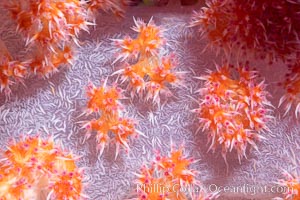
Dendronephthya soft coral detail including polyps and calcium carbonate spicules, Fiji.
Species: Dendronephthya soft coral, Dendronephthya
Location: Namena Marine Reserve, Namena Island, Fiji
Image ID: 34738
Species: Dendronephthya soft coral, Dendronephthya
Location: Namena Marine Reserve, Namena Island, Fiji
Image ID: 34738
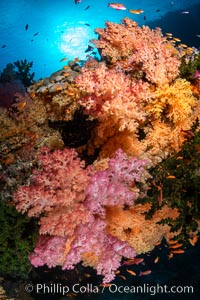
Colorful and exotic coral reef in Fiji, with soft corals, hard corals, anthias fishes, anemones, and sea fan gorgonians.
Species: Anthias, Dendronephthya soft coral, Dendronephthya, Pseudanthias
Location: Fiji
Image ID: 34739
Species: Anthias, Dendronephthya soft coral, Dendronephthya, Pseudanthias
Location: Fiji
Image ID: 34739
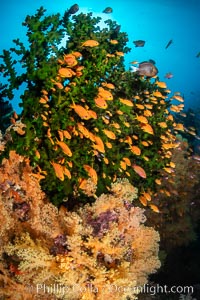
Anthias fish school around green fan coral, Fiji.
Species: Anthias, Pseudanthias
Location: Fiji
Image ID: 34740
Species: Anthias, Pseudanthias
Location: Fiji
Image ID: 34740
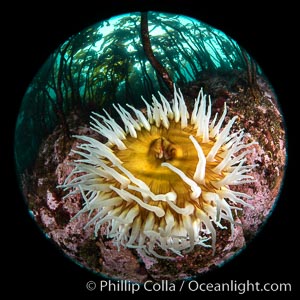
The Fish Eating Anemone Urticina piscivora, a large colorful anemone found on the rocky underwater reefs of Vancouver Island, British Columbia.
Species: Fish-eating anemone, Urticina piscivora
Location: British Columbia, Canada
Image ID: 35249
Species: Fish-eating anemone, Urticina piscivora
Location: British Columbia, Canada
Image ID: 35249
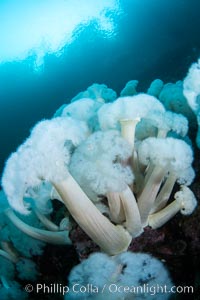
Giant Plumose Anemones cover underwater reef, Browning Pass, northern Vancouver Island, Canada.
Species: Giant plumose anemone, Metridium farcimen
Location: British Columbia, Canada
Image ID: 35251
Species: Giant plumose anemone, Metridium farcimen
Location: British Columbia, Canada
Image ID: 35251
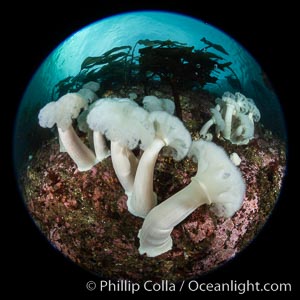
Giant Plumose Anemones cover underwater reef, Browning Pass, northern Vancouver Island, Canada.
Species: Giant plumose anemone, Metridium farcimen
Location: British Columbia, Canada
Image ID: 35284
Species: Giant plumose anemone, Metridium farcimen
Location: British Columbia, Canada
Image ID: 35284
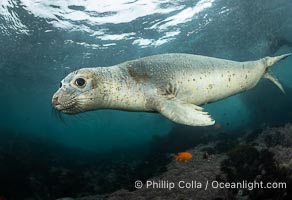
Juvenile Northern Elephant Seal Underwater, Coronado Islands, Mexico.
Species: Elephant seal, Mirounga angustirostris
Location: Coronado Islands (Islas Coronado), Baja California, Mexico
Image ID: 36465
Species: Elephant seal, Mirounga angustirostris
Location: Coronado Islands (Islas Coronado), Baja California, Mexico
Image ID: 36465
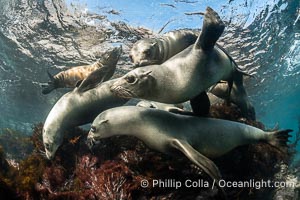
California Sea Lions Underwater, Coronado Islands, Baja California, Mexico.
Species: California sea lion, Zalophus californianus
Location: Coronado Islands (Islas Coronado), Baja California, Mexico
Image ID: 36467
Species: California sea lion, Zalophus californianus
Location: Coronado Islands (Islas Coronado), Baja California, Mexico
Image ID: 36467
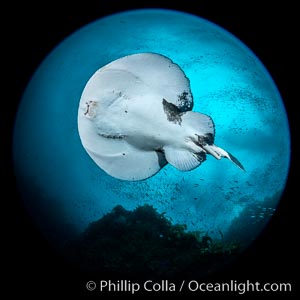
Pacific torpedo ray Tetronarce californica, amidst huge schools of fish and baitfish, Farnsworth Banks, Catalina Island. This electric ray will shock the hell out of you if you are not careful.
Species: Pacific torpedo ray, Tetronarce californica, Torpedo californica
Location: Catalina Island, California
Image ID: 37231
Species: Pacific torpedo ray, Tetronarce californica, Torpedo californica
Location: Catalina Island, California
Image ID: 37231
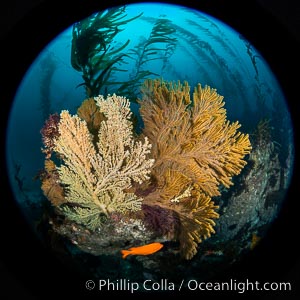
Parasitic zoanthid anemones cover, encrust and overwhelm a golden gorgonian. The gorgonian on the left has been completely parasitized by zoanthid anemones, while the gorgonian to the right remains free of zoanthids (for now). A garibaldi swims below the two sea fans. The golden gorgonian is a filter-feeding temperate colonial species that lives on the rocky bottom at depths between 50 to 200 feet deep. Each individual polyp is a distinct animal, together they secrete calcium that forms the structure of the colony. Gorgonians are oriented at right angles to prevailing water currents to capture plankton drifting by.
Species: California Golden Gorgonian, Luminescent Parazoanthid, Zoanthid Anemone, Giant Kelp, Garibaldi, Muricea californica, Parazoanthus lucificum, Savalia lucifica, Macrocystis pyrifera, Hypsypops rubicundus
Location: San Clemente Island, California
Image ID: 38493
Species: California Golden Gorgonian, Luminescent Parazoanthid, Zoanthid Anemone, Giant Kelp, Garibaldi, Muricea californica, Parazoanthus lucificum, Savalia lucifica, Macrocystis pyrifera, Hypsypops rubicundus
Location: San Clemente Island, California
Image ID: 38493
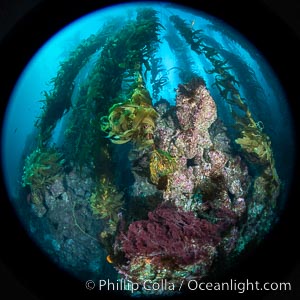
The Kelp Forest and Rocky Reef of San Clemente Island. Giant kelp grows rapidly, up to 2' per day, from the rocky reef on the ocean bottom to which it is anchored, toward the ocean surface where it spreads to form a thick canopy. Myriad species of fishes, mammals and invertebrates form a rich community in the kelp forest. Lush forests of kelp are found throughout California's Southern Channel Islands.
Species: Giant kelp, Macrocystis pyrifera
Location: San Clemente Island, California
Image ID: 38494
Species: Giant kelp, Macrocystis pyrifera
Location: San Clemente Island, California
Image ID: 38494
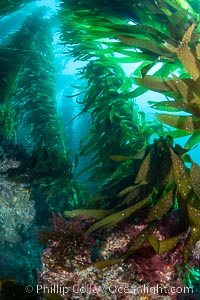
The Kelp Forest and Rocky Reef of San Clemente Island. Giant kelp grows rapidly, up to 2' per day, from the rocky reef on the ocean bottom to which it is anchored, toward the ocean surface where it spreads to form a thick canopy. Myriad species of fishes, mammals and invertebrates form a rich community in the kelp forest. Lush forests of kelp are found throughout California's Southern Channel Islands.
Species: Giant kelp, Macrocystis pyrifera
Location: San Clemente Island, California
Image ID: 38495
Species: Giant kelp, Macrocystis pyrifera
Location: San Clemente Island, California
Image ID: 38495
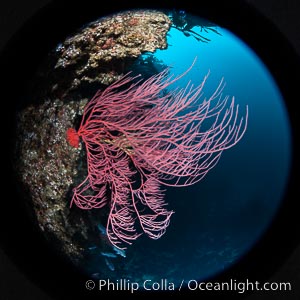
Red gorgonian on rocky reef, below kelp forest, underwater. The red gorgonian is a filter-feeding temperate colonial species that lives on the rocky bottom at depths between 50 to 200 feet deep. Gorgonians are typically oriented at right angles to prevailing water currents to capture plankton drifting by.
Species: Red gorgonian, Leptogorgia chilensis, Lophogorgia chilensis
Location: San Clemente Island, California
Image ID: 38496
Species: Red gorgonian, Leptogorgia chilensis, Lophogorgia chilensis
Location: San Clemente Island, California
Image ID: 38496
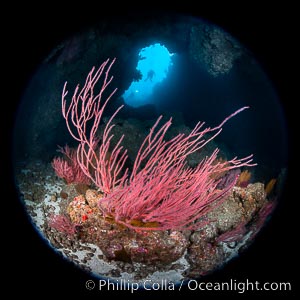
Red Gorgonians form a lush colorful garden below a submarine arch, while two scuba divers pass through the opening to the cavern.
Species: Red gorgonian, Leptogorgia chilensis, Lophogorgia chilensis
Location: San Clemente Island, California
Image ID: 38497
Species: Red gorgonian, Leptogorgia chilensis, Lophogorgia chilensis
Location: San Clemente Island, California
Image ID: 38497
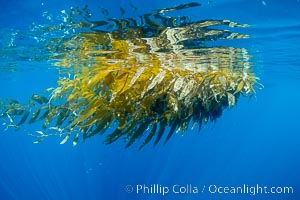
Drift kelp paddy floating on the ocean surface, San Diego.
Species: Giant kelp, Macrocystis pyrifera
Location: San Diego, California
Image ID: 38533
Species: Giant kelp, Macrocystis pyrifera
Location: San Diego, California
Image ID: 38533
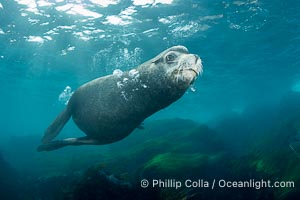
Huge California Sea Lion Male Underwater, a bull, patrolling his breeding harem and territory, Coronado Islands, Mexico. His sagittal crest, the bony bump on his head that distinguishes adult male sea lions, is clearly seen. This particular sea lion bears an orange tag on his left foreflipper, probably as a result of rescue and release as a young sea lion years earlier.
Species: California sea lion, Zalophus californianus
Location: Coronado Islands (Islas Coronado), Baja California, Mexico
Image ID: 38655
Species: California sea lion, Zalophus californianus
Location: Coronado Islands (Islas Coronado), Baja California, Mexico
Image ID: 38655
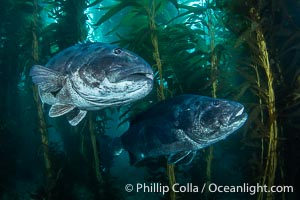
Two Giant Black Sea Bass in a Courtship Posture, in Kelp at Catalina Island. In summer months, black seabass gather in kelp forests in California to form mating aggregations. Courtship behaviors include circling of pairs of giant sea bass, production of booming sounds by presumed males, and nudging of females by males in what is though to be an effort to encourage spawning.
Species: Giant black sea bass, Stereolepis gigas
Location: Catalina Island, California
Image ID: 39432
Species: Giant black sea bass, Stereolepis gigas
Location: Catalina Island, California
Image ID: 39432
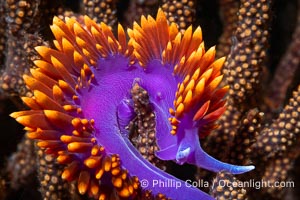
Spanish shawl nudibranch, Flabellinopsis iodinea, Midriff Islands, Sea of Cortez.
Species: Spanish Shawl Nudibranch, Flabellinopsis iodinea
Location: Islas San Lorenzo, Baja California, Mexico
Image ID: 40475
Species: Spanish Shawl Nudibranch, Flabellinopsis iodinea
Location: Islas San Lorenzo, Baja California, Mexico
Image ID: 40475
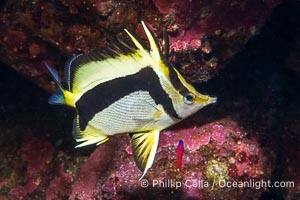
Scythe-mark butterflyfish, Prognathodes falcifer, Catalina Island.
Species: Scythe-mark butterflyfish, Prognathodes falcifer
Location: Catalina Island, California
Image ID: 40516
Species: Scythe-mark butterflyfish, Prognathodes falcifer
Location: Catalina Island, California
Image ID: 40516
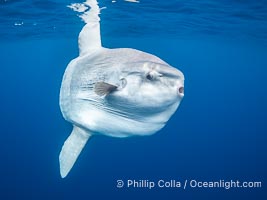
Ocean Sunfish (Mola mola) Offshore of San Diego.
Species: Ocean sunfish, Mola mola
Location: San Diego, California
Image ID: 40975
Species: Ocean sunfish, Mola mola
Location: San Diego, California
Image ID: 40975
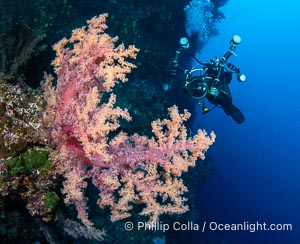
Photographer captures a spectacular display of Dendronephthya Soft Coral on the wall of the deepwater pinnacle Mount Mutiny in the Bligh Waters of Fiji.
Species: Dendronephthya soft coral, Dendronephthya
Location: Fiji
Image ID: 41024
Species: Dendronephthya soft coral, Dendronephthya
Location: Fiji
Image ID: 41024
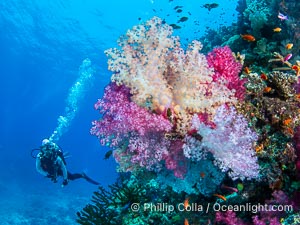
Tracy admires a colorful cluster of Dendronephthya soft coral on a spectacular coral reef in Fiji.
Species: Dendronephthya soft coral, Dendronephthya
Location: Namena Marine Reserve, Namena Island, Fiji
Image ID: 41027
Species: Dendronephthya soft coral, Dendronephthya
Location: Namena Marine Reserve, Namena Island, Fiji
Image ID: 41027
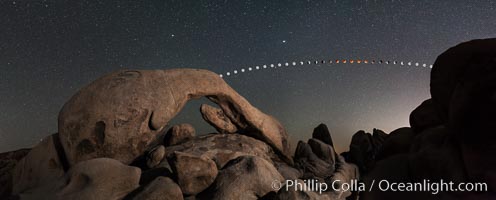
Lunar Eclipse and blood red moon sequence over Arch Rock, planet Mars above the moon, composite image, Joshua Tree National Park, April 14/15 2014.
Image ID: 29201
Panorama dimensions: 5835 x 14655
Image ID: 29201
Panorama dimensions: 5835 x 14655
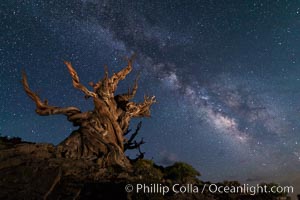
Stars and the Milky Way over ancient bristlecone pine trees, in the White Mountains at an elevation of 10,000' above sea level. These are the oldest trees in the world, some exceeding 4000 years in age.
Species: Bristlecone pine, Pinus longaeva
Location: Ancient Bristlecone Pine Forest, White Mountains, Inyo National Forest, California
Image ID: 29406
Species: Bristlecone pine, Pinus longaeva
Location: Ancient Bristlecone Pine Forest, White Mountains, Inyo National Forest, California
Image ID: 29406
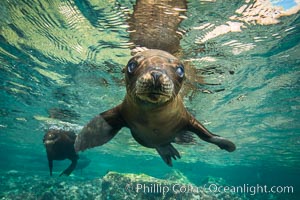
California sea lion underwater, Sea of Cortez, Mexico.
Species: California sea lion, Zalophus californianus
Location: Sea of Cortez, Baja California, Mexico
Image ID: 31204
Species: California sea lion, Zalophus californianus
Location: Sea of Cortez, Baja California, Mexico
Image ID: 31204
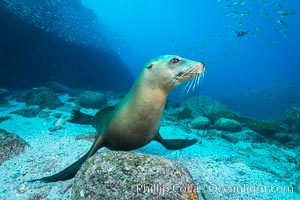
California sea lion underwater at Los Islotes, Sea of Cortez, Mexico.
Species: California sea lion, Zalophus californianus
Location: Sea of Cortez, Baja California, Mexico
Image ID: 31206
Species: California sea lion, Zalophus californianus
Location: Sea of Cortez, Baja California, Mexico
Image ID: 31206
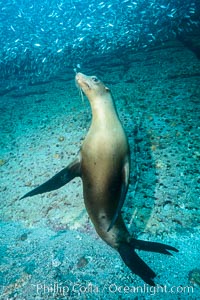
California sea lion underwater, Sea of Cortez, Mexico.
Species: California sea lion, Zalophus californianus
Location: Sea of Cortez, Baja California, Mexico
Image ID: 31207
Species: California sea lion, Zalophus californianus
Location: Sea of Cortez, Baja California, Mexico
Image ID: 31207
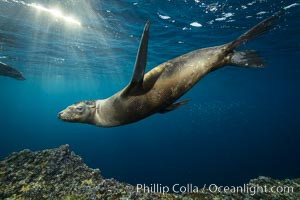
Sea lion underwater in beautiful sunset light.
Species: California sea lion, Zalophus californianus
Location: Sea of Cortez, Baja California, Mexico
Image ID: 31208
Species: California sea lion, Zalophus californianus
Location: Sea of Cortez, Baja California, Mexico
Image ID: 31208
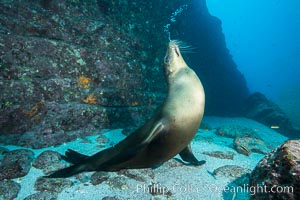
Sea lion blowing underwater bubbles as it stands on its flippers.
Species: California sea lion, Zalophus californianus
Location: Sea of Cortez, Baja California, Mexico
Image ID: 31210
Species: California sea lion, Zalophus californianus
Location: Sea of Cortez, Baja California, Mexico
Image ID: 31210