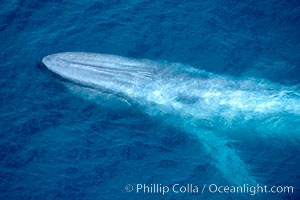
Blue whale. The sleek hydrodynamic shape of the enormous blue whale allows it to swim swiftly through the ocean, at times over one hundred miles in a single day.
Species: Blue whale, Balaenoptera musculus
Location: La Jolla, California
Image ID: 21250
Species: Blue whale, Balaenoptera musculus
Location: La Jolla, California
Image ID: 21250
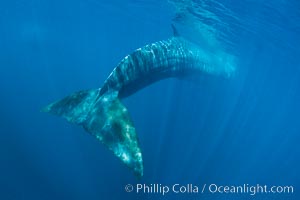
Fin whale underwater. The fin whale is the second longest and sixth most massive animal ever, reaching lengths of 88 feet.
Species: Fin whale, Balaenoptera physalus
Location: La Jolla, California
Image ID: 27116
Species: Fin whale, Balaenoptera physalus
Location: La Jolla, California
Image ID: 27116
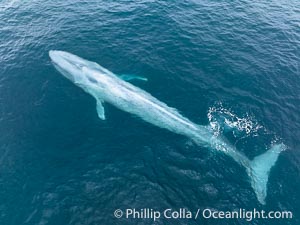
Aerial photo of blue whale near San Diego. This enormous blue whale glides at the surface of the ocean, resting and breathing before it dives to feed on subsurface krill.
Species: Blue whale, Balaenoptera musculus
Location: San Diego, California
Image ID: 39422
Species: Blue whale, Balaenoptera musculus
Location: San Diego, California
Image ID: 39422
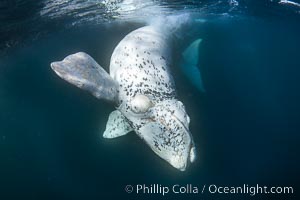
White southern right whale calf underwater, Eubalaena australis. About five per cent of southern right whales are born white due to a condition known as grey morphism and will gradually turn dark as they age. They are not albino (which is a complete lack of pigmentation). Sometimes referred to as "brindled", the white coloration is a recessive genetic trait and only lasts a few months. Typically, but not always, white calves will become much darker as they mature but will still be somewhat lighter than normal even as adults.
Species: Southern Right Whale, Eubalaena australis
Location: Puerto Piramides, Chubut, Argentina
Image ID: 38279
Species: Southern Right Whale, Eubalaena australis
Location: Puerto Piramides, Chubut, Argentina
Image ID: 38279
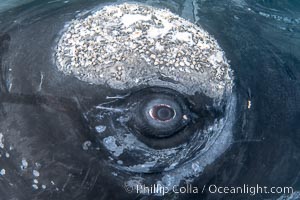
Southern right whale eyeballing the camera up close, Eubalaena australis. Whale lice can be seen clearly in the folds and crevices around the whales eye and lip groove.
Species: Southern Right Whale, Eubalaena australis
Location: Puerto Piramides, Chubut, Argentina
Image ID: 38403
Species: Southern Right Whale, Eubalaena australis
Location: Puerto Piramides, Chubut, Argentina
Image ID: 38403
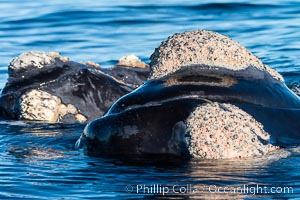
Rostrum and callosities of southern right whale, Eubalaena australis. Whale lice can be seen attached to the collosities, which are patches of thickened keratinized tissue, like calluses (thus the name). The pattern of callosities on a right whale are unique and serve as a way to identify individuals throughout their lifetime.
Species: Southern Right Whale, Eubalaena australis
Location: Puerto Piramides, Chubut, Argentina
Image ID: 38450
Species: Southern Right Whale, Eubalaena australis
Location: Puerto Piramides, Chubut, Argentina
Image ID: 38450
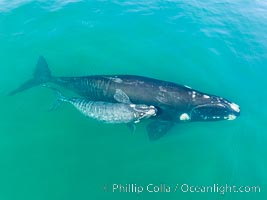
Southern right whale mother and calf, aerial photo, Eubalaena australis.
Species: Southern Right Whale, Eubalaena australis
Location: Puerto Piramides, Chubut, Argentina
Image ID: 38350
Species: Southern Right Whale, Eubalaena australis
Location: Puerto Piramides, Chubut, Argentina
Image ID: 38350
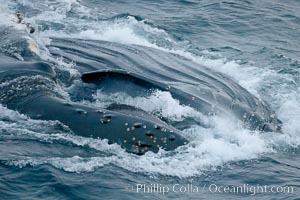
Humpback whale lunge feeding on Antarctic krill, with mouth open and baleen visible. The humbpack's throat grooves are seen as its pleated throat becomes fully distended as the whale fills its mouth with krill and water. The water will be pushed out, while the baleen strains and retains the small krill.
Species: Humpback whale, Megaptera novaeangliae
Location: Gerlache Strait, Antarctic Peninsula, Antarctica
Image ID: 25648
Species: Humpback whale, Megaptera novaeangliae
Location: Gerlache Strait, Antarctic Peninsula, Antarctica
Image ID: 25648
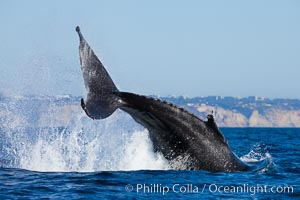
A humpback whale performs a peduncle throw in which it uses its long pectoral fins as levers to swing its fluke and caudal stem out of the water, flinging water everywhere., the coast of Del Mar and La Jolla is visible in the distance.
Species: Humpback whale, Megaptera novaeangliae
Location: Del Mar, California
Image ID: 27142
Species: Humpback whale, Megaptera novaeangliae
Location: Del Mar, California
Image ID: 27142
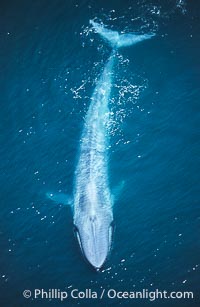
A huge blue whale swims through the open ocean in this aerial photograph. The blue whale is the largest animal ever to live on Earth.
Species: Blue whale, Balaenoptera musculus
Image ID: 02169
Species: Blue whale, Balaenoptera musculus
Image ID: 02169
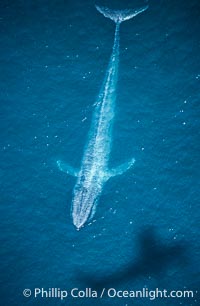
Blue whale aerial photo, with the shadow of the survey plane providing scale as to how huge the whale really is.
Species: Blue whale, Balaenoptera musculus
Image ID: 02168
Species: Blue whale, Balaenoptera musculus
Image ID: 02168
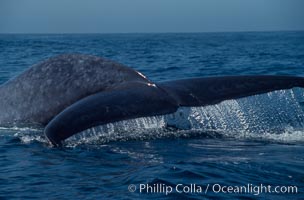
Blue whale fluking up (raising its tail) before a dive to forage for krill, Baja California (Mexico).
Species: Blue whale, Balaenoptera musculus
Image ID: 03332
Species: Blue whale, Balaenoptera musculus
Image ID: 03332
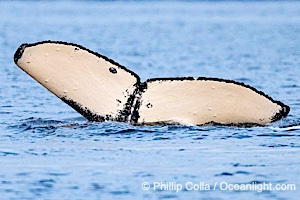
Humpback Whale Fluke ID. Perfect view of the ventral surface of a humpback whale's fluke, as the whale raises its fluke just before diving underwater. The white patches, spots, scratches and scalloping along the trailing edge of the fluke make this whale identifiable when it is observed from year to year.
Species: Humpback whale, Megaptera novaeangliae
Location: Sitka Sound, Alaska
Image ID: 41566
Species: Humpback whale, Megaptera novaeangliae
Location: Sitka Sound, Alaska
Image ID: 41566
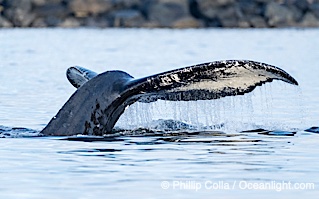
Humpback whale fluke raised out of the water before a dive.
Species: Humpback whale, Megaptera novaeangliae
Location: Sitka Sound, Alaska
Image ID: 41597
Species: Humpback whale, Megaptera novaeangliae
Location: Sitka Sound, Alaska
Image ID: 41597
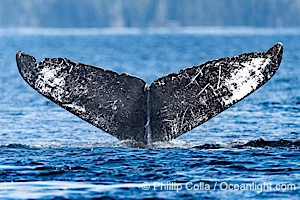
Humpback Whale Fluke ID. Perfect view of the ventral surface of a humpback whale's fluke, as the whale raises its fluke just before diving underwater. The white patches, spots, scratches and scalloping along the trailing edge of the fluke make this whale identifiable when it is observed from year to year.
Species: Humpback whale, Megaptera novaeangliae
Location: Sitka Sound, Alaska
Image ID: 41736
Species: Humpback whale, Megaptera novaeangliae
Location: Sitka Sound, Alaska
Image ID: 41736
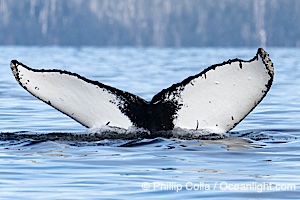
Humpback Whale Fluke ID. Perfect view of the ventral surface of a humpback whale's fluke, as the whale raises its fluke just before diving underwater. The white patches, spots, scratches and scalloping along the trailing edge of the fluke make this whale identifiable when it is observed from year to year.
Species: Humpback whale, Megaptera novaeangliae
Location: Sitka Sound, Alaska
Image ID: 41567
Species: Humpback whale, Megaptera novaeangliae
Location: Sitka Sound, Alaska
Image ID: 41567
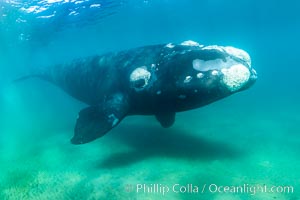
Southern right whale underwater, Eubalaena australis, Argentina.
Species: Southern right whale, Eubalaena australis
Location: Puerto Piramides, Chubut, Argentina
Image ID: 35907
Species: Southern right whale, Eubalaena australis
Location: Puerto Piramides, Chubut, Argentina
Image ID: 35907
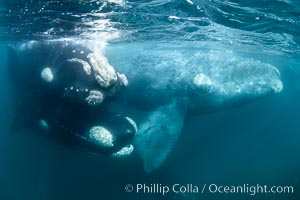
Mating pair of southern right whales underwater (on left). The gray adult whale on the right was formerly a white calf and, while it is not longer white, will remain lighter than normal throughout its life, Eubalaena australis, Argentina.
Species: Southern Right Whale, Eubalaena australis
Location: Puerto Piramides, Chubut, Argentina
Image ID: 35923
Species: Southern Right Whale, Eubalaena australis
Location: Puerto Piramides, Chubut, Argentina
Image ID: 35923
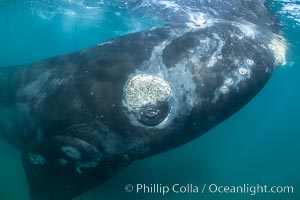
Inquisitive southern right whale underwater, Eubalaena australis, closely approaches cameraman, Argentina.
Species: Southern right whale, Eubalaena australis
Location: Puerto Piramides, Chubut, Argentina
Image ID: 35942
Species: Southern right whale, Eubalaena australis
Location: Puerto Piramides, Chubut, Argentina
Image ID: 35942
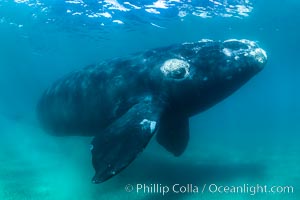
Inquisitive southern right whale underwater, Eubalaena australis, closely approaches cameraman, Argentina.
Species: Southern right whale, Eubalaena australis
Location: Puerto Piramides, Chubut, Argentina
Image ID: 35943
Species: Southern right whale, Eubalaena australis
Location: Puerto Piramides, Chubut, Argentina
Image ID: 35943
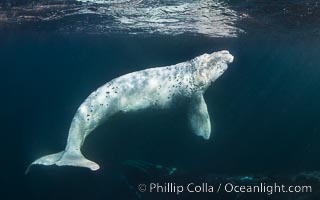
White southern right whale calf underwater, Eubalaena australis. About five per cent of southern right whales are born white due to a condition known as grey morphism and will gradually turn dark as they age. They are not albino (which is a complete lack of pigmentation). Sometimes referred to as "brindled", the white coloration is a recessive genetic trait and only lasts a few months. Typically, but not always, white calves will become much darker as they mature but will still be somewhat lighter than normal even as adults.
Species: Southern Right Whale, Eubalaena australis
Location: Puerto Piramides, Chubut, Argentina
Image ID: 38261
Species: Southern Right Whale, Eubalaena australis
Location: Puerto Piramides, Chubut, Argentina
Image ID: 38261
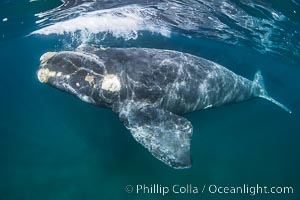
Southern right whale calf underwater, Eubalaena australis.
Species: Southern Right Whale, Eubalaena australis
Location: Puerto Piramides, Chubut, Argentina
Image ID: 38288
Species: Southern Right Whale, Eubalaena australis
Location: Puerto Piramides, Chubut, Argentina
Image ID: 38288
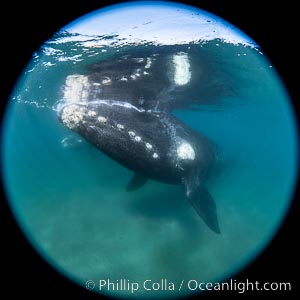
Southern right whale underwater, Eubalaena australis, Patagonia.
Species: Southern Right Whale, Eubalaena australis
Location: Puerto Piramides, Chubut, Argentina
Image ID: 38367
Species: Southern Right Whale, Eubalaena australis
Location: Puerto Piramides, Chubut, Argentina
Image ID: 38367
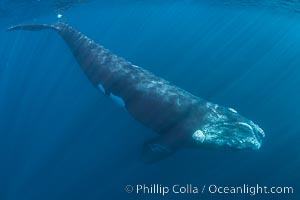
Portrait of a Southern Right Whale Underwater, Eubalaena australis.
Species: Southern Right Whale, Eubalaena australis
Location: Puerto Piramides, Chubut, Argentina
Image ID: 38387
Species: Southern Right Whale, Eubalaena australis
Location: Puerto Piramides, Chubut, Argentina
Image ID: 38387
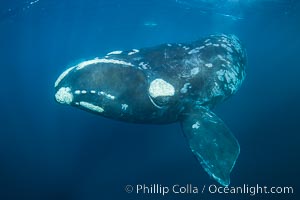
Portrait of a Southern Right Whale Underwater, Eubalaena australis. This particular right whale exhibits a beautiful mottled pattern on its sides.
Species: Southern Right Whale, Eubalaena australis
Location: Puerto Piramides, Chubut, Argentina
Image ID: 38391
Species: Southern Right Whale, Eubalaena australis
Location: Puerto Piramides, Chubut, Argentina
Image ID: 38391
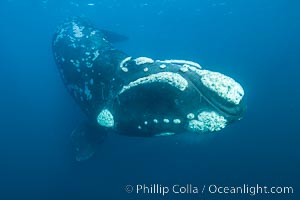
Portrait of a Southern Right Whale Underwater, Eubalaena australis. This particular right whale exhibits a beautiful mottled pattern on its sides.
Species: Southern Right Whale, Eubalaena australis
Location: Puerto Piramides, Chubut, Argentina
Image ID: 38393
Species: Southern Right Whale, Eubalaena australis
Location: Puerto Piramides, Chubut, Argentina
Image ID: 38393
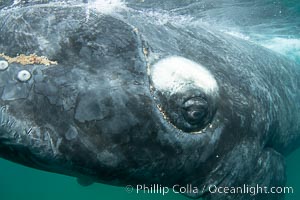
Southern right whale eyeballing the camera up close, Eubalaena australis. Whale lice can be seen clearly in the folds and crevices around the whales eye and lip groove.
Species: Southern Right Whale, Eubalaena australis
Location: Puerto Piramides, Chubut, Argentina
Image ID: 38400
Species: Southern Right Whale, Eubalaena australis
Location: Puerto Piramides, Chubut, Argentina
Image ID: 38400
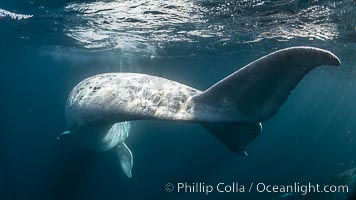
White southern right whale calf underwater, Eubalaena australis. About five per cent of southern right whales are born white due to a condition known as grey morphism and will gradually turn dark as they age. They are not albino (which is a complete lack of pigmentation). Sometimes referred to as "brindled", the white coloration is a recessive genetic trait and only lasts a few months. Typically, but not always, white calves will become much darker as they mature but will still be somewhat lighter than normal even as adults.
Species: Southern Right Whale, Eubalaena australis
Location: Puerto Piramides, Chubut, Argentina
Image ID: 38434
Species: Southern Right Whale, Eubalaena australis
Location: Puerto Piramides, Chubut, Argentina
Image ID: 38434
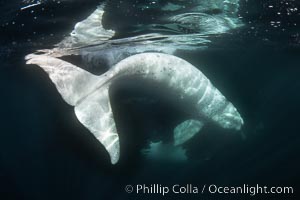
White southern right whale calf underwater, Eubalaena australis. About five per cent of southern right whales are born white due to a condition known as grey morphism and will gradually turn dark as they age. They are not albino (which is a complete lack of pigmentation). Sometimes referred to as "brindled", the white coloration is a recessive genetic trait and only lasts a few months. Typically, but not always, white calves will become much darker as they mature but will still be somewhat lighter than normal even as adults.
Species: Southern Right Whale, Eubalaena australis
Location: Puerto Piramides, Chubut, Argentina
Image ID: 38438
Species: Southern Right Whale, Eubalaena australis
Location: Puerto Piramides, Chubut, Argentina
Image ID: 38438
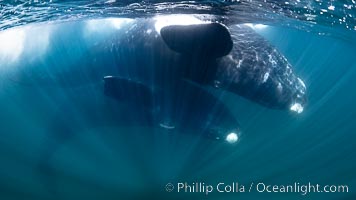
Courting pair of southern right whales underwater, Eubalaena australis. While the posture in this photo isn't quite mating, it is a courting behavior that often precedes mating. The male is below, upside down and trying to access the female belly-to-belly. However, the female does not want to mate, so she has positioned herself upside down at the surface so that the males in the courting group cannot reach her genital slit.
Species: Southern Right Whale, Eubalaena australis
Location: Puerto Piramides, Chubut, Argentina
Image ID: 38446
Species: Southern Right Whale, Eubalaena australis
Location: Puerto Piramides, Chubut, Argentina
Image ID: 38446