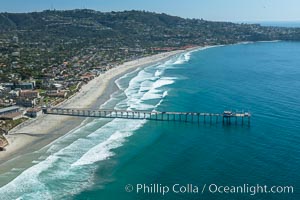
Aerial Photo of San Diego Scripps Coastal SMCA. Scripps Institution of Oceanography Research Pier.
Location: Scripps Institution of Oceanography, La Jolla, California
Image ID: 30626
Location: Scripps Institution of Oceanography, La Jolla, California
Image ID: 30626
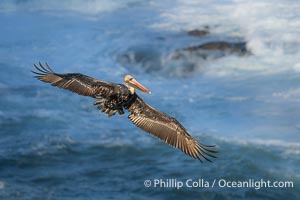
Brown pelican in flight. Adult winter non-breeding plumage. Brown pelicans were formerly an endangered species. In 1972, the United States Environmental Protection Agency banned the use of DDT in part to protect bird species like the brown pelican . Since that time, populations of pelicans have recovered and expanded. The recovery has been so successful that brown pelicans were taken off the endangered species list in 2009.
Species: Brown Pelican, Pelecanus occidentalis, Pelecanus occidentalis californicus
Location: La Jolla, California
Image ID: 40011
Species: Brown Pelican, Pelecanus occidentalis, Pelecanus occidentalis californicus
Location: La Jolla, California
Image ID: 40011
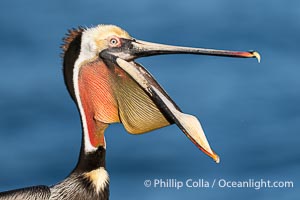
California Brown Pelican claps its jaws mandibles, sometimes rapidly several times, perhaps to dislodge debris or simply because its fun and feels good. This is not the same as the "yawn" that precedes a head throw. Adult winter breeding plumage with brown hind-neck.
Species: Brown Pelican, Pelecanus occidentalis, Pelecanus occidentalis californicus
Location: La Jolla, California
Image ID: 40239
Species: Brown Pelican, Pelecanus occidentalis, Pelecanus occidentalis californicus
Location: La Jolla, California
Image ID: 40239
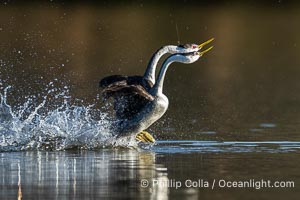
Western Grebes rushing across Lake Wohlford, exhibiting a spectacular courtship behavior in which the aquatic birds literally run across the surface of the water while their feet hit the water up to 20 times per second. The grebe on the left is "Hook" famous for the fishing hook and line embedded in the back of his head.
Species: Western Grebe, Aechmophorus occidentalis
Location: Lake Wohlford, Escondido, California
Image ID: 40843
Species: Western Grebe, Aechmophorus occidentalis
Location: Lake Wohlford, Escondido, California
Image ID: 40843
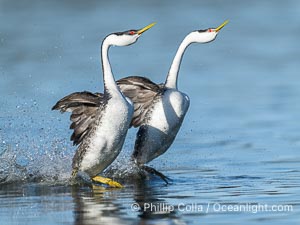
Two Western Grebes Walk on Water. Grebe rushing, a courtship behavior, happens when the birds slap the lake surface up to 20 times per second, literally running across the water.
Species: Western Grebe, Aechmophorus occidentalis
Location: Lake Wohlford, Escondido, California
Image ID: 40889
Species: Western Grebe, Aechmophorus occidentalis
Location: Lake Wohlford, Escondido, California
Image ID: 40889
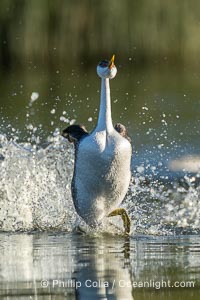
Western Grebe rushes across Lake Wohlford, exhibiting a spectacular courtship behavior in which the aquatic bird literally runs across the surface of the water while its feet hit the water up to 20 times per second.
Species: Western Grebe, Aechmophorus occidentalis
Location: Lake Wohlford, Escondido, California
Image ID: 41539
Species: Western Grebe, Aechmophorus occidentalis
Location: Lake Wohlford, Escondido, California
Image ID: 41539
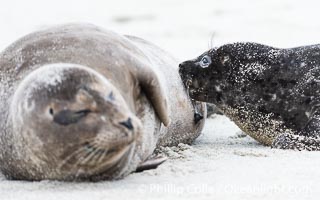
A young Pacific Harbor Seal pup nursing. Mother harbor seals will only nurse their pups for about four to six weeks, at which point the small seal is weaned and must begin to forage and fend for itself. That short period of time is crucial for the young seal to learn how to hunt, socialize and swim.
Species: Pacific harbor seal, Phoca vitulina richardsi
Location: La Jolla, California
Image ID: 39063
Species: Pacific harbor seal, Phoca vitulina richardsi
Location: La Jolla, California
Image ID: 39063
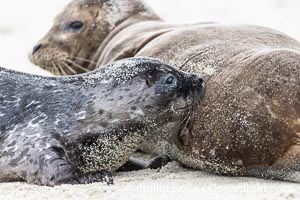
A young Pacific Harbor Seal pup nursing. Mother harbor seals will only nurse their pups for about four to six weeks, at which point the small seal is weaned and must begin to forage and fend for itself. That short period of time is crucial for the young seal to learn how to hunt, socialize and swim.
Species: Pacific harbor seal, Phoca vitulina richardsi
Location: La Jolla, California
Image ID: 39082
Species: Pacific harbor seal, Phoca vitulina richardsi
Location: La Jolla, California
Image ID: 39082
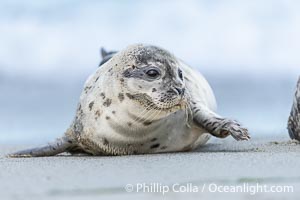
Pacific Harbor Seal Pup About Two Weeks Old, hauled out on a white sand beach along the coast of San Diego. This young seal will be weaned off its mothers milk and care when it is about four to six weeks old, and before that time it must learn how to forage for food on its own, a very difficult time for a young seal.
Species: Pacific harbor seal, Phoca vitulina richardsi
Location: La Jolla, California
Image ID: 39083
Species: Pacific harbor seal, Phoca vitulina richardsi
Location: La Jolla, California
Image ID: 39083
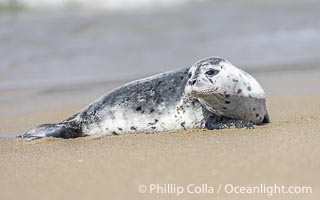
Pacific Harbor Seal Pup About Two Weeks Old, hauled out on a white sand beach along the coast of San Diego. This young seal will be weaned off its mothers milk and care when it is about four to six weeks old, and before that time it must learn how to forage for food on its own, a very difficult time for a young seal.
Species: Pacific harbor seal, Phoca vitulina richardsi
Location: La Jolla, California
Image ID: 39096
Species: Pacific harbor seal, Phoca vitulina richardsi
Location: La Jolla, California
Image ID: 39096
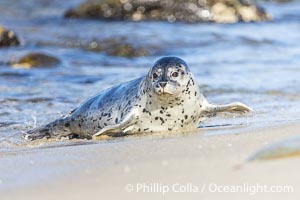
Pacific Harbor Seal Pup About Two Weeks Old, hauled out on a white sand beach along the coast of San Diego. This young seal will be weaned off its mothers milk and care when it is about four to six weeks old, and before that time it must learn how to forage for food on its own, a very difficult time for a young seal.
Species: Pacific harbor seal, Phoca vitulina richardsi
Location: La Jolla, California
Image ID: 39103
Species: Pacific harbor seal, Phoca vitulina richardsi
Location: La Jolla, California
Image ID: 39103
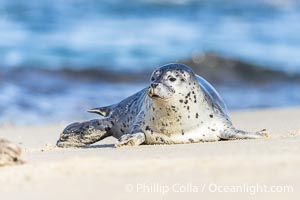
Pacific Harbor Seal Pup About Two Weeks Old, hauled out on a white sand beach along the coast of San Diego. This young seal will be weaned off its mothers milk and care when it is about four to six weeks old, and before that time it must learn how to forage for food on its own, a very difficult time for a young seal.
Species: Pacific harbor seal, Phoca vitulina richardsi
Location: La Jolla, California
Image ID: 39104
Species: Pacific harbor seal, Phoca vitulina richardsi
Location: La Jolla, California
Image ID: 39104
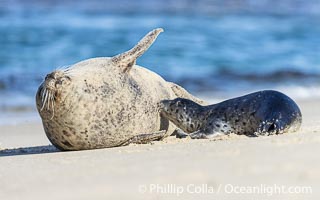
A young Pacific Harbor Seal pup nursing. Mother harbor seals will only nurse their pups for about four to six weeks, at which point the small seal is weaned and must begin to forage and fend for itself. That short period of time is crucial for the young seal to learn how to hunt, socialize and swim.
Species: Pacific harbor seal, Phoca vitulina richardsi
Location: La Jolla, California
Image ID: 39105
Species: Pacific harbor seal, Phoca vitulina richardsi
Location: La Jolla, California
Image ID: 39105
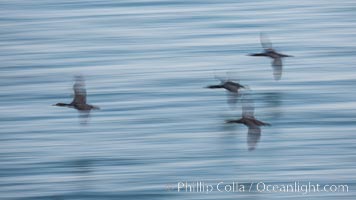
Cormorants in flight, wings blurred by time exposure.
Species: Double-crested cormorant, Phalacrocorax auritus
Location: La Jolla, California
Image ID: 30163
Species: Double-crested cormorant, Phalacrocorax auritus
Location: La Jolla, California
Image ID: 30163
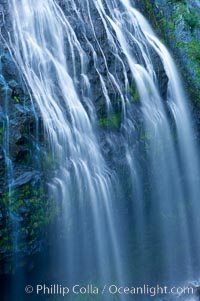
Narada Falls cascades down a cliff, with the flow blurred by a time exposure. Narada Falls is a 188 foot (57m) waterfall in Mount Rainier National Park.
Location: Narada Falls, Mount Rainier National Park, Washington
Image ID: 13843
Location: Narada Falls, Mount Rainier National Park, Washington
Image ID: 13843
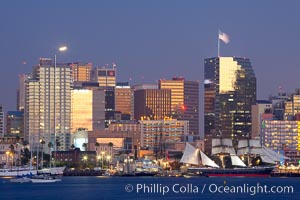
San Diego city skyline at dusk, viewed from Harbor Island, the Star of India at right.
Location: San Diego, California
Image ID: 14533
Location: San Diego, California
Image ID: 14533
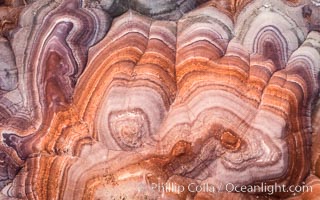
Fantastic colorful sedimentary patterns, Bentonite layers are seen as striations exposed in the Utah Badlands. The Bentonite Hills are composed of the Brushy Basin shale member of the Morrison Formation. This layer was formed during Jurassic times when mud, silt, fine sand, and volcanic ash were deposited in swamps and lakes. Aerial photograph.
Location: Utah
Image ID: 38029
Location: Utah
Image ID: 38029
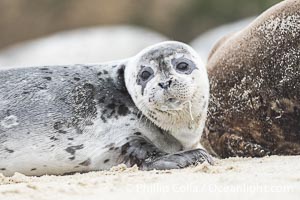
A young Pacific Harbor Seal pup with milk on its face from nursing. Mother harbor seals will only nurse their pups for about four to six weeks, at which point the small seal is weaned and must begin to forage and fend for itself. That short period of time is crucial for the young seal to learn how to hunt, socialize and swim.
Species: Pacific harbor seal, Phoca vitulina richardsi
Location: La Jolla, California
Image ID: 39130
Species: Pacific harbor seal, Phoca vitulina richardsi
Location: La Jolla, California
Image ID: 39130
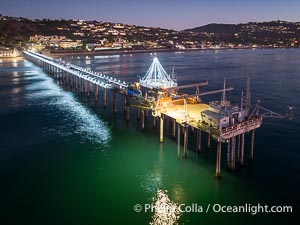
Holiday Christmas Lights on Scripps Pier, Scripps Institution of Oceanography, sunset, aerial.
Location: La Jolla, California
Image ID: 39880
Location: La Jolla, California
Image ID: 39880
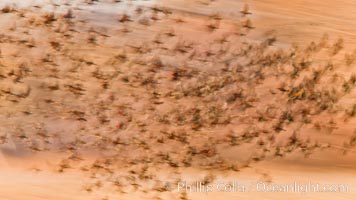
Flock of red-winged blackbirds, in flight, blurred in time exposure.
Species: Red-winged blackbird, Agelaius phoeniceus
Location: Bosque Del Apache, Socorro, New Mexico
Image ID: 26200
Species: Red-winged blackbird, Agelaius phoeniceus
Location: Bosque Del Apache, Socorro, New Mexico
Image ID: 26200
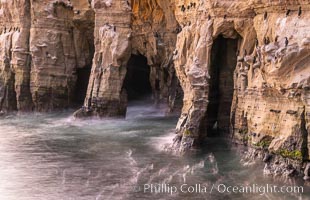
Sea Caves, the famous La Jolla sea caves lie below tall cliffs at Goldfish Point. Sunny Jim Cave. Sunrise. Sea gulls floating in the water blur in this time exposure. Cormorants rest on jagged edges of the cliffs.
Location: La Jolla, California
Image ID: 37470
Location: La Jolla, California
Image ID: 37470
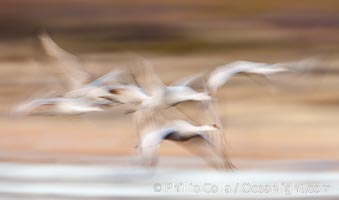
Sandhill cranes flying, wings blurred from long time exposure.
Species: Sandhill crane, Grus canadensis
Location: Bosque Del Apache, Socorro, New Mexico
Image ID: 26216
Species: Sandhill crane, Grus canadensis
Location: Bosque Del Apache, Socorro, New Mexico
Image ID: 26216
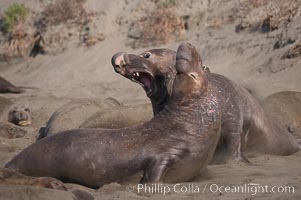
Male elephant seals (bulls) rear up on their foreflippers and fight for territory and harems of females. Bull elephant seals will haul out and fight from December through March, nearly fasting the entire time as they maintain their territory and harem. They bite and tear at each other on the neck and shoulders, drawing blood and creating scars on the tough hides. Sandy beach rookery, winter, Central California.
Species: Elephant seal, Mirounga angustirostris
Location: Piedras Blancas, San Simeon, California
Image ID: 15394
Species: Elephant seal, Mirounga angustirostris
Location: Piedras Blancas, San Simeon, California
Image ID: 15394
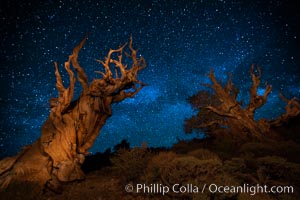
Stars and the Milky Way rise above ancient bristlecone pine trees, in the White Mountains at an elevation of 10,000' above sea level. These are some of the oldest trees in the world, reaching 4000 years in age.
Species: Bristlecone pine, Pinus longaeva
Location: Ancient Bristlecone Pine Forest, White Mountains, Inyo National Forest, California
Image ID: 27775
Species: Bristlecone pine, Pinus longaeva
Location: Ancient Bristlecone Pine Forest, White Mountains, Inyo National Forest, California
Image ID: 27775
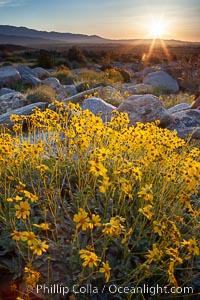
Brittlebush at sunrise, dawn, springtime bloom, Palm Canyon, Anza Borrego Desert State Park.
Species: Brittlebush, Encelia farinosa
Location: Anza-Borrego Desert State Park, Borrego Springs, California
Image ID: 24301
Species: Brittlebush, Encelia farinosa
Location: Anza-Borrego Desert State Park, Borrego Springs, California
Image ID: 24301
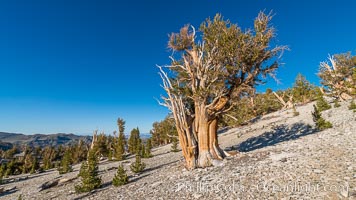
Ancient Bristlecone Pine tree, White Mountain Wilderness, Inyo National Forest.
Species: Bristlecone pine, Pinus longaeva
Location: Ancient Bristlecone Pine Forest, White Mountains, Inyo National Forest, California
Image ID: 29314
Species: Bristlecone pine, Pinus longaeva
Location: Ancient Bristlecone Pine Forest, White Mountains, Inyo National Forest, California
Image ID: 29314
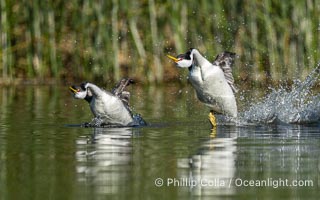
Western Grebes rushing across Lake Wohlford, exhibiting a spectacular courtship behavior in which the aquatic birds literally run across the surface of the water while their feet hit the water up to 20 times per second.
Species: Western Grebe, Aechmophorus occidentalis
Location: Lake Wohlford, Escondido, California
Image ID: 41545
Species: Western Grebe, Aechmophorus occidentalis
Location: Lake Wohlford, Escondido, California
Image ID: 41545
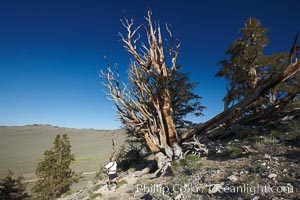
A hiker admires an ancient bristlecone pine tree, on the Methuselah Walk in the Schulman Grove in the White Mountains at an elevation of 9500 above sea level. The oldest bristlecone pines in the world are found in the Schulman Grove, some of them over 4700 years old. Ancient Bristlecone Pine Forest.
Species: Bristlecone pine, Pinus longaeva
Location: White Mountains, Inyo National Forest, California
Image ID: 23232
Species: Bristlecone pine, Pinus longaeva
Location: White Mountains, Inyo National Forest, California
Image ID: 23232
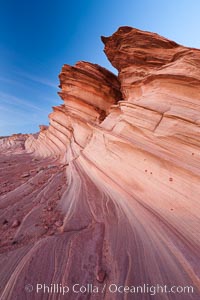
The Great Wall, Navajo Tribal Lands, Arizona. Sandstone "fins", eroded striations that depict how sandstone -- ancient compressed sand -- was laid down in layers over time. Now exposed, the layer erode at different rates, forming delicate "fins" that stretch for long distances.
Location: Navajo Tribal Lands, Page, Arizona
Image ID: 26643
Location: Navajo Tribal Lands, Page, Arizona
Image ID: 26643
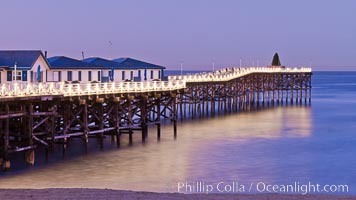
The Crystal Pier and Pacific Ocean at sunrise, dawn, waves blur as they crash upon the sand. Crystal Pier, 872 feet long and built in 1925, extends out into the Pacific Ocean from the town of Pacific Beach.
Location: Pacific Beach, California
Image ID: 27239
Location: Pacific Beach, California
Image ID: 27239