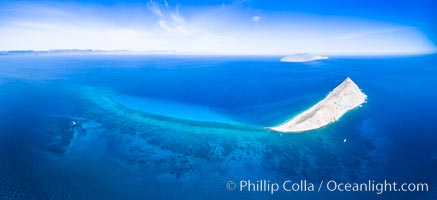
Isla San Diego and Coral Reef, reef extends from Isla San Diego to Isla San Jose, aerial photo, Sea of Cortez, Baja California.
Location: Isla San Diego, Baja California, Mexico
Image ID: 33601
Panorama dimensions: 5596 x 12223
Location: Isla San Diego, Baja California, Mexico
Image ID: 33601
Panorama dimensions: 5596 x 12223
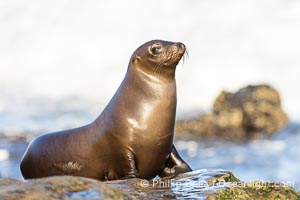
California Sea Lion Resting in the Sun, on rocky reef.
Species: California sea lion, Zalophus californianus
Location: La Jolla, California
Image ID: 36855
Species: California sea lion, Zalophus californianus
Location: La Jolla, California
Image ID: 36855
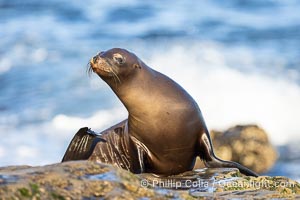
California Sea Lion Resting in the Sun, on rocky reef.
Species: California sea lion, Zalophus californianus
Location: La Jolla, California
Image ID: 36858
Species: California sea lion, Zalophus californianus
Location: La Jolla, California
Image ID: 36858
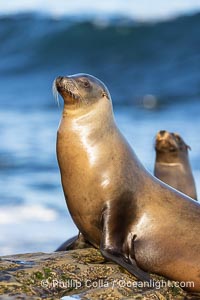
California Sea Lion Resting in the Sun, on rocky reef.
Species: California sea lion, Zalophus californianus
Location: La Jolla, California
Image ID: 36859
Species: California sea lion, Zalophus californianus
Location: La Jolla, California
Image ID: 36859
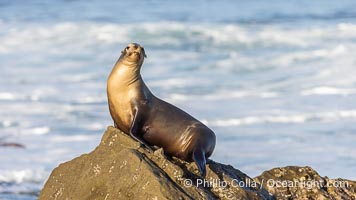
California Sea Lion Resting in the Sun, on rocky reef.
Species: California sea lion, Zalophus californianus
Location: La Jolla, California
Image ID: 36868
Species: California sea lion, Zalophus californianus
Location: La Jolla, California
Image ID: 36868
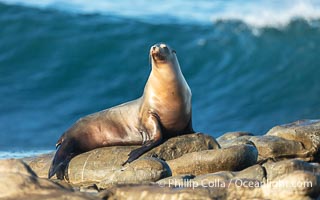
California sea lion perched on reef at La Jolla Cove in San Diego with large wave breaking in the background.
Species: California Sea Lion, Zalophus californianus
Location: La Jolla, California
Image ID: 40202
Species: California Sea Lion, Zalophus californianus
Location: La Jolla, California
Image ID: 40202
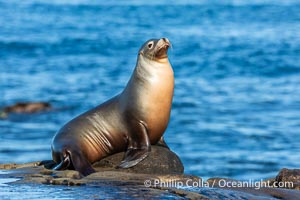
Sunrise Portrait of California Sea Lion at La Jolla Cove on the Point La Jolla Reef.
Species: California Sea Lion, Zalophus californianus
Location: La Jolla, California
Image ID: 40191
Species: California Sea Lion, Zalophus californianus
Location: La Jolla, California
Image ID: 40191
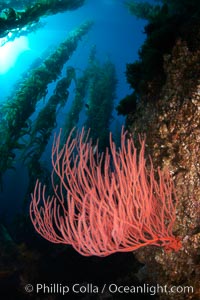
Red gorgonian on rocky reef, below kelp forest, underwater. The red gorgonian is a filter-feeding temperate colonial species that lives on the rocky bottom at depths between 50 to 200 feet deep. Gorgonians are oriented at right angles to prevailing water currents to capture plankton drifting by.
Species: Red Gorgonian, Giant Kelp, Leptogorgia chilensis, Lophogorgia chilensis, Macrocystis pyrifera
Location: San Clemente Island, California
Image ID: 23420
Species: Red Gorgonian, Giant Kelp, Leptogorgia chilensis, Lophogorgia chilensis, Macrocystis pyrifera
Location: San Clemente Island, California
Image ID: 23420
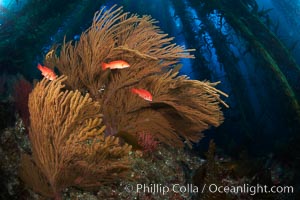
California golden gorgonian and small juvenile sheephead fishes on rocky reef, below kelp forest, underwater. The golden gorgonian is a filter-feeding temperate colonial species that lives on the rocky bottom at depths between 50 to 200 feet deep. Each individual polyp is a distinct animal, together they secrete calcium that forms the structure of the colony. Gorgonians are oriented at right angles to prevailing water currents to capture plankton drifting by.
Species: California Golden Gorgonian, Giant Kelp, Muricea californica, Semicossyphus pulcher, Macrocystis pyrifera
Location: San Clemente Island, California
Image ID: 23421
Species: California Golden Gorgonian, Giant Kelp, Muricea californica, Semicossyphus pulcher, Macrocystis pyrifera
Location: San Clemente Island, California
Image ID: 23421
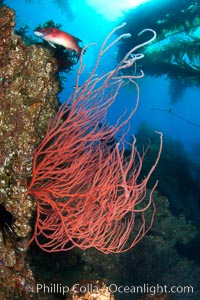
Red gorgonian on rocky reef, below kelp forest, underwater. The red gorgonian is a filter-feeding temperate colonial species that lives on the rocky bottom at depths between 50 to 200 feet deep. Gorgonians are oriented at right angles to prevailing water currents to capture plankton drifting by.
Species: Red gorgonian, Leptogorgia chilensis, Lophogorgia chilensis
Location: San Clemente Island, California
Image ID: 23425
Species: Red gorgonian, Leptogorgia chilensis, Lophogorgia chilensis
Location: San Clemente Island, California
Image ID: 23425
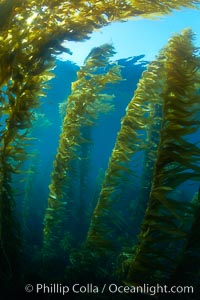
A kelp forest. Giant kelp grows rapidly, up to 2' per day, from the rocky reef on the ocean bottom to which it is anchored, toward the ocean surface where it spreads to form a thick canopy. Myriad species of fishes, mammals and invertebrates form a rich community in the kelp forest. Lush forests of kelp are found through California's Southern Channel Islands.
Species: Giant kelp, Macrocystis pyrifera
Location: San Clemente Island, California
Image ID: 23428
Species: Giant kelp, Macrocystis pyrifera
Location: San Clemente Island, California
Image ID: 23428
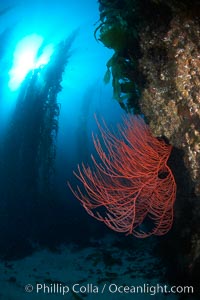
Red gorgonian on rocky reef, below kelp forest, underwater. The red gorgonian is a filter-feeding temperate colonial species that lives on the rocky bottom at depths between 50 to 200 feet deep. Gorgonians are oriented at right angles to prevailing water currents to capture plankton drifting by.
Species: Red Gorgonian, Giant Kelp, Leptogorgia chilensis, Lophogorgia chilensis, Macrocystis pyrifera
Location: San Clemente Island, California
Image ID: 23431
Species: Red Gorgonian, Giant Kelp, Leptogorgia chilensis, Lophogorgia chilensis, Macrocystis pyrifera
Location: San Clemente Island, California
Image ID: 23431
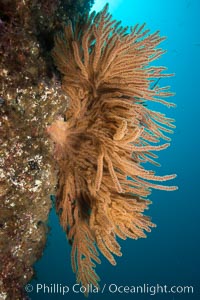
California golden gorgonian on rocky reef, underwater. The golden gorgonian is a filter-feeding temperate colonial species that lives on the rocky bottom at depths between 50 to 200 feet deep. Each individual polyp is a distinct animal, together they secrete calcium that forms the structure of the colony. Gorgonians are oriented at right angles to prevailing water currents to capture plankton drifting by.
Species: California golden gorgonian, Muricea californica
Location: San Clemente Island, California
Image ID: 25397
Species: California golden gorgonian, Muricea californica
Location: San Clemente Island, California
Image ID: 25397
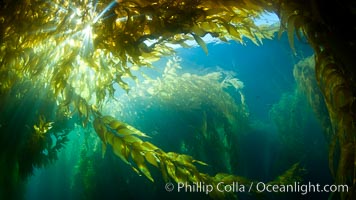
A view of an underwater forest of giant kelp. Giant kelp grows rapidly, up to 2' per day, from the rocky reef on the ocean bottom to which it is anchored, toward the ocean surface where it spreads to form a thick canopy. Myriad species of fishes, mammals and invertebrates form a rich community in the kelp forest. Lush forests of kelp are found through California's Southern Channel Islands.
Species: Giant kelp, Macrocystis pyrifera
Location: San Clemente Island, California
Image ID: 25400
Species: Giant kelp, Macrocystis pyrifera
Location: San Clemente Island, California
Image ID: 25400
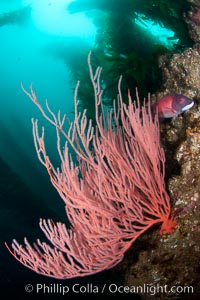
Red gorgonian on rocky reef, below kelp forest, underwater. The red gorgonian is a filter-feeding temperate colonial species that lives on the rocky bottom at depths between 50 to 200 feet deep. Gorgonians are oriented at right angles to prevailing water currents to capture plankton drifting by.
Species: Red gorgonian, Leptogorgia chilensis, Lophogorgia chilensis
Location: San Clemente Island, California
Image ID: 25406
Species: Red gorgonian, Leptogorgia chilensis, Lophogorgia chilensis
Location: San Clemente Island, California
Image ID: 25406
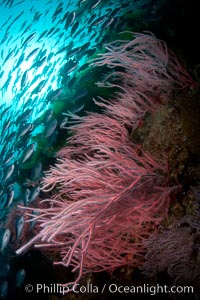
Red gorgonian on rocky reef, below kelp forest, underwater. The red gorgonian is a filter-feeding temperate colonial species that lives on the rocky bottom at depths between 50 to 200 feet deep. Gorgonians are oriented at right angles to prevailing water currents to capture plankton drifting by.
Species: Red gorgonian, Lophogorgia chilensis
Location: San Clemente Island, California
Image ID: 25413
Species: Red gorgonian, Lophogorgia chilensis
Location: San Clemente Island, California
Image ID: 25413
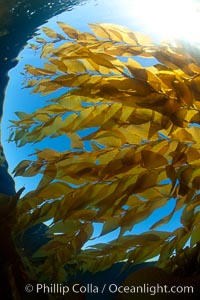
A view of an underwater forest of giant kelp. Giant kelp grows rapidly, up to 2' per day, from the rocky reef on the ocean bottom to which it is anchored, toward the ocean surface where it spreads to form a thick canopy. Myriad species of fishes, mammals and invertebrates form a rich community in the kelp forest. Lush forests of kelp are found through California's Southern Channel Islands.
Species: Giant kelp, Macrocystis pyrifera
Location: San Clemente Island, California
Image ID: 25432
Species: Giant kelp, Macrocystis pyrifera
Location: San Clemente Island, California
Image ID: 25432
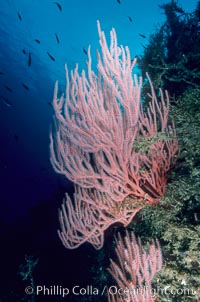
Red gorgonian clings to a vertical undersea reef at San Clemente Island, California.
Species: Red gorgonian, Leptogorgia chilensis, Lophogorgia chilensis
Location: San Clemente Island, California
Image ID: 00616
Species: Red gorgonian, Leptogorgia chilensis, Lophogorgia chilensis
Location: San Clemente Island, California
Image ID: 00616
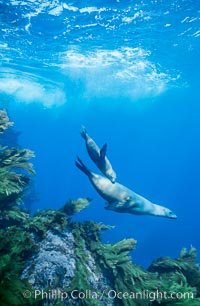
California sea lion mother and pup swimming over kelp-covered reef at the base of Isla Afuera, Guadalupe Island, Mexico.
Species: California sea lion, Zalophus californianus
Location: Guadalupe Island (Isla Guadalupe), Baja California, Mexico
Image ID: 02976
Species: California sea lion, Zalophus californianus
Location: Guadalupe Island (Isla Guadalupe), Baja California, Mexico
Image ID: 02976
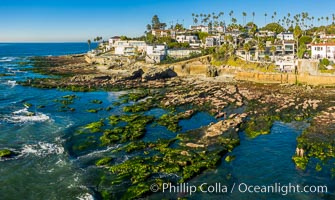
Sun Gold Point Reef Exposed at Extreme Low Tide, La Jolla, California.
Location: La Jolla, California
Image ID: 37984
Location: La Jolla, California
Image ID: 37984
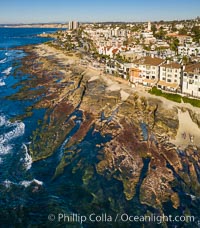
Nicholson Point and Hospitals Beach, aerial photo, extreme low tide, La Jolla, California.
Location: La Jolla, California
Image ID: 37987
Location: La Jolla, California
Image ID: 37987
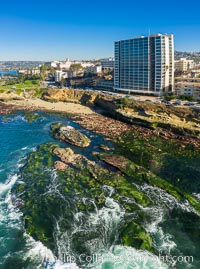
Shell Beach Reef Exposed at Extreme Low Tide, La Jolla, California.
Location: La Jolla, California
Image ID: 37988
Location: La Jolla, California
Image ID: 37988
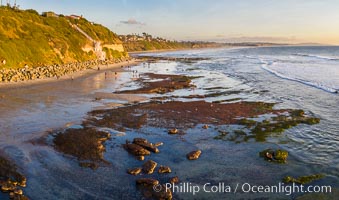
Swamis Beach Reefs Exposed by King Tides, people explore ocean reefs normally underwater but exposed on the extreme low tides known as King Tides. Aerial photo.
Location: Swamis, Encinitas, California
Image ID: 37989
Location: Swamis, Encinitas, California
Image ID: 37989
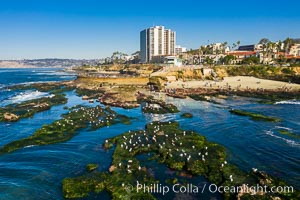
Childrens Pool Reef Exposed at Extreme Low King Tide, La Jolla, California. Aerial panoramic photograph.
Location: Children's Pool, La Jolla, California
Image ID: 37990
Location: Children's Pool, La Jolla, California
Image ID: 37990
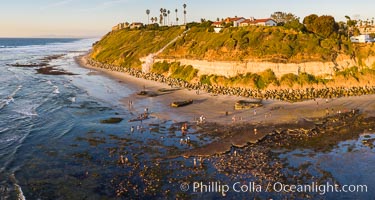
Swamis Beach Reefs Exposed by King Tides, people explore ocean reefs normally underwater but exposed on the extreme low tides known as King Tides. Aerial photo.
Location: Swamis, Encinitas, California
Image ID: 37991
Location: Swamis, Encinitas, California
Image ID: 37991
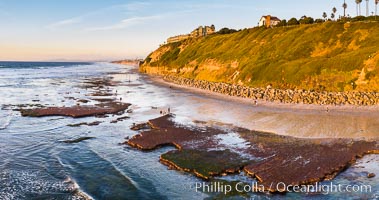
Swamis Beach Reefs Exposed by King Tides, people explore ocean reefs normally underwater but exposed on the extreme low tides known as King Tides. Aerial photo.
Location: Swamis, Encinitas, California
Image ID: 37992
Location: Swamis, Encinitas, California
Image ID: 37992
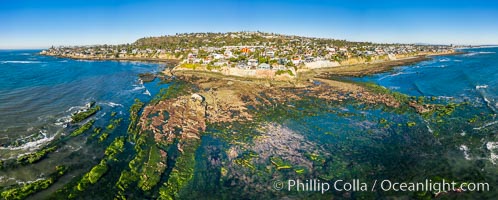
Bird Rock Reef Exposed at Extreme Low Tide, La Jolla, California.
Location: Bird Rock, La Jolla, California
Image ID: 37993
Panorama dimensions: 5578 x 13879
Location: Bird Rock, La Jolla, California
Image ID: 37993
Panorama dimensions: 5578 x 13879
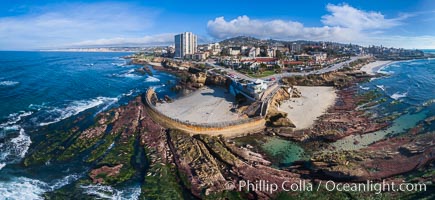
Childrens Pool Reef Exposed at Extreme Low King Tide, La Jolla, California. Aerial panoramic photograph.
Location: Children's Pool, La Jolla, California
Image ID: 37995
Panorama dimensions: 5787 x 12589
Location: Children's Pool, La Jolla, California
Image ID: 37995
Panorama dimensions: 5787 x 12589
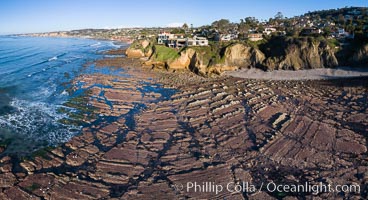
La Jolla Bay submarine reef system on extreme low King Tide, south of La Jolla Shores, aerial panoramic photo.
Location: La Jolla, California
Image ID: 37999
Panorama dimensions: 5103 x 9390
Location: La Jolla, California
Image ID: 37999
Panorama dimensions: 5103 x 9390
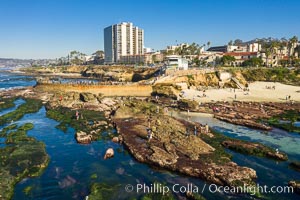
Childrens Pool Reef Exposed at Extreme Low Tide, La Jolla, California.
Location: Children's Pool, La Jolla, California
Image ID: 38009
Location: Children's Pool, La Jolla, California
Image ID: 38009