|
 |
 |
 |
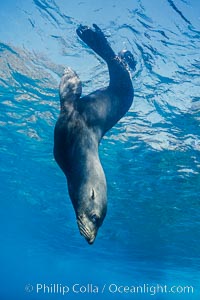
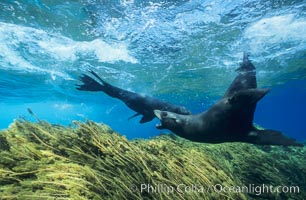
| Adult male, Guadalupe fur seal, floating upside down under the ocean's surface at Guadalupe Island, watching the photographer and looking for passing predators, Arctocephalus townsendi, Guadalupe Island (Isla Guadalupe), Image 02114 |
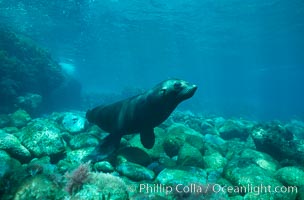
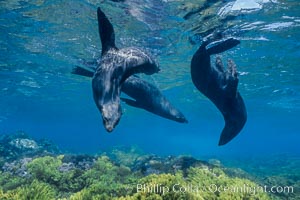
Juveniles, Guadalupe fur seals, floating upside down underwater over a rocky reef covered with golden kelp at Guadalupe Island, Arctocephalus townsendi, Guadalupe Island (Isla Guadalupe), Image 02113 |
Adult male. |
| I have dived among Northern fur seals (Callorhinus ursinus) and Galapagos fur seals ( Arctocephalus galapagoensis) and have seen both species adopt this head-down pose as well, and suspect that it may be a natural resting position for fur seals that share their waters with large sharks. |
 |
 |
 |
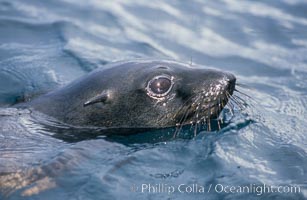
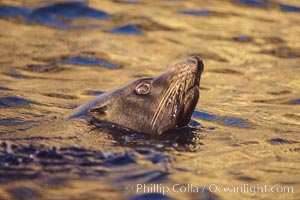
| Adult male, Guadalupe fur seal, Islas San Benito, Arctocephalus townsendi, San Benito Islands (Islas San Benito), Image 02298 |
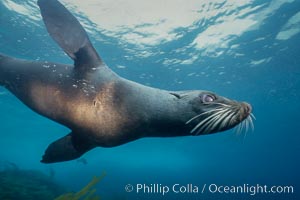
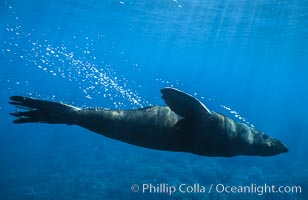
As this fur seal swims, twists and turns it leaves behind glistening trails of bubbles squeezed from its dense, two-layered coat, Guadalupe fur seal, bubbles emitted by dense fur coat, Arctocephalus townsendi, Guadalupe Island (Isla Guadalupe), Image 02366 |
Juveniles |
 |
 |
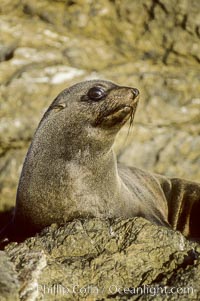
| Adult male, Guadalupe fur seal, Arctocephalus townsendi, Guadalupe Island (Isla Guadalupe), Image 02362 |
Territorial dispute between two adult males guarding their harem territories, Territorial male Guadalupe fur seal threatening another intruding seal, Arctocephalus townsendi, Guadalupe Island (Isla Guadalupe), Image 02372 |
 |
 |
 |
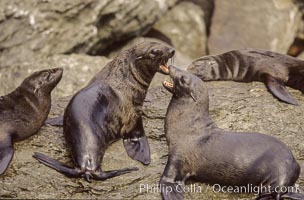
| Two young males, mock sparring, not yet with harems, Guadalupe fur seals, two males fighting, Islas San Benito, Arctocephalus townsendi, San Benito Islands (Islas San Benito), Image 02296 |
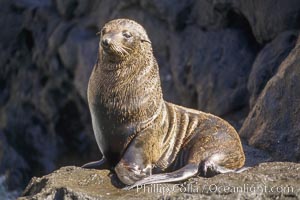
Juvenile, Guadalupe fur seal, San Benito Islands, Arctocephalus townsendi, San Benito Islands (Islas San Benito), Image 02103 |
Guadalupe fur seal, Islas San Benito, Arctocephalus townsendi, San Benito Islands (Islas San Benito), Image 02295 |
 |
 |
 |
| Adult female, Guadalupe fur seal, Arctocephalus townsendi, Guadalupe Island (Isla Guadalupe), Image 01949 |
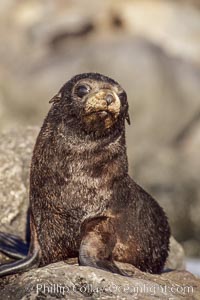
Pup, Guadalupe fur seal pup sits on brown rocks along the coastline of Guadalupe Island, Arctocephalus townsendi, Guadalupe Island (Isla Guadalupe), Image 02441 |
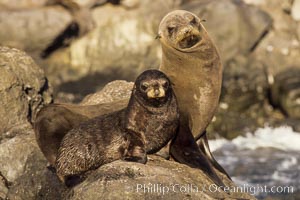
Mother and pup, Guadalupe fur seal mother and pup, Arctocephalus townsendi, Guadalupe Island (Isla Guadalupe), Image 02440 |
 |
 |
| Adult male, Guadalupe fur seal bull, Arctocephalus townsendi, Guadalupe Island (Isla Guadalupe), Image 02356 |
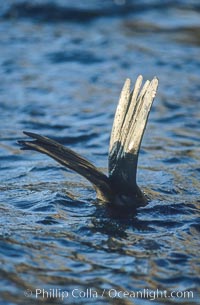
Adopting head-down resting posture in water, perhaps thermoregulating as well, Guadalupe fur seal thermoregulating, hind flippers elevated, Arctocephalus townsendi, Guadalupe Island (Isla Guadalupe), Image 02357 |
| (Following is an excerpt from Guadalupe's Regal Fur Seal by Phillip Colla and Harrison 'Skip' Stubbs, Ph.D., appearing in the Summer 1998 edition of Ocean Realm magazine. Please respect the copyright.) |
| The recent history of Arctocephalus townsendi is both a sobering account of wanton killing and greed and an encouraging tale of resilience and recovery. Although it once numbered perhaps 200,000 across its 1500 mile range -- from the Revilligigedos and the Baja peninsula to California's Channel Islands -- the Guadalupe fur seal nearly passed into oblivion before being recognized by science. At one time, Guadalupe Island alone was home to probably 30,000 fur seals, so many that its western shore has long tracts of waterline lava rocks polished smooth by centuries of hauling-out fur seals. With the onset of North Pacific whaling in the late 1700's, the seals' beautiful fur pelts -- black outer fur over an underfur so dense that the seal's skin remains dry -- became liabilities, and the seals were taken in vast numbers by Russian and Aleut hunters to adorn Chinese royalty and Parisian society. Scammon wrote of Cedros Island, near the Pacific coast of Baja California, that its 'surrounding shores teemed with sealers, seal elephant and sea-otter hunters.' The greatest numbers of Guadalupe fur seals were taken before 1820, and by 1883 the seal was considered 'commercially extinct.' In 1894 sealers located a group of 15 fur seals at Guadalupe Island -- all that were known to exist -- and killed every one. Three years later, four weathered and broken skulls collected from the ruins of a once busy Guadalupe Island sealing station provided the description for a species 'new to science,' but by then the Guadalupe fur seal was assumed to be gone forever. (continued...) |
See also:
Galapagos Fur Seals Northern Fur Seals Pinniped Behaviors |
| Keywords: Guadalupe, fur, seal, Guadalupe fur seal, fur seal, photograph, photography, Arctocephalus townsendi, underwater, endangered, photo |
HOME |
Online Image Search |
Photo of the Day |
Keywords |
Contact / Bio |
Licensing/Pricing |
Prints |
Stock List |
Image Hierarchy |
List of Log Entries |
Site Map |
Blue Whale |
Cetaceans |
Pinnipeds |
Sharks |
Rays |
Fishes |
Kelp Forest |
Sea Birds |
Inverts |
Man & Animal |
Man & Ocean |
Ocean & Light |
Ocean & Motion |
Portraits |
About Color and Monitor Calibration |
Copyright Statement |
Buzz |
Surf Photos |
Great White Shark Photo |
Blue Whale Photo |
All text and photographs copyright © Phillip Colla Natural History Photography
All rights reserved worldwide. The content of this site is made available for purposes of researching images offered for license by Phillip Colla Natural History Photography. No image is to be copied, duplicated, modified or redistributed in whole or part without the prior written permission of Phillip Colla Natural History Photography. Phillip Colla Natural History Photography,
7302 Azalea Place, Carlsbad, CA 92011, USA. (760) 804-0731.
Email: oceanlight@OceanLight.com Web: www.OceanLight.com
Portfolios: www.Gygis.com
Updated: November 21, 2009 |
|