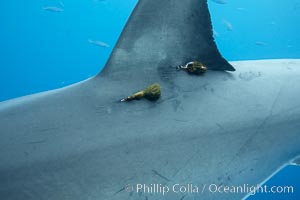
Two satellite tags, below dorsal fin of great white shark. The tags record the sharks movements, relaying data to researchers via satellite.
Species: Great white shark, Carcharodon carcharias
Location: Guadalupe Island (Isla Guadalupe), Baja California, Mexico
Image ID: 21391
Species: Great white shark, Carcharodon carcharias
Location: Guadalupe Island (Isla Guadalupe), Baja California, Mexico
Image ID: 21391
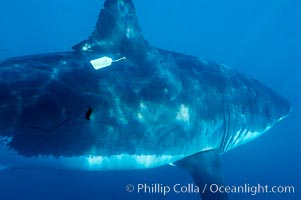
A great white shark bearing a white plastic researcher's identification ID tag near its dorsal fin swims through the clear waters of Isla Guadalupe, far offshore of the Pacific Coast of Baja California. Guadalupe Island is host to a concentration of large great white sharks, which visit the island to feed on pinnipeds and tuna.
Species: Great white shark, Carcharodon carcharias
Location: Guadalupe Island (Isla Guadalupe), Baja California, Mexico
Image ID: 07739
Species: Great white shark, Carcharodon carcharias
Location: Guadalupe Island (Isla Guadalupe), Baja California, Mexico
Image ID: 07739
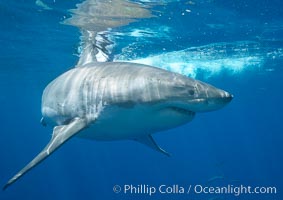
A great white shark is countershaded, with a dark gray dorsal color and light gray to white underside, making it more difficult for the shark's prey to see it as approaches from above or below in the water column. The particular undulations of the countershading line along its side, where gray meets white, is unique to each shark and helps researchers to identify individual sharks in capture-recapture studies. Guadalupe Island is host to a relatively large population of great white sharks who, through a history of video and photographs showing their countershading lines, are the subject of an ongoing study of shark behaviour, migration and population size.
Species: Great white shark, Carcharodon carcharias
Location: Guadalupe Island (Isla Guadalupe), Baja California, Mexico
Image ID: 19468
Species: Great white shark, Carcharodon carcharias
Location: Guadalupe Island (Isla Guadalupe), Baja California, Mexico
Image ID: 19468
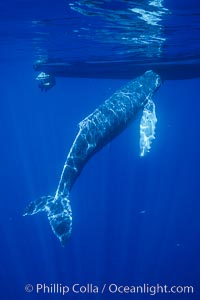
Humpback whale, abandoned calf alongside University of Hawaii research boat. This young calf lived only a few days after being abandoned or separated from its mother, and was eventually attacked by tiger sharks.
Species: Humpback whale, Megaptera novaeangliae
Location: Maui, Hawaii
Image ID: 05979
Species: Humpback whale, Megaptera novaeangliae
Location: Maui, Hawaii
Image ID: 05979
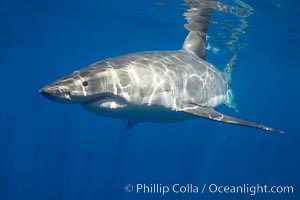
A great white shark is countershaded, with a dark gray dorsal color and light gray to white underside, making it more difficult for the shark's prey to see it as approaches from above or below in the water column. The particular undulations of the countershading line along its side, where gray meets white, is unique to each shark and helps researchers to identify individual sharks in capture-recapture studies. Guadalupe Island is host to a relatively large population of great white sharks who, through a history of video and photographs showing their countershading lines, are the subject of an ongoing study of shark behaviour, migration and population size.
Species: Great white shark, Carcharodon carcharias
Location: Guadalupe Island (Isla Guadalupe), Baja California, Mexico
Image ID: 19455
Species: Great white shark, Carcharodon carcharias
Location: Guadalupe Island (Isla Guadalupe), Baja California, Mexico
Image ID: 19455
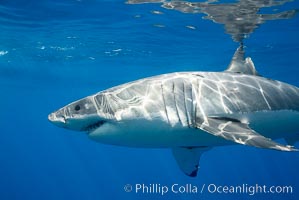
A great white shark is countershaded, with a dark gray dorsal color and light gray to white underside, making it more difficult for the shark's prey to see it as approaches from above or below in the water column. The particular undulations of the countershading line along its side, where gray meets white, is unique to each shark and helps researchers to identify individual sharks in capture-recapture studies. Guadalupe Island is host to a relatively large population of great white sharks who, through a history of video and photographs showing their countershading lines, are the subject of an ongoing study of shark behaviour, migration and population size.
Species: Great white shark, Carcharodon carcharias
Location: Guadalupe Island (Isla Guadalupe), Baja California, Mexico
Image ID: 19456
Species: Great white shark, Carcharodon carcharias
Location: Guadalupe Island (Isla Guadalupe), Baja California, Mexico
Image ID: 19456
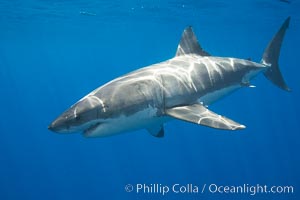
A great white shark is countershaded, with a dark gray dorsal color and light gray to white underside, making it more difficult for the shark's prey to see it as approaches from above or below in the water column. The particular undulations of the countershading line along its side, where gray meets white, is unique to each shark and helps researchers to identify individual sharks in capture-recapture studies. Guadalupe Island is host to a relatively large population of great white sharks who, through a history of video and photographs showing their countershading lines, are the subject of an ongoing study of shark behaviour, migration and population size.
Species: Great white shark, Carcharodon carcharias
Location: Guadalupe Island (Isla Guadalupe), Baja California, Mexico
Image ID: 19458
Species: Great white shark, Carcharodon carcharias
Location: Guadalupe Island (Isla Guadalupe), Baja California, Mexico
Image ID: 19458
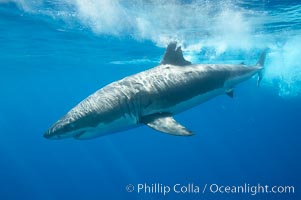
A great white shark is countershaded, with a dark gray dorsal color and light gray to white underside, making it more difficult for the shark's prey to see it as approaches from above or below in the water column. The particular undulations of the countershading line along its side, where gray meets white, is unique to each shark and helps researchers to identify individual sharks in capture-recapture studies. Guadalupe Island is host to a relatively large population of great white sharks who, through a history of video and photographs showing their countershading lines, are the subject of an ongoing study of shark behaviour, migration and population size.
Species: Great white shark, Carcharodon carcharias
Location: Guadalupe Island (Isla Guadalupe), Baja California, Mexico
Image ID: 19459
Species: Great white shark, Carcharodon carcharias
Location: Guadalupe Island (Isla Guadalupe), Baja California, Mexico
Image ID: 19459
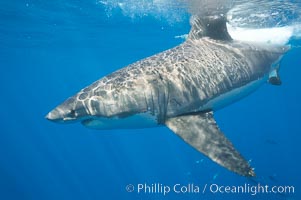
A great white shark is countershaded, with a dark gray dorsal color and light gray to white underside, making it more difficult for the shark's prey to see it as approaches from above or below in the water column. The particular undulations of the countershading line along its side, where gray meets white, is unique to each shark and helps researchers to identify individual sharks in capture-recapture studies. Guadalupe Island is host to a relatively large population of great white sharks who, through a history of video and photographs showing their countershading lines, are the subject of an ongoing study of shark behaviour, migration and population size.
Species: Great white shark, Carcharodon carcharias
Location: Guadalupe Island (Isla Guadalupe), Baja California, Mexico
Image ID: 19460
Species: Great white shark, Carcharodon carcharias
Location: Guadalupe Island (Isla Guadalupe), Baja California, Mexico
Image ID: 19460
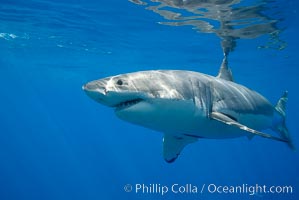
A great white shark is countershaded, with a dark gray dorsal color and light gray to white underside, making it more difficult for the shark's prey to see it as approaches from above or below in the water column. The particular undulations of the countershading line along its side, where gray meets white, is unique to each shark and helps researchers to identify individual sharks in capture-recapture studies. Guadalupe Island is host to a relatively large population of great white sharks who, through a history of video and photographs showing their countershading lines, are the subject of an ongoing study of shark behaviour, migration and population size.
Species: Great white shark, Carcharodon carcharias
Location: Guadalupe Island (Isla Guadalupe), Baja California, Mexico
Image ID: 19463
Species: Great white shark, Carcharodon carcharias
Location: Guadalupe Island (Isla Guadalupe), Baja California, Mexico
Image ID: 19463
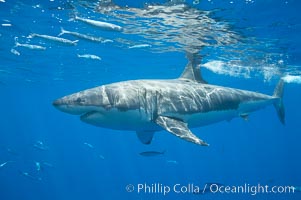
A great white shark is countershaded, with a dark gray dorsal color and light gray to white underside, making it more difficult for the shark's prey to see it as approaches from above or below in the water column. The particular undulations of the countershading line along its side, where gray meets white, is unique to each shark and helps researchers to identify individual sharks in capture-recapture studies. Guadalupe Island is host to a relatively large population of great white sharks who, through a history of video and photographs showing their countershading lines, are the subject of an ongoing study of shark behaviour, migration and population size.
Species: Great white shark, Carcharodon carcharias
Location: Guadalupe Island (Isla Guadalupe), Baja California, Mexico
Image ID: 19464
Species: Great white shark, Carcharodon carcharias
Location: Guadalupe Island (Isla Guadalupe), Baja California, Mexico
Image ID: 19464
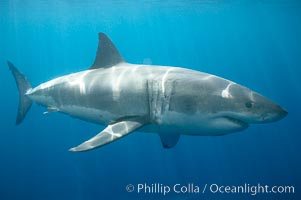
A great white shark is countershaded, with a dark gray dorsal color and light gray to white underside, making it more difficult for the shark's prey to see it as approaches from above or below in the water column. The particular undulations of the countershading line along its side, where gray meets white, is unique to each shark and helps researchers to identify individual sharks in capture-recapture studies. Guadalupe Island is host to a relatively large population of great white sharks who, through a history of video and photographs showing their countershading lines, are the subject of an ongoing study of shark behaviour, migration and population size.
Species: Great white shark, Carcharodon carcharias
Location: Guadalupe Island (Isla Guadalupe), Baja California, Mexico
Image ID: 19467
Species: Great white shark, Carcharodon carcharias
Location: Guadalupe Island (Isla Guadalupe), Baja California, Mexico
Image ID: 19467
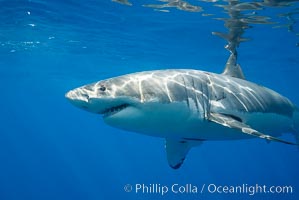
A great white shark is countershaded, with a dark gray dorsal color and light gray to white underside, making it more difficult for the shark's prey to see it as approaches from above or below in the water column. The particular undulations of the countershading line along its side, where gray meets white, is unique to each shark and helps researchers to identify individual sharks in capture-recapture studies. Guadalupe Island is host to a relatively large population of great white sharks who, through a history of video and photographs showing their countershading lines, are the subject of an ongoing study of shark behaviour, migration and population size.
Species: Great white shark, Carcharodon carcharias
Location: Guadalupe Island (Isla Guadalupe), Baja California, Mexico
Image ID: 19471
Species: Great white shark, Carcharodon carcharias
Location: Guadalupe Island (Isla Guadalupe), Baja California, Mexico
Image ID: 19471
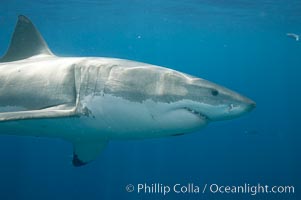
A great white shark is countershaded, with a dark gray dorsal color and light gray to white underside, making it more difficult for the shark's prey to see it as approaches from above or below in the water column. The particular undulations of the countershading line along its side, where gray meets white, is unique to each shark and helps researchers to identify individual sharks in capture-recapture studies. Guadalupe Island is host to a relatively large population of great white sharks who, through a history of video and photographs showing their countershading lines, are the subject of an ongoing study of shark behaviour, migration and population size.
Species: Great white shark, Carcharodon carcharias
Location: Guadalupe Island (Isla Guadalupe), Baja California, Mexico
Image ID: 19474
Species: Great white shark, Carcharodon carcharias
Location: Guadalupe Island (Isla Guadalupe), Baja California, Mexico
Image ID: 19474
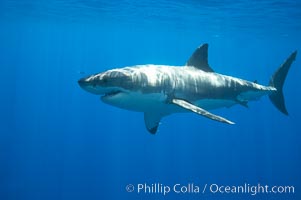
A great white shark is countershaded, with a dark gray dorsal color and light gray to white underside, making it more difficult for the shark's prey to see it as approaches from above or below in the water column. The particular undulations of the countershading line along its side, where gray meets white, is unique to each shark and helps researchers to identify individual sharks in capture-recapture studies. Guadalupe Island is host to a relatively large population of great white sharks who, through a history of video and photographs showing their countershading lines, are the subject of an ongoing study of shark behaviour, migration and population size.
Species: Great white shark, Carcharodon carcharias
Location: Guadalupe Island (Isla Guadalupe), Baja California, Mexico
Image ID: 19481
Species: Great white shark, Carcharodon carcharias
Location: Guadalupe Island (Isla Guadalupe), Baja California, Mexico
Image ID: 19481
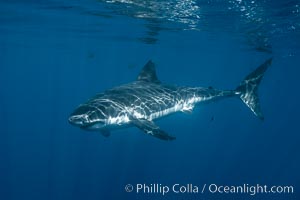
Great white shark, research identification photograph. A great white shark is countershaded, with a dark gray dorsal color and light gray to white underside, making it more difficult for the shark's prey to see it as approaches from above or below in the water column. The particular undulations of the countershading line along its side, where gray meets white, is unique to each shark and helps researchers to identify individual sharks in capture-recapture studies. Guadalupe Island is host to a relatively large population of great white sharks who, through a history of video and photographs showing their countershading lines, are the subject of an ongoing study of shark behaviour, migration and population size.
Species: Great white shark, Carcharodon carcharias
Location: Guadalupe Island (Isla Guadalupe), Baja California, Mexico
Image ID: 28768
Species: Great white shark, Carcharodon carcharias
Location: Guadalupe Island (Isla Guadalupe), Baja California, Mexico
Image ID: 28768
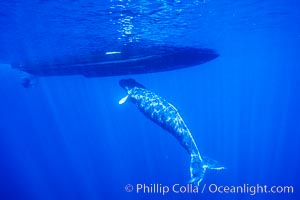
Humpback whale, abandoned calf alongside Hawaii Whale Research Foundation research boat. This young calf lived only a few days after being abandoned or separated from its mother, and was eventually attacked by tiger sharks.
Species: Humpback whale, Megaptera novaeangliae
Location: Maui, Hawaii
Image ID: 05983
Species: Humpback whale, Megaptera novaeangliae
Location: Maui, Hawaii
Image ID: 05983
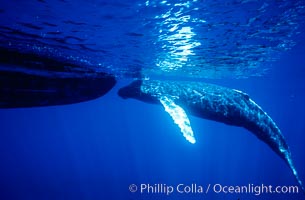
Humpback whale, abandoned calf alongside Hawaii Whale Research Foundation research boat. This young calf lived only a few days after being abandoned or separated from its mother, and was eventually attacked by tiger sharks.
Species: Humpback whale, Megaptera novaeangliae
Location: Maui, Hawaii
Image ID: 05987
Species: Humpback whale, Megaptera novaeangliae
Location: Maui, Hawaii
Image ID: 05987
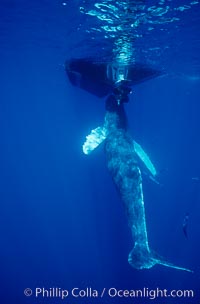
Humpback whale, abandoned calf alongside Hawaii Whale Research Foundation research boat. This young calf lived only a few days after being abandoned or separated from its mother, and was eventually attacked by tiger sharks.
Species: Humpback whale, Megaptera novaeangliae
Location: Maui, Hawaii
Image ID: 05992
Species: Humpback whale, Megaptera novaeangliae
Location: Maui, Hawaii
Image ID: 05992
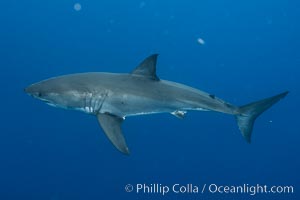
Great white shark, research identification photograph. A great white shark is countershaded, with a dark gray dorsal color and light gray to white underside, making it more difficult for the shark's prey to see it as approaches from above or below in the water column. The particular undulations of the countershading line along its side, where gray meets white, is unique to each shark and helps researchers to identify individual sharks in capture-recapture studies. Guadalupe Island is host to a relatively large population of great white sharks who, through a history of video and photographs showing their countershading lines, are the subject of an ongoing study of shark behaviour, migration and population size.
Species: Great white shark, Carcharodon carcharias
Location: Guadalupe Island (Isla Guadalupe), Baja California, Mexico
Image ID: 28761
Species: Great white shark, Carcharodon carcharias
Location: Guadalupe Island (Isla Guadalupe), Baja California, Mexico
Image ID: 28761
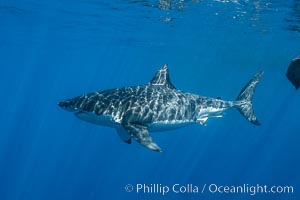
Great white shark, research identification photograph. A great white shark is countershaded, with a dark gray dorsal color and light gray to white underside, making it more difficult for the shark's prey to see it as approaches from above or below in the water column. The particular undulations of the countershading line along its side, where gray meets white, is unique to each shark and helps researchers to identify individual sharks in capture-recapture studies. Guadalupe Island is host to a relatively large population of great white sharks who, through a history of video and photographs showing their countershading lines, are the subject of an ongoing study of shark behaviour, migration and population size.
Species: Great white shark, Carcharodon carcharias
Location: Guadalupe Island (Isla Guadalupe), Baja California, Mexico
Image ID: 28762
Species: Great white shark, Carcharodon carcharias
Location: Guadalupe Island (Isla Guadalupe), Baja California, Mexico
Image ID: 28762
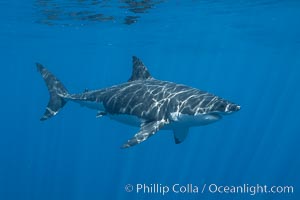
Great white shark, research identification photograph. A great white shark is countershaded, with a dark gray dorsal color and light gray to white underside, making it more difficult for the shark's prey to see it as approaches from above or below in the water column. The particular undulations of the countershading line along its side, where gray meets white, is unique to each shark and helps researchers to identify individual sharks in capture-recapture studies. Guadalupe Island is host to a relatively large population of great white sharks who, through a history of video and photographs showing their countershading lines, are the subject of an ongoing study of shark behaviour, migration and population size.
Species: Great white shark, Carcharodon carcharias
Location: Guadalupe Island (Isla Guadalupe), Baja California, Mexico
Image ID: 28763
Species: Great white shark, Carcharodon carcharias
Location: Guadalupe Island (Isla Guadalupe), Baja California, Mexico
Image ID: 28763
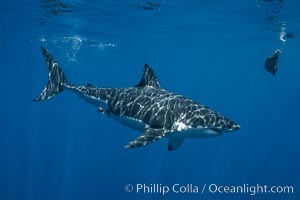
Great white shark, research identification photograph. A great white shark is countershaded, with a dark gray dorsal color and light gray to white underside, making it more difficult for the shark's prey to see it as approaches from above or below in the water column. The particular undulations of the countershading line along its side, where gray meets white, is unique to each shark and helps researchers to identify individual sharks in capture-recapture studies. Guadalupe Island is host to a relatively large population of great white sharks who, through a history of video and photographs showing their countershading lines, are the subject of an ongoing study of shark behaviour, migration and population size.
Species: Great white shark, Carcharodon carcharias
Location: Guadalupe Island (Isla Guadalupe), Baja California, Mexico
Image ID: 28764
Species: Great white shark, Carcharodon carcharias
Location: Guadalupe Island (Isla Guadalupe), Baja California, Mexico
Image ID: 28764
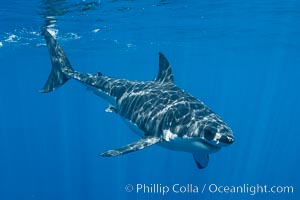
Great white shark, research identification photograph. A great white shark is countershaded, with a dark gray dorsal color and light gray to white underside, making it more difficult for the shark's prey to see it as approaches from above or below in the water column. The particular undulations of the countershading line along its side, where gray meets white, is unique to each shark and helps researchers to identify individual sharks in capture-recapture studies. Guadalupe Island is host to a relatively large population of great white sharks who, through a history of video and photographs showing their countershading lines, are the subject of an ongoing study of shark behaviour, migration and population size.
Species: Great white shark, Carcharodon carcharias
Location: Guadalupe Island (Isla Guadalupe), Baja California, Mexico
Image ID: 28765
Species: Great white shark, Carcharodon carcharias
Location: Guadalupe Island (Isla Guadalupe), Baja California, Mexico
Image ID: 28765
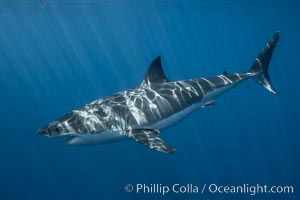
Great white shark, research identification photograph. A great white shark is countershaded, with a dark gray dorsal color and light gray to white underside, making it more difficult for the shark's prey to see it as approaches from above or below in the water column. The particular undulations of the countershading line along its side, where gray meets white, is unique to each shark and helps researchers to identify individual sharks in capture-recapture studies. Guadalupe Island is host to a relatively large population of great white sharks who, through a history of video and photographs showing their countershading lines, are the subject of an ongoing study of shark behaviour, migration and population size.
Species: Great white shark, Carcharodon carcharias
Location: Guadalupe Island (Isla Guadalupe), Baja California, Mexico
Image ID: 28766
Species: Great white shark, Carcharodon carcharias
Location: Guadalupe Island (Isla Guadalupe), Baja California, Mexico
Image ID: 28766
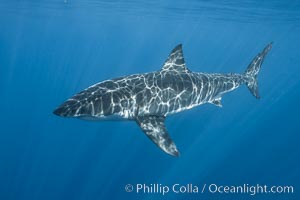
Great white shark, research identification photograph. A great white shark is countershaded, with a dark gray dorsal color and light gray to white underside, making it more difficult for the shark's prey to see it as approaches from above or below in the water column. The particular undulations of the countershading line along its side, where gray meets white, is unique to each shark and helps researchers to identify individual sharks in capture-recapture studies. Guadalupe Island is host to a relatively large population of great white sharks who, through a history of video and photographs showing their countershading lines, are the subject of an ongoing study of shark behaviour, migration and population size.
Species: Great white shark, Carcharodon carcharias
Location: Guadalupe Island (Isla Guadalupe), Baja California, Mexico
Image ID: 28767
Species: Great white shark, Carcharodon carcharias
Location: Guadalupe Island (Isla Guadalupe), Baja California, Mexico
Image ID: 28767
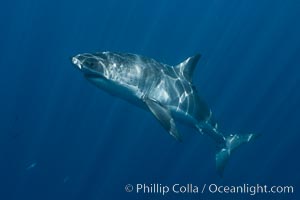
Great white shark, research identification photograph. A great white shark is countershaded, with a dark gray dorsal color and light gray to white underside, making it more difficult for the shark's prey to see it as approaches from above or below in the water column. The particular undulations of the countershading line along its side, where gray meets white, is unique to each shark and helps researchers to identify individual sharks in capture-recapture studies. Guadalupe Island is host to a relatively large population of great white sharks who, through a history of video and photographs showing their countershading lines, are the subject of an ongoing study of shark behaviour, migration and population size.
Species: Great white shark, Carcharodon carcharias
Location: Guadalupe Island (Isla Guadalupe), Baja California, Mexico
Image ID: 28769
Species: Great white shark, Carcharodon carcharias
Location: Guadalupe Island (Isla Guadalupe), Baja California, Mexico
Image ID: 28769
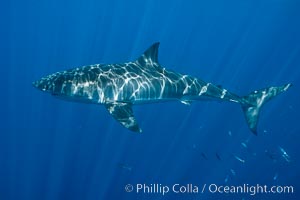
Great white shark, research identification photograph. A great white shark is countershaded, with a dark gray dorsal color and light gray to white underside, making it more difficult for the shark's prey to see it as approaches from above or below in the water column. The particular undulations of the countershading line along its side, where gray meets white, is unique to each shark and helps researchers to identify individual sharks in capture-recapture studies. Guadalupe Island is host to a relatively large population of great white sharks who, through a history of video and photographs showing their countershading lines, are the subject of an ongoing study of shark behaviour, migration and population size.
Species: Great white shark, Carcharodon carcharias
Location: Guadalupe Island (Isla Guadalupe), Baja California, Mexico
Image ID: 28770
Species: Great white shark, Carcharodon carcharias
Location: Guadalupe Island (Isla Guadalupe), Baja California, Mexico
Image ID: 28770

Permit wristband issued by Mexican environmental agencies to shark divers to support research, conservation and protection of Isla Guadalupe Special Biosphere Reserve.
Location: Guadalupe Island (Isla Guadalupe), Baja California, Mexico
Image ID: 19488
Location: Guadalupe Island (Isla Guadalupe), Baja California, Mexico
Image ID: 19488
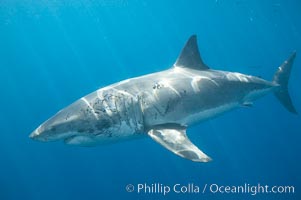
A great white shark shows scarring on the left side of its body, almost certainly the result of bites from another white shark. Certain formidable prey, such as huge elephant seals who have claws and large jaws, can also inflict injuries on the shark during the course of an attack. Such injuries, especially to the eyes or gills, could be fatal to the shark. In this case the shark has survived its injuries and the resulting scars are helping researchers identify this shark.
Species: Great white shark, Carcharodon carcharias
Location: Guadalupe Island (Isla Guadalupe), Baja California, Mexico
Image ID: 19482
Species: Great white shark, Carcharodon carcharias
Location: Guadalupe Island (Isla Guadalupe), Baja California, Mexico
Image ID: 19482