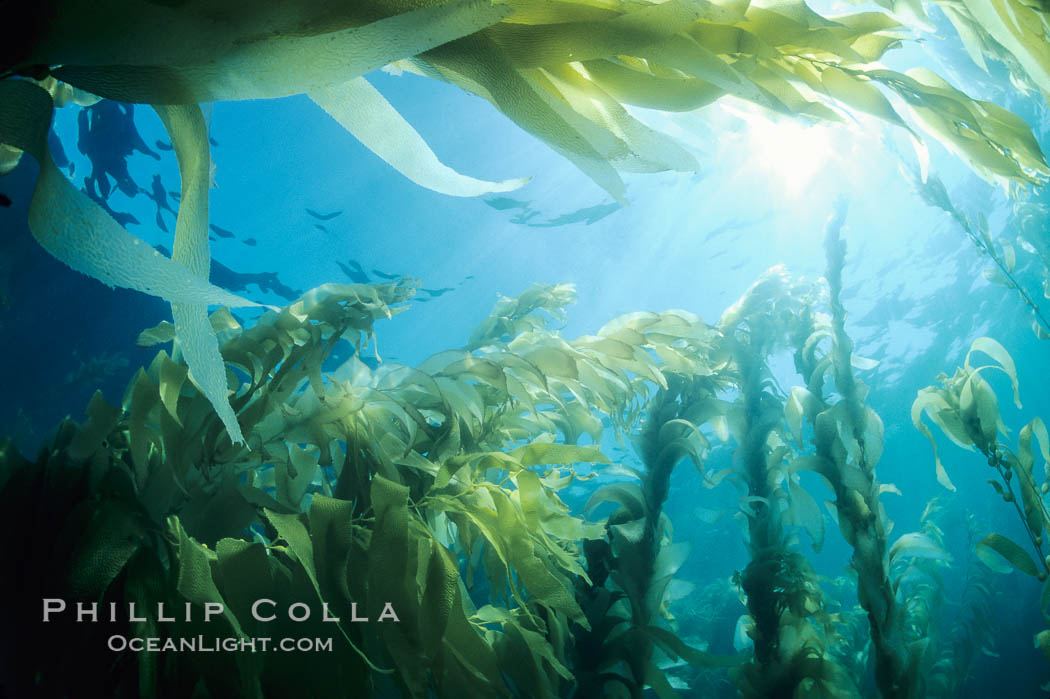
A kelp forest, with sunbeams passing through kelp fronds. Giant kelp, the fastest growing plant on Earth, reaches from the rocky bottom to the ocean's surface like a submarine forest.
Species: Giant Kelp, Macrocystis pyrifera
Location: San Clemente Island, California
Image ID: 02411
Lat/Long: 32.89001, -118.52625 (Coordinates: 32° 53' 24.04" N, 118° 31' 34.50" W)
Format: Film 3:2
Species: Giant Kelp, Macrocystis pyrifera
Location: San Clemente Island, California
Image ID: 02411
Lat/Long: 32.89001, -118.52625 (Coordinates: 32° 53' 24.04" N, 118° 31' 34.50" W)
Format: Film 3:2
Keywords: algae, braendeltang, california, channel islands, environment, forest, gedroogde kelp, giant kelp, habitat, harina de kelp, harina de la macroalga, kelp, kelp forest, landscape, macroalga marina, macrocystis, macrocystis pyrifera, marine, marine algae, marine plant, nature, ocean, oceans, outdoors, outside, pacific, pacific ocean, phaeophyceae, plant, portfolio, reuzenkelp, san clemente island, sargazo gigante, scene, scenery, scenic, sea, sea grass, sea weed, seascape, seaweed, underwater, underwater landscape, usa, zeewier
Categories:
- Gallery > California
- Gallery > Icon
- Gallery > Kelp Forest
- Gallery > Landscape
- Gallery > San Clemente Island
- Location > Oceans > Pacific > California (USA) / Baja California (Mexico) > Channel Islands > San Clemente Island
- Location > USA > California > San Clemente Island
- Natural World > Habitat > Kelp Forest
- Plant > Marine Plant > Giant Kelp
- Portfolio
- Subject > Technique > Underwater
Copyright © Phillip Colla / Oceanlight.com, all rights reserved worldwide.
This professional quality stock photo can be licensed in high resolution form by contacting the photographer: Phillip Colla, photos@oceanlight.com, (760) 707-7153, more info and photographer bio.