Home
Contact / Bio
Search For Images
Buzz
Stocklist & Subjects
Archival Prints
Whales & Dolphins
Seals & Sea Lions
Land Mammals
Manatees
Sharks & Rays
Fishes
Kelp Forest
Marine Inverts
Sea Birds
Photo Essays
Places
Video
For Students
Downloads
About Color
Site Map

Search Options    Stock List

Ocean Sunfish Photographs

Mola mola photos, Ocean sunfish photo, Ocean sunfish video
Display all related images of Mola mola    Show full image data
See also:     Ocean Sunfish Portfolio    Ocean Sunfish Video

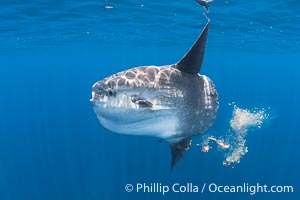
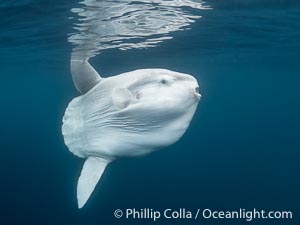
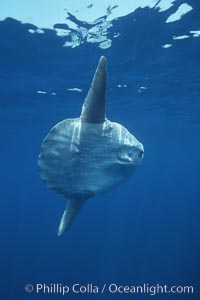
The ocean sunfish (Mola mola) is the world’s largest known bony fish (sharks and rays are cartilaginous, not bony). At least one estimate over 3000 lb. has been recorded and individuals reaching 11 ft. (3 m.) from fin tip to fin tip have been seen. It is found in all oceans in tropical and temperate climes, and is known to eat gelatinous zooplankton (jellyfish) and probably small fishes and algae. In the eastern Pacific, Mola mola is normally found from British Columbia to South America, although in El Nino events it has been recorded as far north as Alaska.
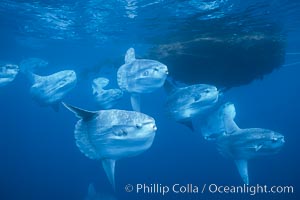
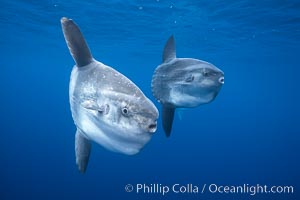
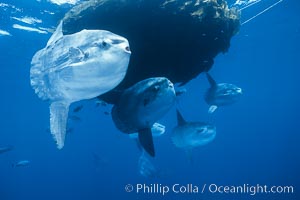
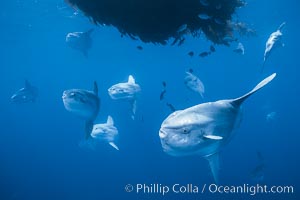
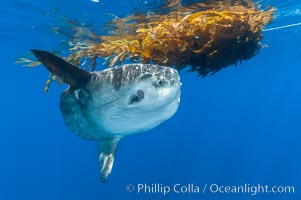
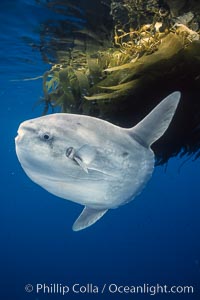
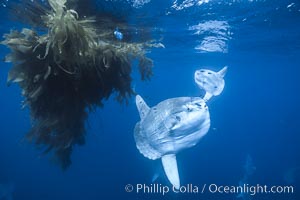
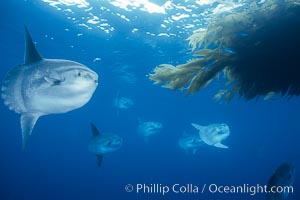
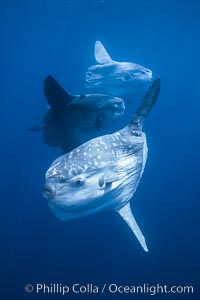
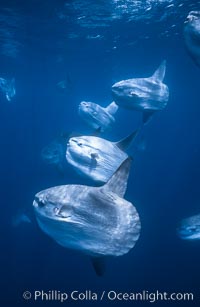
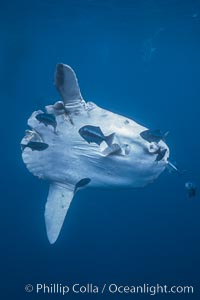
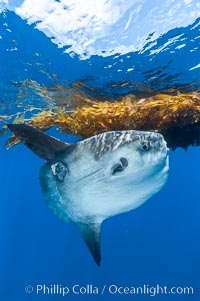
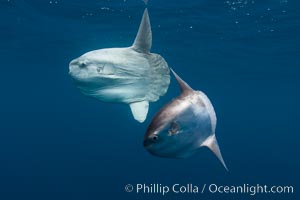
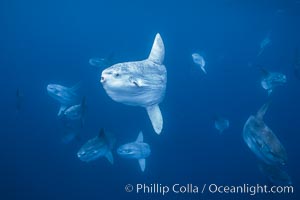
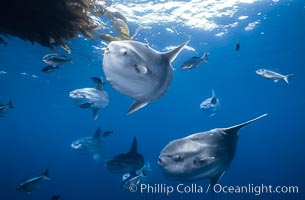
Ocean sunfish schooling near drift kelp, soliciting cleaner fishes, open ocean, Baja California., Mola mola, copyright Phillip Colla Natural History Photography, www.oceanlight.com, image #06308, all rights reserved worldwide. Ocean sunfish schooling near drift kelp, soliciting cleaner fishes, open ocean, Baja California., Mola mola, copyright Phillip Colla Natural History Photography, www.oceanlight.com, image #06304, all rights reserved worldwide. Ocean sunfish schooling, open ocean near San Diego., Mola mola, copyright Phillip Colla Natural History Photography, www.oceanlight.com, image #03562, all rights reserved worldwide.
Do molas gather and socialize? It appears so. 2002 presented us with many large schools of molas, gathered to be cleaned and ???.
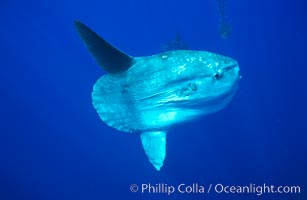
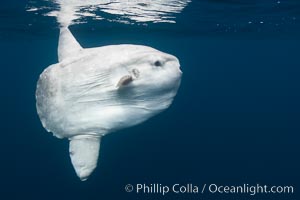
Ocean sunfish, open ocean., Mola mola, copyright Phillip Colla Natural History Photography, www.oceanlight.com, image #03316, all rights reserved worldwide.
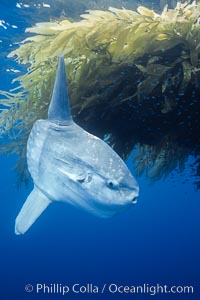
Long dorsal and anal fins are the mola’s principal source of locomotion -- they are flapped from side to side. The caudal fin of the ocean sunfish is quite short and acts like a rudder.
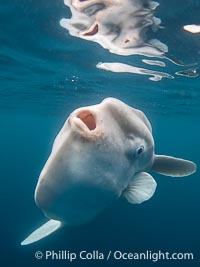
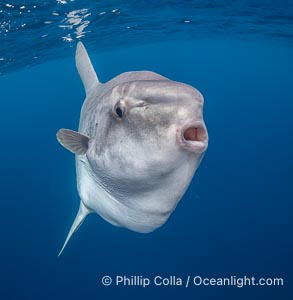
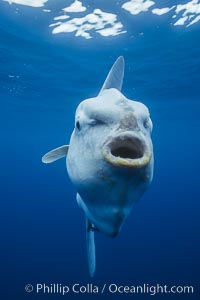
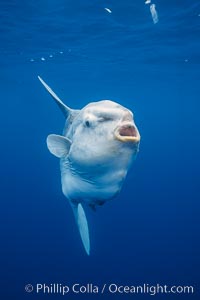
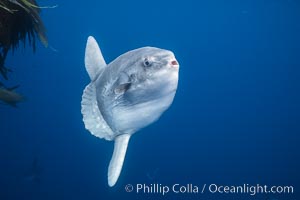
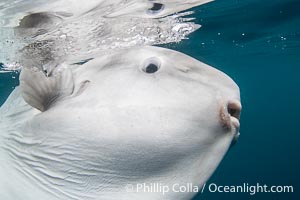
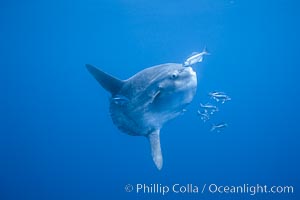
Ocean sunfish recruiting fish near drift kelp to clean parasites, open ocean, Baja California., Mola mola, copyright Phillip Colla Natural History Photography, www.oceanlight.com, image #03267, all rights reserved worldwide. Ocean sunfish, halfmoon perch removing its parasites, open ocean., Mola mola, Medialuna californiensis, copyright Phillip Colla Natural History Photography, www.oceanlight.com, image #03168, all rights reserved worldwide. Ocean sunfish with mouth for slurping zooplankton, open ocean., Mola mola, copyright Phillip Colla Natural History Photography, www.oceanlight.com, image #03319, all rights reserved worldwide.
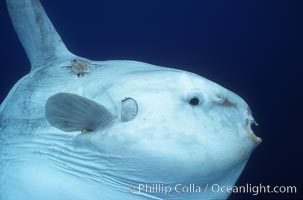
Molas are often covered with small parasites, and will approach drift kelp and other flotsam to recruit small fish (which hide in and below the kelp) to remove these parasites. The business end of a mola: a mouth well suited for slurping gelatinous zooplankton, a principal food source for molas.
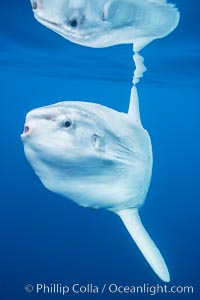
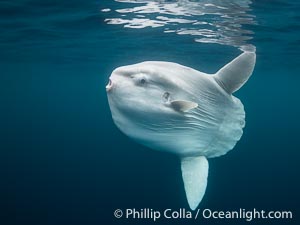
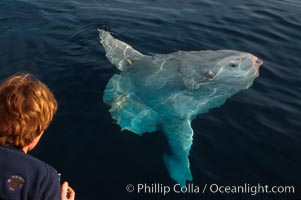
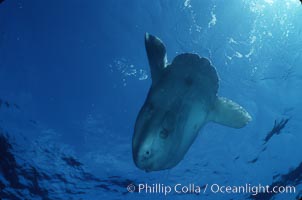
Ocean sunfish., Mola mola, copyright Phillip Colla Natural History Photography, www.oceanlight.com, image #02028, all rights reserved worldwide. Ocean sunfish., Mola mola, copyright Phillip Colla Natural History Photography, www.oceanlight.com, image #02030, all rights reserved worldwide. Ocean sunfish sunning at surface, viewed from below, open ocean, Baja California., Mola mola, copyright Phillip Colla Natural History Photography, www.oceanlight.com, image #03269, all rights reserved worldwide.
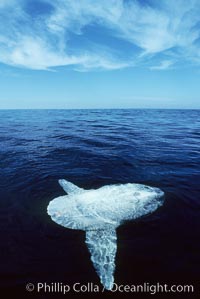
Molas are often seen basking flat on the ocean surface, nearly motionless. This may be a thermoregulation behavior; it is not necessarily a indication that the mola is sick or injured as has been reported elsewhere.
click for video click for video click for video
Ocean Sunfish / Mola mola Video! Click on any of the above three images to open a new window and view a video clip of the enormous, amazing, strange ocean sunfish. Also available are dozens of video clips of ocean sunfish available for license.
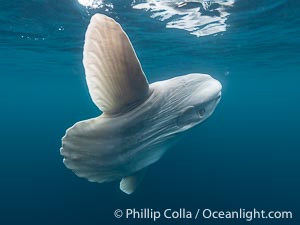
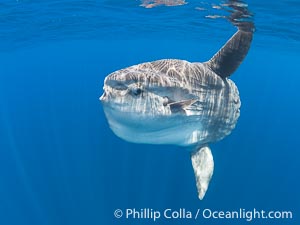
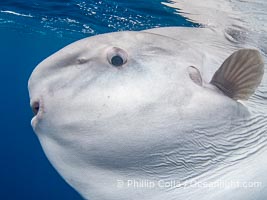
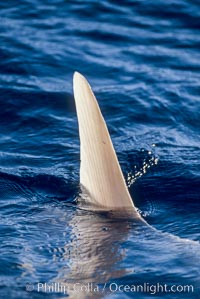
Ocean sunfish, open ocean., Mola mola, copyright Phillip Colla Natural History Photography, www.oceanlight.com, image #03318, all rights reserved worldwide. Ocean sunfish, dorsal fin at water surface, open ocean., Mola mola, copyright Phillip Colla Natural History Photography, www.oceanlight.com, image #03309, all rights reserved worldwide.
The mola’s gill slit is covered by an operculum and is positioned just in front of the small pectoral fin. Molas range in color from dark gray to white, with many variations in mottling and spots. Juvenile molas may appear “shiny”. When molas are swimming at the surface it is common for their fins to be mistaken for those of sharks.
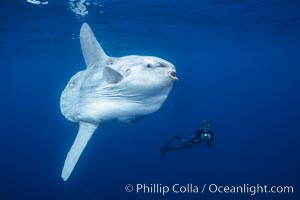
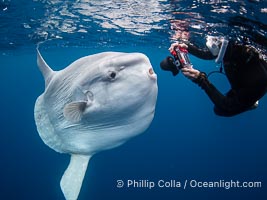
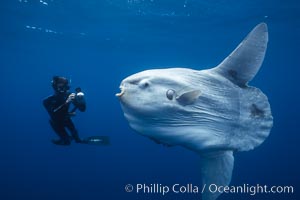
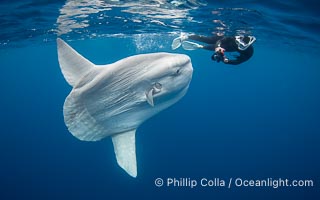
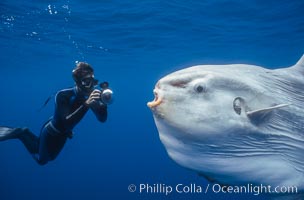
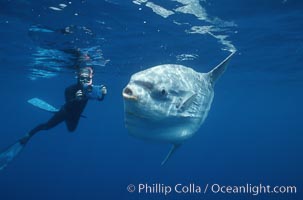
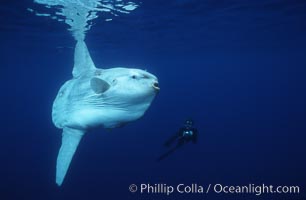
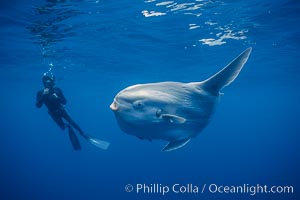
Ocean sunfish and videographer, open ocean., Mola mola, copyright Phillip Colla Natural History Photography, www.oceanlight.com, image #02057, all rights reserved worldwide. Ocean sunfish and freediving photographer, open ocean., Mola mola, copyright Phillip Colla Natural History Photography, www.oceanlight.com, image #03325, all rights reserved worldwide.
Molas can be quite inquisitive of divers.
Molas are sometimes observed breaching the ocean surface and landing with a splash, perhaps attempting to dislodge parasites. Ocean sunfish are occasionally mauled by California sea lions, especially near the Monterey Peninsula, reportedly because the sea lions eat the mola’s internal organs and perhaps just for “sport.” The nearest relative to Mola mola is Ranzania laevis, the slender mola. Found in the tropical and subtropical Pacific, Ranzania is rarely seen north of Mexico. Up to 2 feet (.6m) in size, its aspect ratio is “longer” than is the nearly circular Mola mola. Neither species of mola is to be confused with the tiny, freshwater “sunfish”, a completely different animal.
Keywords: mola, Mola mola, ocean, sunfish, ocean sunfish, sun, fish, photography, photograph, underwater
Bookmark this page

HOME | Online Image Search | Photo of the Day | Keywords | Contact / Bio | Licensing/Pricing | Prints | Stock List | Image Hierarchy | List of Log Entries | Site Map | Blue Whale | Cetaceans | Pinnipeds | Sharks | Rays | Fishes | Kelp Forest | Sea Birds | Inverts | Man & Animal | Man & Ocean | Ocean & Light | Ocean & Motion | Portraits | About Color and Monitor Calibration | Copyright Statement | Buzz | Surf Photos | Great White Shark Photo | Blue Whale Photo | All text and photographs copyright © Phillip Colla Natural History Photography   All rights reserved worldwide. The content of this site is made available for purposes of researching images offered for license by Phillip Colla Natural History Photography.  No image is to be copied, duplicated, modified or redistributed in whole or part without the prior written permission of Phillip Colla Natural History Photography.  Whale logo is a trademark of Phillip Colla Natural History Photography, 7302 Azalea Place, Carlsbad, CA 92011, USA.  (760) 804-0731.  Email: oceanlight@OceanLight.com    Web: www.OceanLight.com      Portfolios: www.Gygis.com

Updated: September 8, 2008

This epic website is created by The Scientific Programming Group