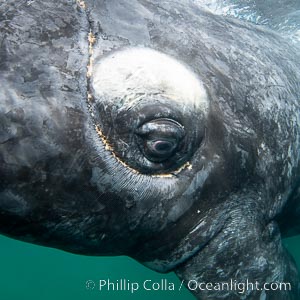
Southern right whale eyeballing the camera up close, Eubalaena australis. Whale lice can be seen clearly in the folds and crevices around the whales eye and lip groove.
Species: Southern Right Whale, Eubalaena australis
Location: Puerto Piramides, Chubut, Argentina
Image ID: 38401
Species: Southern Right Whale, Eubalaena australis
Location: Puerto Piramides, Chubut, Argentina
Image ID: 38401
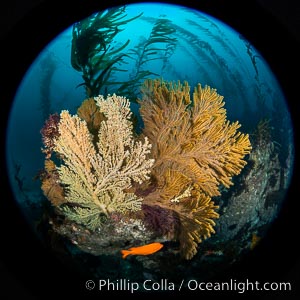
Parasitic zoanthid anemones cover, encrust and overwhelm a golden gorgonian. The gorgonian on the left has been completely parasitized by zoanthid anemones, while the gorgonian to the right remains free of zoanthids (for now). A garibaldi swims below the two sea fans. The golden gorgonian is a filter-feeding temperate colonial species that lives on the rocky bottom at depths between 50 to 200 feet deep. Each individual polyp is a distinct animal, together they secrete calcium that forms the structure of the colony. Gorgonians are oriented at right angles to prevailing water currents to capture plankton drifting by.
Species: California Golden Gorgonian, Luminescent Parazoanthid, Zoanthid Anemone, Giant Kelp, Garibaldi, Muricea californica, Parazoanthus lucificum, Savalia lucifica, Macrocystis pyrifera, Hypsypops rubicundus
Location: San Clemente Island, California
Image ID: 38493
Species: California Golden Gorgonian, Luminescent Parazoanthid, Zoanthid Anemone, Giant Kelp, Garibaldi, Muricea californica, Parazoanthus lucificum, Savalia lucifica, Macrocystis pyrifera, Hypsypops rubicundus
Location: San Clemente Island, California
Image ID: 38493
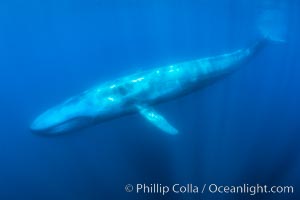
A huge blue whale swims through the open ocean in this underwater photograph. The blue whale is the largest animal ever to live on Earth.
Species: Blue whale, Balaenoptera musculus
Location: San Diego, California
Image ID: 34567
Species: Blue whale, Balaenoptera musculus
Location: San Diego, California
Image ID: 34567
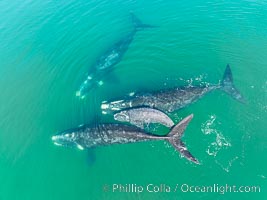
Mother and calf southern right whales are seen here as part of a larger courtship group, with adult males interested in mating with the mother. The calf has no choice but to stay by her mother's side during the courting activities.
Species: Southern Right Whale, Eubalaena australis
Location: Puerto Piramides, Chubut, Argentina
Image ID: 38381
Species: Southern Right Whale, Eubalaena australis
Location: Puerto Piramides, Chubut, Argentina
Image ID: 38381
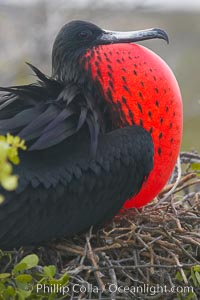
Magnificent frigatebird, adult male on nest, with throat pouch inflated, a courtship display to attract females.
Species: Magnificent frigatebird, Fregata magnificens
Location: North Seymour Island, Galapagos Islands, Ecuador
Image ID: 16725
Species: Magnificent frigatebird, Fregata magnificens
Location: North Seymour Island, Galapagos Islands, Ecuador
Image ID: 16725
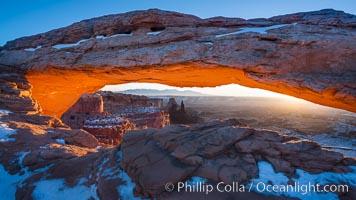
Mesa Arch spans 90 feet and stands at the edge of a mesa precipice thousands of feet above the Colorado River gorge. For a few moments at sunrise the underside of the arch glows dramatically red and orange.
Location: Island in the Sky, Canyonlands National Park, Utah
Image ID: 18040
Location: Island in the Sky, Canyonlands National Park, Utah
Image ID: 18040
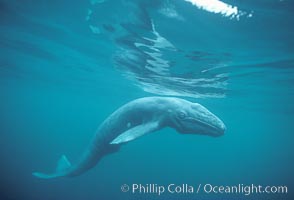
A neonate gray whale calf, born just hours before, still exhbiting embryonic folds in the skin along its side. This baby gray whale was born in the cold waters of Big Sur, far to the north of the Mexican lagoons of Baja California where most gray whale births take place.
Species: Gray whale, Eschrichtius robustus
Location: Monterey, California
Image ID: 01135
Species: Gray whale, Eschrichtius robustus
Location: Monterey, California
Image ID: 01135
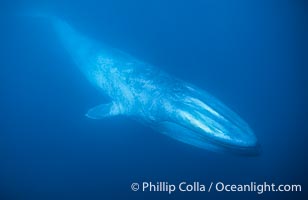
A huge blue whale swims through the open ocean in this underwater photograph. The blue whale is the largest animal ever to live on Earth.
Species: Blue whale, Balaenoptera musculus
Image ID: 03027
Species: Blue whale, Balaenoptera musculus
Image ID: 03027
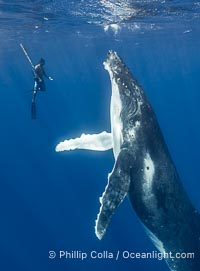
Solitary inquisitive humpback whale underwater near the island of Moorea, French Polynesia.
Species: Humpback whale, Megaptera novaeangliae
Location: Moorea, French Polynesia, France
Image ID: 41335
Species: Humpback whale, Megaptera novaeangliae
Location: Moorea, French Polynesia, France
Image ID: 41335
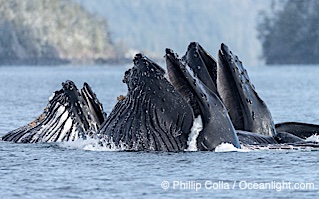
Humpback whales surface together during coordinated bubble-net feeding in Southeast Alaska. The whales use bubbles, sound, and movement to corral fish before capturing them in their open mouths.
Species: Humpback whale, Megaptera novaeangliae
Location: Sitka Sound, Alaska
Image ID: 41585
Species: Humpback whale, Megaptera novaeangliae
Location: Sitka Sound, Alaska
Image ID: 41585
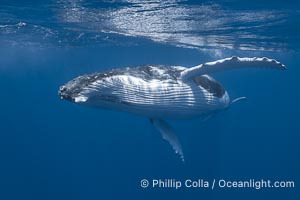
Solitary inquisitive humpback whale underwater near the island of Moorea, French Polynesia.
Species: Humpback whale, Megaptera novaeangliae
Location: Moorea, French Polynesia, France
Image ID: 41330
Species: Humpback whale, Megaptera novaeangliae
Location: Moorea, French Polynesia, France
Image ID: 41330
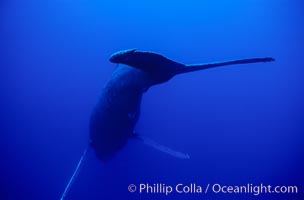
Adult male humpback whale singing, suspended motionless underwater. Only male humpbacks have been observed singing. All humpbacks in the North Pacific sing the same whale song each year, and the song changes slightly from one year to the next.
Species: Humpback whale, Megaptera novaeangliae
Location: Maui, Hawaii
Image ID: 02796
Species: Humpback whale, Megaptera novaeangliae
Location: Maui, Hawaii
Image ID: 02796
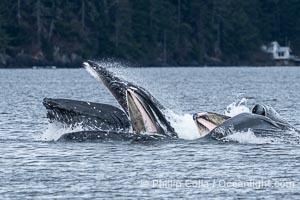
Humpback whales bubblenet feeding in Southeast Alaska. Coordinated bubble-net feeding is a specialized cooperative feeding technique used by humpback whales, where a group of whales works together to trap fish or krill in a net of bubbles then lunge through to feed.
Species: Humpback whale, Megaptera novaeangliae
Location: Sitka Sound, Alaska
Image ID: 40920
Species: Humpback whale, Megaptera novaeangliae
Location: Sitka Sound, Alaska
Image ID: 40920
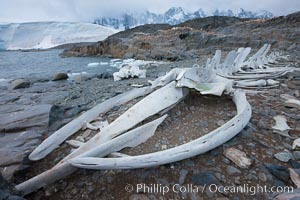
Blue whale skeleton in Antarctica, on the shore at Port Lockroy, Antarctica. This skeleton is composed primarily of blue whale bones, but there are believed to be bones of other baleen whales included in the skeleton as well.
Species: Blue whale, Balaenoptera musculus
Location: Port Lockroy, Antarctic Peninsula, Antarctica
Image ID: 25604
Species: Blue whale, Balaenoptera musculus
Location: Port Lockroy, Antarctic Peninsula, Antarctica
Image ID: 25604
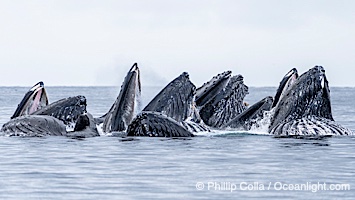
Humpback whales surface together during coordinated bubble-net feeding in Southeast Alaska. The whales use bubbles, sound, and movement to corral fish before capturing them in their open mouths.
Species: Humpback whale, Megaptera novaeangliae
Location: Sitka Sound, Alaska
Image ID: 41584
Species: Humpback whale, Megaptera novaeangliae
Location: Sitka Sound, Alaska
Image ID: 41584
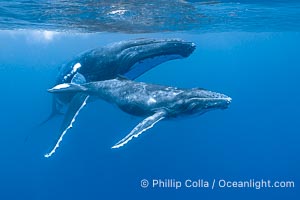
Humpback mother and calf swimming together underwater, Moorea Island, French Polynesia.
Species: Humpback whale, Megaptera novaeangliae
Location: Moorea, French Polynesia, France
Image ID: 41339
Species: Humpback whale, Megaptera novaeangliae
Location: Moorea, French Polynesia, France
Image ID: 41339
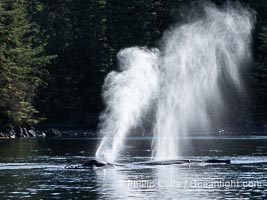
Humpback whale breath hanging in cold still air, Southeast Alaska.
Species: Humpback whale, Megaptera novaeangliae
Location: Sitka Sound, Alaska
Image ID: 40964
Species: Humpback whale, Megaptera novaeangliae
Location: Sitka Sound, Alaska
Image ID: 40964
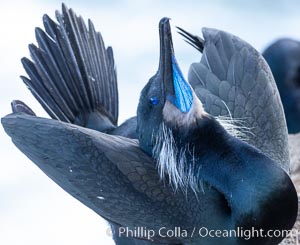
Male Brandt's Cormorant Skypointing, Courtship Display, Breeding Plumage with blue throat and white pin-feathers, La Jolla. Skypointing is an interesting courtship behavior that many birds practice. Among Brandt's Cormorants the male performs this, likely as a way of attracting a mate to the nest he has built by showing off his striking blue throat. He tips his head backward showing off his striking blue throat, and partially raises his wings. Seen here on seacliffs above the ocean.
Species: Brandt's cormorant, Phalacrocorax penicillatus
Image ID: 36801
Species: Brandt's cormorant, Phalacrocorax penicillatus
Image ID: 36801
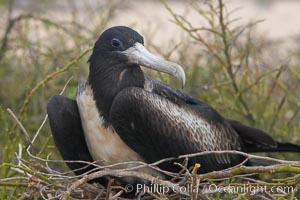
Magnificent frigatebird, adult female on nest.
Species: Magnificent frigatebird, Fregata magnificens
Location: North Seymour Island, Galapagos Islands, Ecuador
Image ID: 16726
Species: Magnificent frigatebird, Fregata magnificens
Location: North Seymour Island, Galapagos Islands, Ecuador
Image ID: 16726
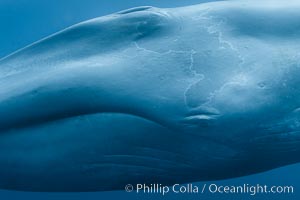
Blue whale underwater closeup photo. This incredible picture of a blue whale, the largest animal ever to inhabit earth, shows it swimming through the open ocean, a rare underwater view. Over 80' long and just a few feet from the camera, an extremely wide lens was used to photograph the entire enormous whale.
Species: Blue whale, Balaenoptera musculus
Location: California
Image ID: 27318
Species: Blue whale, Balaenoptera musculus
Location: California
Image ID: 27318
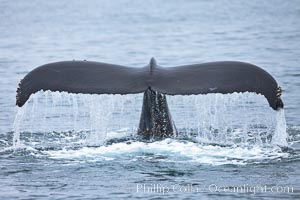
Water falling from the fluke (tail) of a humpback whale as the whale dives to forage for food in the Santa Barbara Channel.
Species: Humpback whale, Megaptera novaeangliae
Location: Santa Rosa Island, California
Image ID: 27029
Species: Humpback whale, Megaptera novaeangliae
Location: Santa Rosa Island, California
Image ID: 27029
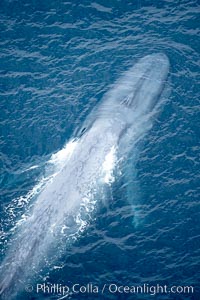
Blue whale, swimming through the open ocean.
Species: Blue whale, Balaenoptera musculus
Location: La Jolla, California
Image ID: 21248
Species: Blue whale, Balaenoptera musculus
Location: La Jolla, California
Image ID: 21248
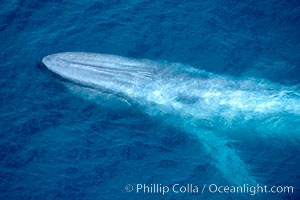
Blue whale. The sleek hydrodynamic shape of the enormous blue whale allows it to swim swiftly through the ocean, at times over one hundred miles in a single day.
Species: Blue whale, Balaenoptera musculus
Location: La Jolla, California
Image ID: 21250
Species: Blue whale, Balaenoptera musculus
Location: La Jolla, California
Image ID: 21250
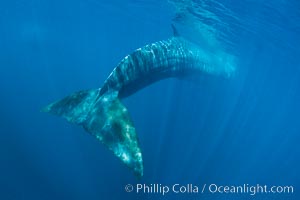
Fin whale underwater. The fin whale is the second longest and sixth most massive animal ever, reaching lengths of 88 feet.
Species: Fin whale, Balaenoptera physalus
Location: La Jolla, California
Image ID: 27116
Species: Fin whale, Balaenoptera physalus
Location: La Jolla, California
Image ID: 27116
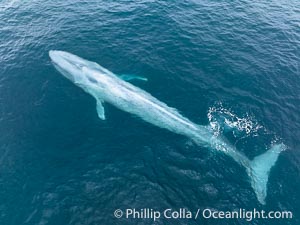
Aerial photo of blue whale near San Diego. This enormous blue whale glides at the surface of the ocean, resting and breathing before it dives to feed on subsurface krill.
Species: Blue whale, Balaenoptera musculus
Location: San Diego, California
Image ID: 39422
Species: Blue whale, Balaenoptera musculus
Location: San Diego, California
Image ID: 39422
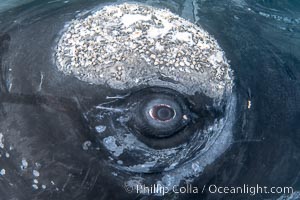
Southern right whale eyeballing the camera up close, Eubalaena australis. Whale lice can be seen clearly in the folds and crevices around the whales eye and lip groove.
Species: Southern Right Whale, Eubalaena australis
Location: Puerto Piramides, Chubut, Argentina
Image ID: 38403
Species: Southern Right Whale, Eubalaena australis
Location: Puerto Piramides, Chubut, Argentina
Image ID: 38403
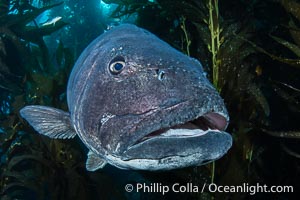
Closeup Portrait of the Face of a Giant Black Sea Bass, showing parasitic sea lice. The sea lice are parasites that find their nutrition from the skin and blood of the host giant sea bass. Smaller fishes such as senoritas and wrasses will commonly clean the sea lice off the giant sea bass.
Species: Giant black sea bass, Stereolepis gigas
Location: Catalina Island, California
Image ID: 39436
Species: Giant black sea bass, Stereolepis gigas
Location: Catalina Island, California
Image ID: 39436
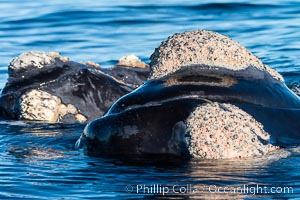
Rostrum and callosities of southern right whale, Eubalaena australis. Whale lice can be seen attached to the collosities, which are patches of thickened keratinized tissue, like calluses (thus the name). The pattern of callosities on a right whale are unique and serve as a way to identify individuals throughout their lifetime.
Species: Southern Right Whale, Eubalaena australis
Location: Puerto Piramides, Chubut, Argentina
Image ID: 38450
Species: Southern Right Whale, Eubalaena australis
Location: Puerto Piramides, Chubut, Argentina
Image ID: 38450
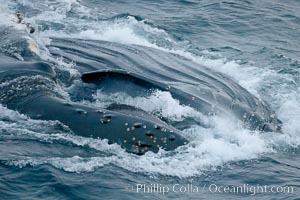
Humpback whale lunge feeding on Antarctic krill, with mouth open and baleen visible. The humbpack's throat grooves are seen as its pleated throat becomes fully distended as the whale fills its mouth with krill and water. The water will be pushed out, while the baleen strains and retains the small krill.
Species: Humpback whale, Megaptera novaeangliae
Location: Gerlache Strait, Antarctic Peninsula, Antarctica
Image ID: 25648
Species: Humpback whale, Megaptera novaeangliae
Location: Gerlache Strait, Antarctic Peninsula, Antarctica
Image ID: 25648
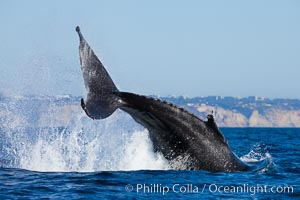
A humpback whale performs a peduncle throw in which it uses its long pectoral fins as levers to swing its fluke and caudal stem out of the water, flinging water everywhere., the coast of Del Mar and La Jolla is visible in the distance.
Species: Humpback whale, Megaptera novaeangliae
Location: Del Mar, California
Image ID: 27142
Species: Humpback whale, Megaptera novaeangliae
Location: Del Mar, California
Image ID: 27142