Phillip Colla Photography

Photographing Antelope Canyon, The Wave, Buckskin Gulch and Horseshoe Bend

Filed under: Arizona, How To, Landscape, The Wave, Utah on 3/11/2009

I have been fortunate to visit and photograph a few of the iconic locations around Page, Arizona: The Wave, Antelope Canyon, Buckskin Gulch, Horseshoe Bend and Monument Valley. Recently, I shared some correspondance about these places with UK photographer David Sharp, whom I originally met at Brooks River a few years ago. Since I receive emails from other photographers about the Wave every few weeks, I decided to edit my comments to David and post them here for others to consider. Note that I am not what a true landscape photographer would call a true landscape photographer! I know what I am doing with a camera but do not have the dedication or time that is required to photograph landscapes, and these Southwestern landscapes in particular, properly. However, I do have clear impressions of these places and, not being shy, I am putting them out there. Furthermore, this website currently gets about 5000 visitors a day, so I am reasonably certain at least a few people would read this even if it was composed by a monkey at a typewriter which, in a sense, it is. On all of my trips through the American Southwest, visiting the places mentioned above plus Zion, Bryce, Canyonlands, and Arches, I was pedal to the metal, flying, booking, jamming, screaming, etc. In other words, I had too little time and too far to drive, was all hopped up on caffeine, and tried to see it all. Naturally, that is not the best way to visit such special and serene places but it is how I, and many others, approach such a trip, especially those coming from far away to see the American Southwest for perhaps the only time in their lives. To photograph and experience these locations properly requires a more relaxed, contemplative and deliberate pace, one that I shall be sure to adopt when I turn 80.

Note that virtually all of photos on this website have GPS coordinates as well as links to Google Earth, taking you to the exact spot where they were taken, so there is no mystery where to go.

Rental Car: Assuming you are arriving in Las Vegas (NV) or Salt Lake City (UT), you will probably rent a car. Although none of these destinations requires one, I suggest that you rent a nice cushy SUV (the kind Americans love) when you arrive. It will make the little bit of off-roading you do more comfortable. Since some of the drives are quite long, having room in the back for your kids to spread out is helpful. Yes, you will burn gas — a lot of it. I realize that I am politically incorrect just mentioning the word “SUV”. Note that House Rock Valley Road, which is the dirt road that takes you to the Wave and Buckskin Gulch, can be a bit rough (but should not actually require 4WD) and having a larger SUV-type vehicle, with high clearance, makes the drive more pleasant. If there are long or deep muddy parts on the road, an SUV might actually make it possible to get to the trailhead whereas in a passenger (sedan) vehicle it could be more dicey. It all depends on the road conditions when you get there, there is no predicting those. If the conditions are truly bad, the road may simply be closed. Opting for the satellite radio on your rental SUV is important, since the variety of radio stations in this part of the country is quite slim with country/western and western/country being the only two choices.

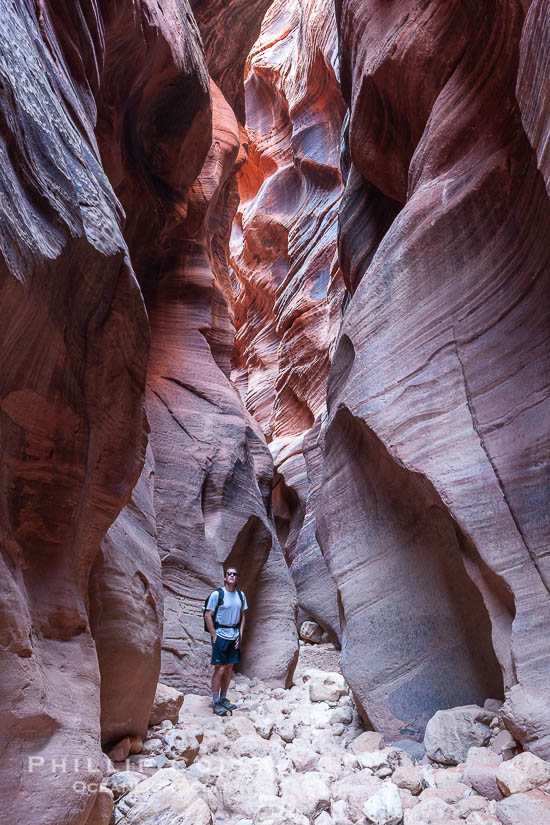
Hiker in Buckskin Gulch.  A hiker considers the towering walls and narrow passageway of Buckskin Gulch, a dramatic slot canyon forged by centuries of erosion through sandstone.  Buckskin Gulch is the worlds longest accessible slot canyon, running from the Paria River toward the Colorado River.  Flash flooding is a serious danger in the narrows where there is no escape.,  Copyright Phillip Colla, image #20716, all rights reserved worldwide.
Hiker in Buckskin Gulch. A hiker considers the towering walls and narrow passageway of Buckskin Gulch, a dramatic slot canyon forged by centuries of erosion through sandstone. Buckskin Gulch is the worlds longest accessible slot canyon, running from the Paria River toward the Colorado River. Flash flooding is a serious danger in the narrows where there is no escape. Buckskin Gulch, Paria Canyon-Vermilion Cliffs Wilderness, Arizona, USA.
Image: 20716  

Buckskin Gulch: Buckskin Gulch is easily accessed from the same trailhead that one uses to hike to the Wave: the “Wire Pass trailhead”. For this reason, if you are in the area to visit the Wave it makes perfect sense to visit Buckskin the day before or the day after you visit the Wave. Consider staying in Kanab, and just drive out to the Wire Pass trailhead each day for the two hikes. Kanab is quiet, simple and has a few good restaurants and plenty of hotels and motels. Watch your speed driving through Kanab or Officer Dummy may catch you in his speed trap. Camping at the Wire Pass trailhead is an option. However, since I do not like dirt and do not camp, I cannot advise about the camping there from personal experience. The drive from Kanab to Wire Pass trailhead, via Hwy 89 and House Rock Valley Road is, as I recall, about 30-45 minutes or so, quite easy except for perhaps a bit of the dirt House Rock Valley Road which may be muddy or a bit rough in some places. A half day, especially if you get started reasonably early (7am comes to mind) is enough for you to hike into the “upper reaches” of Buckskin Gulch, get into a few deep and really fun sections, and then return back out the way you came. A full day gives you further reach into the gulch. The alternative is to make a one-way trip down through Buckskin and Paria Canyon, but that requires overnights, permits, and arranging a pick up at the far end, and so the time investment is considerably more. Note that flash floods in Buckskin Gulch and Wire Pass Narrows are a real danger, and it is good to know where the exits to the gulch are as well as the weather forecast for the wider area (flash floods can be created by rain many miles away). It is possible to visit both Buckskin and the Wave in the same day. I did it last May. It was about a 15-17 mile day and tiring but I was in good shape and able to do it without problems. I even had time to catch a one-hour nap at the Second Wave waiting for sunset light. Do not underestimate the need for hydration on a day such as this. I drank about 10 liters of fluids and sweated out all of it (I think I peed only twice all day). Buckskin Gulch blog posts, Buckskin Gulch stock photos.

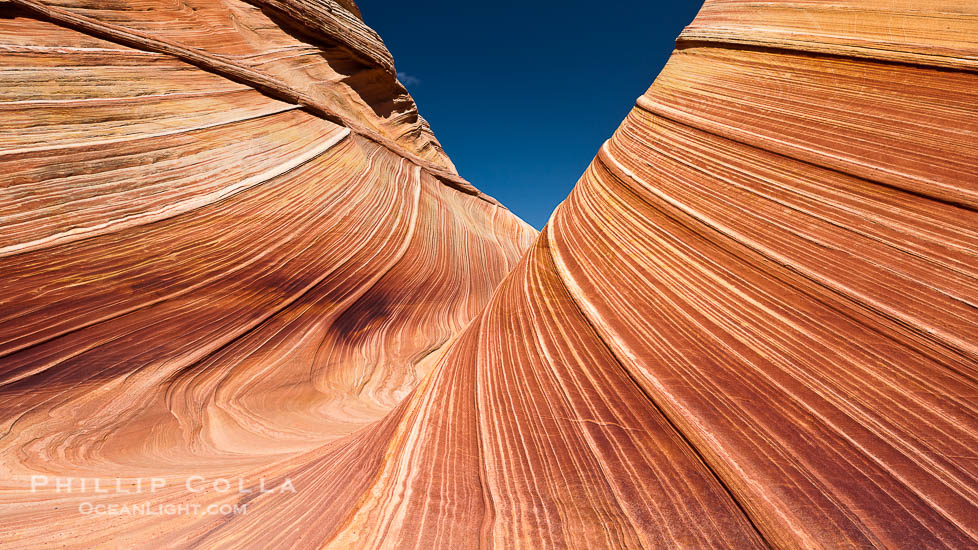
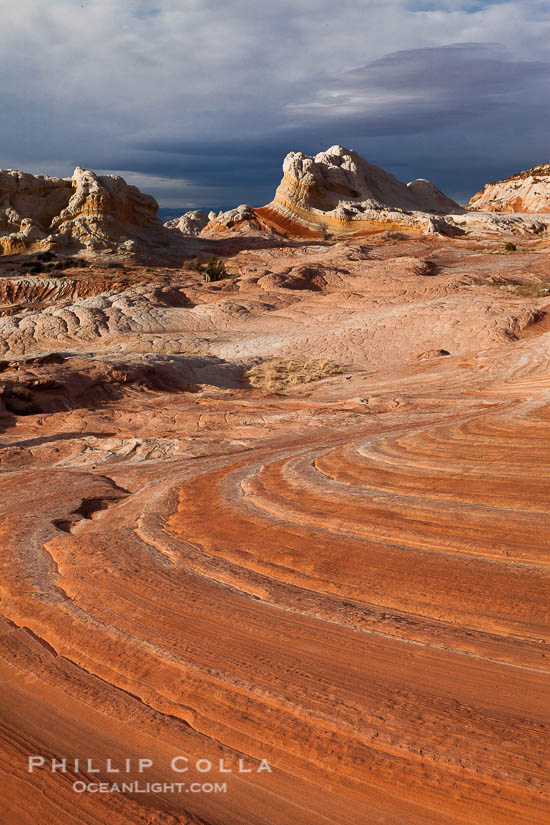
The Wave, an area of fantastic eroded sandstone featuring beautiful swirls, wild colors, countless striations, and bizarre shapes set amidst the dramatic surrounding North Coyote Buttes of Arizona and Utah.  The sandstone formations of the North Coyote Buttes, including the Wave, date from the Jurassic period. Managed by the Bureau of Land Management, the Wave is located in the Paria Canyon-Vermilion Cliffs Wilderness and is accessible on foot by permit only.,  Copyright Phillip Colla, image #20608, all rights reserved worldwide.
The Wave, an area of fantastic eroded sandstone featuring beautiful swirls, wild colors, countless striations, and bizarre shapes set amidst the dramatic surrounding North Coyote Buttes of Arizona and Utah. The sandstone formations of the North Coyote Buttes, including the Wave, date from the Jurassic period. Managed by the Bureau of Land Management, the Wave is located in the Paria Canyon-Vermilion Cliffs Wilderness and is accessible on foot by permit only. North Coyote Buttes, Paria Canyon-Vermilion Cliffs Wilderness, Arizona, USA.
Image: 20608  

The Wave: There is no denying the appeal of a sunrise hike to the Wave. At that hour the air is cool with perhaps a hint of dew, the surrounding hills and canyons are quiet and still, and within minutes of setting out one is alone. However, while you may be eager to get to the Wave early in the day, the photography at the Wave formation itself seems to me to be best in mid- to late-morning. By that time the sun has risen enough to fill the deeper parts around the main Wave formation for evenly lit photos. That said, during late spring, summer and fall, the cooler it is walking out to the Wave, the more comfortable you will be. The hike is about 3 miles one way, so plan on two hours at a easy but constant pace. The last part going up a sand hill is the most tiring. There is little shade once you are there, so be prepared for sun! Do not forget the Second Wave, which is only about a 5-10 minute walk from the main wave. You do not actually see the Second Wave until you round a knob of rock at which point you suddenly realize you are are practically on top of it. Although the spot is no secret, the GPS coordinates and Google Earth links alongside my photos will put you right on it. The light on the Second Wave is best just before the sun goes down at the end of the day, so if you stay for that photo it makes for a long day. In that instance you will hike out as the sky is growing dark but that’s ok, there is still plenty of light and, if you feel unsure of how to return, you can use your GPS to revisit your waypoints in reverse on the way back out. I should mention that both times I visited the Wave, I stayed until dark. As the day went on, there were fewer people around so that by 3pm I was alone, which was very nice. Blog posts about The Wave. Stock Photos of the Wave.

A hiker admiring the striated walls and dramatic light within Antelope Canyon, a deep narrow slot canyon formed by water and wind erosion.,  Copyright Phillip Colla, image #18009, all rights reserved worldwide.
A hiker admiring the striated walls and dramatic light within Antelope Canyon, a deep narrow slot canyon formed by water and wind erosion. Navajo Tribal Lands, Page, Arizona, USA.
Image: 18009  

Antelope Canyon Slots: These are just outside the town of Page and require virtually no effort to visit. They are on Navaho tribal lands, so accessing these slot canyons requires that you be on a tour or with a guide. The Upper Antelope canyon, which is the most iconic and photogenic, is the one that gets most crowded. If it is crowded when you are there just be patient and wait for the chamber(s) that you are photographing to clear out and then bang out your exposures before someone else walks in front of you. It can help to carry an electric cattle prod or pocket Taser to ensure the area where you are photographing remains clear of New Yorkers and Nikon photographers. OK, my bad on that last part. I highly recommend that you do not change lenses, there is simply too much dust. In fact, do not be surprised if you encounter another photographer tossing dust in the air to better define the light beams in his composition. If his forward technique does not balance harmoniously with your chi, you can rebalance the moment by tossing sand into his eyes to better define your opinion of his method. If I had to choose one lens to use to use at Antelope Canyon, it would be 16-35 (or either of Nikon’s 14-24 or 17-35) on a full-frame camera. On a second body I carry a 24-70 or similar. Those two should cover 95% of my needs in terms of focal lengths at Antelope. The LOWER canyon is, I hear, far less crowded and has very good photography as well. There are two types of “tours” to visit Upper Antelope Canyon: a normal tour (about 30-60 minutes) and “photo” or extended tour, the latter being more suitable for photographers who feel a need for more time in the slot. I went on an “extended” tour and had about 90 minutes at the canyon, with a 15 minute ride in a van from Page (we met the tour at a small storefront in Page). That was in winter. I understand that during much of the year the Navaho Indian tribe offers guide services (for a fee) right at the entrance to the Antelope Canyon area on the main highway, in which case you might save a little money over the tours that are arranged in the town of Page itself. However, all visits require some Navaho guide presence. If you are coming from far away I suggest that you just reserve a photo tour ahead of time to ensure that you have the time you need. It may cost a little more but at least you know you will be in the canyon at the right time of day, with enough time to relax and take photos. The only unknowns are weather and how crowded it will be on the day of your visit. Kids might get bored after half hour, so families might arrange for the shorter tour while the lone photographer in the family goes on a longer tour. I went to the Upper Antelope Canyon with Antelope Canyon Tours when I was there in Jan 2007. At that time we literally had the entire Upper Canyon to ourselves (a group of 5 people) for 90 minutes, with one 20 minute exception when another small group came by for a brief visit. However, in the winter the dramatic light shafts do not reach the floor of the slots. Those appear in summer, principally June and July, coincidental with the crowds. So if you want solitude in Antelope Canyon (or something approaching it), try it winter. If you want the cool beams, battle the crowds.

Horseshoe Bend.  The Colorado River makes a 180-degree turn at Horseshoe Bend.  Here the river has eroded the Navaho sandstone for eons, digging a canyon 1100-feet deep.,  Copyright Phillip Colla, image #18029, all rights reserved worldwide.
Horseshoe Bend. The Colorado River makes a 180-degree turn at Horseshoe Bend. Here the river has eroded the Navaho sandstone for eons, digging a canyon 1100-feet deep. Navajo Tribal Lands, Page, Arizona, USA.
Image: 18029  

Horseshoe Bend: If you are in Page, Arizona, you must find a bit of time for Horseshoe Bend. From a pulloff on the side of the highway just a few minutes outside town, an easy 10 minute walk takes one to the edge of the chasm that is Horseshoe Bend. It is so easy it would be a shame to miss it. Just be careful that Fido and the kids are paying attention since there are no rails or anything keeping you from falling in. (Give the personal injury lawyers time, I am sure there will be a fence and a “viewing area” that we are required to use eventually). If you stay in Page for the night, you might want to go photograph Horseshoe Bend at sunset, late morning and/or sunrise to see what you can get. I took this the above shot with a 16-35 at its widest.

Monument Valley panorama, a composite of four individual photographs.,  Copyright Phillip Colla, image #20902, all rights reserved worldwide.
Monument Valley panorama, a composite of four individual photographs. Monument Valley, Arizona, USA.
Image: 20902  

Monument Valley: OK, in spite of how little experience I have in Monument Valley, I will add some words about it, since it is likely others travelling to Page will visit Monument Valley the same way that I did. I blew through there one day by myself on my way to Page, spending about 1 hour at one of the main viewpoints (where I think I paid $5 to the Navaho tribe at the gate and then drove my own car about 2-3 miles on an easy dirt road into the area and then back out, looking for view points, until I found the one above). The timing was good, I was there in the final hour of light, although having clouds would have helped. If you want to just make a quick stop in Monument Valley and visit only one of the easily-accessed viewpoints, I suggest you make it sunrise or sunset. (If you want to spend a full day at Monument Valley, you can arrange private guides that will take you deep into the area and show you views that are better and different, but I believe it will require most of a day to accomplish.)

Tech: For any of these locations, my photography equipment is quite simple and light, no need for any heavy stuff. Landscape shooting is simple compared to all the gear needed for underwater and/or wildlife shooting!

  • Two full-frame bodies (currently Canon 1DsII & 1DsIII)
  • Canon 16-35 II f/2.8 lens
  • Canon 24-70 f/2.8 lens
  • Canon 70-200 f/4 lens
  • Tripod with ball head, cable release, polarizers

If you found this information useful, please post the link to it and let others know. Cheers!

Photo of Buckskin Gulch

View This Blog Post in Google Earth (How Cool Is That?)  View this blog entry in Google Earth
Latitude: 37° 0' 47.41" N, Longitude: 112° 0' 4.28" W, Coord: 37.01317°, -112.00119°
Filed under: Arizona, Photo of the Day on 6/11/2008

Last one from Buckskin Gulch: a hiker considering the towering walls and narrow, convoluted passageway of the the Buckskin Gulch narrows. The trail continues behind the hiker, disappearing into the twisting walls so that it is hard to tell that it is even there. The floor of the passage is littered with large cobblestones, deposited there from upstream by powerful floodwaters that fill the slot canyon and carve it deeper into the sandstone with each passing year’s storms.

Hiker in Buckskin Gulch.  A hiker considers the towering walls and narrow passageway of Buckskin Gulch, a dramatic slot canyon forged by centuries of erosion through sandstone.  Buckskin Gulch is the worlds longest accessible slot canyon, running from the Paria River toward the Colorado River.  Flash flooding is a serious danger in the narrows where there is no escape.,  Copyright Phillip Colla, image #20716, all rights reserved worldwide.
Hiker in Buckskin Gulch. A hiker considers the towering walls and narrow passageway of Buckskin Gulch, a dramatic slot canyon forged by centuries of erosion through sandstone. Buckskin Gulch is the worlds longest accessible slot canyon, running from the Paria River toward the Colorado River. Flash flooding is a serious danger in the narrows where there is no escape. Buckskin Gulch, Paria Canyon-Vermilion Cliffs Wilderness, Arizona, USA.
Image: 20716  
Location: Buckskin Gulch, Paria Canyon-Vermilion Cliffs Wilderness, Arizona, USA
 

Buckskin Gulch Backpacking

Filed under: Arizona, Photo of the Day on 6/10/2008

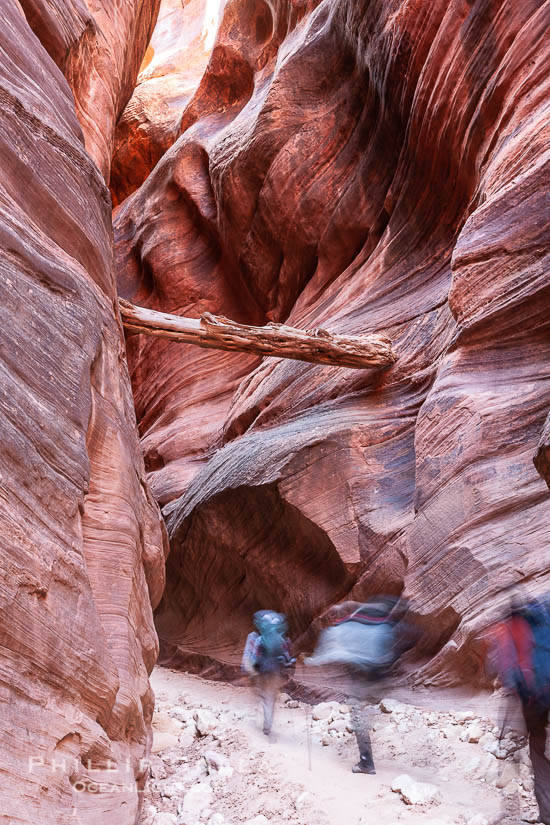
Here are a few backpackers walking through the Buckskin Gulch narrows. They are blurry because it is so dark in the narrows that a tripod and long exposure must be used, which caused the backpackers to smear across the photo as they walked while the stationary walls and ground remain sharp and clear. Check out the big log jammed between the sandstone walls! It was left there by a powerful flash flood some time in the past, and is a testament to the height and strength of those floods.

Suspended log in Buckskin Gulch.  Hikers pass beneath a heavy log suspended between the walls of Buckskin Gulch, placed there by a flash flood some time in the past.  Buckskin Gulch is the world's longest accessible slot canyon, forged by centuries of erosion through sandstone.  Flash flooding is a serious danger in the narrows where there is no escape.,  Copyright Phillip Colla, image #20723, all rights reserved worldwide.
Suspended log in Buckskin Gulch. Hikers pass beneath a heavy log suspended between the walls of Buckskin Gulch, placed there by a flash flood some time in the past. Buckskin Gulch is the world’s longest accessible slot canyon, forged by centuries of erosion through sandstone. Flash flooding is a serious danger in the narrows where there is no escape. Buckskin Gulch, Paria Canyon-Vermilion Cliffs Wilderness, Arizona, USA.
Image: 20723  
Location: Buckskin Gulch, Paria Canyon-Vermilion Cliffs Wilderness, Arizona, USA
Click To View This Location in Google Earth.  You must have Google Earth installed for this feature to work correctly. View this Image in Google Earth!


Hiking Buckskin Gulch

View This Blog Post in Google Earth (How Cool Is That?)  View this blog entry in Google Earth
Latitude: 37° 1' 1.74" N, Longitude: 112° 0' 6.48" W, Coord: 37.01715°, -112.0018°
Filed under: Arizona, Panoramas, Photo of the Day, Photography on 6/9/2008

This is a 360-degree panorama showing, in a single image, a hiker in Buckskin Gulch both coming and going. I set my camera on a tripod in the middle of the trail through Buckskin Gulch, leveled it with a bubble level, and spun it in a complete circle taking sixteen photos roughly evenly spaced as I did so. In two of the photographs I set the camera’s self-timer and jumped into the picture myself. Later, the images were then “stitched” together on a the computer with panoramic imaging software, resulting in the single image you see. Click on it to see it larger!

Buckskin Gulch hiker.  A hiker moves through the deep narrow passages of Buckskin Gulch, a slot canyon cut deep into sandstone by years of river-induced erosion.  In some places the Buckskin Gulch narrows are only about 15 feet wide but several hundred feet high, blocking sunlight.  Flash floods are dangerous as there is no escape once into the Buckskin Gulch slot canyons.  This is a panorama made of sixteen individual photos.,  Copyright Phillip Colla, image #20699, all rights reserved worldwide.
Buckskin Gulch hiker. A hiker moves through the deep narrow passages of Buckskin Gulch, a slot canyon cut deep into sandstone by years of river-induced erosion. In some places the Buckskin Gulch narrows are only about 15 feet wide but several hundred feet high, blocking sunlight. Flash floods are dangerous as there is no escape once into the Buckskin Gulch slot canyons. This is a panorama made of sixteen individual photos. Buckskin Gulch, Paria Canyon-Vermilion Cliffs Wilderness, Arizona, USA.
Image: 20699  
Location: Buckskin Gulch, Paria Canyon-Vermilion Cliffs Wilderness, Arizona, USA
Click To View This Location in Google Earth.  You must have Google Earth installed for this feature to work correctly. View this Image in Google Earth!

Pano dimensions: 4771 x 15311
 

Wire Pass Trailhead

View This Blog Post in Google Earth (How Cool Is That?)  View this blog entry in Google Earth
Latitude: 37° 1' 8.25" N, Longitude: 112° 1' 30.57" W, Coord: 37.01896°, -112.02516°
Filed under: Arizona, Photo of the Day, The Wave on 6/6/2008

If you are going to hike to Buckskin Gulch or the North Coyote Buttes, you will likely start at the Wire Pass trailhead. Here is what it looks like at 6am. The dirt road you see, on which the trailhead parking lot is located, is the House Rock Valley Road. The few times I have driven it, the road has been fine. However, it is an unpaved road and I have heard that, following rain storms, it can be nearly unpassable. Just to be safe I have always used a high clearance vehicle on the House Rock Valley Road. A few cars are in the trailhead parking lot, with hikers readying their stuff for the day’s outing or still snoozing in their campers if they spent the night there.

Wire Pass trailhead.  The parking lot at the Wire Pass trailhead, early morning, as hikers arrive and set out to Buckskin Gulch, the North Coyote Buttes and the Wave.,  Copyright Phillip Colla, image #20745, all rights reserved worldwide.
Wire Pass trailhead. The parking lot at the Wire Pass trailhead, early morning, as hikers arrive and set out to Buckskin Gulch, the North Coyote Buttes and the Wave. Wire Pass, Paria Canyon-Vermilion Cliffs Wilderness, Arizona, USA.
Image: 20745  
Location: Wire Pass, Paria Canyon-Vermilion Cliffs Wilderness, Arizona, USA
Click To View This Location in Google Earth.  You must have Google Earth installed for this feature to work correctly. View this Image in Google Earth!


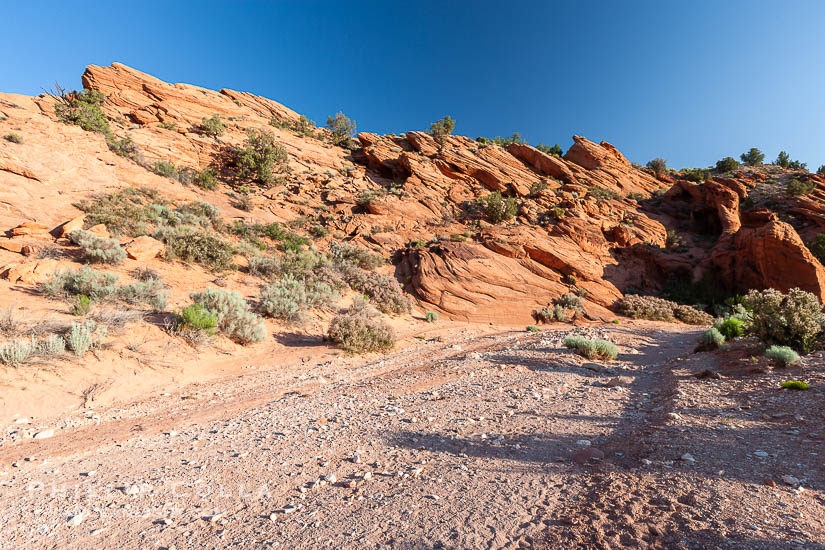
Here is a look at the Wire Pass Trail itself, which runs down a sandy wash. It is quite unexceptional, and does not begin to hint at the wonderful sights that it will lead one to in either the Wire Pass Narrows or at the Wave.

Wire Pass trail.  The Wire Pass trail runs along a river wash through sandstone bluffs and scattered trees and scrub brush.,  Copyright Phillip Colla, image #20746, all rights reserved worldwide.
Wire Pass trail. The Wire Pass trail runs along a river wash through sandstone bluffs and scattered trees and scrub brush. Wire Pass, Paria Canyon-Vermilion Cliffs Wilderness, Arizona, USA.
Image: 20746  
Location: Wire Pass, Paria Canyon-Vermilion Cliffs Wilderness, Arizona, USA
Click To View This Location in Google Earth.  You must have Google Earth installed for this feature to work correctly. View this Image in Google Earth!


Bad Cop, No Donut

View This Blog Post in Google Earth (How Cool Is That?)  View this blog entry in Google Earth
Latitude: 37° 2' 16.22" N, Longitude: 112° 31' 30.25" W, Coord: 37.03784°, -112.52507°
Filed under: Funny, Utah on 6/5/2008

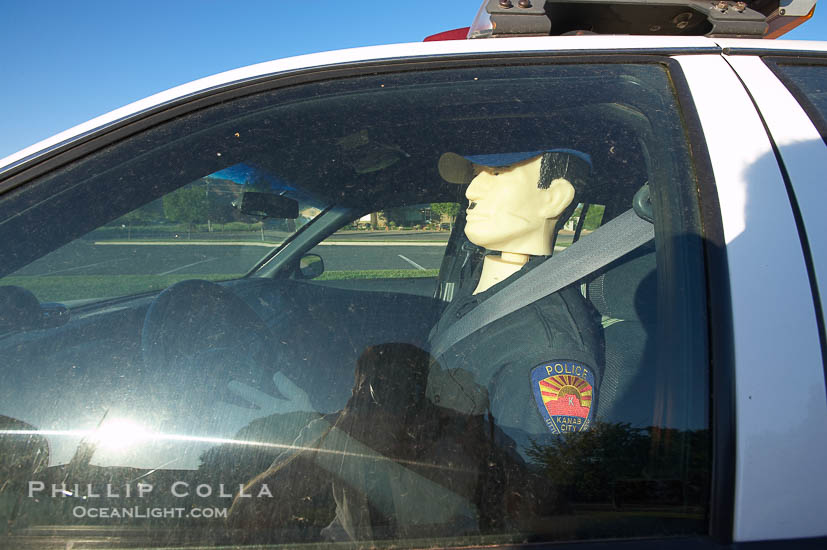
While passing through beautiful Kanab, Utah, on my way to hike Wire Pass, Buckskin Gulch and the North Coyote Buttes, I spotted a cop on the side of the road, presumably speed-gunning people as they entered town. Last time I blew through Kanab I noticed it was crawling with cops, or rather, with speed traps: cops parked on the side of the road just out of sight until you were too close to slow down in time. This time I slowed down figuring if this guy was lurking there must be other cops around too. As I passed by Officer Man in his poh-leece cruiser, I noticed he had a strange complexion, sort of green and sick looking, and he had a wierd pencil neck. I slowed down to shoot him a little Whachoo looking at, badge buddy? glare. He had his windows rolled up but, since his engine was off, he had no A/C so it must have been 300 freaking degrees inside his car, and yet this guy is not even sweating. Eventually my road-weary pea-brain figured it out: the cop was inflatable, a mannikin, a dummy. I guess the real cop on duty — one of Kanab’s Finest — was off somewhat taking a little afternoon siesta with his honey and propped up this doppleganger as a placeholder until he got back. I just had to stop and introduce myself, never having had a chance to say “Officer, I suggest you use your night stick” to an inflatable adult novelty doll sporting a police costume and KMart shades before. He let me take his photo but wouldn’t comment on whether he got his training at the academy or came straight from the factory. Check out his bizarre little Hitler mustache, what’s up with that?

Inflatable cop.  Kanab's Finest, hard at work.  A Kanab police officer actively enforcing the speed limit in the town of Kanab, Utah.,  Copyright Phillip Colla, image #20768, all rights reserved worldwide.
Inflatable cop. Kanab’s Finest, hard at work. A Kanab police officer actively enforcing the speed limit in the town of Kanab, Utah. Kanab, Utah, USA.
Image: 20768  
Location: Kanab, Utah, USA
Click To View This Location in Google Earth.  You must have Google Earth installed for this feature to work correctly. View this Image in Google Earth!

 
Inflatable cop.  Kanab's Finest, hard at work.  A Kanab police officer actively enforcing the speed limit in the town of Kanab, Utah.,  Copyright Phillip Colla, image #20769, all rights reserved worldwide.
Inflatable cop. Kanab’s Finest, hard at work. A Kanab police officer actively enforcing the speed limit in the town of Kanab, Utah. Kanab, Utah, USA.
Image: 20769  
Location: Kanab, Utah, USA
Click To View This Location in Google Earth.  You must have Google Earth installed for this feature to work correctly. View this Image in Google Earth!


Of course the blow-up cop did what he was supposed to — I slowed down. I’m guessing Kanab probably has the most cost-effective police force in the nation.

P.S. A Kanab resident who spotted my little blog posting kindly emailed me to say that Officer Man’s real name is Latex Larry. A search on the internet reveals that Latex Larry has worked assignments in Fredonia as well. Seems the guy works 24/7 and all over the place.

A Day At The Wave, North Coyote Buttes, Part I

View This Blog Post in Google Earth (How Cool Is That?)  View this blog entry in Google Earth
Latitude: 37° 0' 24.53" N, Longitude: 112° 0' 27.64" W, Coord: 37.006814°, -112.00768°
Filed under: Arizona, Photo of the Day, Stories, The Wave on 4/19/2008

I have long heard comments from hikers and landscape photographers about the beautiful and bizarre sandstone formations of the North Coyote Buttes area of Arizona. I am not a serious landscape photographer nor am I a what you would consider a “desert lover”. However, on a lark, I decided to apply for a permit for a hiking permit to the Wave, a particularly fantastic and odd section of the North Coyote Buttes. The Wave is so popular that the Bureau of Land Management must limit access to the Wave to only 20 people per day, by lottery. Summer is to be avoided due to the heat, and winter is not particularly pleasant due to cold and possible ice, snow or rain out there. Spring and Fall are the times to go. In spite of my applying for the most popular time of year, I lucked out and scored a permit. It came in the mail about 5 weeks later, along with some cool topo maps and directions to find the Wave amid the crazy random sandstone confusion that is the North Coyote Buttes. (More about finding the Wave in future posts.)

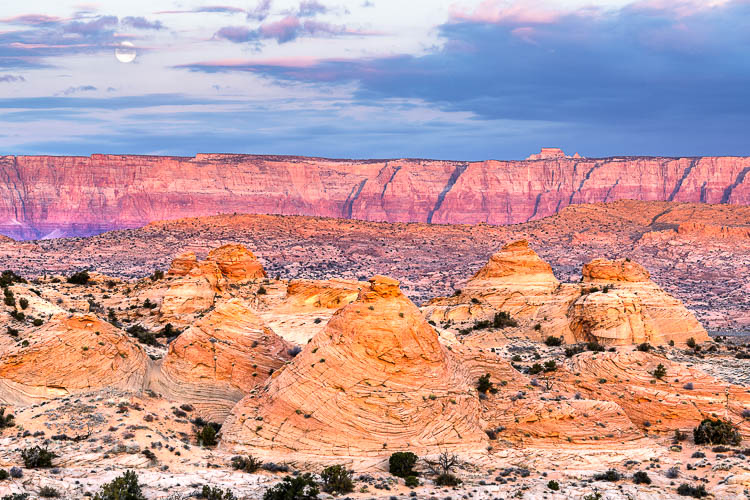
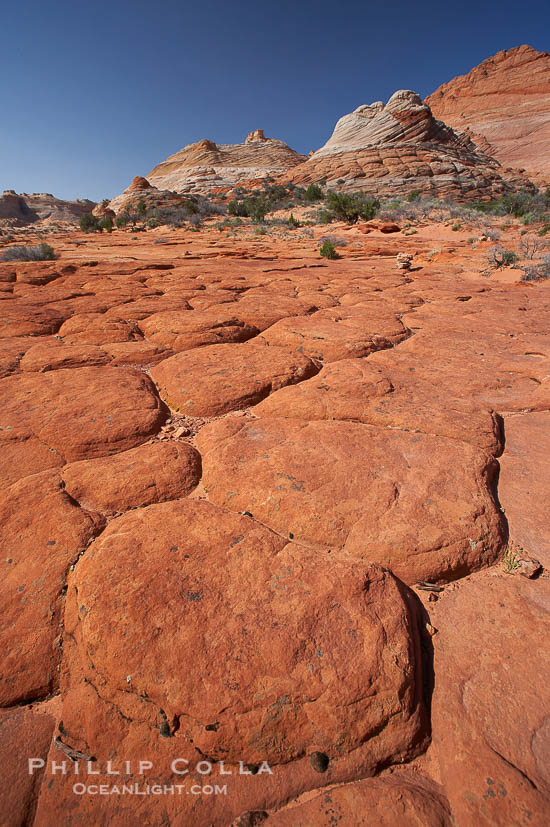
Geometric joints and cracks form in eroding sandstone.,  Copyright Phillip Colla, image #20610, all rights reserved worldwide.
Geometric joints and cracks form in eroding sandstone. North Coyote Buttes, Paria Canyon-Vermilion Cliffs Wilderness, Arizona, USA.
Image: 20610  
Location: North Coyote Buttes, Paria Canyon-Vermilion Cliffs Wilderness, Arizona, USA
Click To View This Location in Google Earth.  You must have Google Earth installed for this feature to work correctly. View this Image in Google Earth!


As my permit date (April 16) approached, I was besieged with work and family responsibilities, and it became clear that I would not be able to take a proper four- to seven-day trip allowing me to explore the area immediately around the Vermilion Cliffs National Monument (in which the Coyote Buttes and the Wave are located), which includes cool places like Lake Powell, Horseshoe Bend, Antelope Canyon, Buckskin Gulch, etc. Instead I pulled a virtual overnighter, hopping the hooker flight to Vegas on Tuesday, driving four hours to Page, getting up at dawn on Wednesday, hitting the trail, spending the whole day out in the area of the Wave exploring and admiring the sandstone formations, getting back to my car after sunset, driving back to Vegas, settling down in some nasty hotel next to the airport (should have stayed on the Strip, what was I thinking), finally hitting the sack at 1am only to rise at 4:30am Thursday for a 6am flight back to San Diego. Back in my office at 8:30am on Thursday. Door to door about 40 hours. Whew. It was worth it though: it was one of the coolest hikes I have ever taken, and I am looking forward to going back to look around the area more.

Photos of the Wave, North Coyote Buttes


HOME | Online Image Search | Photo of the Day | Contact / Bio | Licensing/Pricing | Prints | Stock List | Image Hierarchy | List of Log Entries | Site Map | Blue Whale | Cetaceans | Pinnipeds | Sharks | Rays | Fishes | Kelp Forest | Sea Birds | Inverts | Man & Animal | Man & Ocean | Ocean & Light | Ocean & Motion | Portraits | About Color and Monitor Calibration | Copyright Statement | All text and photographs copyright © Phillip Colla Natural History Photography   All rights reserved worldwide. The content of this site is made available for purposes of researching images offered for license by Phillip Colla Natural History Photography.  No image is to be copied, duplicated, modified or redistributed in whole or part without the prior written permission of Phillip Colla Natural History Photography.  Whale logo is a trademark of Phillip Colla Natural History Photography, 7302 Azalea Place, Carlsbad, CA 92011, USA.  (760) 804-0731.  Email: oceanlight@OceanLight.com    Web: www.OceanLight.com      Portfolios: www.Gygis.com

Updated: November 21, 2009