Western Grebes (Aechmophorus occidentalis) and Clark’s Grebes (A. clarkii) are large, colonial diving birds inhabiting open lakes, marsh-edged wetlands, and reservoirs across western North America. They were long treated as color morphs of one species, but studies by Ratti (1979), Nuechterlein (1981), and Storer and Nuechterlein (1985) helped establish that they differ in plumage details, bill color, vocalizations, and courtship behavior, and that they usually mate assortatively. Both species typically breed in mixed colonies, build floating nests anchored in emergent vegetation, and move to larger or ice-free waters outside the breeding season; Western Grebes are generally more widespread and more northern, whereas Clark’s Grebes tend to be relatively more southern in distribution (Wilson et al. 2013; LaPorte, Storer, and Nuechterlein 2020a; LaPorte, Storer, and Nuechterlein 2020b).
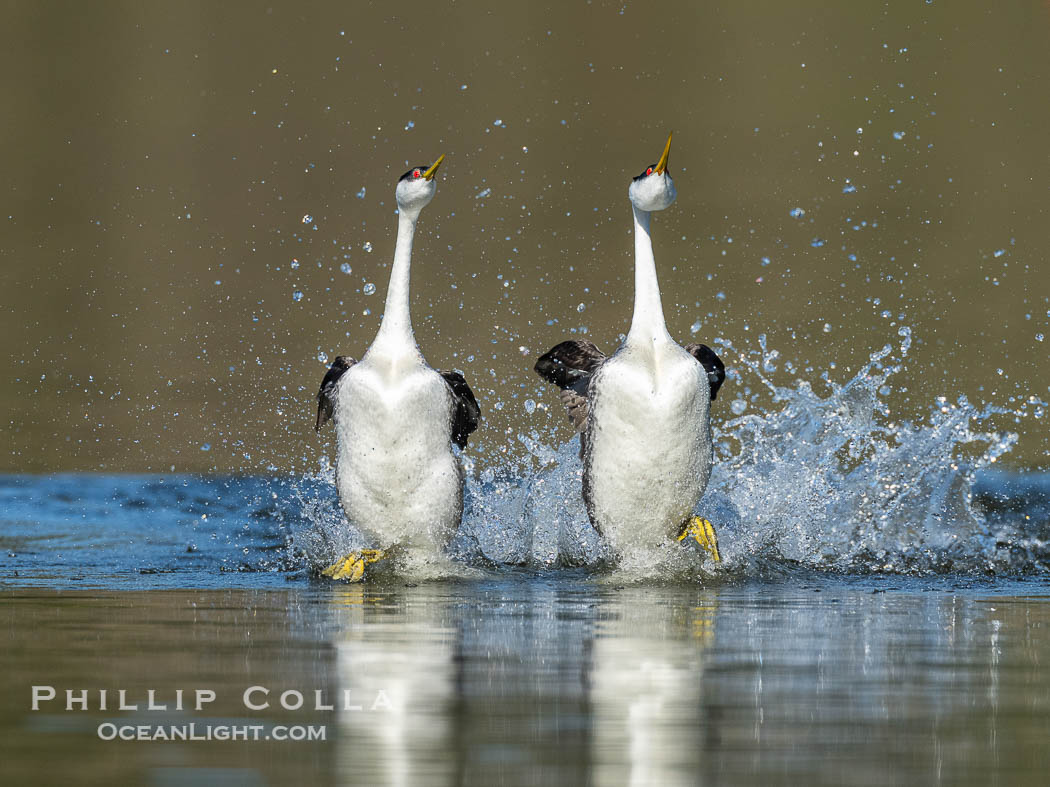
Western Grebes rushing on Lake Wohlford, running across the water by slapping their feet rapidly, part of the grebe's elaborate courtship.
Image ID: 41704
Location: Lake Wohlford, Escondido, California
The famous rushing display is part of a broader pair-formation sequence rather than an isolated behavior. In The Pair-Formation Displays of the Western Grebe, Nuechterlein and Storer (1982) described rushing as the centerpiece of a courtship sequence that can occur between a male and female, between two males, or in competitive groups involving several males and a female. That context shows that rushing is closely tied to mate attraction, mate assessment, and pair bonding. Other work found that unpaired males use advertising calls to attract females (Nuechterlein 1981), that vocal signals are important in mate choice and reproductive isolation (Nuechterlein and Buitron 1998), and that copulation itself usually occurs later on floating nest platforms rather than as part of the rushing display (Hayes and Turner 2017).
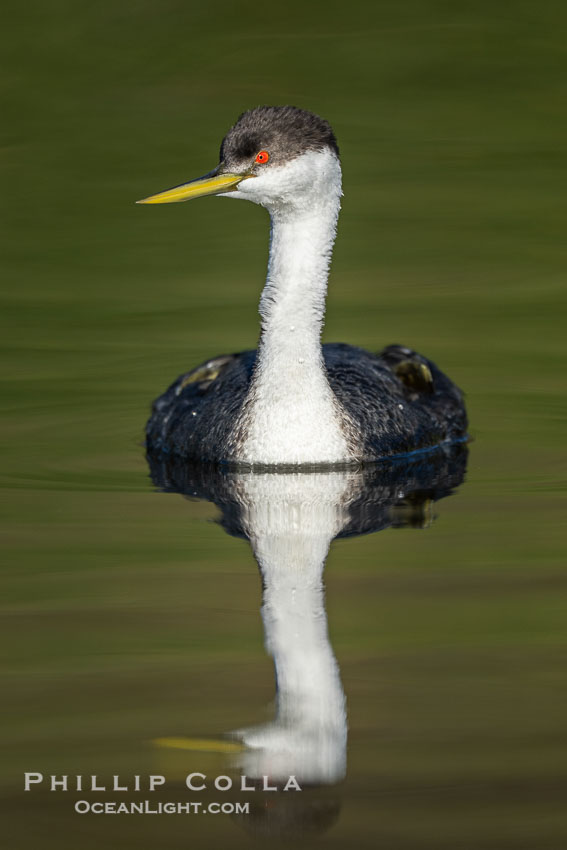
Western Grebe, Lake Wohlford.
Image ID: 41544
Species: Western Grebe, Aechmophorus occidentalis
Location: Lake Wohlford, Escondido, California
Rushing looks extraordinary because the birds suddenly lunge forward, rise almost upright from the water, hold the neck extended and slightly arched, sweep the wings back from the body, and run side by side over the lake surface before dropping back into the water. The best quantitative biomechanical analysis, by Clifton, Hedrick, and Biewener (2015), found stride frequencies of about 6.7 to 10 strides per second, which is roughly 13.3 to 20 footfalls or water slaps per second. Typical rushes lasted about 4 seconds, sometimes up to 7 seconds, and usually covered roughly 5 to 20 meters. That study also showed that the grebes’ lobed feet generate unusually large forces during impact and stroke, with water slap contributing about 30 to 55 percent of the support needed to keep the birds above the surface.
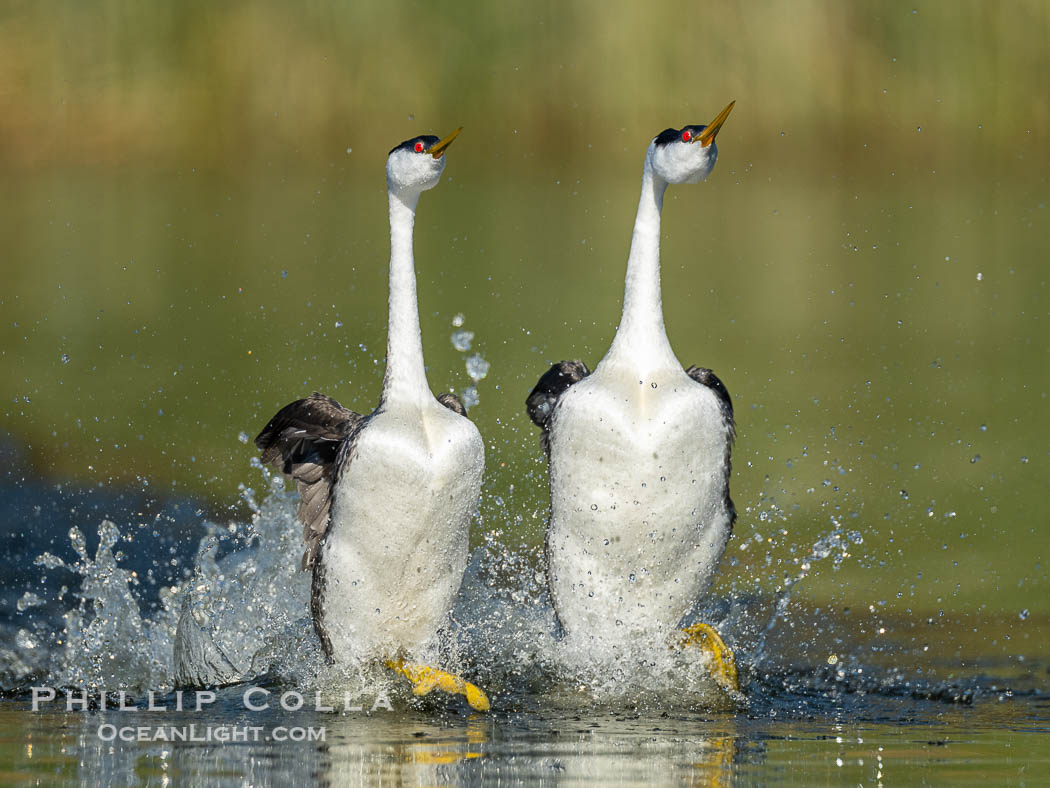
Western Grebes rushing across Lake Wohlford, exhibiting a spectacular courtship behavior in which the aquatic birds literally run across the surface of the water while their feet hit the water up to 20 times per second.
Image ID: 41538
Species: Western Grebe, Aechmophorus occidentalis
Location: Lake Wohlford, Escondido, California
There is no single fixed rate at which rushing events are performed because it depends on breeding stage, colony density, and social excitement, but the behavior can be very frequent during peak courtship. Nuechterlein and Storer (1982) reported that when two unpaired birds completed a ratchet-pointing and dip-shaking sequence without interruption, mutual rushing followed in 96 percent of 302 bouts, showing how central the display is to pair formation. Clifton and colleagues (2015) observed that rushing displays at Upper Klamath Lake sometimes exceeded 30 per hour at peak times and could trigger chain reactions among nearby birds. The display continues through much of the breeding season, although it becomes less regular once most birds are paired and focused on nesting. Both Western and Clark’s grebes share this courtship system and the behavior has been described from mixed colonies and staging sites across the western North American range of Aechmophorus; sometimes mixed species will rush together although this is uncommon.
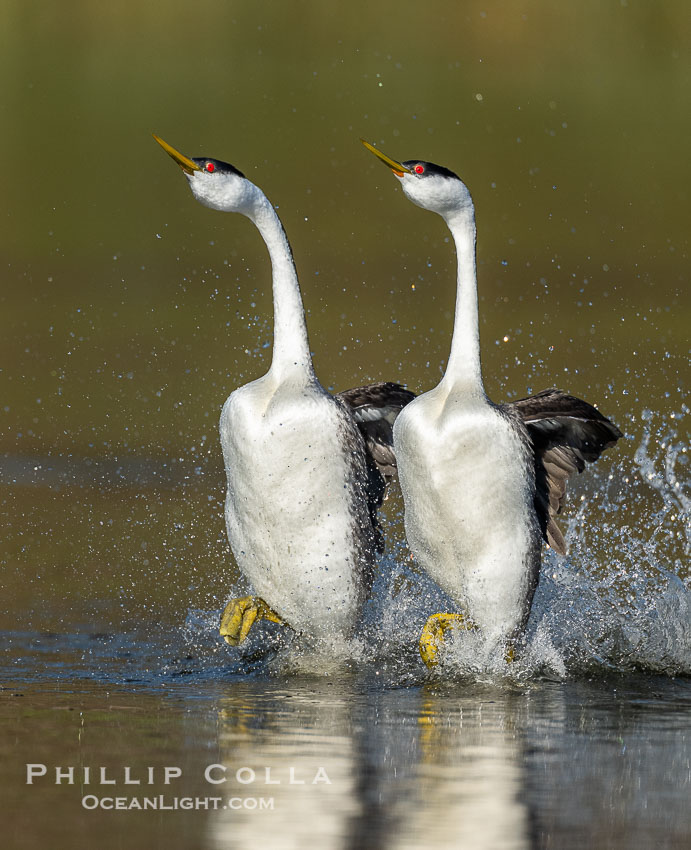
Two Western Grebes Rushing on Lake Wohlford near San Diego. Grebe rushing, a courtship behavior, happens when the birds slap the lake surface up to 20 times per second, literally running across the water.
Image ID: 41562
Species: Western Grebe, Aechmophorus occidentalis
Location: Lake Wohlford, Escondido, California
Whether rushing is learned is uncertain. There does not seem to have been an experimental study showing that young grebes learn the motor pattern by watching parents, nor is there evidence that adults actively teach the display. The most cautious assessment of the literature is that rushing is probably an innate species-typical courtship display that is passed on mainly through inherited anatomy, neuromuscular capacity, and the hormonal and social conditions that release the behavior. What may have a learned component is mate recognition rather than the running motion itself: playback and mate-choice studies show that vocalizations are important in pairing (Nuechterlein and Buitron 1998), and a recent hybridization study suggested that errors in sexual imprinting may help explain some mixed pairing between Western and Clark’s grebes (Hayes et al. 2024). At present, while rushing as a courtship and pair-bonding display is widely distributed in both species, there does not seem to be cultural transmission of the display from one generation to the next.
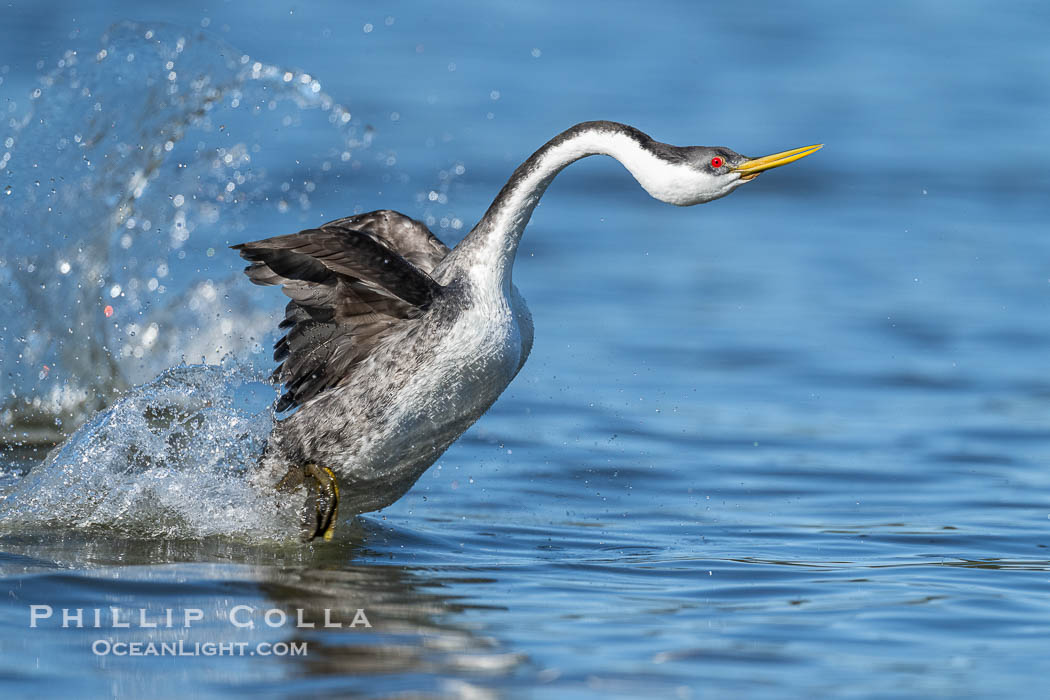
Western Grebe rushing on Lake Wohlford, running across the water by slapping its feet rapidly, part of the grebe's elaborate courtship.
Image ID: 41706
Location: Lake Wohlford, Escondido, California
References:
- Ratti, J. T. 1979. Reproductive Separation and Isolating Mechanisms between Sympatric Dark- and Light-Phase Western Grebes. The Auk 96: 573–586. https://doi.org/10.1093/auk/96.3.573
- Nuechterlein, G. L. 1981. Courtship Behavior and Reproductive Isolation between Western Grebe Color Morphs. The Auk 98: 335–349. https://doi.org/10.1093/auk/98.2.335
- Nuechterlein, G. L. 1981. Variations and Multiple Functions of the Advertising Display of Western Grebes. Behaviour 76: 289–317. https://doi.org/10.1163/156853981X00121
- Nuechterlein, G. L., and R. W. Storer. 1982. The Pair-Formation Displays of the Western Grebe. The Condor 84: 351–369. https://doi.org/10.2307/1367437
- Storer, R. W., and G. L. Nuechterlein. 1985. An Analysis of Plumage and Morphological Characters of the Two Color Forms of the Western Grebe (Aechmophorus). The Auk 102: 102–119. https://doi.org/10.2307/4086826
- Nuechterlein, G. L., and R. W. Storer. 1989. Mate Feeding by Western and Clark’s Grebes. The Condor 91: 37–42. https://doi.org/10.2307/1368146
- Nuechterlein, G. L., and D. Buitron. 1998. Interspecific Mate Choice by Late-Courting Male Western Grebes. Behavioral Ecology 9: 313–321. https://doi.org/10.1093/beheco/9.3.313
- Clifton, G. T., T. L. Hedrick, and A. A. Biewener. 2015. Western and Clark’s Grebes Use Novel Strategies for Running on Water. Journal of Experimental Biology 218: 1235–1243. https://doi.org/10.1242/jeb.118745
- Hayes, F. E., and D. G. Turner. 2017. Copulation Behavior in Western Grebe (Aechmophorus occidentalis) and Clark’s Grebe (A. clarkii). Waterbirds 40: 168–172. https://doi.org/10.1675/063.040.0209
- Wilson, S., E. M. Anderson, A. S. G. Wilson, D. F. Bertram, and P. Arcese. 2013. Citizen Science Reveals an Extensive Shift in the Winter Distribution of Migratory Western Grebes. PLOS ONE 8: e65408. https://doi.org/10.1371/journal.pone.0065408
- LaPorte, N., R. W. Storer, and G. L. Nuechterlein. 2020a. Western Grebe (Aechmophorus occidentalis), version 1.0. In Birds of the World. https://doi.org/10.2173/bow.wesgre.01
- LaPorte, N., R. W. Storer, and G. L. Nuechterlein. 2020b. Clark’s Grebe (Aechmophorus clarkii), version 1.0. In Birds of the World. https://doi.org/10.2173/bow.clagre.01
- Hayes, F. E., B. J. McIntosh, D. G. Turner, and D. E. Weidemann. 2024. Mate Choice and Hybridization in the Western Grebe and Clark’s Grebe: Tests of the Scarcity of Mates and Sexual Selection Hypotheses. Western North American Naturalist 84: 335–341. https://doi.org/10.3398/064.084.0303
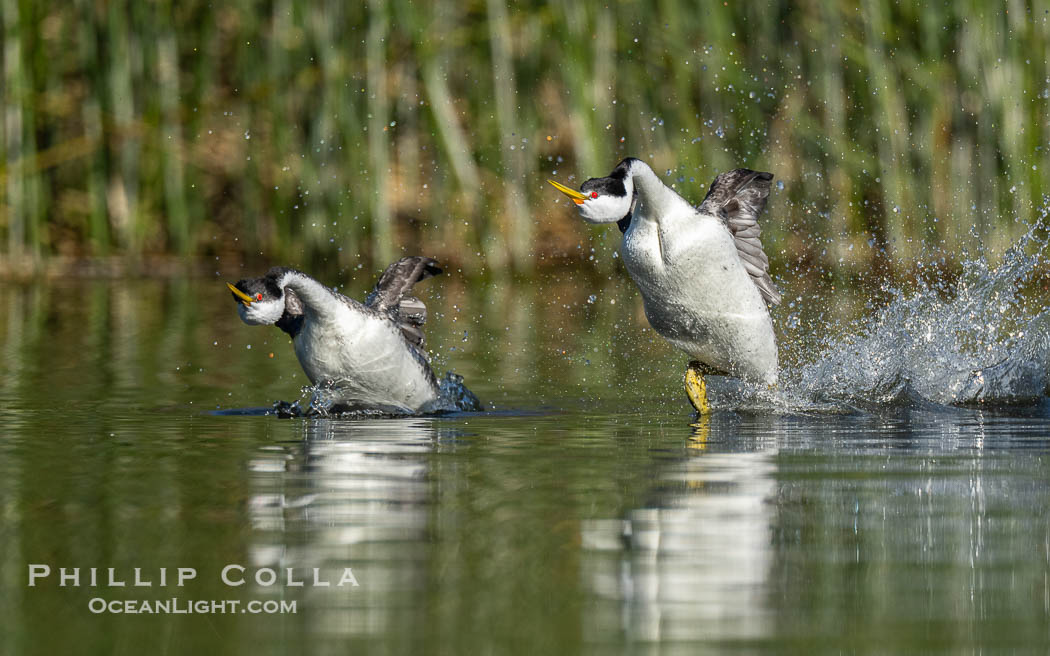
Western Grebes rushing across Lake Wohlford, exhibiting a spectacular courtship behavior in which the aquatic birds literally run across the surface of the water while their feet hit the water up to 20 times per second.
Image ID: 41545
Species: Western Grebe, Aechmophorus occidentalis
Location: Lake Wohlford, Escondido, California
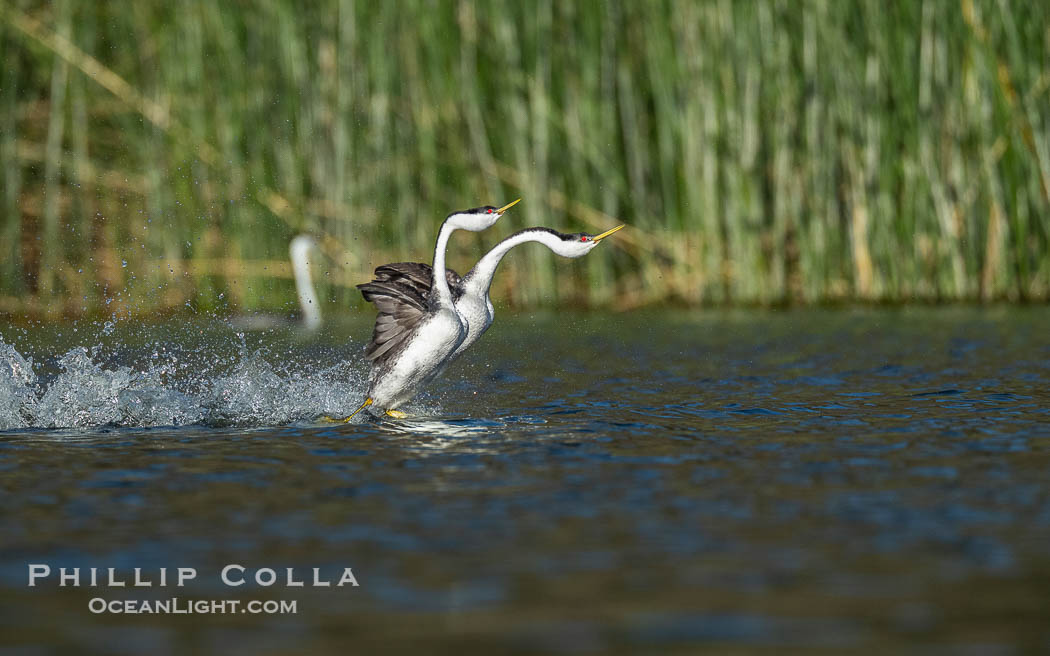
Western Grebes rushing across Lake Wohlford, exhibiting a spectacular courtship behavior in which the aquatic birds literally run across the surface of the water while their feet hit the water up to 20 times per second.
Image ID: 41546
Species: Western Grebe, Aechmophorus occidentalis
Location: Lake Wohlford, Escondido, California
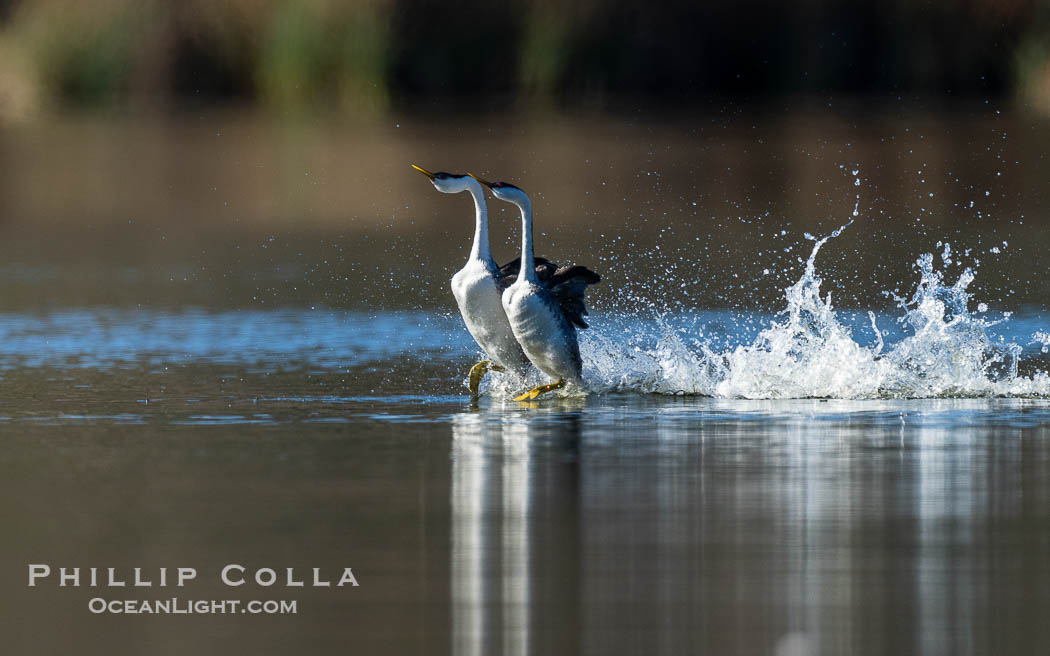
Western Grebes rushing across Lake Wohlford, exhibiting a spectacular courtship behavior in which the aquatic birds literally run across the surface of the water while their feet hit the water up to 20 times per second.
Image ID: 41547
Species: Western Grebe, Aechmophorus occidentalis
Location: Lake Wohlford, Escondido, California
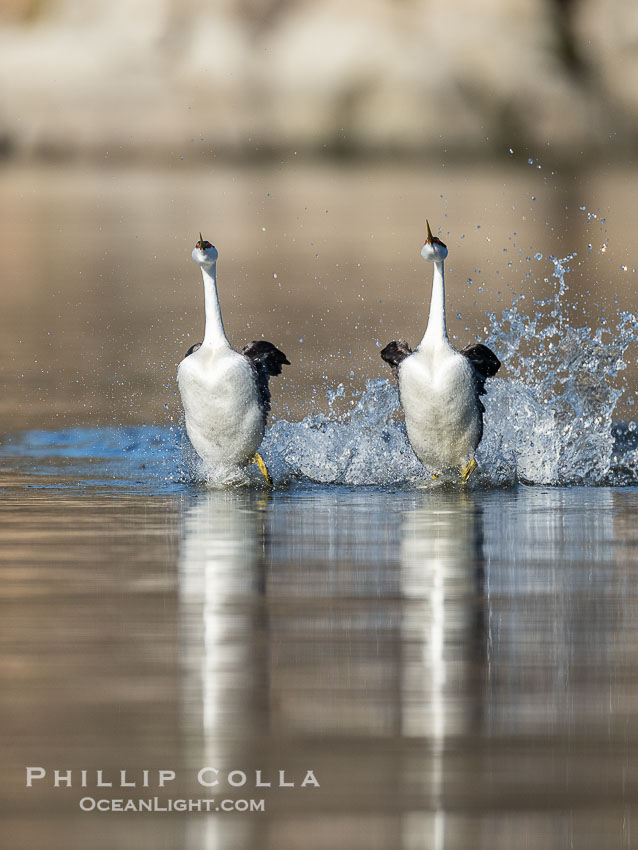
Two Western Grebes Rushing on Lake Wohlford near San Diego. Grebe rushing, a courtship behavior, happens when the birds slap the lake surface up to 20 times per second, literally running across the water.
Image ID: 41564
Species: Western Grebe, Aechmophorus occidentalis
Location: Lake Wohlford, Escondido, California
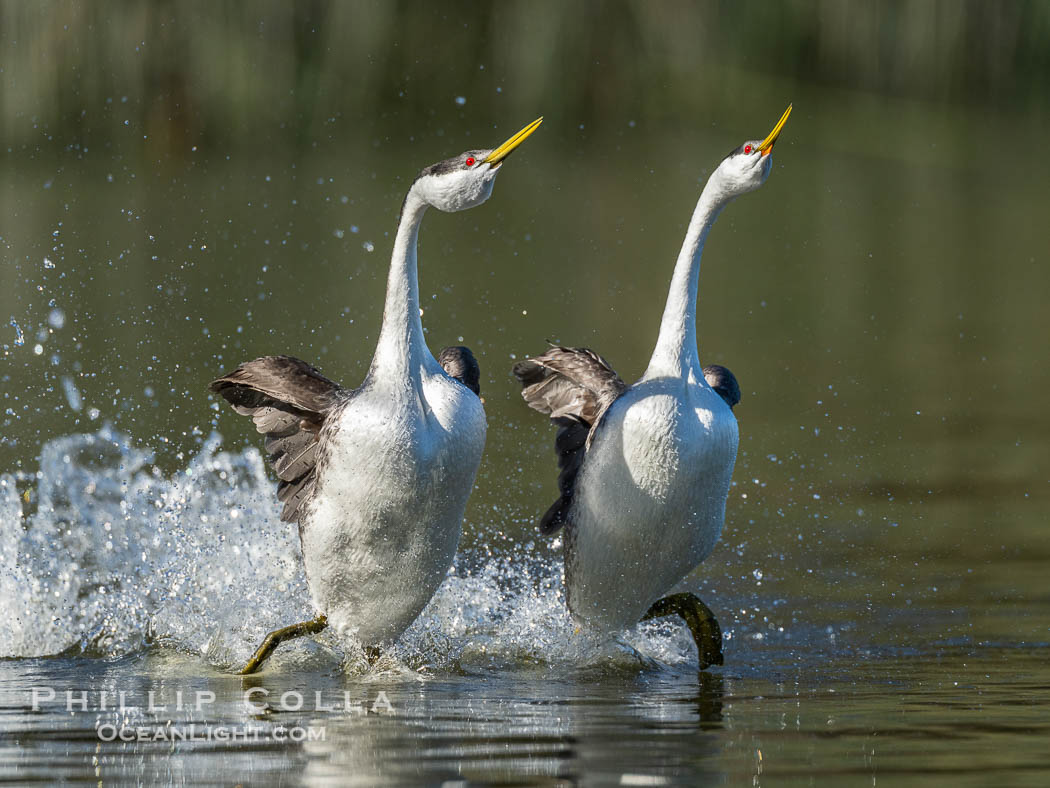
Western Grebes rushing on Lake Wohlford, running across the water by slapping their feet rapidly, part of the grebe's elaborate courtship.
Image ID: 41709
Location: Lake Wohlford, Escondido, California
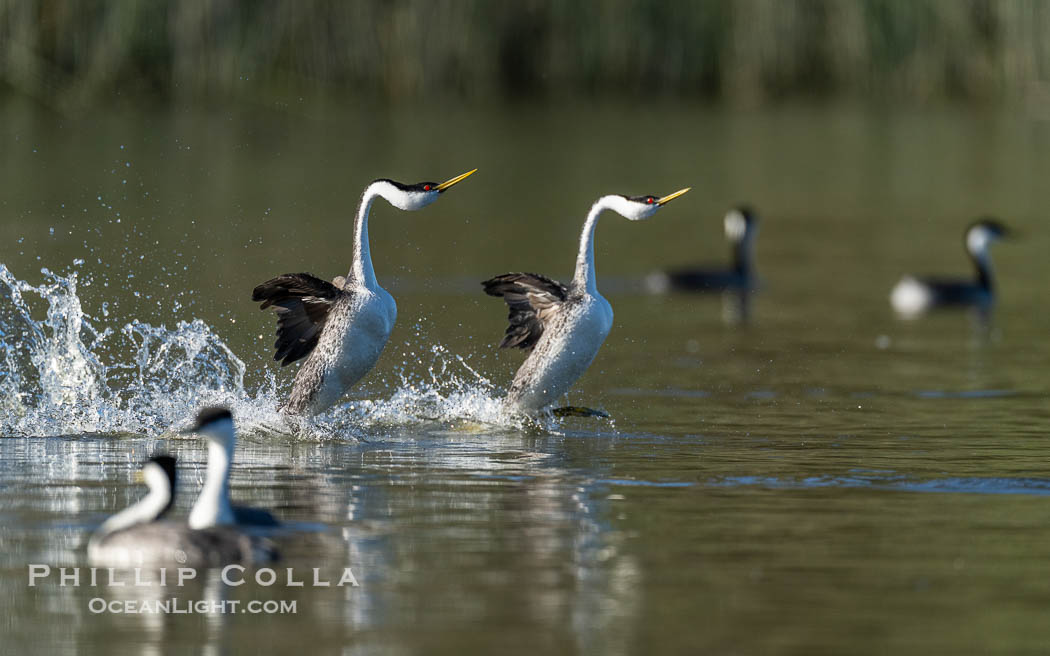
Western Grebes rushing on Lake Wohlford, running across the water by slapping their feet rapidly, part of the grebe's elaborate courtship.
Image ID: 41710
Location: Lake Wohlford, Escondido, California


