Ancient Bristlecone pine trees (Pinus longaeva) live in a relatively restricted area of eastern California, Nevada and Utah, typically at altitudes above 9500′. The ancient bristlecone pine tree is considered to be the world’s oldest species of tree (and indeed the world’s oldest sexually reproducing, nonclonal lifeform). A number of individual bristlecone pine trees are known to exceed 4000 years of age; the “Methuselah tree” in the Schulman grove was estimated to be 4838 years old in 2006. These extraordinarily hardy, gnarled and lonely trees are best seen in the Inyo National Forest in the White Mountains of California, where two exemplary groves (Schulman and Patriarch) can be accessed by car. These photos were taken in the Patriarch Grove, but my stock of images includes photos from the Schulman Grove as well.
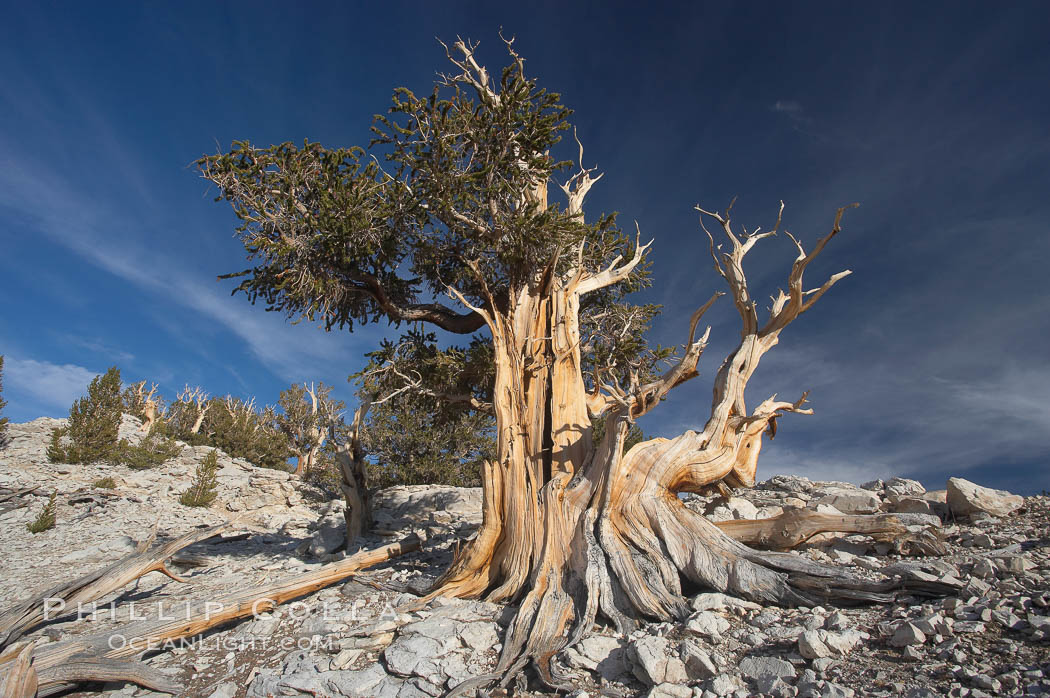
Bristlecone pine displays its characteristic gnarled, twisted form as it rises above the arid, dolomite-rich slopes of the White Mountains at 11000-foot elevation. Patriarch Grove, Ancient Bristlecone Pine Forest.
Image ID: 17475
Species: Bristlecone Pine, Pinus longaeva
Location: White Mountains, Inyo National Forest, California, USA
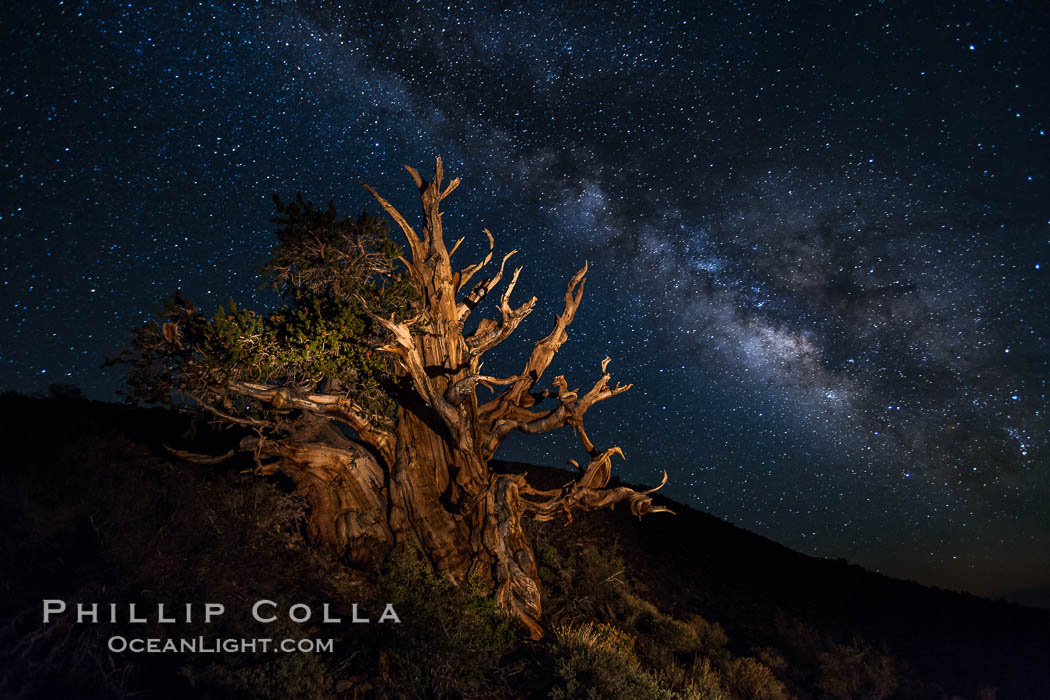
Stars and the Milky Way rise above ancient bristlecone pine trees, in the White Mountains at an elevation of 10,000′ above sea level. These are some of the oldest trees in the world, reaching 4000 years in age.
Image ID: 27782
Species: Bristlecone Pine, Pinus longaeva
Location: Ancient Bristlecone Pine Forest, White Mountains, Inyo National Forest, California, USA
Ancient bristlecone pine trees live at extremely high altitudes. In some regions, the lower treeline for bristlecone pines exceeds the upper treeline for all other species. Bristlecone forests often occur in areas where there is a strong carbonate content (limestone, dolomite and/or marble). In these barren, remote mountain areas, exposure to constant wind, excessive sun and bitter cold has molded the trees into remarkably gnarled, twisted shapes that have captured the interest of photographers and artists for years.
The trees do not grow tall — 60′ is about the tallest — but tend to be girthy with a wide base and roots that splay outward in all directions. Ancient bristlecone pine trees grow very slowly, and pine needles are infrequently dropped with some living for 30 years. Pinus longaeva has evolved a few strategies that yield such a long lifespan. Their wood is extraordinarily dense, and full of resin, making it nearly impossible for invasive bacteria and insects (what few there are in that inhospitable climate) to bore into and damage the wood. Bristlecone pines also tolerate a gradual dieback of their bark, in such a way that old specimens may have only a small amount of living bark. While the tree may appear dead or nearly so, this is actually an advantage as it lessens the bulk of living material the root system and crown must support. In some old trees, a thin strip of bark a foot or less in size is enough to support a healthy specimen.
Ancient bristlecone wood is so resistant to decay, and occurs in such an arid and cold environment, that fallen pieces dating back 8000+ years have been found in some groves. These pieces have been used in the calibration of the radiocarbon time-dating method, a technique which is employed in a broad range of scientific disciplines.
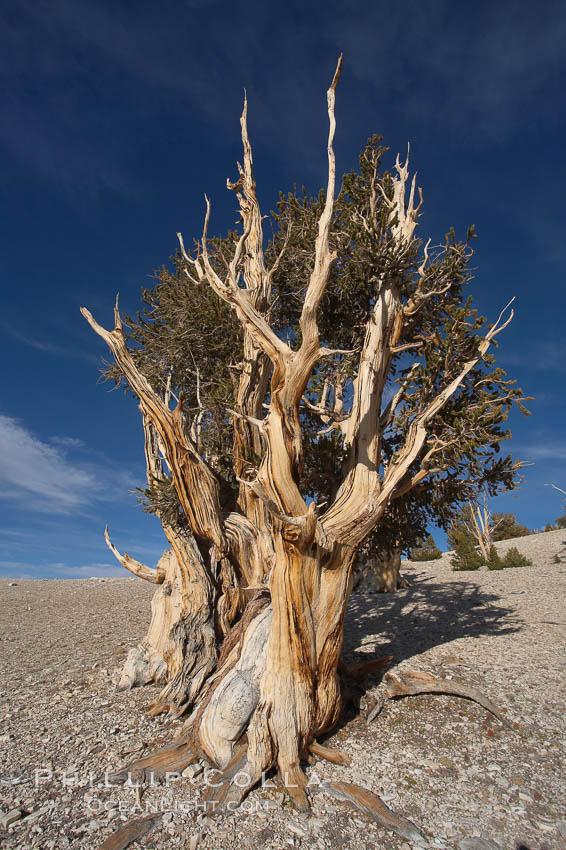
Bristlecone pine rising above the arid, dolomite-rich slopes of the White Mountains at 11000-foot elevation. Patriarch Grove, Ancient Bristlecone Pine Forest.
Image ID: 17476
Species: Bristlecone Pine, Pinus longaeva
Location: White Mountains, Inyo National Forest, California, USA
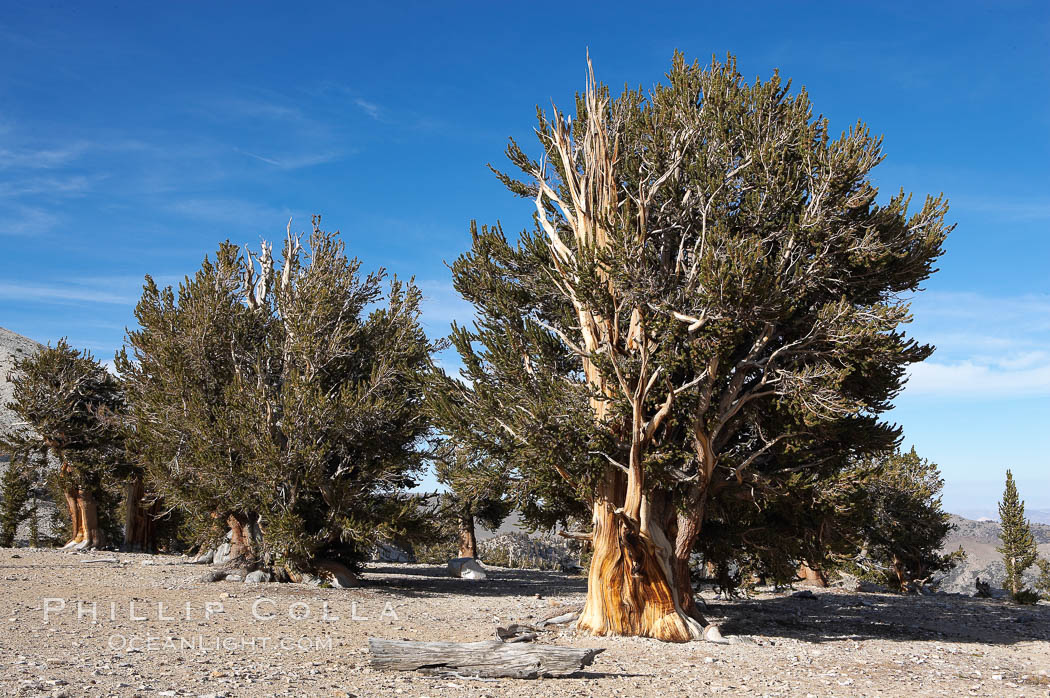
Bristlecone pines rising above the arid, dolomite-rich slopes of the White Mountains at 11000-foot elevation. Patriarch Grove, Ancient Bristlecone Pine Forest.
Image ID: 17478
Species: Bristlecone Pine, Pinus longaeva
Location: White Mountains, Inyo National Forest, California, USA
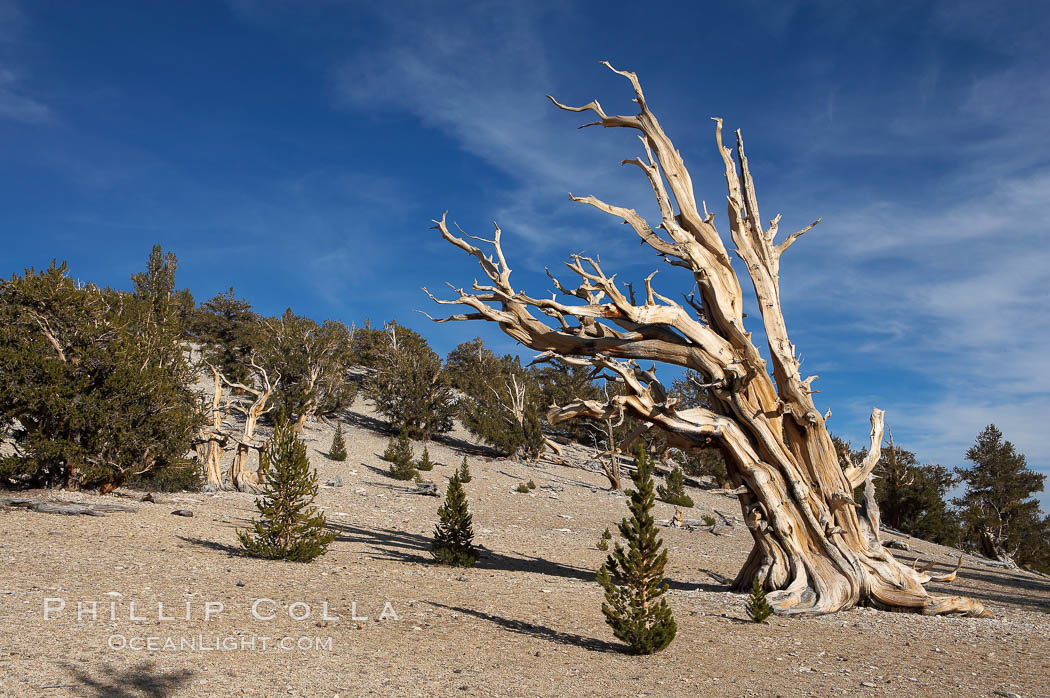
Bristlecone pines rising above the arid, dolomite-rich slopes of the White Mountains at 11000-foot elevation. Patriarch Grove, Ancient Bristlecone Pine Forest.
Image ID: 17479
Species: Bristlecone Pine, Pinus longaeva
Location: White Mountains, Inyo National Forest, California, USA
Ancient Bristlecone Pine Forest photos
Pinus longaeva photos
Bristlecone pine tree photo
Keywords: ancient, bristlecone, pine, tree, photo, picture, stock photos, image, pinus longaeva, california, white moun


