California Brown Pelican Photo, Natural History Photography Blog

California Brown Pelican Photo

View This Blog Post in Google Earth (How Cool Is That?)  View this blog entry in Google Earth
Latitude: 32° 51' 0.75" N, Longitude: 117° 16' 13.01" W, Coord: 32.850211°, -117.27028°
Filed under: California, Pelican, Photo of the Day, Wildlife on 1/16/2007

See our Guide to Photographing Pelicans in La Jolla.

I went down to one of my favorite spots in La Jolla yesterday morning, one I have visited each winter since the late ’80s, to test out a lens combination on the California brown pelicans (Pelecanus occidentalis) that rest along the cliffs. Here are a few snaps.
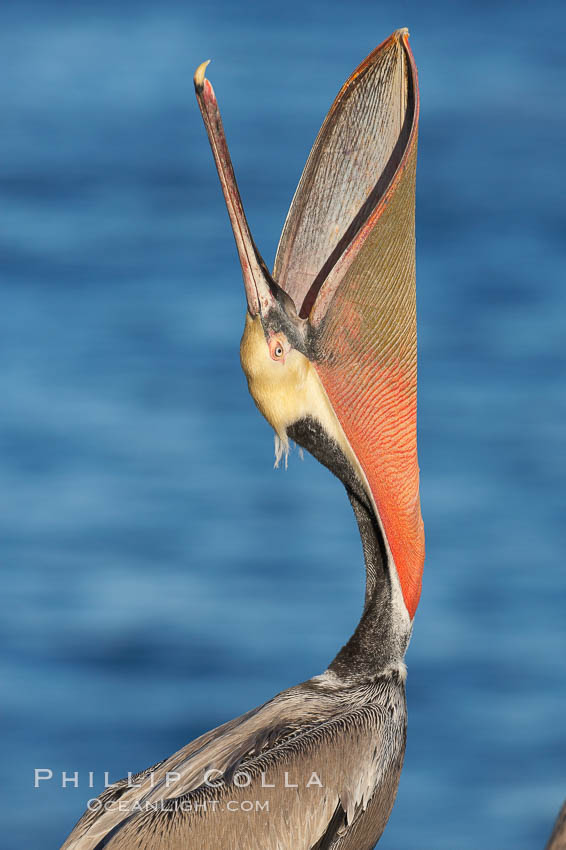
Brown pelican head throw.  During a bill throw, the pelican arches its neck back, lifting its large bill upward and stretching its throat pouch., Pelecanus occidentalis, Pelecanus occidentalis californicus,  Copyright Phillip Colla, image #18044, all rights reserved worldwide.
Brown pelican head throw. During a bill throw, the pelican arches its neck back, lifting its large bill upward and stretching its throat pouch. La Jolla, California, USA.
Image: 18044  
Species: Pelecanus occidentalis, Pelecanus occidentalis californicus
Location: La Jolla, California, USA
Click To View This Location in Google Earth.  You must have Google Earth installed for this feature to work correctly. View this Image in Google Earth!

 
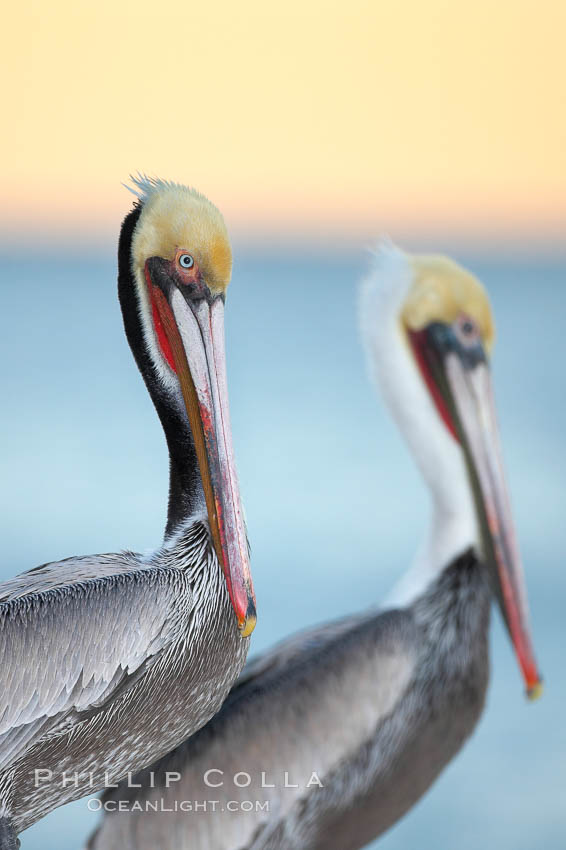
Brown pelicans, breeding plumage (left) and non-breeding adult (right), sunrise.  This large seabird has a wingspan over 7 feet wide. The California race of the brown pelican holds endangered species status, due largely to predation in the early 1900s and to decades of poor reproduction caused by DDT poisoning.  In winter months, breeding adults assume a dramatic plumage with brown neck, yellow and white head and bright red gular throat pouch., Pelecanus occidentalis, Pelecanus occidentalis californicus,  Copyright Phillip Colla, image #18047, all rights reserved worldwide.
Brown pelicans, breeding plumage (left) and non-breeding adult (right), sunrise. This large seabird has a wingspan over 7 feet wide. The California race of the brown pelican holds endangered species status, due largely to predation in the early 1900s and to decades of poor reproduction caused by DDT poisoning. In winter months, breeding adults assume a dramatic plumage with brown neck, yellow and white head and bright red gular throat pouch. La Jolla, California, USA.
Image: 18047  
Species: Pelecanus occidentalis, Pelecanus occidentalis californicus
Location: La Jolla, California, USA
Click To View This Location in Google Earth.  You must have Google Earth installed for this feature to work correctly. View this Image in Google Earth!

 
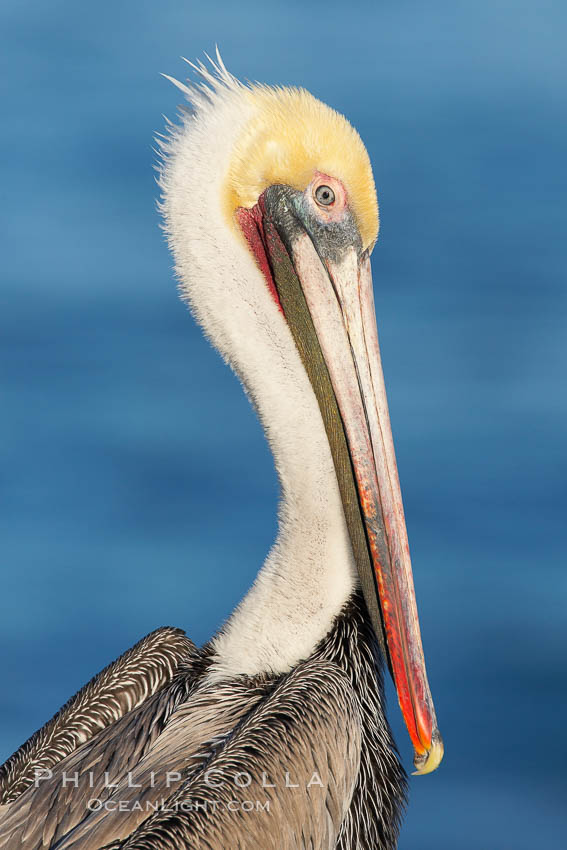
Brown pelican.  This large seabird has a wingspan over 7 feet wide. The California race of the brown pelican holds endangered species status, due largely to predation in the early 1900s and to decades of poor reproduction caused by DDT poisoning.  In winter months, breeding adults assume a dramatic plumage with brown neck, yellow and white head and bright red gular throat pouch., Pelecanus occidentalis, Pelecanus occidentalis californicus,  Copyright Phillip Colla, image #18043, all rights reserved worldwide.
Brown pelican. This large seabird has a wingspan over 7 feet wide. The California race of the brown pelican holds endangered species status, due largely to predation in the early 1900s and to decades of poor reproduction caused by DDT poisoning. In winter months, breeding adults assume a dramatic plumage with brown neck, yellow and white head and bright red gular throat pouch. La Jolla, California, USA.
Image: 18043  
Species: Pelecanus occidentalis, Pelecanus occidentalis californicus
Location: La Jolla, California, USA
Click To View This Location in Google Earth.  You must have Google Earth installed for this feature to work correctly. View this Image in Google Earth!

 
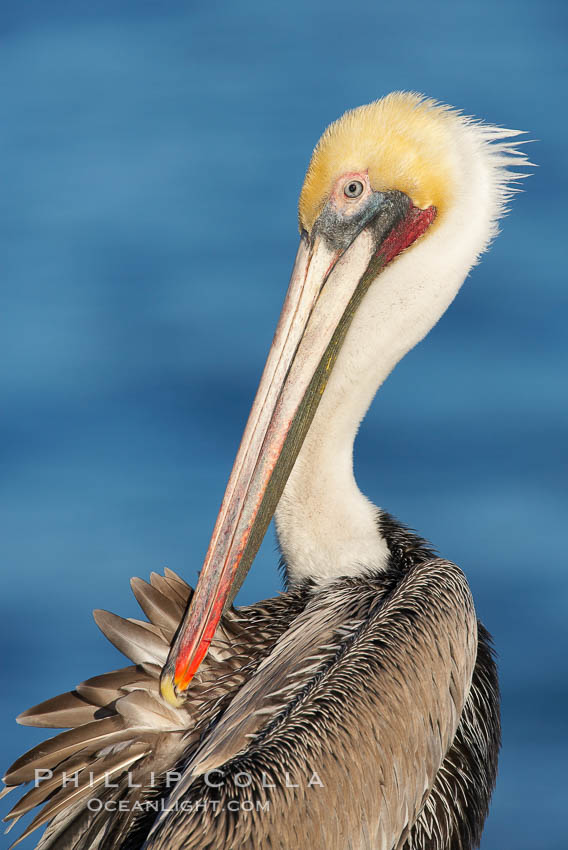
A brown pelican preening, reaching with its beak to the uropygial gland (preen gland) near the base of its tail.  Preen oil from the uropygial gland is spread by the pelican's beak and back of its head to all other feathers on the pelican, helping to keep them water resistant and dry. Adult winter non-breeding plumage showing white hindneck and red gular throat pouch., Pelecanus occidentalis, Pelecanus occidentalis californicus,  Copyright Phillip Colla, image #18045, all rights reserved worldwide.
A brown pelican preening, reaching with its beak to the uropygial gland (preen gland) near the base of its tail. Preen oil from the uropygial gland is spread by the pelican’s beak and back of its head to all other feathers on the pelican, helping to keep them water resistant and dry. Adult winter non-breeding plumage showing white hindneck and red gular throat pouch. La Jolla, California, USA.
Image: 18045  
Species: Pelecanus occidentalis, Pelecanus occidentalis californicus
Location: La Jolla, California, USA
Click To View This Location in Google Earth.  You must have Google Earth installed for this feature to work correctly. View this Image in Google Earth!

 
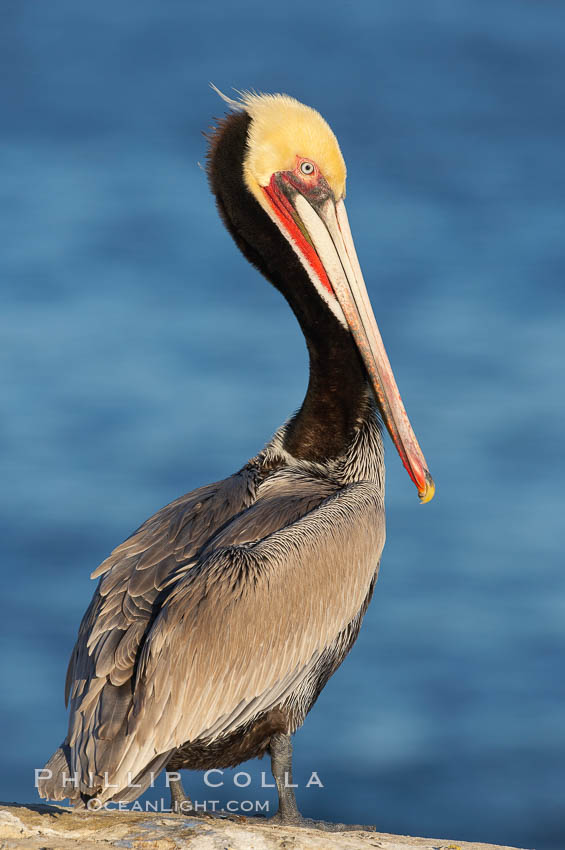
Brown pelican, adult winter non-breeding plumage showing white hindneck and red gular throat pouch..  This large seabird has a wingspan over 7 feet wide. The California race of the brown pelican holds endangered species status, due largely to predation in the early 1900s and to decades of poor reproduction caused by DDT poisoning., Pelecanus occidentalis, Pelecanus occidentalis californicus,  Copyright Phillip Colla, image #18046, all rights reserved worldwide.
Brown pelican, adult winter non-breeding plumage showing white hindneck and red gular throat pouch.. This large seabird has a wingspan over 7 feet wide. The California race of the brown pelican holds endangered species status, due largely to predation in the early 1900s and to decades of poor reproduction caused by DDT poisoning. La Jolla, California, USA.
Image: 18046  
Species: Pelecanus occidentalis, Pelecanus occidentalis californicus
Location: La Jolla, California, USA
Click To View This Location in Google Earth.  You must have Google Earth installed for this feature to work correctly. View this Image in Google Earth!


See: brown pelican photos.

2 Comments »

  1. My husband and I are EXTREME amatures, we love to try and just being there is wonderful. Thank you for all the great information on the Brown Pelicans in La Jolla and the incredible images!

    Comment by Dora Bianchini — 1/18/2011 @ 8:57 am

  2. Dora, you are very welcome!

    Comment by Phil — 1/18/2011 @ 10:46 am


Leave a comment


HOME | Online Image Search | Photo of the Day | Contact / Bio | Licensing/Pricing | Prints | Stock List | Image Hierarchy | List of Log Entries | Site Map | Blue Whale | Cetaceans | Pinnipeds | Sharks | Rays | Fishes | Kelp Forest | Sea Birds | Inverts | Man & Animal | Man & Ocean | Ocean & Light | Ocean & Motion | Portraits | About Color and Monitor Calibration | Copyright Statement | All text and photographs copyright © Phillip Colla Natural History Photography   All rights reserved worldwide. The content of this site is made available for purposes of researching images offered for license by Phillip Colla Natural History Photography.  No image is to be copied, duplicated, modified or redistributed in whole or part without the prior written permission of Phillip Colla Natural History Photography.  Whale logo is a trademark of Phillip Colla Natural History Photography, 8021 Paseo Arrayan, Carlsbad, CA 92009, USA.  760.707.7153  Email: oceanlight@OceanLight.com    Web: www.OceanLight.com      Portfolios: www.Gygis.com

Updated: June 19, 2013