Darwin’s Arch is a spectacular natural rock arch that rises above the ocean offshore of Darwin Island in the Galapagos Archipelago. (Typical of most islands in the Galapagos, Darwin Island has a second name that often appears on nautical charts: Culpepper Island.)
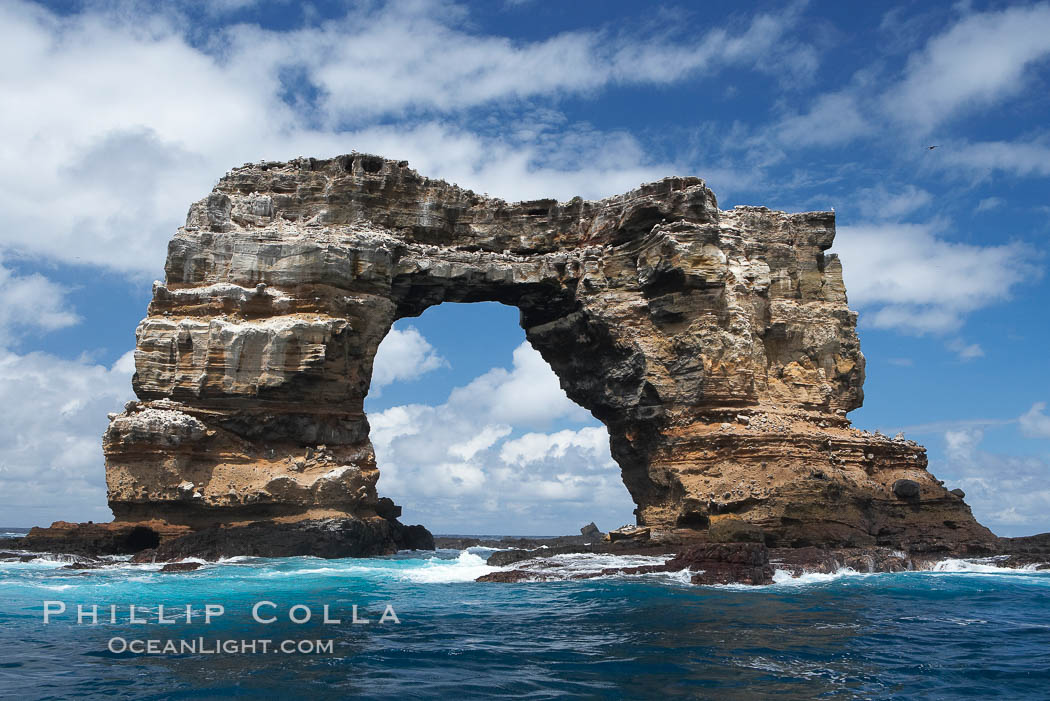
Darwins Arch, a dramatic 50-foot tall natural lava arch, rises above the ocean a short distance offshore of Darwin Island.
Image ID: 16621
Location: Darwin Island, Galapagos Islands, Ecuador
Darwin’s Arch is a natural lighthouse of sorts, marking the end of a reef, the point where the reef’s foul shallow area drops off into deeper water. Darwin’s Arch also marks what many believe is the finest scuba dive in the world, a wild underwater place where anything can happen. There are other dives one can make at Darwin Island but “diving the arch” is what visitors to the island want to do, over and over. The reef slope here is a mix of lava and coral that drops to a sand bottom which itself grows deeper as it slopes away from the island and the arch. Strong currents sweep over the reef; at times these currents are strong enough to carry divers away, and the diving here can be uncomfortable or intimidating to a novice diver. It is not uncommon to see enormous schools of scalloped hammerhead sharks here, lined up in the current and numbering in the hundreds or thousands. Schools of Barberfish and small groups of king angelfish congregate above the reef, drawing individual hammerheads down from their schools to hover over the reef to be cleaned of parasite and bits old skin. Other species of sharks are seen here as well, the most notable of which is the enormous whale shark, the largest fish in the sea.
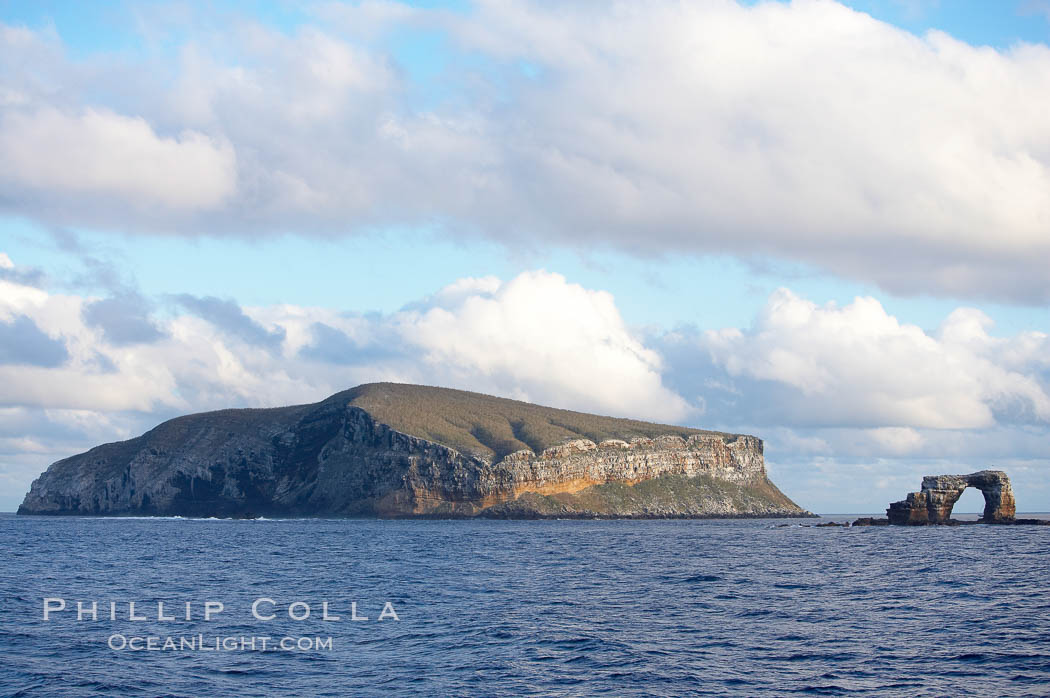
Darwin Island, with the Arch on the right. Darwin Island is the northernmost of the Galapagos Islands and is home to enormous numbers of seabirds.
Image ID: 16622
Location: Darwin Island, Galapagos Islands, Ecuador
In 1994 we dove Darwin’s Arch repeatedly over a four-day stretch and had encounters with whale sharks on every single dive. In 1997, during the second year of a particularly strong El Nino cycle, we arrived at Darwin Island to find its underwater haunts almost dead, with no large animals of any kind and very few schools of fish. The water was simply too warm. It was a stark and disappointing contrast to what we had seen just a few years prior. Our 2006 trip offered five days of unbelievable hammerhead schools with literally thousands on each dive. Every time we hopped in the water, we had hammerheads around us for a solid hour, continuously from the moment we entered the water until we were picked up by the panga. We would end our dives at the arch surrounded by huge schools of Pacific creolefish, large enough to block out the sun, which hover in walls 40-50 yards out from the reef. As we reached the surface and began to drift away from the island on the current, hoping our panga drivers would come find us quickly, we were usually visited by large, inquisitive bottlenose dolphins.
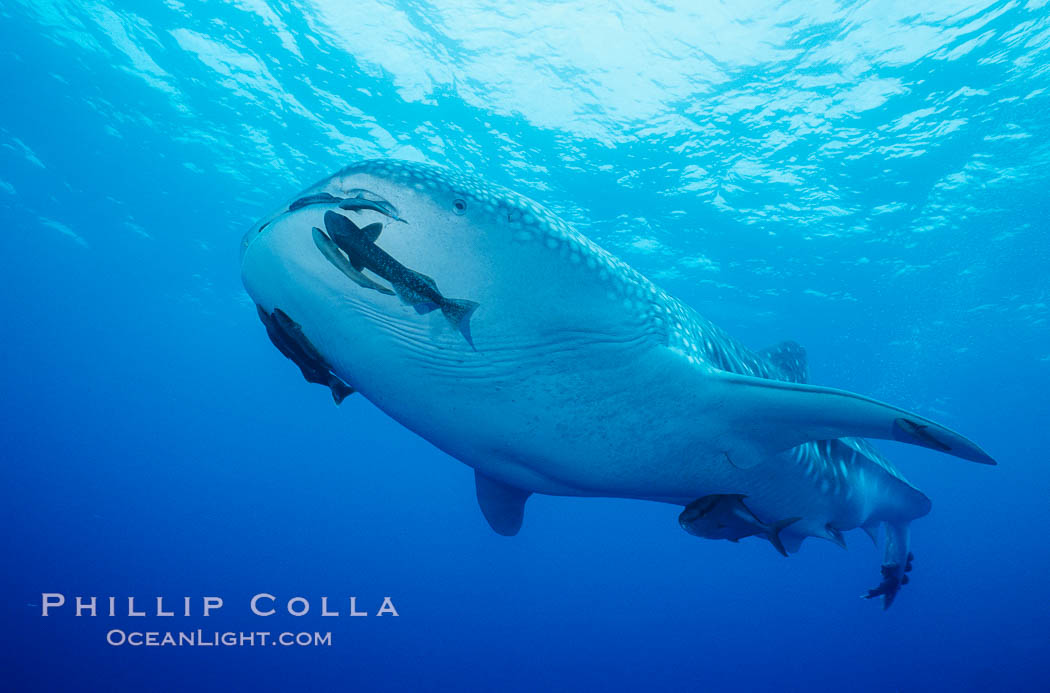
A whale shark swims through the open ocean in the Galapagos Islands. The whale shark is the largest shark on Earth, but is harmless eating plankton and small fish.
Image ID: 01520
Species: Whale shark, Rhincodon typus
Location: Darwin Island, Galapagos Islands, Ecuador
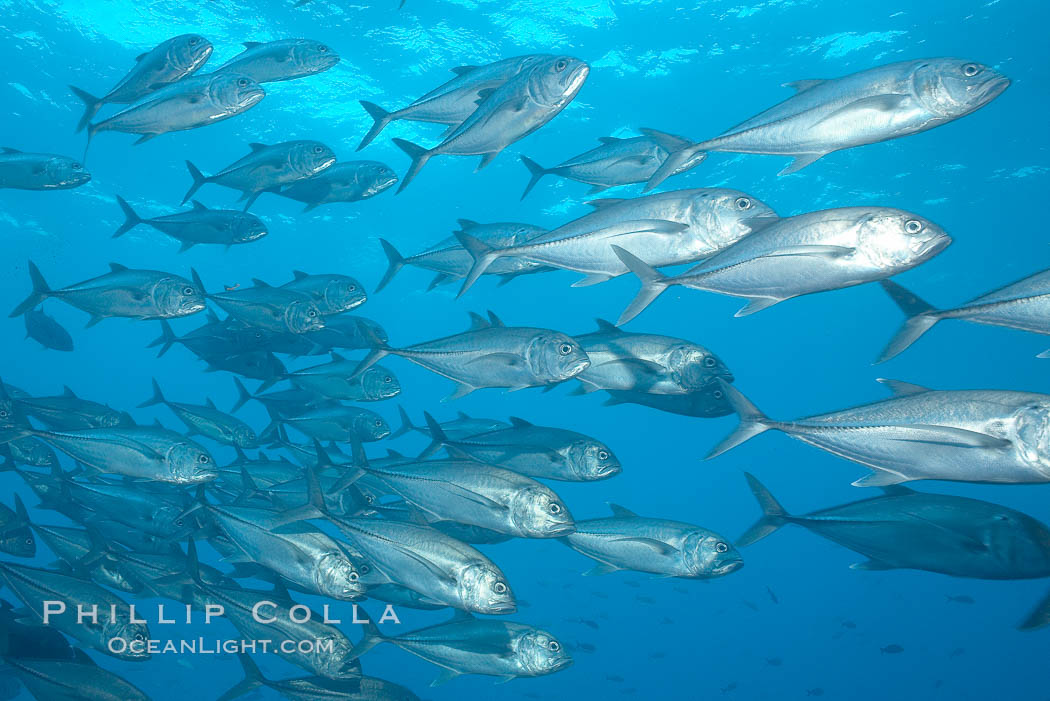
Bigeye trevally jacks, schooling.
Image ID: 16346
Species: Bigeye jack, Caranx sexfasciatus
Location: Darwin Island, Galapagos Islands, Ecuador
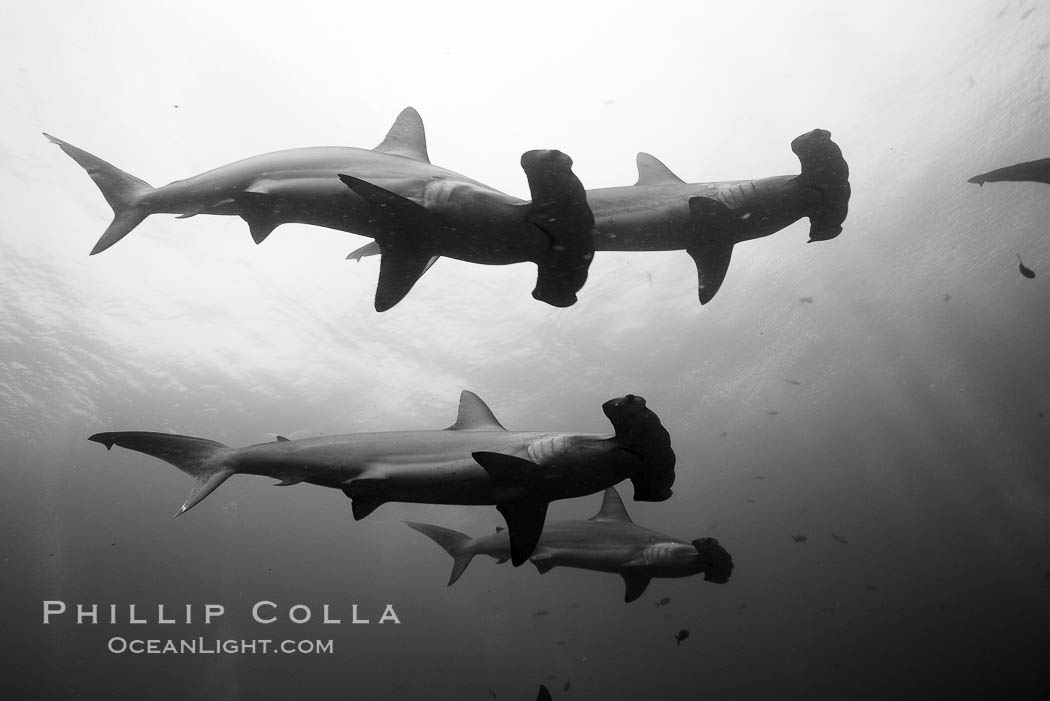
Hammerhead sharks, schooling, black and white / grainy.
Image ID: 16254
Species: Scalloped hammerhead shark, Sphyrna lewini
Location: Darwin Island, Galapagos Islands, Ecuador
See also: Darwin’s Arch photo


