by Phillip Colla and Harrison “Skip” Stubbs, Ph.D.
This blog post is now available as a downloadable PDF article.
This post was originally published in Ocean Realm Magazine in the Spring 1997 issue, one of a series of articles I contributed to Ocean Realm in the ’90s. In August 1995 a thirteen-member inter-agency scientific team of which Skip and I were a part visited Rose Atoll National Wildlife Refuge to assess injury caused by the 1993 grounding of a Taiwanese fishing vessel. While the specific injuries to Rose Atoll are unique and the coralline algae composition of the atoll is uncommon, many other isolated atolls worldwide face similar dangers. It is their remote nature, and the unique assemblages of life that they often support, that make such atolls special. Yet their isolation also means that little, if any, enforcement to protect them from damage by fishing and shipping activities exists. The authors collected photographic and videotape evidence in support of litigation and ongoing injury assessment and research efforts. Rose Atoll NWR is jointly managed by the United States and American Samoa governments and on January 6, 2009 became a National Marine Monument.
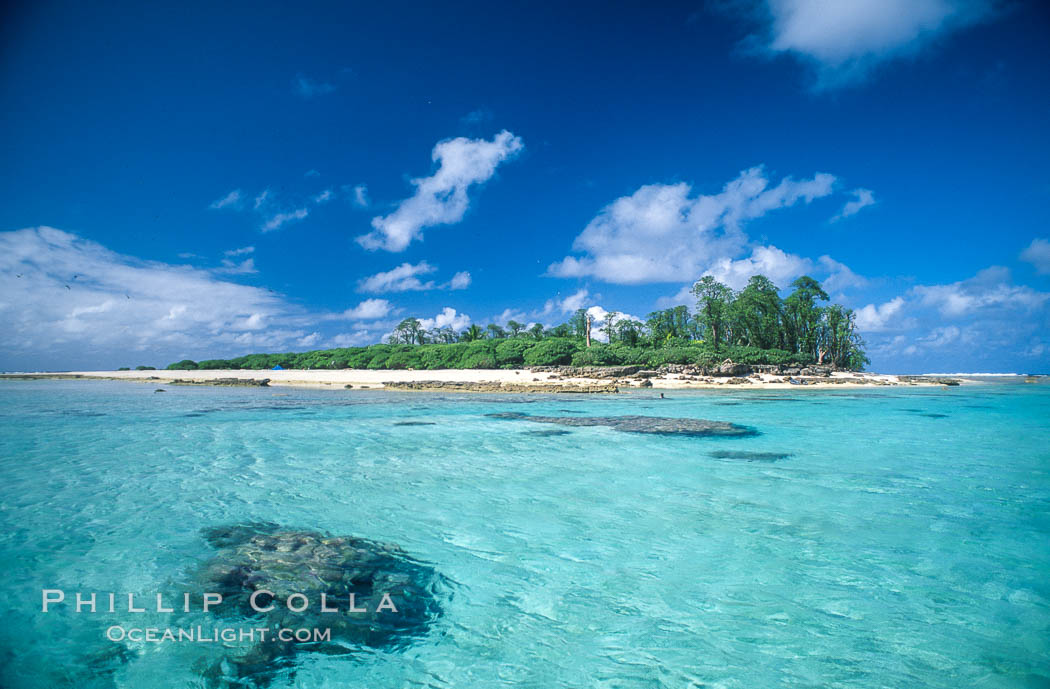
Rose Islet.
Image ID: 00839
Location: Rose Atoll National Wildlife Sanctuary, American Samoa, USA
Remote, tiny and unprotected, Rose Atoll stands alone at the eastern extreme of the Samoan archipelago, 14 degrees south of the equator and southernmost among National Wildlife Refuges. Among the world’s smallest and most pristine atolls, Rose is a nearly square reef surrounding an azure lagoon dotted with coralline bommie towers. Tiny Rose Island rises above the waterline at the atoll’s eastern corner. Rose Atoll’s beauty lies not only in its geometry but in the vibrant pink hue of its reefs — it is one of the few atolls whose primary element of construction is the pink calcareous coralline alga Porolithon.
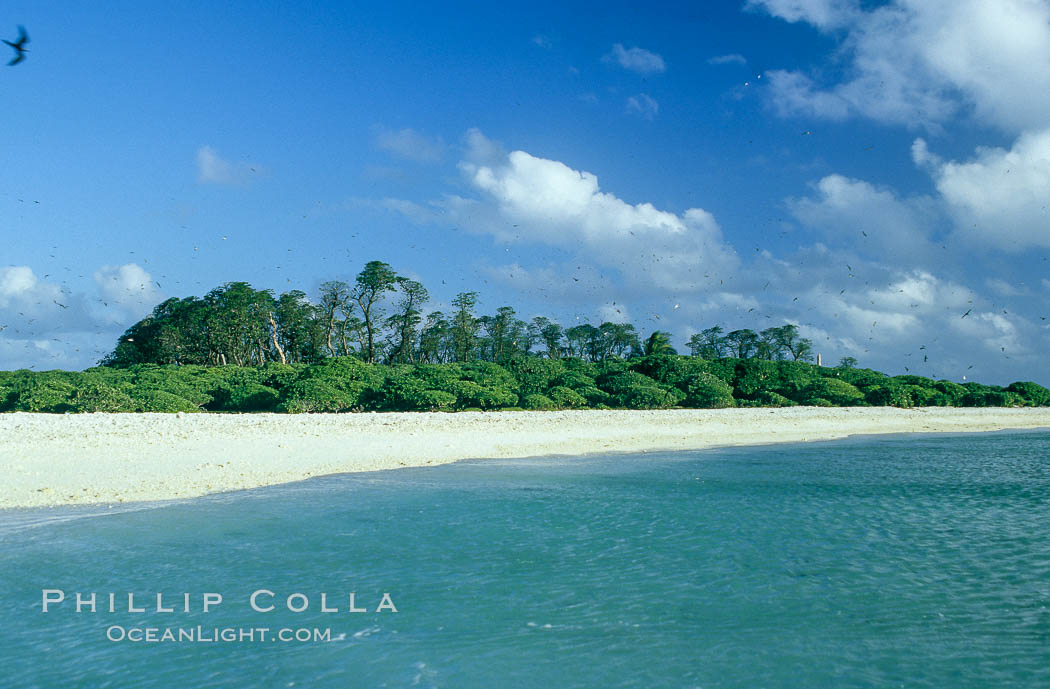
Rose islet and Pisonia trees.
Image ID: 00830
Location: Rose Atoll National Wildlife Sanctuary, American Samoa, USA
Rose’s reef system is of the classic spur-and-groove type: massive coralline shoulders extending outward from the atoll separated at regular intervals by deep troughs, grooves through which open ocean wave energy is funneled back to sea. The shallow reef flat surrounding Rose’s interior lagoon is broken only at the atoll’s northern corner by an ava, an opening through which water, elevated within the lagoon by a constant influx of waves, rushes out in a perpetual current. Where the submarine outer reef graduates from a ledge to reef flat is the forereef, an abrupt ten-foot wall of cement-hard coralline algae just beneath the waterline. Crucial to the health of the entire atoll, the forereef acts as a structural armoring that reflects and dissipates wave energy and protects the reef flat from erosion. Injury to the forereef could change gross reef structures and alter established current patterns about the atoll, allowing new avenues of erosion to threaten the atoll’s fragile island.
An Eden in the center the Pacific, Rose Atoll is lonely and beautiful, but virgin no more. The pristine nature of Rose Atoll was violated in October 1993 when the Taiwanese fishing vessel Jin Shiang Fa ran aground on the atoll’s southwest arm. The destructive effect of this event on Rose Atoll was, and continues to be, many-faceted and difficult to quantify.
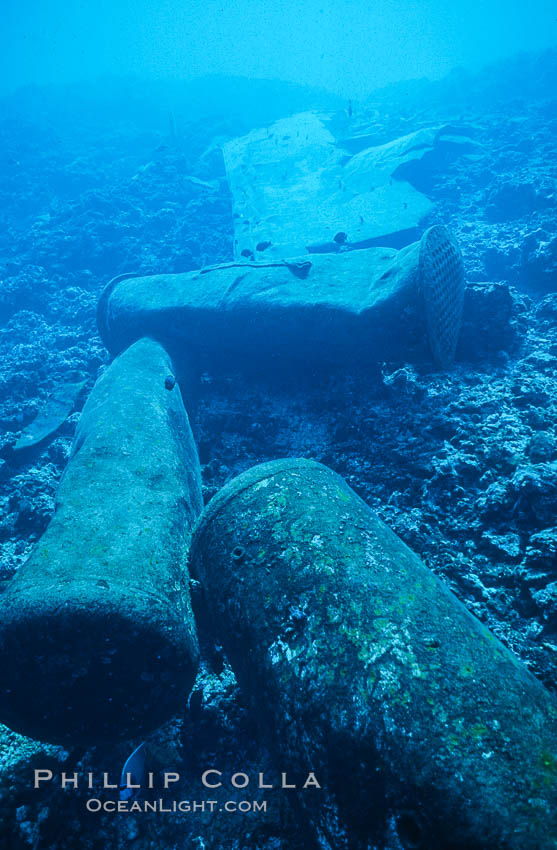
Debris, wreck of F/V Jin Shiang Fa.
Image ID: 00807
Location: Rose Atoll National Wildlife Sanctuary, American Samoa, USA

Propellor and debris, wreck of F/V Jin Shiang Fa.
Image ID: 00810
Location: Rose Atoll National Wildlife Sanctuary, American Samoa, USA
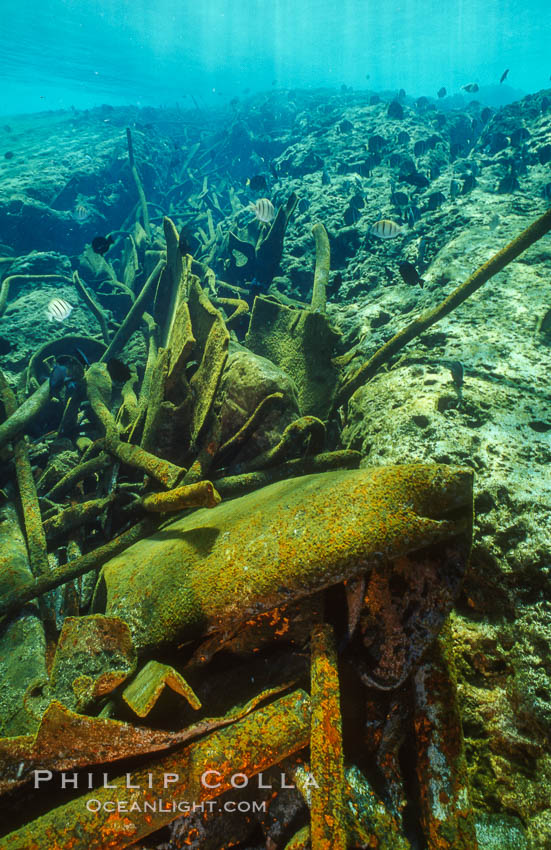
Debris, wreck of F/V Jin Shiang Fa.
Image ID: 00827
Location: Rose Atoll National Wildlife Sanctuary, American Samoa, USA
Structural reef injury to the southwest arm of the atoll was extensive. The Jin Shiang Fa hit the reef obliquely, plowing a deep trench through several reef spurs before coming to rest hard aground. Debris washed overboard, including fishing line, nets, garbage and plastics, snagging on coral heads at the wreck site and in the lagoon. For months, major hull sections remained perched on the reef ledge against the forereef and gradually broke apart in pounding waves, slamming into the forereef wall and carving deep gouges in the brittle coralline reef structure before being towed off the ledge and dumped into deep water by a salvage tug. Remaining are many fragments of the boat that may never be removed. Mangled refrigeration pipes and balls of line are wedged in the reef ledge and the forereef wall. Thirty-foot long hull plates, boiler tanks and much of the vessel’s superstructure slid in pieces down the outer slope of the atoll, leaving behind a swath of crushed reef. In 1994 many of these massive fragments returned to the shallow reef ledge, lifted by hurricane waves, while some pieces came to rest on the reef flat or all the way into the lagoon. Virtually all of the hull debris is still subject to wave movement and continues to erode and weaken the protective forereef, sending a smothering layer of sand up onto the reef flat.
Changes to the atoll precipitated by the release of toxic chemicals may ultimately prove to be more devastating than the grounding itself. The Jin Shiang Fa’s fuel tanks broke open along with a refrigeration system, spilling approximately 100,000 gallons of diesel, 500 gallons of lube oil and 2,500 pounds of ammonia that eventually spread over portions of the outer reef, reef flat, lagoon and ava. A survey conducted two weeks after the grounding, while the vessel was still leaking oil, found evidence of extensive die-off of reef invertebrates (including Tridacna clams and Echinometra urchins) and major reef-building coralline algae (Lithophyllum and Porolithon). Five months later, most of the southwest reef was covered with invasive filamentous cyanobacteria (blue-green algae) which overgrew the reef-building coralline algae. These patches of cyanobacteria marked areas of stressed or dead coralline algae since, for healthy coralline algae, growth occurs just below a thin surface layer that is constantly sloughed off as a natural defense.
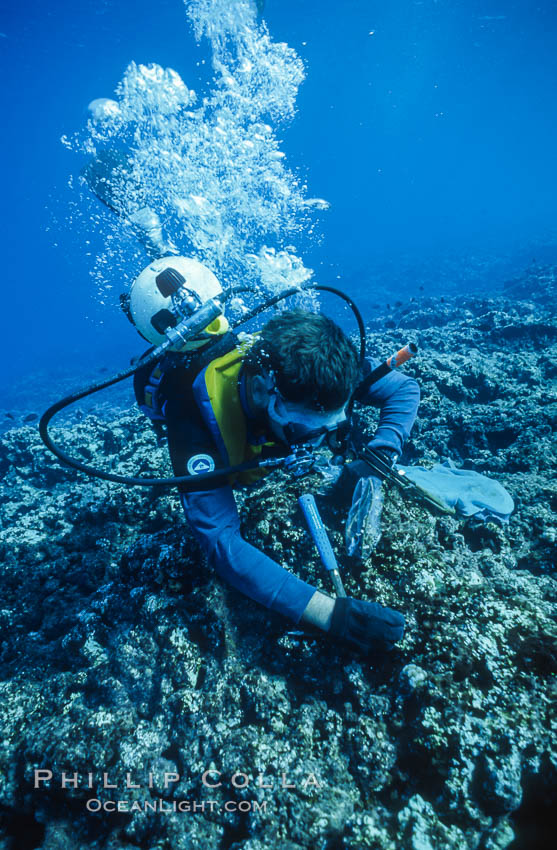
Paul W. Gabrielson, Ph.D., collecting algae and coral samples.
Image ID: 00824
Location: Rose Atoll National Wildlife Sanctuary, American Samoa, USA
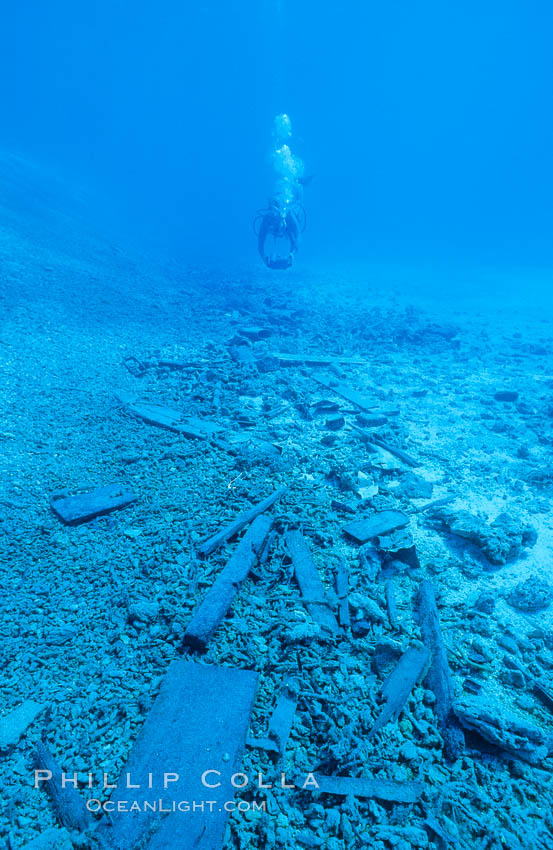
Debris from wreck of F/V Jin Shiang Fa.
Image ID: 00793
Location: Rose Atoll National Wildlife Sanctuary, American Samoa, USA
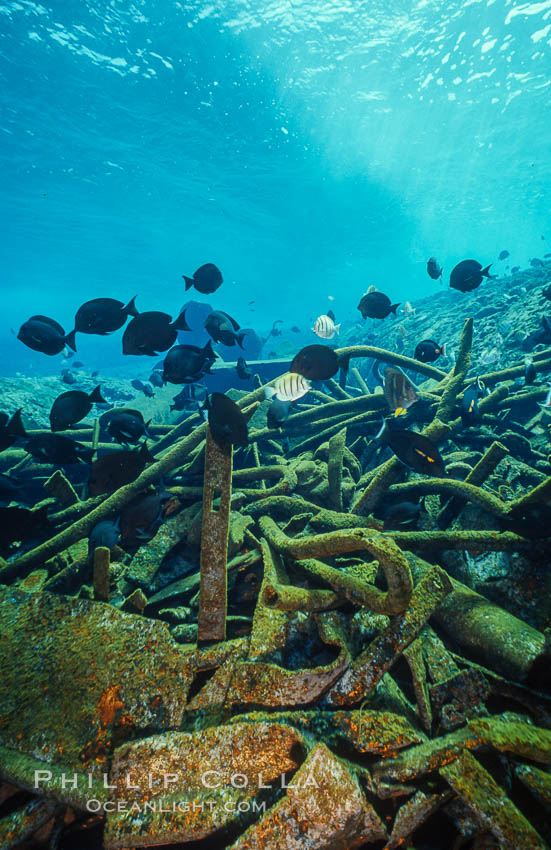
Debris, wreck of F/V Jin Shiang Fa.
Image ID: 00814
Location: Rose Atoll National Wildlife Sanctuary, American Samoa, USA
Our survey dives at Rose Atoll were superb. Along the outer reef we could constantly hear the vocalizations of the South Pacific humpbacks that swam near us several times. Well away from the wreck site, vast tracts of pastel pink coralline algae and clear water dominate the underwater landscape, a canvas across which is painted a menagerie of wary gray and black-tip reef sharks, swirling blue-spotted jacks and parrotfish schooling by the hundreds. Near the ava sea turtles cruise the reef, soon to mate in the lagoon and nest on either Rose Island or a small sandbar generously named Sand Island. Sixty-foot coralline towers in the lagoon are home to dense communities of Tridacna clams and strange clusters of procreating nudibranchs.
Yet each dive brought us a measure of dismay to temper our sense of wonder. The physical damage from the Jin Shiang Fa is stunning and contrasts harshly with the sections of pristine reef that we had seen earlier. A deep hull scar leads directly to the grounding site where the engine block and propellers, massive enough to resist hurricane waves, sit in the deep bowls that they have gouged out of the shallow reef ledge. Along the forereef and ledge, thick coralline algae structures lie broken underneath the pipes, hull plating and antenna tower that litter the wreck site. Coral heads are wrapped in balls of fishing line replete with steel hooks poised to snag passersby. Chinese videotapes, hip waders, plastic tarps, storm boots and large metal tanks are spread across the sandy floor and the coral rubble slope inside the lagoon.
Most troubling were our reef flat observations. It seemed that the chemical spill injured the coralline algae, as well as the community of invertebrates that normally graze on cyanobacteria, enough to unnaturally trigger a succession of species that are replacing or smothering the reef-building Porolithon. Cyanobacteria, although ephemeral, was first to recruit and overgrow the reef flat. By our visit it had given way to the finely-branched, non-reef-building coralline alga Jania, which had spread to include about one-third of the entire reef flat, well beyond the wreck site. We found that, although earlier aerial surveys provided useful information on the gross effects of the ship wreck, ground-based and underwater field work is the best way to investigate the temporal dynamics of this tragedy. Unfortunately the remote location of Rose Atoll, which so long kept it pristine, may now hamper scientists who try to monitor its future.
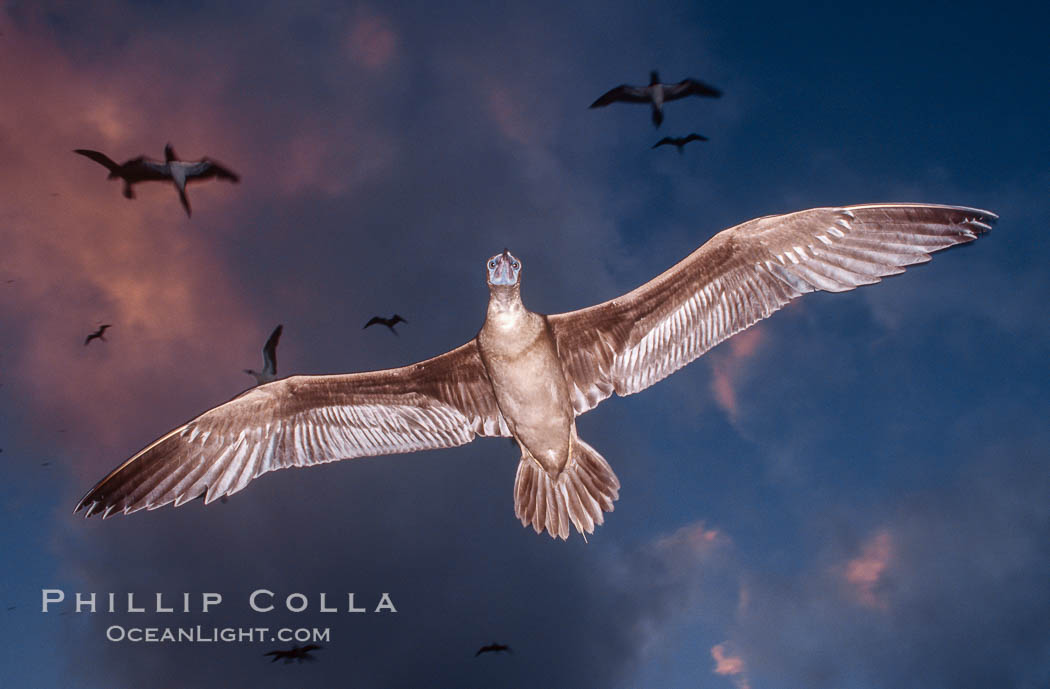
Brown booby flying over Rose Atoll at sunset, with dark colorful storm clouds and other birds in the background.
Image ID: 00914
Species: Brown booby, Sula leucogaster
Location: Rose Atoll National Wildlife Sanctuary, American Samoa, USA
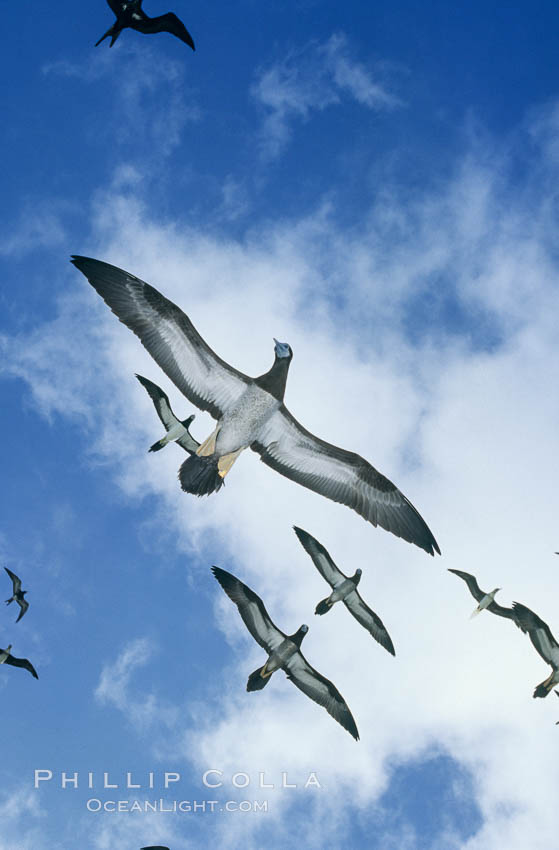
Brown boobies.
Image ID: 00908
Species: Brown booby, Sula leucogaster
Location: Rose Atoll National Wildlife Sanctuary, American Samoa, USA
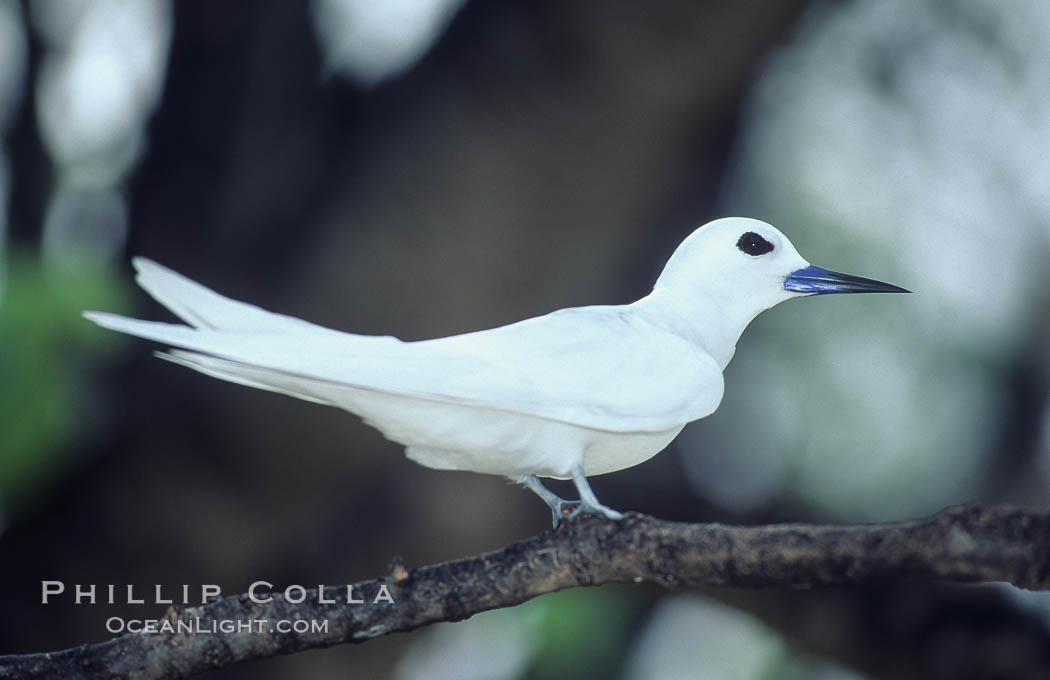
White (or fairy) tern.
Image ID: 00872
Species: Fairy tern, Gygis alba
Location: Rose Atoll National Wildlife Sanctuary, American Samoa, USA
Since we originally joined the science team to assist with underwater surveys of the wreck site, neither of us was prepared for what we would witness during our visits ashore, a spectacle of wildlife that emphasizes the critical importance of the atoll for nesting and roosting seabirds. While essentially only twenty acres of compacted coral rubble, tiny Rose Island manages to support a small forest of rare Pisonia trees and a rich assemblage of wheeling, diving, nesting, hatching and crying seabirds. Chicks and eggs seem to be under every bush and tree while juveniles walk openly about, fearless. Inquisitive boobies — red-footed, masked and brown — hover above the shoreline in large groups, crying incessantly. Brown noddies and sooty terns flush from the cover of Pisonia, soon to return to their stumbling chicks and nests laid on the barren coral rubble. Red-throated frigate birds hover high above, sky-borne pirates poised to steal a lesser bird’s catch. Diminutive white terns gracefully flutter about among the trees, pure alabaster but for their large black eyes and exotic blue beaks — could there be more delicate and enchanting creatures?
Such magical visits ashore afforded us time not only to intimately observe these captivating and naive birds but also to contemplate a sobering thought that is at the heart of our team’s work at Rose Atoll: This solitary speck of land atop the atoll, cradling a unique abundance of life, is nothing more than a fragile rubble aggregate, subject to the whim of tides and currents that may have already begun to change in the wake of the grounding.
Paul W. Gabrielson, Ph.D., collecting algae and coral samples.
Image ID: 00824
Location: Rose Atoll National Wildlife Sanctuary, American Samoa, USA
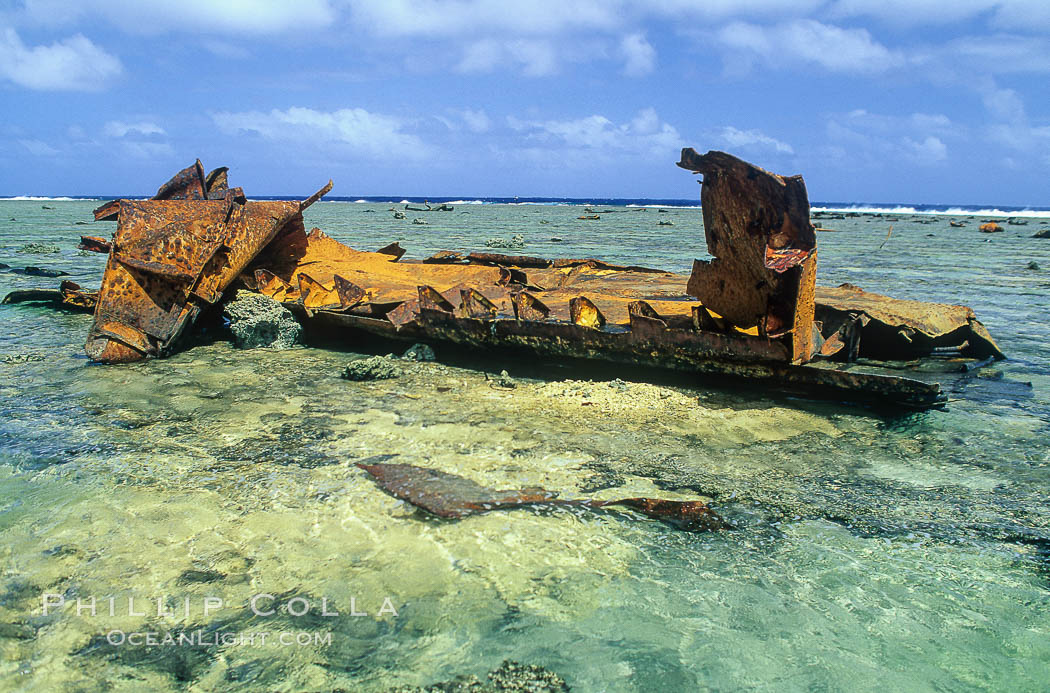
Wreck of F/V Jin Shiang Fa.
Image ID: 00709
Location: Rose Atoll National Wildlife Sanctuary, American Samoa, USA
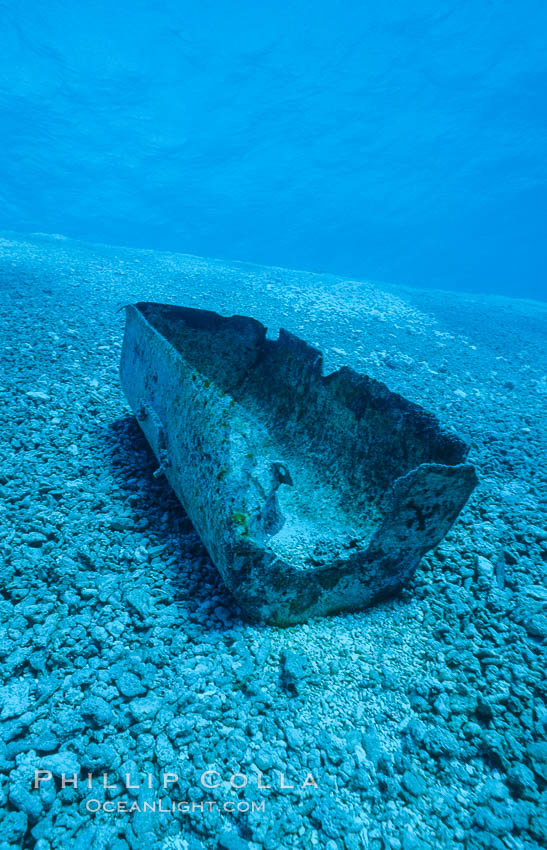
Debris from wreck of F/V Jin Shiang Fa, lagoon talus slope.
Image ID: 00789
Location: Rose Atoll National Wildlife Sanctuary, American Samoa, USA
Rose Atoll’s coralline algae reefs have managed to withstand natural disturbances such as hurricanes, varying salinity and changes in sea level. Can they also adapt to the unnatural changes caused by the Jin Shiang Fa? Of greatest concern is the death of the slow-growing, reef-building coralline algae through local structural reef injury and widespread toxin-induced die-off and replacement. The disappearance of these coralline algae may lead to long-term bioerosion that ultimately weakens the reef, altering current patterns and threatening the existence of Rose Island, its forest and its avian inhabitants.
Rose Atoll’s misfortune may ultimately serve to illustrate how delicate the link is between reef welfare and the existence of remote seabird and turtle nesting sites, and how vulnerable such ecosystems are worldwide. Groundings such as that of the Jin Shiang Fa injure tropical reefs and atolls, yet few such incidents occur in countries with the means and interest to carry out damage assessments, sponsor follow-up research efforts, or attempt to mitigate injury to the reef. By chance, had the Jin Shiang Fa ran aground elsewhere, would anyone have heard about it?


