Sun and Water Beget the Summer Girl
|
Wind becoming warm |
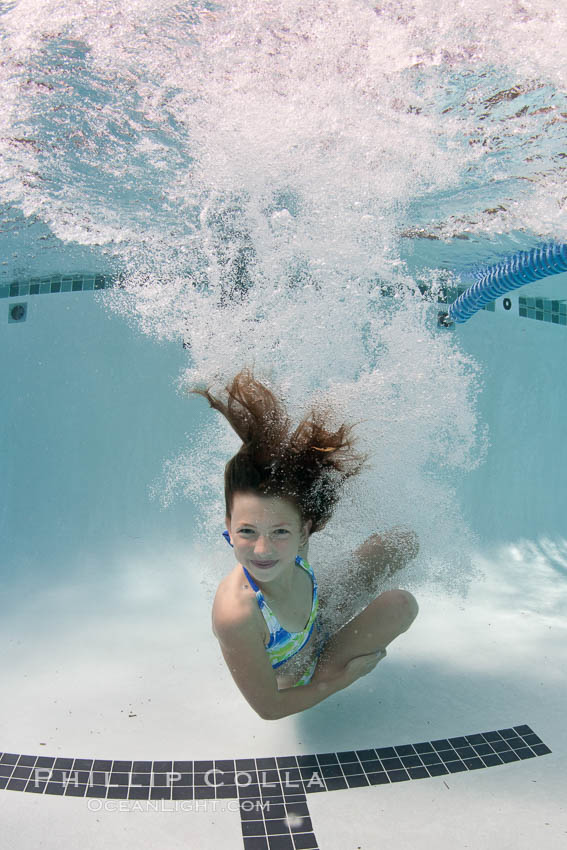
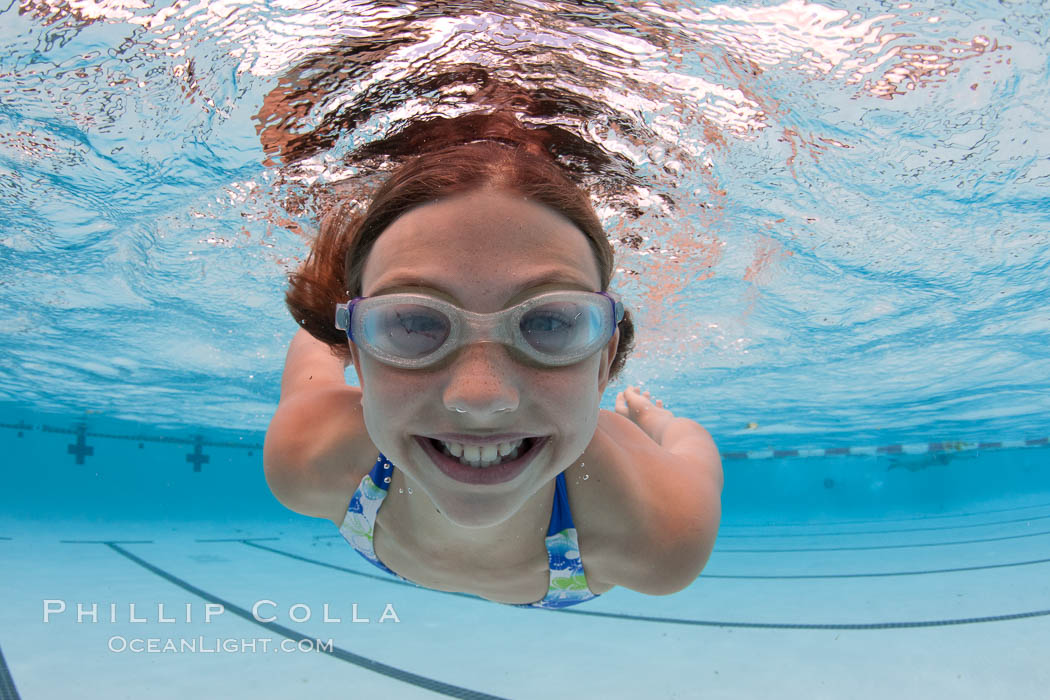
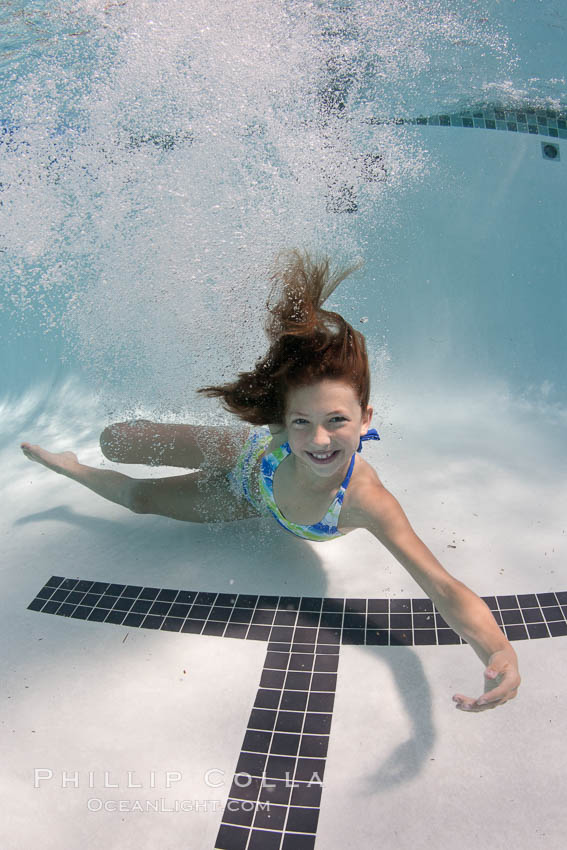
I am readying gear for a bit of diving, so I had to drag the camera out of deep storage and call upon one of my two favorite fitness models for a few test shots. Summer is almost here. I can tell by watching my girls. One was on the beach playing a volleyball tournament today, the other swimming in the pool. Life is good.
(Note to photographers: I am again reminded today that Canon’s 15mm fisheye is the sharpest lens for underwater purposes I have ever used. Due to its curved-field nature, and the fact that a camera behind a spherical dome underwater is forced to focus on a curved-field virtual image, a good fisheye lens holds sharpness further into the corners while flat field lenses break down and go soft. I have been a sucker for very wide lenses since I first picked up a camera — why the hell would anyone waste their time on macro when the big picture is out there waiting to be told? — and the Canon 15mm and Nikon 16mm fisheye lenses are two of my favorites.)
![]() |
![]() |
![]() |
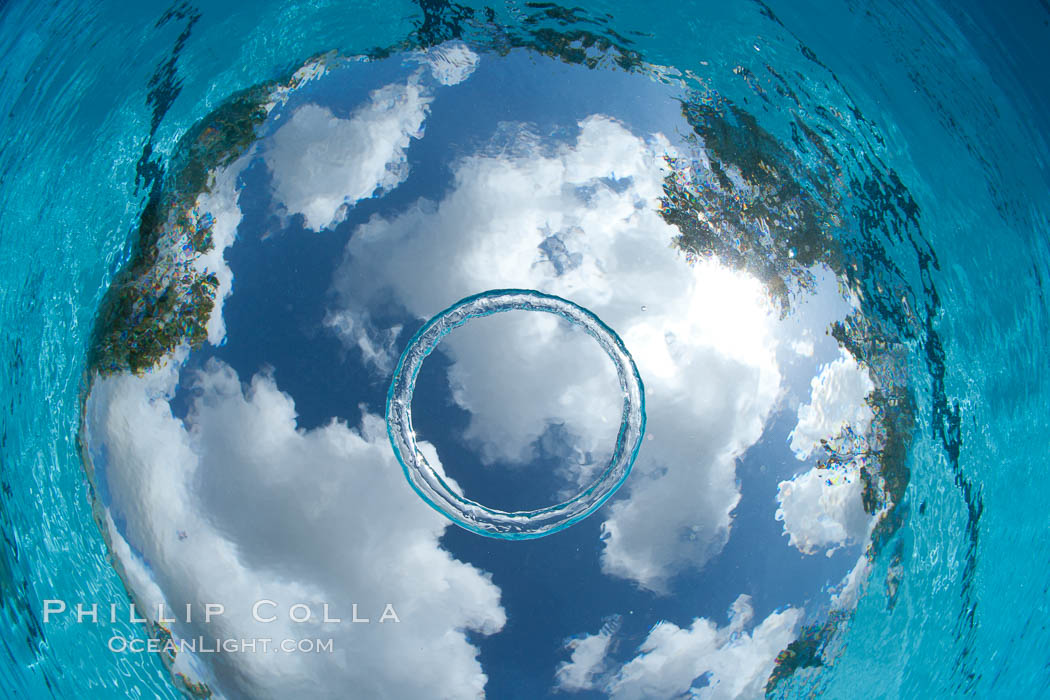
Can you blow a perfect bubble ring underwater? I can. That’s right. This is a bubble that I made, like a smoke ring, except I blew it underwater. There’s a trick to making them, a way to snap your lips in a snarky, La-Jolla-socialite sort of way while exhaling that results in the bubble organizing itself into a ring. Once in a while I get a really perfect ring, a thing of beauty. A bubble ring is a stable toroidal air pocket that maintains its shape — even growing in diameter and rotating along its axis — as it ascends to the surface.
![]() |
| Underwater bubble ring, a stable toroidal pocket of air. Image ID: 25282
|
4 Comments »
Leave a comment
HOME | Online Image Search | Photo of the Day | Contact / Bio | Licensing/Pricing | Prints | Stock List | Image Hierarchy | List of Log Entries | Site Map | Blue Whale | Cetaceans | Pinnipeds | Sharks | Rays | Fishes | Kelp Forest | Sea Birds | Inverts | Man & Animal | Man & Ocean | Ocean & Light | Ocean & Motion | Portraits | About Color and Monitor Calibration | Copyright Statement | All text and photographs copyright © Phillip Colla Natural History Photography All rights reserved worldwide. The content of this site is made available for purposes of researching images offered for license by Phillip Colla Natural History Photography. No image is to be copied, duplicated, modified or redistributed in whole or part without the prior written permission of Phillip Colla Natural History Photography. Whale logo is a trademark of Phillip Colla Natural History Photography, 8021 Paseo Arrayan, Carlsbad, CA 92009, USA. 760.707.7153 Email: oceanlight@OceanLight.com Web: www.OceanLight.com Portfolios: www.Gygis.com
Updated: February 10, 2012


Beautiful! Look at your swimming angel. Thanks for sharing these.
Comment by Jon Cornforth — 5/24/2010 @ 8:34 am
Thanks Jon!
Comment by Phil — 5/24/2010 @ 9:40 am
Very nice ! I am surprised that despite the all the straight lines (that you wouldn’t find in the ocean), the distortion doesn’t look too bad. How does the field of view of the Canon 15 compares with a rectilinear, water-contact 15mm ?
Comment by QT Luong — 5/25/2010 @ 11:42 pm
QT - the 15mm fisheye behind a dome retains its topside field of view, which as I recall is nearly 180 degrees. The Nikonos 15mm water-contact lens has a field of view of about 94 degrees. I have not tried using any “de-fish” software yet, but will be shooting the 15mm fisheye a lot this coming weekend and am curious to see how de-fish-ifying the images works, whether they improve or look odd. Alas, although I owned three at one point and used them almost 100% of the time I was in the water, I no longer own any of the wonderful Nikonos 15mm lenses. Those were workhorses.
Comment by Phil — 5/26/2010 @ 7:54 am