Photo of the “Heart of the Wave”, North Coyote Buttes, Phillip Colla Photography

Photo of the “Heart of the Wave”, North Coyote Buttes

View This Blog Post in Google Earth (How Cool Is That?)  View this blog entry in Google Earth
Latitude: 36° 59' 45.48" N, Longitude: 112° 0' 22.28" W, Coord: 36.995969°, -112.00619°
Filed under: Arizona, Photo of the Day, The Wave on 4/26/2008

Sitting on the rim of the main bowl of the Wave — right where the photograph below was taken — I watched a couple of hikers arriving. There reaction was natural: no sooner did they step foot through the entry passage than they looked around at the strange surroundings in awe. As one of them walked toward me, she turned around and suddenly said “Oh, its the Heart of the Wave!” She must have recognized the view (below) that is oft-repeated in photographs, and her name for this view must have been coined by someone before her. It seemed quite fitting to me. So thus it is, the Heart of the Wave:
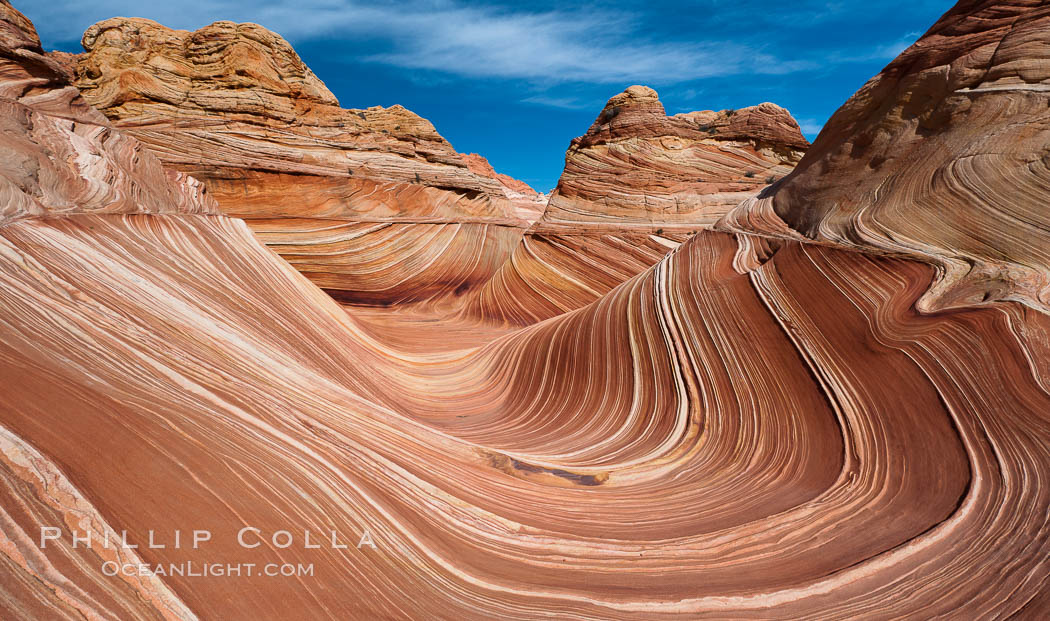
The Wave, an area of fantastic eroded sandstone featuring beautiful swirls, wild colors, countless striations, and bizarre shapes set amidst the dramatic surrounding North Coyote Buttes of Arizona and Utah.  The sandstone formations of the North Coyote Buttes, including the Wave, date from the Jurassic period. Managed by the Bureau of Land Management, the Wave is located in the Paria Canyon-Vermilion Cliffs Wilderness and is accessible on foot by permit only.,  Copyright Phillip Colla, image #20625, all rights reserved worldwide.
The Wave, an area of fantastic eroded sandstone featuring beautiful swirls, wild colors, countless striations, and bizarre shapes set amidst the dramatic surrounding North Coyote Buttes of Arizona and Utah. The sandstone formations of the North Coyote Buttes, including the Wave, date from the Jurassic period. Managed by the Bureau of Land Management, the Wave is located in the Paria Canyon-Vermilion Cliffs Wilderness and is accessible on foot by permit only. North Coyote Buttes, Paria Canyon-Vermilion Cliffs Wilderness, Arizona, USA.
Image: 20625  
Location: North Coyote Buttes, Paria Canyon-Vermilion Cliffs Wilderness, Arizona, USA
Click To View This Location in Google Earth.  You must have Google Earth installed for this feature to work correctly. View this Image in Google Earth!


What process produced this geologic oddity? Diagenic coloration arising from stratigraphic relationships among the sandstone layers. Navaho sandstone, almost 200 million years old, was formed from what were formerly sand dunes, compressed and hardened into their current stony form. The colorations stems from iron oxides (think rust!) such as goethite and hematite, with colors ranging from oranges and yellows to salmon, reds and purples.

Photos of the Wave, North Coyote Buttes


HOME | Online Image Search | Photo of the Day | Contact / Bio | Licensing/Pricing | Prints | Stock List | Image Hierarchy | List of Log Entries | Site Map | Blue Whale | Cetaceans | Pinnipeds | Sharks | Rays | Fishes | Kelp Forest | Sea Birds | Inverts | Man & Animal | Man & Ocean | Ocean & Light | Ocean & Motion | Portraits | About Color and Monitor Calibration | Copyright Statement | All text and photographs copyright © Phillip Colla Natural History Photography   All rights reserved worldwide. The content of this site is made available for purposes of researching images offered for license by Phillip Colla Natural History Photography.  No image is to be copied, duplicated, modified or redistributed in whole or part without the prior written permission of Phillip Colla Natural History Photography.  Whale logo is a trademark of Phillip Colla Natural History Photography, 7302 Azalea Place, Carlsbad, CA 92011, USA.  (760) 804-0731.  Email: oceanlight@OceanLight.com    Web: www.OceanLight.com      Portfolios: www.Gygis.com

Updated: November 21, 2009