Derelict Pier Pilings in Astoria
Astoria, Oregon and the communities surrounding it, at the mouth of the Columbia River, have a long maritime history (since at least the time of Lewis and Clark). It seems like there are thousands of derelict, abandoned and decaying piers all over the place.
![]() |
| Derelict pilings, remnants of long abandoned piers. Columbia River, Astoria, Oregon, USA. Image: 19383 Location: Columbia River, Astoria, Oregon, USA View this Image in Google Earth! |
![]() |
| Derelict pilings, remnants of long abandoned piers. Columbia River, Astoria, Oregon, USA. Image: 19388 Location: Columbia River, Astoria, Oregon, USA View this Image in Google Earth! |
Columbia River Viewed From Vista House
Vista House was built in 1918 as a memorial to Oregon pioneers and as a comfort station for those traveling on the Historic Columbia River Highway. The octagonal stone structure towers 733 feet above the Columbia River and provides a spectacular view. Click it to see it larger, or see more panorama photos in our collection.
![]() |
| Panoramic view of the Columbia River as it flows through Columbia River Gorge Scenic Area, looking east from the Vista House overlook on the southern Oregon side of the river. Columbia River, Columbia River Gorge National Scenic Area, Oregon, USA. Image: 19374 Location: Columbia River, Columbia River Gorge National Scenic Area, Oregon, USA View this Image in Google Earth!Pano dimensions: 3125 x 21408 |
Photo of North Head Lighthouse, Washington
While in Astoria recently, we took a little drive across to the Washington side of the Columbia River to see North Head Lighthouse. It was overcast, sort of pre-storm looking, perfect weather for walking around a blustery promontory high above the coast and checking out an old lighthouse. Below is a panorama of the bluffs beside the North Head Lighthouse, spanning about 180 degrees up and down the coast. Can you see my daughter next to the lens inside the top room of the lighthouse? Click it to see a larger version, or see more panorama photos in our collection.
![]() |
| The North Head Lighthouse was built in 1896. 69 steps lead to the lantern room, which is 65 feet from the ground and 194 feet above sea level. The first-order Fresnel lens, which came from Cape Disappointment, was lit for the first time on May 16, 1898. Washington, USA. Image: 19390 Location: Washington, USA View this Image in Google Earth!Pano dimensions: 4757 x 20503 |
Lunar Eclipse Photo
I took some photos of the total lunar eclipse last night from my backyard. At the peak of the eclipse, when the moon was totally in the Earth’s shadow, no direct sunlight reached the moon so it was lit only faintly by light refracting (bending) through the relatively thin layer of the Earth’s atmosphere. As this refracted light passes through smoke, dust, smog and haze in the atmosphere, it takes on a distinct red tint. Since direct light reaching the moon is whitish-yellow and is many orders of magnitude stronger than the red-tinged refracted light, the red color is only observed at total eclipse when it does not have to compete with direct sunlight. Thus comes the name “blood moon” for such an eclipse. Click the panorama strip to see it larger.
![]() |
| Lunar eclipse sequence, showing total eclipse (left) through full moon (right). While the moon lies in the full shadow of the earth (umbra) it receives only faint, red-tinged light refracted through the Earth’s atmosphere. As the moon passes into the penumbra it receives increasing amounts of direct sunlight, eventually leaving the shadow of the Earth altogether. August 28, 2007. Earth Orbit, Solar System, Milky Way Galaxy, The Universe. Image: 19391 Location: Earth Orbit, Solar System, Milky Way Galaxy, The Universe Pano dimensions: 1826 x 14162 |
For some reason this animated GIF looks terrible compared to the actual images out of the camera, something about limiting to 256 colors I think. Anyway, here is an animated version, over roughly one and 1/2 hours from full eclipse to no eclipse:
![]() |
Photo of a Brown Bear Digging For Clams
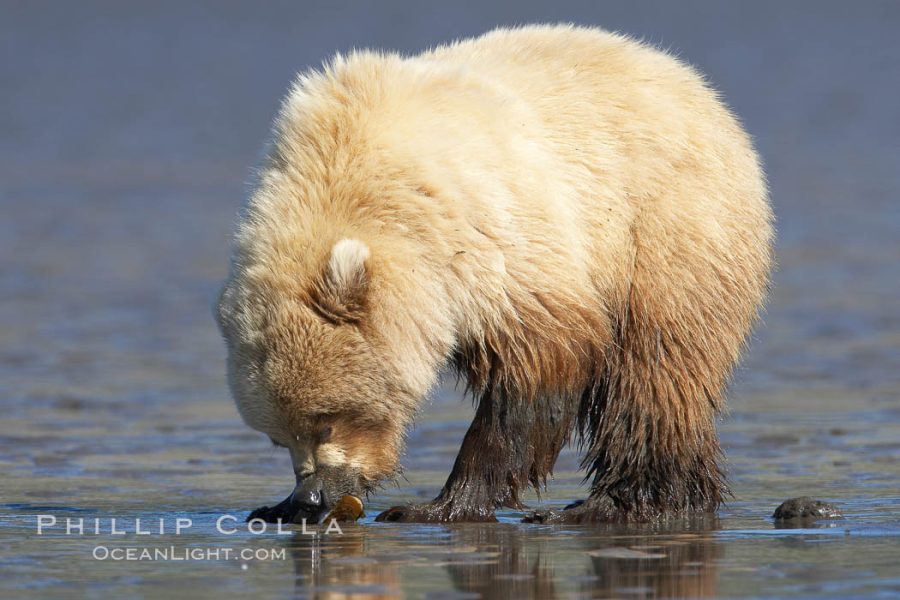
One of the interesting behaviors of coastal brown bears (Ursus arctos) is their interest in eating razor clams. Negative low tides expose broad tide flats along the Cook Inlet coast. Brown bears are quite tuned to the timing of these low tides and will arrive at the beach shortly before the tide flats are exposed. Working alone, each bear will sniff around and look for clam vents in the sand before digging up a razor clam and eating it, repeating the process for hours.
![]() |
| Coastal brown bear forages for razor clams on mud flats at extreme low tide. Lake Clark National Park, Alaska, USA. Image: 19224 Species: Ursus arctos Location: Lake Clark National Park, Alaska, USA View this Image in Google Earth! |
Ron Niebrugge / WildNatureImages.com
Ron Niebrugge is a Alaska-based full-time professional stock and assignment photographer who shoots top notch travel and wildlife images. He maintains a cool blog (www.my-photo-blog.com) with material he has been creating lately, and I find all of it interesting and a good read. I check out his blog every few weeks just to get travel ideas. His photos of San Diego are better than most San Diego-based photographers and pop up really high in Google to boot. Ron’s stock photography can be searched at his website www.wildnatureimages.com. Be sure to check out his deep coverage of Alaskan subjects, particularly Kenai Fjords National Park which is pretty much his backyard.
Standing Tall
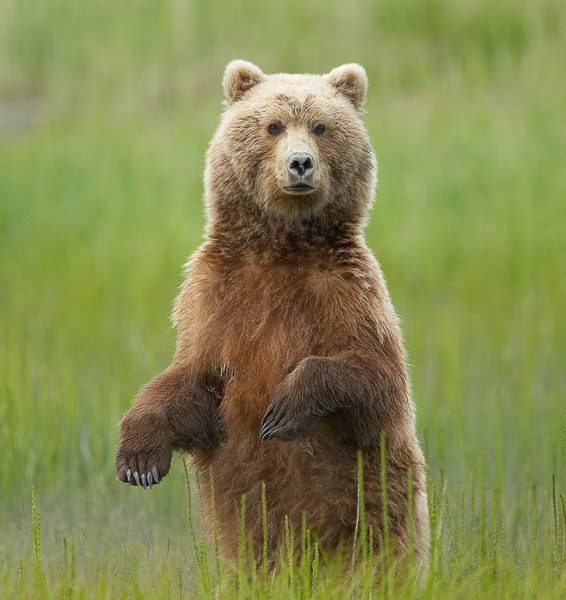
This coastal brown bear sow caught the scent of an approaching adult male. Nervous for her cubs, who could be attacked by the male, she stands in the deep sedge grass to get a better look around.
![]() |
| A brown bear mother (sow) stands in tall sedge grass to look for other approaching bears that may be a threat to her cubs. Lake Clark National Park, Alaska, USA. Image: 19139 Species: Ursus arctos Location: Lake Clark National Park, Alaska, USA View this Image in Google Earth! |
Lake Tahoe Panoramic Photo
Last summer we went to Lake Tahoe for a wedding. Lake Tahoe in summer is beautiful. I found a turnout on the highway above Incline Village which offered this view. This is a panoramic photograph obtained by stitching 6 separate images together on the computer. If you like this you can see more panorama photos in our collection.
![]() |
| Panorama of Lake Tahoe, viewed from above Incline Village. Sitting between the Carson Range to the east and the Sierra Nevada to the west, Lake Tahoe was formed about 2 to 3 million years ago and is now the second deepest lake in the United States, and tenth deepest in the world, at 1645 ft (501m) deep. It lies at an altitude of 6225 feet (1897m) above sea level. This view is from the north end of Lake Tahoe looking south. Lake Tahoe, Incline Village, Nevada, USA. Image: 19128 Location: Lake Tahoe, Incline Village, Nevada, USA View this Image in Google Earth!Pano dimensions: 3116 x 20490 |
Silver Salmon Creek Lodge, Lake Clark National Park, Alaska
In 2005 I received a recommendation to visit Silver Salmon Creek Lodge to see bears. I already had a trip planned to Brooks Camp so I didn’t look into SSCL for a while. A week at Brooks in July 2006, with superb weather, company and bears, helped me to realize that I enjoyed the “Alaska thing” much more than I had anticipated. I was eager to do it again. About the same time we were put on notice that we might be making a family trip in Alaska in 2008, complete with cousins, grandparents, aunts and uncles. If indeed we were making the effort of taking the kids to Alaska, it was inconceivable to me that we would not include a good close look at coastal brown bears (Ursus arctos) in the wild. Brooks Camp was a known quantity at this point, and while it would be ok for my family it was not ideal; the younger kids would get bored waiting on the viewing platforms and the crowds that Brooks Camp attracts (lodge, campers and day visitors alike) conflicted with the quieter experience I wanted Tracy and the kids to have their first time in Alaska. I needed to find an alternative place to take them. I got in touch with David Coray, longtime owner of Silver Salmon Creek Lodge, and arranged to spend a week there in July 2007. I had a great time.
![]() |
| Silver Salmon Creek Lodge, spruce trees and Chigmit Range. Lake Clark National Park, Alaska, USA. Image: 19064 Location: Lake Clark National Park, Alaska, USA View this Image in Google Earth! |
Silver Salmon Creek Lodge, part of a private parcel of 160 acres in Lake Clark National Park, lies at the edge of a spruce forest and is fronted by broad flat sedge grass meadows. The view from the lodge is wonderful: the meadows stretch left and right several miles and out about a half mile, beyond which are the sandy beaches and tide flats of Cook Inlet. Tidal sloughs slice across the meadows in many places. About a mile to the south lies Silver Salmon Creek, while three miles to the north is Johnson River. Both of the rivers open directly to Cook Inlet and are host to runs of spawning salmon in late summer. Bears constantly stroll about the meadows while bald eagles can be seen often flying or perched on trees. A short distance behind the lodge, through the trees, is a large pond covered with lilies and surrounded by green peaks with patches of snow. Access to Silver Salmon Creek Lodge is by plane or boat only, and the vast majority of visitors come by air. Those arriving on float planes will land on the pond while those coming on wheeled planes land on the beach.
![]() |
| Brown bears graze among sedge grass meadows at Silver Salmon Creek Lodge. Lake Clark National Park, Alaska, USA. Image: 19067 Location: Lake Clark National Park, Alaska, USA View this Image in Google Earth! |
On a clear Sunday morning I met our pilot Mark Madura at Lake Hood, along with five fellow guests also spending the week at the lodge: John, Kent and Jenny, father, son and daughter who were set to fish Silver Salmon Creek and Copper River, and Dennis and Denny, father and son who were planning to shoot photos like myself. After an hour in the air Mark announced we would be waylaid by thick clouds over the lodge and could not land, so he landed on a pond at Homer, told us to cross our fingers for a change in the weather and set us free onshore to kill some time at the local brewery while he topped off the fuel and waited for word from David that all was clear to land. This turned out to be a fortunate diversion as we got a chance to get to know another a bit and buy a bunch of growlers of Homer Brewing Company’s finest to take with us. After a lunch of bratwurst and onion rings, we squeezed the beer in the few remaining bits of room on the plane and took off again, spotted a few whales crossing Cook Inlet, had a magnificent view of Mt. Redoubt rising above the clouds, and finally landed on the lily-covered pond behind the lodge.
![]() |
| Float plane, water lilies and pond lie beneath the Chigmit Range near Silver Salmon Creek. Lake Clark National Park, Alaska, USA. Image: 19092 Location: Lake Clark National Park, Alaska, USA View this Image in Google Earth! |
Naturally, before bothering to see if my cameras, clothes and money had arrived on the other plane, I had to check out the kitchen and dining room. I’ve learned from many liveaboard boat trips that the cook and his menu are crucial to the success of the trip! As luck would have it chef Steve had saved some lunch for us latecomers. I will state without reservation that mealtime at Silver Salmon Creek Lodge is superb. The view from the dining room is beautiful. David’s daughter Dorian makes her baked treats fresh daily, the veggies come from the lodge’s own garden and the fish that is served is from the river and ocean one sees right out the window. The clams are the same ones the bears are after! It is all delicious and served in generous quantities. I ate really well and put on a few well-earned pounds. OK, enough said.
![]() |
| Kitchen and chef Steve, Silver Salmon Creek Lodge. Lake Clark National Park, Alaska, USA. Image: 19070 Location: Lake Clark National Park, Alaska, USA View this Image in Google Earth! |
While bear viewing has in recent years been the major draw at SSCL, historically fishing is the pursuit of choice. Guests at the lodge can spend time fishing the rivers for salmon, sea kayaking, canoeing on the pond, or halibut fishing on the ocean. Or chilling at the lodge, napping or just enjoying the fresh air and fantastic views. One of the days at Silver Salmon Creek Lodge involved a boat trip up the coast a ways to a small island loaded with seabirds. Murres, puffins, gulls, and I think some terns and a hawk were all spotted there. I am not a bird photographer — I don’t have the patience or skill for it — so I just napped and watched the flocks of birds wheeling about above us. For the most part I chose to spend my time in the sedge grass meadows and on the beach and tide flats watching the bears and photographing them. My guide, Dawn, not only has guided in the area for years but has a formal biology education so she was able to keep me appraised of the natural history around us and answer my many questions. Dawn was willing to get out early and stay out late to give us ample opportunities to photograph the bears in the best light. Her husband John has worked even longer at SSCL and has some outstanding photographs to show for it, ones that would make the pros visiting the lodge envious. The staff at SSCL are both professional and personable (i.e., fun!), and are an important part of the success of SSCL.
![]() |
| Johnson River, side waters and tidal sloughs, flowing among sedge grass meadows before emptying into Cook Inlet. Johnson River, Lake Clark National Park, Alaska, USA. Image: 19063 Location: Johnson River, Lake Clark National Park, Alaska, USA View this Image in Google Earth! |
Summer days are quite long in Alaska, and there was plenty of time to shoot. Granted, I was blessed with nearly perfect weather: lots of sun with high overcast to soften it punctuated by two days of darker skies and a tad of light rain. We (my fellow photographers, Dawn and I) would make several outings each day to see bears. Sometimes we would head north, with three miles of beaches and meadows to explore before reaching Johnson River. Other times we would head out to the beach at low tide, hoping to see bears digging for clams on the broad tide flats. A mile to the south is Silver Salmon Creek, with a tidal slough and grass meadows along the way. Bears were found throughout these areas, at nearly all times, while I was there. Getting around was done almost entirely by ATV, with a rugged and simple trailer on the back. When I first learned we would get around by ATV I was confused (why not just walk?) but given the distances involved using an ATV really allows one to make the most of one’s time. We found large male boars, juveniles alone and in pairs, solitary sows as well as mothers with one, two and even three cubs. Some cubs were “spring cubs”, quite small and born just months earlier, who are totally dependent on their mother for survival. Others were born the previous winter and are now a year and a half old, much more gregarious and able to venture further from their mother and act more independently.
![]() |
| Coastal brown bear forages for razor clams on mud flats at extreme low tide. Lake Clark National Park, Alaska, USA. Image: 19221 Species: Ursus arctos Location: Lake Clark National Park, Alaska, USA View this Image in Google Earth! |
The lodge itself and its operations are just the right size: large enough to be comfortable while small enough to feel private and uncrowded. About 12 to 16 guests were present while I was there, a handful coming or going every few days. We had three different parties from Switzerland (two fishing, one bear viewing) during just the week I was there — the Swiss love Alaska it seems. Professional photographer David Cardinal was conducting one of his two annual tours at SSCL, leading a group of five serious photographers. David has been photographing the bears and leading tours to SSCL for eight years, and has some fine images on his web site to show for it. Occasionally we would see David and his group while out in the field, but the area is so large that everyone has plenty of space. Other tour groups led by Charles Glatzer and Jess Lee were coming soon after or had left before I arrived. Another lodge, Alaska Homestead Lodge, lies a short distance from SSCL and hosts primarily day fly-in visitors whom we would see on the trails once in a while.
![]() |
| Photographers and brown bear. Lake Clark National Park, Alaska, USA. Image: 19075 Location: Lake Clark National Park, Alaska, USA View this Image in Google Earth! |
At low tide we went out to the tide flats to watch the bears digging for clams. We saw up to about 9 or 10 bears at once, spread widely over the flats. Each bear worked alone and had its own technique for shelling the clams once they were pulled from the sand. Some bears were clearly less skilled than others as their clams would be essentially destroyed as the bear tried to shell them. These bears would also end up covered with more sand and mud than their more skiller counterparts. A couple old pros we saw were able to lay the razor clam on the back of one paw and slide the claws of its other paw between the shells, opening the clam with little damage. Their dexterity is surprising.
![]() |
| Coastal brown bear forages for razor clams in sand flats at extreme low tide. Grizzly bear. Lake Clark National Park, Alaska, USA. Image: 19140 Species: Ursus arctos Location: Lake Clark National Park, Alaska, USA View this Image in Google Earth! |
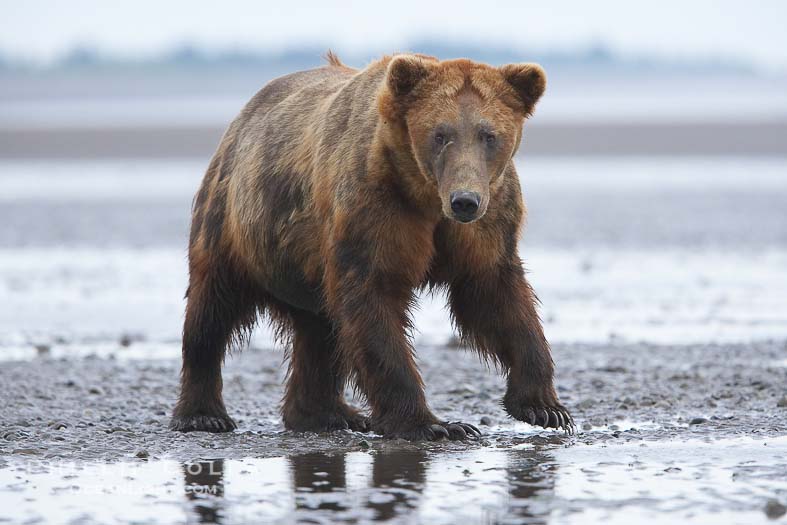
My goal visiting Silver Salmon Creek Lodge was to shoot simple portraits of large brown bears. Coastal brown bears are considerably larger than brown bears living in the interior of North America because they have access to salmon coming in from the ocean to spawn in the rivers and lakes. I am told by bear experts that interior brown bears are often referred to as grizzly bears or grizzlies, while it is generally agreed that coastal brown bears are not grizzlies. This distinction seems silly to me, however. Coastal brown bears are the largest bears in the world, surpassing polar bears and peaking in size with the Kodiak Island race. The best opportunities for portraits were in the meadows, with bears eating sedge grass. Being essentially pure fiber, sedge grass is not very nutritious for the bears but they are hungry as they wait for the salmon to arrive and so will eat lots of it. I even tried a little of it, and didn’t get sick, ok. The bears can eat up to 30 lbs of sedge grass each day and will spend hours in the meadows resting and grazing. Below are a couple of portraits of the bear that I thought was most impressive of those I saw during my stay. His eyes appear beady small because his head has grown so large and thick over the years, his shoulders were monstrously broad and thick and he walked with a swagger that suggested there was nothing that concerned him. He bears a recent scar over his right eye presumably from a fight with another male for territory or mating rights. I hope my kids get a chance to see him next year.
![]() |
| Full grown, mature male coastal brown bear boar (grizzly bear) in sedge grass meadows. Lake Clark National Park, Alaska, USA. Image: 19134 Species: Ursus arctos Location: Lake Clark National Park, Alaska, USA View this Image in Google Earth! |
![]() |
| Mature male coastal brown bear boar waits on the tide flats at the mouth of Silver Salmon Creek for salmon to arrive. Grizzly bear. Lake Clark National Park, Alaska, USA. Image: 19149 Species: Ursus arctos Location: Lake Clark National Park, Alaska, USA View this Image in Google Earth! |
Mount St. Helens Panoramic Photo
From the 2005 archives: I left Seattle in the late afternoon and began my speed run south, home to Carlsbad. I planned to stop at three spots: Mount St. Helens, Crater Lake and Oakland. I reached the Johnston Ridge viewpoint of Mount St. Helens National Volcanic Monument (say that three times quickly) before sunset and had the entire place to myself. It was eerie, I was wondering if I had missed an eruption warning or something. This is a panoramic photo, composed of 4 separate images stitched (on the computer) into a single picture.
![]() |
| Panorama of Mount St. Helens, viewed from Johnston Ridge. Mount St. Helens National Volcanic Monument, Mount St. Helens National Volcanic Monument, Washington, USA. Image: 19118 Location: Mount St. Helens National Volcanic Monument, Washington, USA View this Image in Google Earth!Pano dimensions: 3058 x 14970 |
Click the image to see it larger.
Tenaya Lake Panoramic Photo
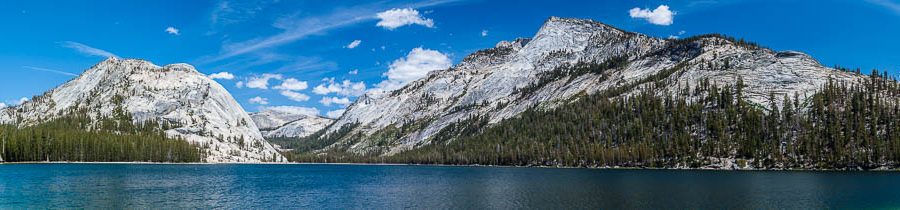
In late summer a few years ago we took the kids to spend a few nights in Tuolumne Meadows and then drive over Tioga Pass to see Mono Lake. We stopped at Lake Tenaya for a swim and a picnic lunch on the way to the meadows. This is a panoramic image, composed of 8 separate photographs stitched (on the computer) into a single picture.
![]() |
| Panorama of Tenaya Lake, in Yosemite’s high country. Image ID: 19121 Location: Tenaya Lake, Yosemite National Park, California, USA Pano dimensions: 2009 x 14383 |
Click the image to see it larger.
Aerial Photos of Kenai Fjords National Park, Alaska
While out hiking around the Exit Glacier area I was so impressed by the weather that I decided to go to the airport and look for a pilot to take me flying. I love flying in the little planes, wheeled and float alike, in Alaska. For some reason I feel safer and more at ease on those small planes. Perhaps it is because I can actually meet the pilot and get a small sense about whether he cares to go on living as much as I do. (On the big planes I might get a robotic “bah-bye” from him after the flight is over.) I met Jim Craig of Scenic Mountain Air who agreed to take me up later in the day, although he felt that the clouds would fill in making flying over the fjords unspectacular. We abandoned the usual flightseeing tour route and just flew around looking for clear air. I figured that since everything below us was amazing, just finding some clear air and sun would allow for good picture taking. Jim is a pilot, flight instructor and writer who really knows the area and flight conditions well, and I enjoyed talking to him as we flew.
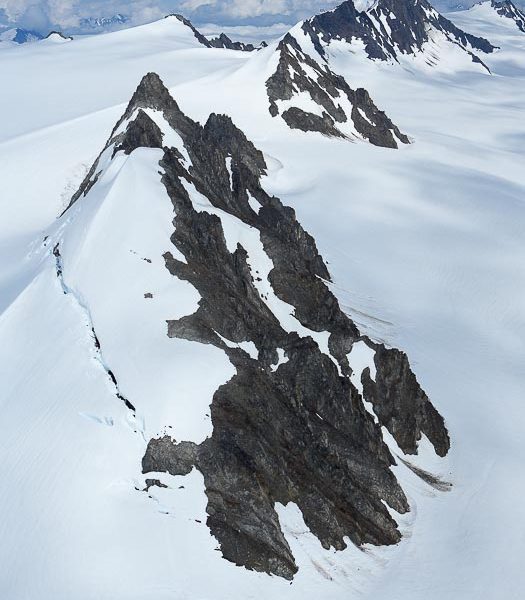
![]() |
| The Kenai Mountains rise above thick ice sheets and the Harding Icefield which is one of the largest icefields in Alaska and gives rise to over 30 glaciers. Kenai Range, Kenai Fjords National Park, Alaska, USA. Image: 19016 Location: Kenai Range, Kenai Fjords National Park, Alaska, USA |
![]() |
| The Kenai Mountains rise above thick ice sheets and the Harding Icefield which is one of the largest icefields in Alaska and gives rise to over 30 glaciers. Kenai Fjords National Park, Alaska, USA. Image: 19022 Location: Kenai Fjords National Park, Alaska, USA |
We flew over parts of Kenai Fjords National Park and the Kenai Mountains, including in particular the enormous Harding Icefield, a broad expanse of thick ice through which jagged peaks appear. The Harding Icefield spawns over thirty glaciers, so there was glacier somewhere in sight below us at almost all times. We then left the national park boundaries and flew over the Resurrection Mountains, seeing different glaciers, lush green valleys and dramatic mountains. My hour in the air was up too quickly.
![]() |
| Glacier and rocky peaks, Resurrection Mountains. Resurrection Mountains, Alaska, USA. Image: 19015 Location: Resurrection Mountains, Alaska, USA |
![]() |
| Aerial view, Resurrection Mountains. Resurrection Mountains, Alaska, USA. Image: 19051 Location: Resurrection Mountains, Alaska, USA |
Jim Craig can be reached at (907) 224-6607 or by email at jcraig9218@yahoo.com.
Le Barn Appetit, Seward, Alaska
Yvon van Driessche owns and runs Le Barn Appetit, a funky inn and delicious restaurant in Seward, Alaska. I was looking for a room in Seward and all the hotels I could find on the internet were full, but someone was kind enough to recommend Le Barn. Yup, its actually an old barn. I called and got the “treehouse” room, which is (seriously) a small house built around a tree about 15′ off the ground and quite comfortable. I showed up tired from a long day of travel (San Diego / Anchorage / Seward) and Yvon greets me with good natured ribbing, a risky proposition perhaps but his is a colorful personality that one warms up to quickly. When I mentioned that I would be leaving at sunrise to go hiking the next morning he looked genuinely offended, and was disappointed that I would not be enjoying his breakfast. Yvon is a chef who takes his breakfast service very seriously, and the pride in his cooking is evident. While I usually do not eat breakfast, I agreed to return after my hike and eat. Boy, am I glad I did — his was absolutely, hands down the best Quiche Lorraine I have ever eaten and one of the most satisfying breakfasts I have had for that matter. He offered to serve me any size slice I wanted (its included in the room rate). I had a huge 4″ slice and still I could have eaten more it was so good. The other three guests who were there had what looked like crepes piled high with fruit — amazing. Next time I will get those. Yes, there will be a next time. The combination of unique, off-the-beaten-path, comfortable inn and terrific breakfast is just too good for me to pass up, and I am always looking for a reason to pass through Seward.
![]() |
| Yvon van Driessche, owner and chef at his crepe table, Le Barn Appetit, creperie and inn. Seward, Alaska, USA. Image: 18998 Location: Seward, Alaska, USA View this Image in Google Earth! |
![]() |
| Le Barn Appetit, creperie and inn. Seward, Alaska, USA. Image: 18997 Location: Seward, Alaska, USA View this Image in Google Earth! |
![]() |
| Le Barn Appetit, creperie and inn. Seward, Alaska, USA. Image: 18999 Location: Seward, Alaska, USA View this Image in Google Earth! |
Le Barn Appetit can be reached at (907)224-8706 or email: lebarn@alaska.com.
Brown Bear Portrait
My goal in July was to shoot portraits of bears. I scheduled my visit before the arrival of salmon so that the bears would be in the meadows eating sedge grass and staging in the area, waiting for salmon to arrive. Next trip will be a bit later to coincide with salmon and look more for interesting behaviour oriented around salmon predation and territoriality between adult bears.
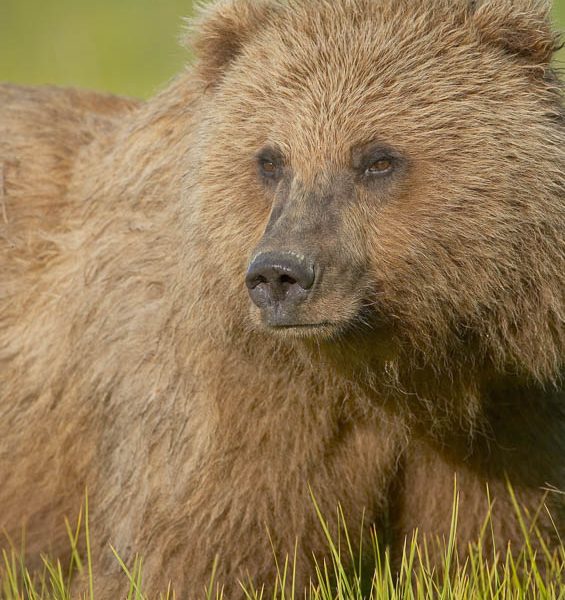
This young coastal brown bear (Ursus arctos) was resting and eating sedge grass.
![]() |
| Portrait of a young brown bear, pausing while grazing in tall sedge grass. Brown bears can consume 30 lbs of sedge grass daily, waiting weeks until spawning salmon fill the rivers. Lake Clark National Park, Alaska, USA. Image: 19157 Species: Ursus arctos Location: Lake Clark National Park, Alaska, USA View this Image in Google Earth! |
Pretty Young Thing
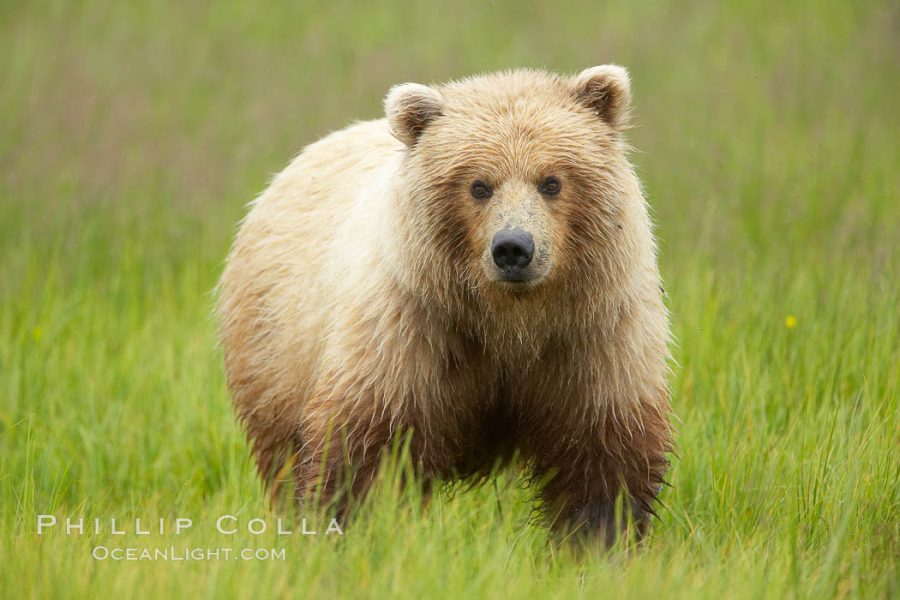
This young female coastal brown bear (Ursus arctos) was often around when I was visiting Lake Clark National Park in Alaska. We saw her clamming on the tide flats and grazing on sedge grass in the meadows. She is a really good looking bear, with a thick blond coat and none of the scars around her muzzle that the older bears typically have.
![]() |
| Juvenile female coastal brown bear (grizzly bear) grazes on sedge grass. Lake Clark National Park, Alaska, USA. Image: 19137 Species: Ursus arctos Location: Lake Clark National Park, Alaska, USA View this Image in Google Earth! |
Minarets Panorama
On our way to a wedding in Tahoe last summer we stopped for a bit of fishing at Mammoth Lakes. I got up early and made a sunrise visit to the Minarets overlook, and got this view. This is a panoramic photograph, composed of 10 separate images stitched (on the computer) into a single, enormous file.
![]() |
| Panorama of the Minarets at sunrise, near Mammoth Mountain. The Minarets are a series of seventeen jagged peaks in the Ritter Range, west of Mammoth Mountain in the Ansel Adams Wilderness. These basalt peaks were carved by glaciers on both sides of the range. The highest of the Minarets stands 12,281 feet above sea level. Mammoth Lakes, California, USA. Image: 19123 Location: Mammoth Lakes, California, USA View this Image in Google Earth!Pano dimensions: 3233 x 26731 |
Click the image to see it larger.
Keywords: Minarets, photo, picture, Mammoth Lakes, image, photography, Sierra Nevada, California.
Lazy Bear
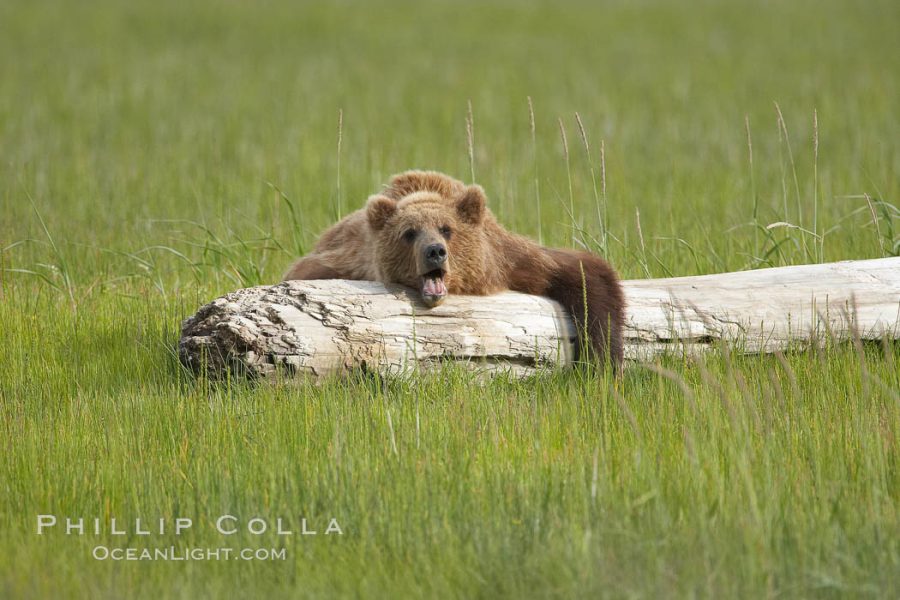
On my recent trip to photograph coastal brown bears (Ursus arctos) in Lake Clark National Park, I experienced nearly perfect weather for a full week, with just one day of light drizzle and only a few overcast days. About half the time we had full sun, with hardly a cloud in the sky, and warm. Great for us, but it can be tiring for the bears to hang in the sun with their thick fur coats. This guy found a comfy log in the center of a sedge grass meadow on which to nap, and gave us hardly a glance as we walked by him.
![]() |
| Lazy brown bear naps on a log. Lake Clark National Park, Alaska, USA. Image: 19251 Species: Ursus arctos Location: Lake Clark National Park, Alaska, USA View this Image in Google Earth! |
Exit Glacier Panoramic Photo
While visiting Kenai Fjords National Park recently, I spent the morning taking an easy hike up to the terminal end (terminus?) of Exit Glacier. This is a popular spot, since it is a gentle hike and it is the main attraction of the only road that enters the national park. I think that I was the first person on the trail that morning, since there were no cars in the parking lot and I saw nobody else until I was nearly done with my walk. The weather was great: full sun, warm and quiet. I was hoping to see a bear or moose or something, but the only wildlife I saw was a fat old marmot who hung out until I got my camera at which point he ditched me. This is a panoramic photograph, composed of 10 separate images stitched (on the computer) into a single, enormous image. Note that this is actually a double-self-portrait, as I appear there twice in a manner of sorts. How’d he do dat?
![]() |
| Self portrait, panorama of Exit Glacier. Exit Glacier, one of 35 glaciers that are spawned by the enormous Harding Icefield, is the only one that can be easily reached on foot. Exit Glacier, Kenai Fjords National Park, Alaska, USA. Image: 19112 Location: Exit Glacier, Kenai Fjords National Park, Alaska, USA View this Image in Google Earth!Pano dimensions: 4298 x 17211 |
Click the image to see it larger.
Moonlight Morning Glass
Dropped my daughter off at junior lifeguard class this morning and got in a quick swim before starting work for the day. The skies were overcast and the waves were small, but so glassy. Combination of the flat light and glassy water made it difficult to discern swells coming in until they had started to lift up and form, pretty cool. I only had one wave I was able to get inside. You can see the cliffs north of Moonlight Beach in the background, and a few beach walkers out for some morning exercise.
![]() |
| Breaking wave. Moonlight Beach, Encinitas, California, USA. Image: 19132 Location: Moonlight Beach, Encinitas, California, USA |
Schwabacher Landing Panoramic Photograph
Schwabacher Landing is one of the “must get” spots for photographers visiting Grand Teton National Park. There is a beaver pond a short ways up a fisherman’s trail in which the Teton Range is nicely reflected in a mirror-calm sidewater of the Snake River, making for a postcard view. I make a point of visiting Schwabacher Landing at least once each time I visit, taking a look for the beavers and hoping to see a moose if I’m lucky. Here is a shot of Schwabacher Landing in Grand Teton National Park, Wyoming. Early morning, summer. This panoramic photo is formed by stitching nine separate images into a longer panoramic strip.
![]() |
| Panorama of the Teton Range reflected in the still waters of Schwabacher Landing, a sidewater of the Snake River. Grand Teton National Park, Wyoming, USA. Image: 19129 Location: Grand Teton National Park, Wyoming, USA View this Image in Google Earth!Pano dimensions: 3104 x 27272 |
Click the image to see it larger.
HOME | Online Image Search | Photo of the Day | Contact / Bio | Licensing/Pricing | Prints | Stock List | Image Hierarchy | List of Log Entries | Site Map | Blue Whale | Cetaceans | Pinnipeds | Sharks | Rays | Fishes | Kelp Forest | Sea Birds | Inverts | Man & Animal | Man & Ocean | Ocean & Light | Ocean & Motion | Portraits | About Color and Monitor Calibration | Copyright Statement | All text and photographs copyright © Phillip Colla Natural History Photography All rights reserved worldwide. The content of this site is made available for purposes of researching images offered for license by Phillip Colla Natural History Photography. No image is to be copied, duplicated, modified or redistributed in whole or part without the prior written permission of Phillip Colla Natural History Photography. Whale logo is a trademark of Phillip Colla Natural History Photography, 8021 Paseo Arrayan, Carlsbad, CA 92009, USA. 760.707.7153 Email: oceanlight@OceanLight.com Web: www.OceanLight.com Portfolios: www.Gygis.com
Updated: February 3, 2012