2010 June, Natural History Photography Blog

Nature’s Best Photography Cover Shot

Filed under: Antarctica, Penguin, Southern Ocean, Tear Sheets on 6/16/2010

The cover image of the current issue of Nature’s Best Photography is my photograph of an Adelie penguin taken earlier this year in Antarctica:

Adelie Penguin, Antarctica, Nature's Best Photography Spring/Summer 2010. Click to see more images from Antarctica

Adelie Penguin, Antarctica, Nature's Best Photography Spring/Summer 2010. Click to see more images from Antarctica

The photo also appears in the interior of the issue, since it was fortunate to be given an honorable mention in this years Ocean Views photography contest.

Adelie Penguins, Antarctica, Nature's Best Photography Ocean Views 2010

Adelie Penguins, Antarctica, Nature's Best Photography Ocean Views 2010

This image was taken at Paulet Island on the Antarctic Peninsula, made with a Canon 5D Mark II camera and 24-105mm f/4 lens (at 24mm), from a zodiac as we were idle alongside an iceberg. If you want to see what the situation was like when I took this shot — and you should, since it will make you want to visit Antarctica yourself! — see my blog post about this encounter from earlier this year. Several Adelie penguins (Pygoscelis adeliae) walked to the edge of an berg to get a good look at us as we cruised around Paulet Island at sunset, and allowed me to rattle off a series of “close/wide” images of them. Honestly, while the encounter was one of the most special moments of the trip for me, Adelie penguins are so numerous and inquisitive that I think situations like this — and photos like the above — are probably rather common in Antarctica. It is one of the reasons I intend to return as soon as I can.

Next: Paulet Island, Antarctic Peninsula, Antarctica
Previous: Pack Ice at the Edge of the Weddell Sea
Trip Index: Cheesemans Antarctica, Falklands and South Georgia
All “Southern Ocean” entries

The Racetrack, Death Valley National Park

View This Blog Post in Google Earth (How Cool Is That?)  View this blog entry in Google Earth
Latitude: 36° 40' 38.06" N, Longitude: 117° 34' 17.29" W, Coord: 36.67724°, -117.57147°
Filed under: California, Death Valley, Desert, National Parks on 6/14/2010

Photos of the Racetrack in Death Valley National Park, and the Racetrack’s sliding rocks (or sailing stones).

The Racetrack is an ancient dry lake bed in Death Valley, famous for its sailing stones. Located between the Last Chance Mountains and the Cottonwood Mountains, the Racetrack Playa lies at 3600′ above sea level, is about 3 miles long by 1 mile wide in size, and appears almost perfectly flat. Much of the year the Racetrack lakebed is totally dessicated and covered with small hexagonal mud patterns, although during the two rainy seasons that Death Valley experiences the playa becomes muddy and is sometimes “underwater”. At the south end of the Racetrack Playa are found the Racetrack’s famous “sailing stones”. Typically about the size of a shoe box or larger, the stones mysteriously move about the playa leaving trails behind them. Noone has actually observed any of the stones moving. One theory about their locomotion suggests that a combination of wet mud (during the winter rainy season) and high winds, perhaps combined with a thin layer of ice atop the mud, allows the stones to slide. Evidence indicates that the rocks move once every few years, and that tracks last only 4-5 years. My hunch is the occasions of the stones’ movement is a function of seasonal weather patterns and the presence or absence of sufficient water, wind and ice to trigger the sailing phenomenon. The sailing stones originate on the slope of a hill that rises above the south end of the playa. Many of the stones have moved hundreds of yards from their source, out toward the center of the lake bed, each leaving a striated channel behind it in the mud, like the wake of a boat.

Sunset over the Racetrack Playa, Death Valley National Park, California
Sunset over the Racetrack Playa. The Cottonwood Mountains rise above the flat, dry, ancient lake bed.
Image ID: 25265  
Location: Racetrack Playa, Death Valley National Park, California, USA
 
Racetrack Playa, an ancient lake now dried and covered with dessicated mud, Death Valley National Park, California
Racetrack Playa, an ancient lake now dried and covered with dessicated mud.
Image ID: 25315
The Grandstand, standing above dried mud flats, on the Racetrack Playa in Death Valley, Death Valley National Park, California
The Grandstand, standing above dried mud flats, on the Racetrack Playa in Death Valley.
Image ID: 25318
A sliding rock of the Racetrack Playa.  The sliding rocks, or sailing stones, move across the mud flats of the Racetrack Playa, leaving trails behind in the mud.  The explanation for their movement is not known with certainty, but many believe wind pushes the rocks over wet and perhaps icy mud in winter, Death Valley National Park, California
A sliding rock of the Racetrack Playa. The sliding rocks, or sailing stones, move across the mud flats of the Racetrack Playa, leaving trails behind in the mud. The explanation for their movement is not known with certainty, but many believe wind pushes the rocks over wet and perhaps icy mud in winter.
Image ID: 25243  
Location: Racetrack Playa, Death Valley National Park, California, USA
 
Sailing stone on the Death Valley Racetrack playa.  The sliding rocks, or sailing stones, move across the mud flats of the Racetrack Playa, leaving trails behind in the mud.  The explanation for their movement is not known with certainty, but many believe wind pushes the rocks over wet and perhaps icy mud in winter, Death Valley National Park, California
Sailing stone on the Death Valley Racetrack playa. The sliding rocks, or sailing stones, move across the mud flats of the Racetrack Playa, leaving trails behind in the mud. The explanation for their movement is not known with certainty, but many believe wind pushes the rocks over wet and perhaps icy mud in winter.
Image ID: 25333

At the north end of the Racetrack is found the “Grandstand”, an assemblage of giant round boulders stacked in the middle of the playa. In the olden days**, miners would gather on the Grandstand to stage and watch horse races on the playa.

Our visit: After we left the Eureka Valley Sand Dunes, we drove on some long but easy dirt roads to Scotty’s Castle where we stopped for lunch and to stretch our legs. We saw some great expanses of flowers along the way, evidence that the wildflower bloom comes later to the higher-altitude reaches of Death Valley. After Scotty’s Castle, we drove to the Racetrack via the notorious Uhebehebe-Crater-to-Racetrack-Road, a 27-mile-long dirt road that is famous for its tire-piercing ability and funky Teakettle Junction at which a photo must be taken. (Yes, those are actual teakettles hanging from the Teakettle Junction sign.) 4WD is not required for this drive but the suspensions that 4WD vehicles typically have are helpful for the washboard track. Sturdy tires with sidewall puncture resistant are also helpful. I have experienced a flat tire on this road in the past and it was a bummer, but on this visit we were in a well-equipped off-road vehicle and the road was in super shape so we made it to the Racetrack in about 45 minutes with no drama. We spent one sunset admiring the sailing stones, then shot some night sky photos and milky way timelapse video while camping at the primitive campground beyond the Racetrack. We returned to look at the rocks again at sunrise the next morning, then climbed to the top of the Grandstand on our way back out to Uhebehebe Crater. We saw one car in the distance while we were at the playa, but never actually enountered another person the entire time we were there. It was great.

I wish Leonard Nimoy would produce an episode of “In Search Of” about these uber-curious stones since it is my theory that, while they are interesting to landscape photographers, the mud tracks are actually landing strips left behind by tiny alien spacecraft. I discovered another Alien Spaceport in California some years ago. I now believe there is a network of these facilities, with the Racetrack being just one example. I will continue my investigations in this regard.

**Olden days (n): a technical term referring to a vague period in history that occurred sometime before I was alive and about which I know virtually nothing.

Eureka Valley Sand Dunes, Death Valley National Park

View This Blog Post in Google Earth (How Cool Is That?)  View this blog entry in Google Earth
Latitude: 37° 6' 21.02" N, Longitude: 117° 40' 30.36" W, Coord: 37.10584°, -117.6751°
Filed under: California, Death Valley, Desert, Infrared, National Parks on 6/11/2010

Stock photos of the Eureka Valley Sand Dunes and the Eureka Valley in Death Valley National Park.

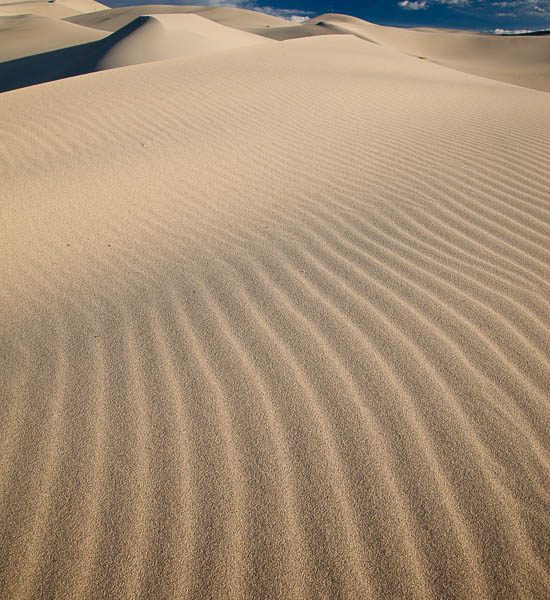
One of the goals of our recent Death Valley trip was to reach the wonderful Eureka Valley Sand Dunes. At almost 700′ tall, these dunes are some of the tallest in the United States (and are the tallest in California). The Eureka Valley lies in the northern reaches of Death Valley National Park, and became an official part of the Death Valley National Park in 1994 with the passage of the Desert Protection Act. The Eureka dune field is approximately 3 miles long and one mile wide, with the tallest dunes being at the north end. The Eureka Valley is geologically impressive, with the Last Chance Mountain Range rising 5500′ above the valley floor on the north and east and the Saline Mountains rising in the west. We reached the Eureka Valley via the Big Pine Road from Highway 395, spent a night at the primitive campground, and left via the Big Pine Road for the Racetrack. Conditions were ideal when we were there, with cool and calm weather and absolutely clear skies with a new moon that made a great night to photograph the Milky Way. We were also treated to a fly-by of the International Space Station in the northern sky just after sunset. I managed to shoot an interesting time lapse movie of the Milky Way rising above the southern horizon. Walking about the dunes, we came across the endangered Eureka Valley Dune Grass, and witnessed the strange phenomenon of “singing sands”. When a sand slope of just the right size and inclination was disturbed, the moving sand produced a deep thrumming that sounded just like a distant airplane. In the morning we found blooming wildflowers in the dessicated mud fields at the foot of the dunes, including the endangered Eureka Valley Evening Primrose and a little wildflower I have yet to identify. Our quick visit was nearly perfect — my one regret is not hiking all the way to the summit of the tallest dune. I am eager to return, and in the future I may skip the southern end of the park entirely and split my time between the Eureka Valley and the White Mountains (bristlecones!). If I do, the first order of business will be to ascend straight to the top of the tallest dune and hoist a cold one.

Eureka Dunes.  The Eureka Valley Sand Dunes are California's tallest sand dunes, and one of the tallest in the United States.  Rising 680' above the floor of the Eureka Valley, the Eureka sand dunes are home to several endangered species, as well as singing sand that makes strange sounds when it shifts.  Located in the remote northern portion of Death Valley National Park, the Eureka Dunes see very few visitors
Eureka Dunes. The Eureka Valley Sand Dunes are California’s tallest sand dunes, and one of the tallest in the United States. Rising 680′ above the floor of the Eureka Valley, the Eureka sand dunes are home to several endangered species, as well as “singing sand” that makes strange sounds when it shifts. Located in the remote northern portion of Death Valley National Park, the Eureka Dunes see very few visitors.
Image ID: 25250  
Location: Eureka Dunes, Death Valley National Park, California, USA
 
Eureka Dunes.  The Eureka Valley Sand Dunes are California's tallest sand dunes, and one of the tallest in the United States.  Rising 680' above the floor of the Eureka Valley, the Eureka sand dunes are home to several endangered species, as well as singing sand that makes strange sounds when it shifts.  Located in the remote northern portion of Death Valley National Park, the Eureka Dunes see very few visitors
Eureka Valley Sand Dunes.
Image ID: 25249
Sunset on the Last Chance Mountain Range, seen from Eureka Valley Sand Dunes.  , Eureka Dunes, Death Valley National Park, California
Sunset on the Last Chance Mountain Range, seen from Eureka Valley Sand Dunes.
Image ID: 25238
Eureka Dunes.  The Eureka Dunes are California's tallest sand dunes, and one of the tallest in the United States.  Rising 680' above the floor of the Eureka Valley, the Eureka sand dunes are home to several endangered species, as well as singing sand that makes strange sounds when it shifts, Death Valley National Park
Eureka Dunes. The Eureka Dunes are California’s tallest sand dunes, and one of the tallest in the United States. Rising 680′ above the floor of the Eureka Valley, the Eureka sand dunes are home to several endangered species, as well as “singing sand” that makes strange sounds when it shifts.
Image ID: 25251
Eureka Sand Dunes, infrared black and white.  The Eureka Dunes are California's tallest sand dunes, and one of the tallest in the United States.  Rising 680' above the floor of the Eureka Valley, the Eureka sand dunes are home to several endangered species, as well as singing sand that makes strange sounds when it shifts, Death Valley National Park
Eureka Sand Dunes, infrared black and white.
Image ID: 25376

The Eureka Valley Sand Dunes are home to a few notable and imperiled plant species, which I blogged about recently: the Eureka Valley Evening Primrose (Oenothera californica eurekensis) and Eureka Valley Dune Grass (Swallenia alexandrae)

Eureka Valley Dune Grass, Swallenia alexandrae

View This Blog Post in Google Earth (How Cool Is That?)  View this blog entry in Google Earth
Latitude: 37° 6' 17.64" N, Longitude: 117° 40' 30.79" W, Coord: 37.1049°, -117.67522°
Filed under: California, Death Valley, Desert, Flora, National Parks on 6/10/2010

Stock photos of the Eureka Valley Dune Grass, Swallenia alexandrae, in Death Valley National Park.

The Eureka Valley Dune Grass (Swallenia alexandrae) is a federally endangered grass found only in the Eureka Valley, in the far northern reaches of Death Valley National Park. Swallenia is a monotypic genus, consisting only of the one species alexandrae. The grass is a rhizome, forming horizontal stems that spread laterally underneath the sand, producing new roots and shoots that lead to a tufted aggregation of the plant. This perennial grass grows on the slopes of the Eureka Valley Sand Dunes. In the past its survival was threatened by off-road vehicles, which were prohibited by BLM in the Eureka Valley in 1976 with enforcement effectively beginning in 1980. The area became part of Death Valley National Park in 1994. We found a number of small tufts of Eureka Valley Dune Grass on the dunes. This one depicts the Last Chance Mountain Range in the background, viewed from the north end of the dunes.

Eureka dune grass, and rare and federally endangered species of grass  endemic to the Eureka Valley and Eureka Sand Dunes.  The Last Chance mountains, lit by sunset, as visible in the distance.  Swallenia alexandrae, a perennial grass, grows only in the southern portion of Eureka Valley Sand Dunes, in Inyo County, California, Swallenia alexandrae, Eureka Dunes, Death Valley National Park
Eureka dune grass, and rare and federally endangered species of grass endemic to the Eureka Valley and Eureka Sand Dunes. The Last Chance mountains, lit by sunset, as visible in the distance. Swallenia alexandrae, a perennial grass, grows only in the southern portion of Eureka Valley Sand Dunes, in Inyo County, California.
Image ID: 25358  
Species: Eureka Valley dune grass, Eureka dunegrass, Swallenia alexandrae
Location: Eureka Dunes, Death Valley National Park, California, USA
 

The Eureka Valley Sand Dunes are home to another notable and imperiled plant species, which I blogged about recently: the Eureka Valley Evening Primrose (Oenothera californica eurekensis)

Eureka Valley Evening Primrose, Oenothera californica eurekensis

View This Blog Post in Google Earth (How Cool Is That?)  View this blog entry in Google Earth
Latitude: 33° 17' 47.79" N, Longitude: 117° 39' 34.92" W, Coord: 33.29661°, -117.6597°
Filed under: California, Death Valley, Desert, Flora, National Parks, Wildflowers on 6/4/2010

Stock photos of the Eureka Valley Dune Evening Primrose, Oenothera californica eurekensis, in Death Valley National Park.

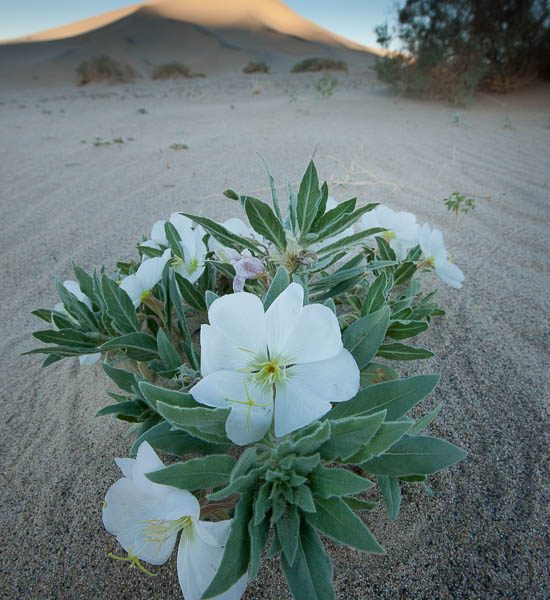
The Eureka Valley Evening Primrose (Oenothera californica eurekensis) is a federally endangered wildflower found only on and near the sand dune habitat of the Eureka Valley, in the far northern reaches of Death Valley National Park. Observed primarily at the Eureka Sand Dunes, it is also found on the nearby Saline Spur Dunes and Marble Canyon Dunes. According to a 2007 review of the 1982 recovery plan for the species, the Eureka Valley Evening Primrose is “a subspecies with a moderate degree of threat and a high recovery potential.” During spring and fall seasons that have enough rainfall, the plant blooms (typically April through June) with large white flowers that turn red as they age. As soon as I saw the first one, it instantly reminded me of its close cousin, the Dune Evening Primrose that I have seen in Anza Borrego. I am intrigued at how severely ecologically isolated the Eureka Valley Evening Primrose is, existing on just three sets of sand dunes. Sort of like a plant found on only a tiny atoll in the middle of the ocean, but this is the desert. Because of its rare nature and the wherethehellamI habitat in which it resides, it is now one of my favorite flowers.

Eureka Valley Dune Evening Primrose.  A federally endangered plant, Oenothera californica eurekensis is a perennial herb that produces white flowers from April to June. These flowers turn red as they age. The Eureka Dunes evening-primrose is found only in the southern portion of Eureka Valley Sand Dunes system in Indigo County, California, Oenothera californica eurekensis, Death Valley National Park
Eureka Valley Dune Evening Primrose. A federally endangered plant, Oenothera californica eurekensis is a perennial herb that produces white flowers from April to June. These flowers turn red as they age. The Eureka Dunes evening-primrose is found only in the southern portion of Eureka Valley Sand Dunes system in Indigo County, California.
Image ID: 25237  
Species: Oenothera californica eurekensis
Location: Eureka Dunes, Death Valley National Park, California, USA
 
Eureka Valley Dune Evening Primrose.  A federally endangered plant, Oenothera californica eurekensis is a perennial herb that produces white flowers from April to June. These flowers turn red as they age. The Eureka Dunes evening-primrose is found only in the southern portion of Eureka Valley Sand Dunes system in Indigo County, California, Oenothera californica eurekensis, Death Valley National Park
Image ID: 25267  

I recently made a short visit to the Eureka Dunes with my photographer friends Garry McCarthy and John Moore. We were on a sort of banzai run**, trying to cover Eureka Dunes, the Racetrack and Badwater Salt Flats in 3 days. We definitely were not looking for wildflowers, so we were fortunate to find a few Eureka Valley Evening Primroses along the outskirts of the dunes. Our visit took place in mid-May, and heading into Death Valley I figured the wildflowers were past peak and would be burnt to a crisp by the harsh conditions. Indeed, in the lower regions of the park, wildflowers that presented such an excellent display earlier in the spring were long gone. However, the floor of the Eureka Valley is at an elevation of 2800′, where conditions are much cooler. In fact, as we approached Eureka Valley, and especially on the dirt roads between Eureka Valley and Death Valley at altitudes between 2000′ and 4000′, I was surprised by the richness and variety of the wildflower displays. It really was superb, and I might consider that region for a wildflower trip in future years since it offers a ton of solitude and some awesome vistas.

The Eureka Valley Sand Dunes are home to another endangered plant species: the Eureka Valley Dune Grass, Swallenia alexandrae.

**banzai photographer (n): (1) a photographer with a working spouse and multiple kids each of whom has lots of activities that require driving all over the place during the week, help with homework in the evenings, and then driving all over the place on the weekends; (2) a photographer who crams five days of photography into a single weekend; (3) a photographer with a banzai attitude about life; (4) a photographer who photographs banzai trees.

Leopard Shark Photos, Triakis semifasciata

View This Blog Post in Google Earth (How Cool Is That?)  View this blog entry in Google Earth
Latitude: 32° 50' 49.66" N, Longitude: 118° 22' 48.72" W, Coord: 32.84713°, -118.3802°
Filed under: Marine Life, Sharks on 6/3/2010

Stock photographs of leopard sharks, Triakis semifasciata.

I’ve been diving in the kelp forest for about 20 years, yet have never been able to get a decent photo of a leopard shark (Triakis semifasciata) in the wild. I’ve seen them many times, but never had a good opportunity for a photo. Leopard sharks are relatively harmless coastal sharks, often found in shallow water in kelp forests or over sand flats. They exhibit a beautiful spotted pattern which provides excellent camoflage, in seaweed especially. However, leopard sharks are timid, and do not typically approach people or divers. The best place that I know of to see leopard sharks is directly in front of the Marine Room restaurant in La Jolla, in shallow water (4′-8′ deep), in summer, since they congregate there en masse. I take my daughters there sometimes to snorkel and look at the leopard sharks. But the water clarity there is poor, making good picture taking difficult. Another good place is the front side of Catalina Island, in summer, in coves and shallow areas.

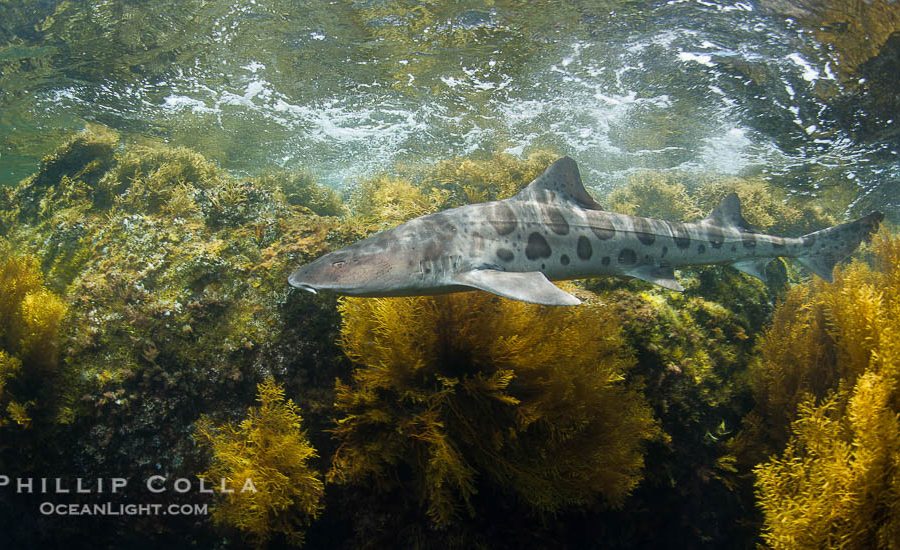
Monday, about an hour before we had to leave San Clemente Island and return home, I had a 4′ long leopard shark surprise me by appearing out of nowhere and swimming right in front of my camera. I didn’t have to do a thing except depress the shutter. Click. Finally got a shot of a leopard shark. This was only about 2-3′ deep, and was shot with a 15mm fisheye lens with the shark about 18″ away from the camera.

A leopard shark, swimming through the shallows waters of a California reef, underwater, Triakis semifasciata, San Clemente Island
A leopard shark, swimming through the shallows waters of a California reef, underwater.
Image ID: 25417  
Species: Leopard shark, Triakis semifasciata
Location: San Clemente Island, California, USA
 

In the past I have shot some nice portraits of leopard sharks, but in a tank so its not quite the same thing!

Leopard shark swims through a kelp forest, Triakis semifasciata
Leopard shark swims through a kelp forest.
Image ID: 14028  
Species: Leopard shark, Triakis semifasciata
 
Leopard shark swims through a kelp forest, Triakis semifasciata
Leopard shark swims through a kelp forest.
Image ID: 14932  
Species: Leopard shark, Triakis semifasciata
 

Sea Fans and Gorgonians at San Clemente Island

View This Blog Post in Google Earth (How Cool Is That?)  View this blog entry in Google Earth
Latitude: 32° 49' 25.49" N, Longitude: 118° 21' 14.39" W, Coord: 32.82375°, -118.354°
Filed under: California, Underwater Life on 6/2/2010

Photos of gorgonians and sea fans at San Clemente Island.

I spent three days diving at one of my favorite spots on Earth: San Clemente Island. The island, about 60 miles offshore of southern California, is home to some of the world’s most beautiful kelp forests. Swimming through these kelp forests is akin to flying through a forest of towering redwoods. Below the tall kelp plants are rocky reefs where gorgonians, also known as sea fans, anchor themselves. Gorgonians are filter feeders, and spread their long slender arms out into the currents where individual polyps will catch and eat organic debris and plankton that floats by in the current. I have a few favorite reefs at San Clemente Island where I know I will always find magnificent examples of gorgonians, several feet in diameter and exhibiting healthy polyps and rich colors. My goal on this trip was to shoot a few good images of the several species that are commonly found at San Clemente Island: red gorgonian (Lophogorgia chilensis), California golden gorgonian (Muricea californica), and brown gorgonian (Muricea fruticosa).

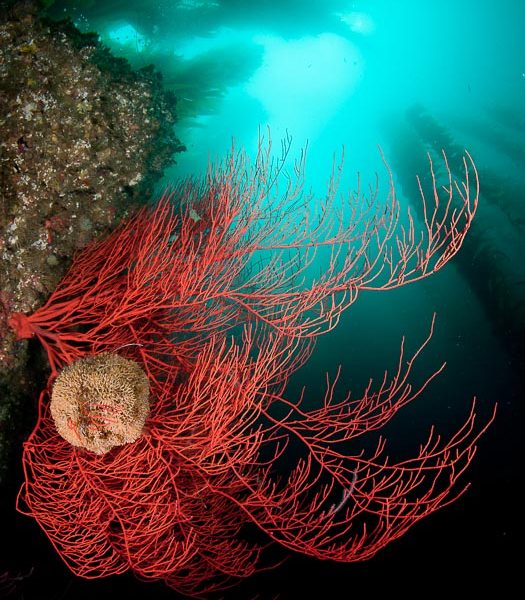
Red gorgonian on rocky reef, below kelp forest, underwater.  The red gorgonian is a filter-feeding temperate colonial species that lives on the rocky bottom at depths between 50 to 200 feet deep. Gorgonians are oriented at right angles to prevailing water currents to capture plankton drifting by, Lophogorgia chilensis, San Clemente Island
Red gorgonian on rocky reef, below kelp forest, underwater. The red gorgonian is a filter-feeding temperate colonial species that lives on the rocky bottom at depths between 50 to 200 feet deep. Gorgonians are oriented at right angles to prevailing water currents to capture plankton drifting by.
Image ID: 25393  
Species: Red gorgonian, Lophogorgia chilensis
Bryozoan grows on a red gorgonian on rocky reef, below kelp forest, underwater.  The red gorgonian is a filter-feeding temperate colonial species that lives on the rocky bottom at depths between 50 to 200 feet deep. Gorgonians are oriented at right angles to prevailing water currents to capture plankton drifting by, Lophogorgia chilensis, San Clemente Island
A large bryozoan cluster grows on a red gorgonian.
Image ID: 25395  
Species: Red gorgonian, Lophogorgia chilensis
California golden gorgonian on rocky reef, underwater.  The golden gorgonian is a filter-feeding temperate colonial species that lives on the rocky bottom at depths between 50 to 200 feet deep.  Each individual polyp is a distinct animal, together they secrete calcium that forms the structure of the colony. Gorgonians are oriented at right angles to prevailing water currents to capture plankton drifting by, Muricea californica, San Clemente Island
California golden gorgonian on rocky reef, underwater.
Image ID: 25397  
Species: California golden gorgonian, Muricea californica
Brown gorgonians on rocky reef, below kelp forest, underwater.  Gorgonians are filter-feeding temperate colonial species that live on the rocky bottom at depths between 50 to 200 feet deep.  Each individual polyp is a distinct animal, together they secrete calcium that forms the structure of the colony. Gorgonians are oriented at right angles to prevailing water currents to capture plankton drifting by, Muricea fruticosa, San Clemente Island
Brown gorgonians on rocky reef, below kelp forest, underwater.
Image ID: 25398  
Species: Brown gorgonian, Muricea fruticosa
Red gorgonian on rocky reef, below kelp forest, underwater.  The red gorgonian is a filter-feeding temperate colonial species that lives on the rocky bottom at depths between 50 to 200 feet deep. Gorgonians are oriented at right angles to prevailing water currents to capture plankton drifting by, Lophogorgia chilensis, San Clemente Island
Red gorgonian.
Image ID: 25394  
Species: Red gorgonian, Lophogorgia chilensis

A few photographic notes: these images were all shot with a 15mm fisheye lens and two submersible lights. Certain colors, suchs as reds, oranges and yellows, effectively disappear below about 10′ deep. Submersible lights are used to bring out the color and detail in these gorgonians, which in the available light would appear colorless and drab at these depths. The water in California tends to have particles floating in it and consequently is not as clear as water in the tropics. To minimize the degree to which poor water clarity adversely impacts the photograph, I get as close as possible to my subject. In these photos, my camera is only about 6-10 inches from the gorgonians, so a very wide lens is required in order to depict the entire sea fans. These images were taken at depths from about 45′ to 70′, all of them at the southern end of San Clemente Island. In all of them, the camera is pointed almost straight up toward the surface, so that some of the sunlight and kelp forest that rises above these gorgonians can be depicted. I hold my breath to make sure my bubbles don’t get in the photo.


HOME | Online Image Search | Photo of the Day | Contact / Bio | Licensing/Pricing | Prints | Stock List | Image Hierarchy | List of Log Entries | Site Map | Blue Whale | Cetaceans | Pinnipeds | Sharks | Rays | Fishes | Kelp Forest | Sea Birds | Inverts | Man & Animal | Man & Ocean | Ocean & Light | Ocean & Motion | Portraits | About Color and Monitor Calibration | Copyright Statement | All text and photographs copyright © Phillip Colla Natural History Photography   All rights reserved worldwide. The content of this site is made available for purposes of researching images offered for license by Phillip Colla Natural History Photography.  No image is to be copied, duplicated, modified or redistributed in whole or part without the prior written permission of Phillip Colla Natural History Photography.  Whale logo is a trademark of Phillip Colla Natural History Photography, 8021 Paseo Arrayan, Carlsbad, CA 92009, USA.  760.707.7153  Email: oceanlight@OceanLight.com    Web: www.OceanLight.com      Portfolios: www.Gygis.com

Updated: June 19, 2013