Photo of Elk Flehmen Response, Natural History Photography Blog

Photo of Elk Flehmen Response

View This Blog Post in Google Earth (How Cool Is That?)  View this blog entry in Google Earth
Latitude: 44° 38' 56.87" N, Longitude: 110° 56' 57.5" W, Coord: 44.649133°, -110.94931°
Filed under: Elk, National Parks, Wildlife, Wyoming, Yellowstone on 12/6/2007

This bull elk (Cervus candensis) had a fine harem of females along the Madison River. He was bugling often and loudly, raising his head and lowering his antler rack behind him as he did so. Note how the bull’s upper lip is curled back. This is an example of the flehmen response (from German flehmen, meaning to “curl the upper lip”). The flehmen response is a particular type of curling of the upper lip in ungulates, felids, and many other mammals, which facilitates the transfer of pheromones and other scents into the vomeronasal organ, also called Jacobson’s Organ. In the flehmen response, animals draw back their lips , particularly the upper lip which curls towards the nostrils. The action, which is used when examining scents left by other animals, helps to expose the vomeronasal organ and draws scent molecules back toward it. This behavior allows animals to detect scents, for example from urine, of other members of their species or clues to the presence of prey. The flehmen response also allows the animals to determine, among other things, the presence or absence of estrus, the physiological state of the animal, and how long ago the animal passed by.
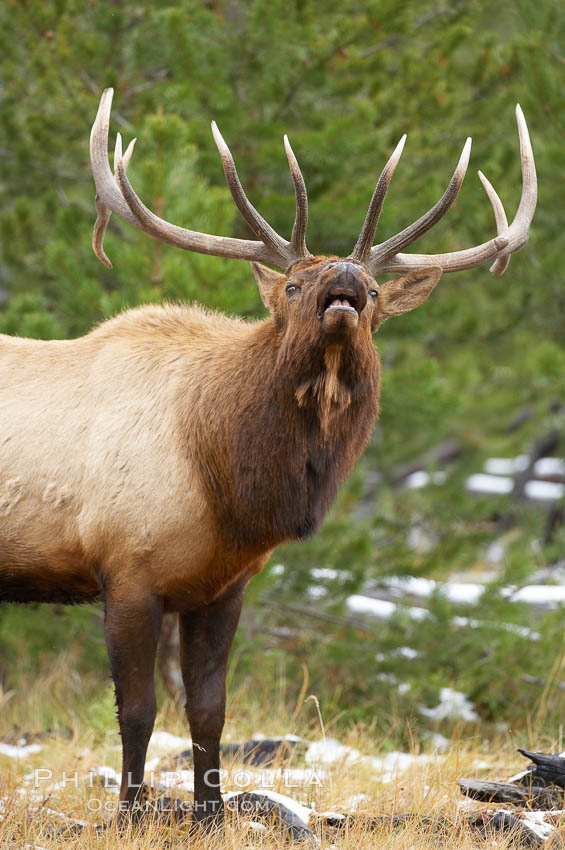
Male elk bugling during the fall rut. Large male elk are known as bulls. Male elk have large antlers which are shed each year. Males engage in competitive mating behaviors during the rut, including posturing, antler wrestling and bugling, a loud series of screams which is intended to establishe dominance over other males and attract females., Cervus canadensis,  Copyright Phillip Colla, image #19708, all rights reserved worldwide.
Male elk bugling during the fall rut. Large male elk are known as bulls. Male elk have large antlers which are shed each year. Males engage in competitive mating behaviors during the rut, including posturing, antler wrestling and bugling, a loud series of screams which is intended to establishe dominance over other males and attract females. Yellowstone National Park, Wyoming, USA.
Image: 19708  
Species: Cervus canadensis
Location: Yellowstone National Park, Wyoming, USA
Click To View This Location in Google Earth.  You must have Google Earth installed for this feature to work correctly. View this Image in Google Earth!


»


Leave a comment


HOME | Online Image Search | Photo of the Day | Contact / Bio | Licensing/Pricing | Prints | Stock List | Image Hierarchy | List of Log Entries | Site Map | Blue Whale | Cetaceans | Pinnipeds | Sharks | Rays | Fishes | Kelp Forest | Sea Birds | Inverts | Man & Animal | Man & Ocean | Ocean & Light | Ocean & Motion | Portraits | About Color and Monitor Calibration | Copyright Statement | All text and photographs copyright © Phillip Colla Natural History Photography   All rights reserved worldwide. The content of this site is made available for purposes of researching images offered for license by Phillip Colla Natural History Photography.  No image is to be copied, duplicated, modified or redistributed in whole or part without the prior written permission of Phillip Colla Natural History Photography.  Whale logo is a trademark of Phillip Colla Natural History Photography, 8021 Paseo Arrayan, Carlsbad, CA 92009, USA.  760.707.7153  Email: oceanlight@OceanLight.com    Web: www.OceanLight.com      Portfolios: www.Gygis.com

Updated: May 25, 2013