Photo of Jupiter and moons Europa, Callisto and Ganymede
Photo of Jupiter and its moons Europa, Callisto and Ganymede
Last night as I put my daughter to bed, we looked out her window. The moon was bright and clear, and below and just to the right of the moon was an especially bright star. When we noticed smaller specks of light near the bright “star”, we realized that we were in fact looking at the planet Jupiter and that the small specks were several of Jupiter’s moons.
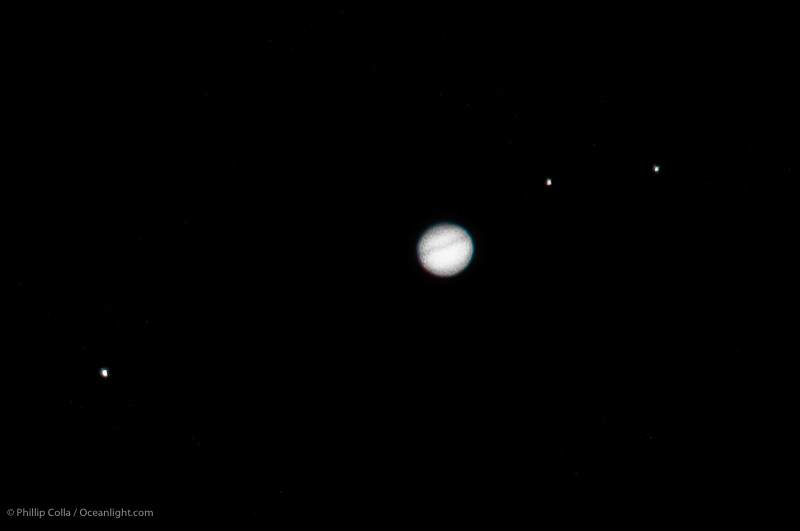
![]() Jupiter and moons Europa, Callisto and Ganymede (right to left). |
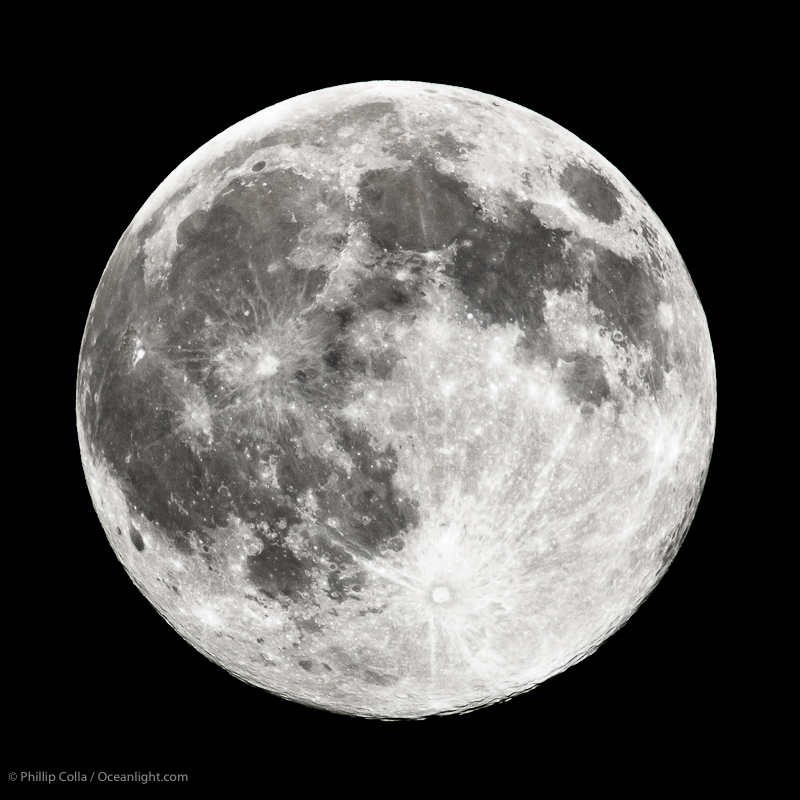
Garry McCarthy had mentioned that Jupiter was as close to Earth now as it will be for years, and had showed me a nice photo of Jupiter and its moons that he shot from his backyard. So I got out the tripod, my longest lens and set them up in the backyard, and had my daughters come out in the backyard to take a look. They were pretty stoked at being able to see another planet and a few of its moons. We swung the lens a few degrees and aimed it at the moon, and were pleased to view the fantastic details visible on the moon. My youngest asked what the rough edges of the moon were, and I told her they were “mountains on the moon” — which they are (they are the ridges of craters viewed on edge). It is amazing to me that we were able to clearly discern the moons of another planet, and indeed a bit of the bands of Jupiter, with consumer camera equipment. Granted, the lens is a high quality 500mm lens (one of the big ones you see at sporting events) but it is not meant for astronomical use.
|
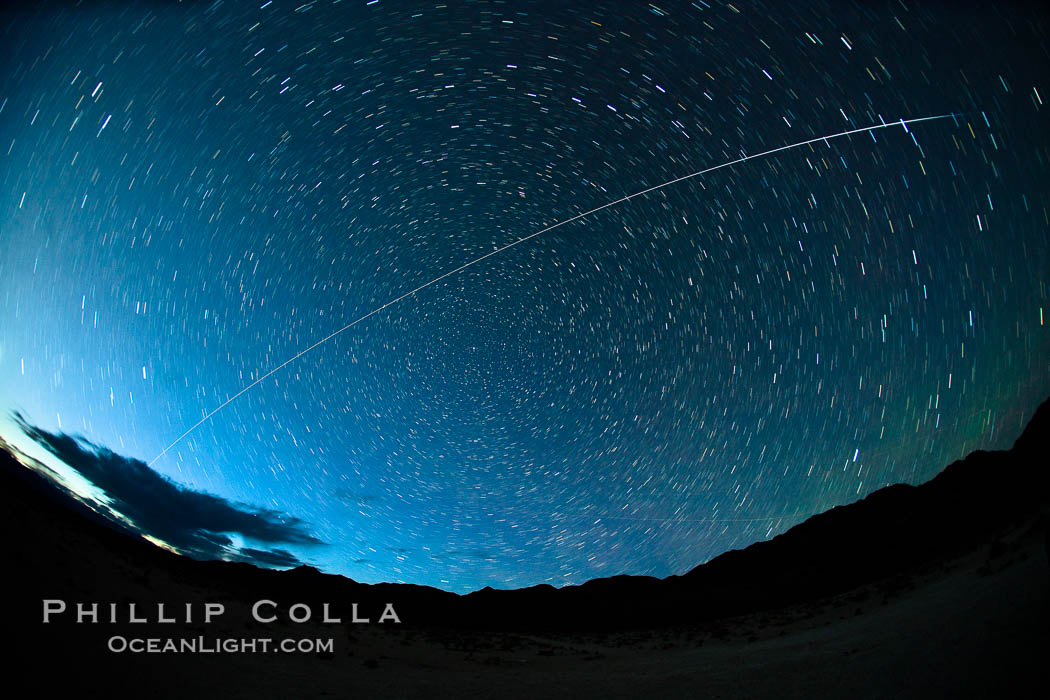
Speaking of Garry, when we were camped at the Eureka Dunes in the remote northern reaches of Death Valley National Park, we had clear skies and superb conditions for stargazing. Garry knew exactly when the International Space Station would be making a flyby over us that very night, and it coincided with dusk. He told John Moore and me where on the horizon the Space Station would appear, and at what minute and how long it would take to cross the sky. Given the length of time it would be visible (which determined the shutter speed), I guessed at the correct exposure and set my aperture and ISO, opened the shutter a minute before the Space Station was scheduled to appear and closed it when the Space Station entered the shadow of the Earth. This is the result:
![]() |
| International Space Station flys over Death Valley shortly after sunset. Image ID: 25247 Location: Earth Orbit, Solar System, Milky Way Galaxy, The Universe |
Exposure notes: The photos of Jupiter and the Moon were made with a Canon 1Ds Mark III, Canon 500mm f/4 lens with stacked 1.4x and 2.0x teleconverters. The photo of the International Space Station was made with Canon 1Ds Mark II and Canon 15mm f/2.8 fisheye lens.
7 Comments »
Leave a comment
HOME | Online Image Search | Photo of the Day | Contact / Bio | Licensing/Pricing | Prints | Stock List | Image Hierarchy | List of Log Entries | Site Map | Blue Whale | Cetaceans | Pinnipeds | Sharks | Rays | Fishes | Kelp Forest | Sea Birds | Inverts | Man & Animal | Man & Ocean | Ocean & Light | Ocean & Motion | Portraits | About Color and Monitor Calibration | Copyright Statement | All text and photographs copyright © Phillip Colla Natural History Photography All rights reserved worldwide. The content of this site is made available for purposes of researching images offered for license by Phillip Colla Natural History Photography. No image is to be copied, duplicated, modified or redistributed in whole or part without the prior written permission of Phillip Colla Natural History Photography. Whale logo is a trademark of Phillip Colla Natural History Photography, 8021 Paseo Arrayan, Carlsbad, CA 92009, USA. 760.707.7153 Email: oceanlight@OceanLight.com Web: www.OceanLight.com Portfolios: www.Gygis.com
Updated: June 19, 2013


That is incredible Phil. I’m surprised you were able to get such clear shots with regular photo equipment.
Comment by Richard Wong — 9/23/2010 @ 10:03 am
Nice symbiosis we have going here, Phil! I’ve been inspired by so many of your photos, it’s nice to be able to give back. Saturday night’s assignment (weather permitting): Rocket Launch!
Comment by Garry McCarthy — 9/23/2010 @ 10:16 am
Thanks Richard. I’m surprised too. There’s no way I would have got this with film. However, just being able to capture a simple rendition of Jupiter, and its moons especially, was fun, never thought the gear would permit that.
Garry — looking forward to it!
Comment by Phil — 9/23/2010 @ 10:29 am
Stacking teleconverters is not for the faint of heart. This shows you’ve got it mastered, Phil. Tonight I cannot see the bands with 8X42 binocs, so your photos are the only proof of what’s happening out there.
Comment by John Pelafigue — 9/23/2010 @ 7:59 pm
Thanks John. The stacking was a test: I tried using 1.4x+2x versus 2x alone and cropping more. The results were better with the stacked teleconverters. I had to stop down to about f/13 or so to try to jack up the sharpness but its still awfully soft.
Comment by Phil — 9/23/2010 @ 9:27 pm
How long was the Jupiter exposure? At that magnification, it had to be moving pretty fast! My brother-in-law has a nice telescope with which you can clearly see the rings and moons, but man you have to move the thing pretty often! I wonder how much more sharp yours would have been with an equatorial mount? I want to try one of those someday…
Comment by John H. Moore — 9/23/2010 @ 10:35 pm
John - I think the exposures were about 1/10 of a second, and yes there is movement. The real problem is that I was bumping up against the resolving power of the lens and sensor. A telescope would have been much better. As part of the NASA article I mentioned there is a nice shot of Jupiter taken with proper equipment. I agree, it would be fun to have the right optics and a proper mount.
Comment by Phil — 9/24/2010 @ 6:27 am