How I Lost My Apple-ginity
You know the feeling. That special iFeeling. You walk into the Apple Store and immediately have the joy. Oooh. Aaah. “How cool would it be to have one of those? Just think how my photography experience would improve with THAT! I know I could be twice as productive with that phone!” My kids love the Apple Store too. “iDad, can I have one of these? I really need it for school!” My wallet climbs out of my pocket and prostrates itself across the “genius bar” before I notice and yank it back. I have an Apple Store a few minutes from my house. It’s my happy place. My car knows the way blindfolded. However, in spite of the fact that I have worked with personal computers since 1984 (yup, the PC-XT), I’ve been a dyed-in-the-wool PC/Windows guy for reasons related to the tech I practice, and have resisted owning an Apple (other than our many iPods, 7 or 8 I think, I’ve lost count).

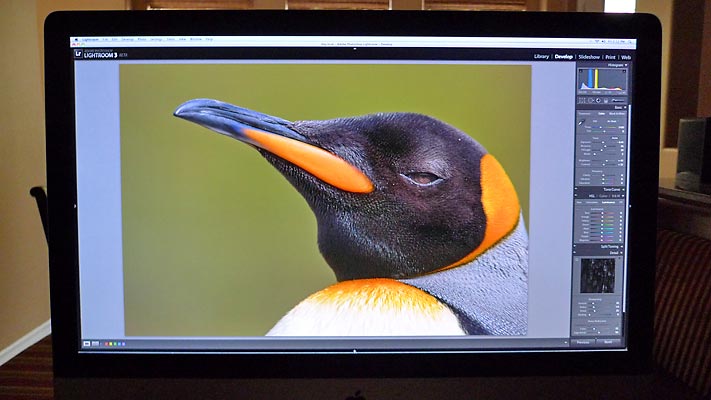
27" iMac Quad Core Gorgeous Screen
Well, I am officially no longer an iVirgin. I am swooning and smitten, shining with that lovely glow that only one’s first iMac can produce. I just picked up a beautiful quad-core iMac 27″. I decided that, given the 30,000 images and hours of video I shot on my recent trip, and the limited time I have to get the images edited and prepped, I should at least have a fun new toy to make the process fun and go quickly. I’m also starting to switch some of my workflow to Lightroom. (I am using Lightroom 3 beta at the moment. It seems more stable on the iMac than on Windows.). Given that Lightroom runs beautifully on a Mac, and the fact that the 27″ iMac monitor is so so sweet, I broke down and bought one. And guess what? Now I’m a hero with my iKids too! My girls have totally taken over the thing until the wee hours of the night when I kick them off and get down to work of editing my images, reliving the places I saw and the animals I met in glorious 27″ iReality.

Oooooooooh, sweeeeeeeet.
The monitor problem that everyone is reporting? Well, from the comments on the internet it is a real issue. My monitor may have the very faintest yellow tinge to it, it is hard to say. I tried this test: http://imac.squeaked.com/test.php and found no dead or stuck pixels (good thing), and depending on the angle of view there may be a bit of a yellow tinge to the lower portion of the monitor. So I guess I’ll have it checked soon.
Apple says they have fixed the problem. So at least they recognize there is a problem and those who are affected may get some satisfaction.
I’m moving forward with it. I was able to calibrate the monitor and get down to work with it, and am happy with the results. The screen is so large, with so many pixels, that working in Lightroom is a breeze even with all the panes opened up.
So, as long as this gushing love story remains on my blog, you can assume I am happy with my iMac. But, like the fickle females that share my house, I may change my mind! And if I do, you’ll see a rant here and I’ll go back to my old CaptureOne software running on a Windows machine.
Westpoint Island, Falkland Islands
Photos of Westpoint Island and Rockhopper Penguins, Falkland Islands
Morning finds us at Westpoint Island. We can only see about 200’ up into the rolling green hills; heavy cloud cover obscures everything above that. It looks wet in the hills. Our zodiac lands on a small boat ramp, one of the few “dry landings” we will have during the trip. We are told we have the option of hiking 1.5 miles to the albatross rookery, or we can hitch a ride on a Land Rover. I opt for the latter. The countryside is pastoral, lush and soft and would be difficult for most vehicles, but the sturdy Rover has no problems.
![]() |
| Colony of nesting black-browed albatross, rockhopper penguins and Imperial shags, set high above the ocean on tussock grass-covered seacliffs. Image ID: 23935 Species: Black-browed albatross, Rockhopper penguin, Imperial shag, Thalassarche melanophrys, Eudyptes chrysocome, Phalacrocorax atriceps Location: Westpoint Island, Falkland Islands, United Kingdom View this Image in Google Earth! |
The “road” is somewhat ambiguous. We roll by some old wooden gates, a few windmills and some sheep. It is foggy and drizzling. I feel British. Soon we reach a colony of black-browed albatross (Thalassarche melanophrys), Imperial shag (Phalacrocorax atriceps) and rockhopper penguins (Eudyptes chrysocome) dramatically set on bluffs high above the sea. This is our first bout with tussock grass. It is rumored to be awkward to walk through, but at this spot the waist-high maze is fairly easy to navigate.
![]() |
| Western rockhopper penguin, standing atop tussock grass near a rookery of black-browed albatross. Image ID: 23932 Species: Rockhopper penguin, Eudyptes chrysocome Location: Westpoint Island, Falkland Islands, United Kingdom View this Image in Google Earth! |
The edge of the colony abuts the tussock so that we can stand just a few feet away from the birds but still be behind large tufts of grass. The sounds are wonderful: wind, penguins vocalizations, clucks by the albatrosses. I brought a long lens and immediately realize it is overkill. I return to my bag and pull out my widest lens so that I can shoot some video of the colony.
![]() |
| Black-browed albatross, adult on nest with chick. Image ID: 23946 Species: Black-browed albatross, Thalassarche melanophrys Location: Westpoint Island, Falkland Islands, United Kingdom View this Image in Google Earth! |
I change locations on the periphery of the colony a few times, photographing and shooting video. At one spot, some rockhoppers march to a small creek to bathe and groom. After a few hours it is time to return to the landing, in the Land Rover again. Such a smooth ride, I must get one of these. We are offered tea and bisquits at the settlement cottage at the landing. I feel British some more. We return to the boat for lunch, and reposition to Carcass Island.
All of my photography from the trip is linked to the location where the images were taken. If you have Google Earth, you can see all of my photos from Westpoint Island overlaid at the exact location they were taken.
Next: Carcass Island, Falkland Islands
Previous: New Island, Falkland Islands
Trip Index: Cheesemans Antarctica, Falklands and South Georgia
All “Southern Ocean” entries
New Island, Falkland Islands
Photos of New Island, Falkland Islands
![]() |
| Tall seacliffs overlook the southern Atlantic Ocean, a habitat on which albatross and penguin reside. Image ID: 23809 Location: New Island, Falkland Islands, United Kingdom |
Today is New Years Day, an appropos date on which to land at New Island in the Falklands, our first landing of the trip. Set next to the ocean in a small bight is New Island Settlement, a picturesque set of cottages at the edge of the bay above a sandy beach. We depart from the boat in zodiacs for the shore, leave our dry bags and life preservers in a pile on the beach, and begin an easy walk over wet, grassy hills to a rockhopper rookery. Flightless steamer ducks, kelp geese and upland geese mill about on the sand and through the tall grass. The weather is quite mild so I only need shorts and a light fleece under my foulies. The rockhopper colony is located at the top of seacliffs several hundred feet above the ocean, in a small bowl-shaped depression. Black-browed albatross and imperial shags (cormorants) are mixed in and around the colony as well. To the right of the colony, cut through the cliffs, is a gully that runs steeply down to the water. It is a thoroughfare for rockhoppers, a way for them to pass from the sea to their colony above. Clean penguins coming from the sea pass up the gully to their nests, while muddy penguins descend. I make my way down the gully carefully, eventually reaching the rocky shore. Many rockhoppers are scattered on the rocks, coming and going to sea. A South American sea lion bull patrols the rocks, presumably hoping to catch an unwary penguin. Some of us sit on the rocks and just watch, taking pictures and admiring the rockhoppers.
![]() |
| Photographer Al Bruton, photographing Magellanic penguins on grasslands above the ocean. Image ID: 23799 Location: New Island, Falkland Islands, United Kingdom |
![]() |
| Sand beach at New Island Settlement, with zodiac ashore and shipwrreck. Image ID: 23800 Location: New Island, Falkland Islands, United Kingdom |
After a few hours, it is time to make our way to the second landing. Rather than return to the big boat, some of us choose to motor straight there by zodiac. Others opt to hike there. We land on another sand beach, with green hills above. The overcast conditions have lifted and we now are favored with blue skies, scattered clouds and some breeze. The objective is to walk to three locations about half mile apart from one another and the beach we are on now: an albatross colony, a gentoo colony and a white sand beach known for surfing penguins. The first thing I encounter on my walk are a series of Magellanic penguins burrowing in the grass. They are cute, standing at the entrances to their small dirt caves. I stick around for 45 minutes checking them out. I don’t see the main group of people so I head off in the direction I think they are, eventually coming to a broad plateau atop the island littered with strange flat, weathered rocks.
![]() |
| Interesting rock formations on plateau atop New Island. Image ID: 23802 Location: New Island, Falkland Islands, United Kingdom |
Continuing through the rocks, my walk takes me to a long line of high sea cliffs offering spectacular views, with albatrosses nesting in many places. The wind is blowing but it is quite warm. I sit for a while, take some photos and admire the view. I am quite alone here, not able to see anyone else at the moment. I have this section of cliffs to myself, but for the birds. I make some photos. Eventually I hike over a couple promontories to reach the others at a dense colony of penguins, albatross and shags, also atop sheer seacliffs. There are more animals here but the setting at my previous spot is far more impressive. I take only a few photos, but shoot some videos trying to capture the sounds of the bird life.
![]() |
| Gentoo penguin coming ashore, after foraging at sea, walking through ocean water as it wades onto a sand beach. Adult gentoo penguins grow to be 30″ and 19lb in size. They feed on fish and crustaceans. Gentoo penguins reside in colonies well inland from the ocean, often formed of a circular collection of stones gathered by the penguins. Image ID: 23831 Species: Gentoo penguin, Pygoscelis papua Location: New Island, Falkland Islands, United Kingdom |
![]() |
| Gentoo penguin colony, set above and inland from the ocean on flat grasslands. Individual nests are formed of small rocks collected by the penguins. Image ID: 23806 Location: New Island, Falkland Islands, United Kingdom |
Soon I leave to hike over a low saddle in the island to reach the third spot of the afternoon, another beach. On the way there I pass several gentoo penguin colonies, set high on the grasslands above the water. The squacking and clicking is loud and raucous, and constant. I sit and listen for a while. After a while I continue down the grassy hills to the surfing beach and arrive there late. Clouds have stolen the sunshine just as I arrive. The others are all departing, photographers included, so I get the sense I have missed the surfing penguins. Eventually, the last of the passengers and staff head back to our originally landing spot, reminding me the last zodiac off the island is in 90 minutes. However, luck is with me and the clouds soon back off, leaving me alone on a beautiful, wide, white sand beach in late afternoon light. Gentoo penguins are coming ashore, splashing in the surf as they do so, making their way to their nearby rookery. I try to photograph them in action in the surf zone but have a hunch I did not stick any really good shots, we’ll see. I spend some time away from the camera, just watching the penguins as they do their thing, and listening to the sounds of the surf, wind and the clucking of the birds. There are large gentoo colonies on a rise above the beach 100 yards away making a constant, low buzzing sound. I am loathe to leave this idyllic spot, and wait until I only have about 15 minutes to hoof it the mile back to the landing in my goofy muck boots and heavy backpack. Time for a workout! I am sweating but happy when I reach the last zodiac and head back to the boat for a shower and a well-earned meal. After dinner I spend some photographing the birds – mostly giant petrels and a few albatross – that follow the boat as we motor to Westpoint Island. I light them with flash, producing a bright sharp bird against a darker sky, pretty neat. What a day. The trip has barely just begun yet I have seen so much already.
All of my photography from the trip is linked to the location where the images were taken. If you have Google Earth, you can see all of my photos from New Island overlaid at the exact location they were taken.
Next: Westpoint Island, Falkland Islands
Previous: Southern Giant Petrel, Macronectes giganteus, Southern Ocean
Trip Index: Cheesemans Antarctica, Falklands and South Georgia
All “Southern Ocean” entries
Southern Giant Petrel, Macronectes giganteus, Southern Ocean
Our trip began with a two-night crossing from Ushuaia to the Falklands. During that middle day, as we sailed north-east though the Southern Ocean, we had some good bird watching, including albatrosses, prions (tiny little rocket birds I am not qualified to photograph), small petrels and the larger and more impressive giant petrels. I spent a lot of time on the back deck, admiring the birds and trying to get photos of them when they came close to the ship. (I typically shot birds from the big boat with 300mm f/2.8 lens with 1.4x converter on a full frame body, which was the perfect setup.) We were on the very stable 270′ ship M/V Polar Star, and had very calm seas for our crossing, so standing on deck and shooting was a breeze.
![]() |
| Southern giant petrel in flight. The distinctive tube nose (naricorn), characteristic of species in the Procellariidae family (tube-snouts), is easily seen. Image ID: 23681 Species: Southern giant petrel, Macronectes giganteus Location: Falkland Islands, Southern Ocean View this Image in Google Earth! |
This day, the birds I photographed the most were the giant petrels, there were just so many of them. They are quite bold, coming alongside the boat often and soaring smoothly, making it easy for even a non-bird-photographer such as myself to get some keeper shots. As for identification, it was not clear to me which species of giant petrel I was seeing. Recently, I consulted with two staff member from our trip, Dave Shaw (Fairbanks, AK) and Jim Danzenbaker, both of whom are skilled at bird identification and educated us during our trip about seabird natural history. Dave is blogging about the trip too, and has had some great posts recently. Did I mention that the staff on our trip was tops? Thanks Dave and Jim. From them I learned that most of the giant petrels I photographed crossing to the Falklands were Southern Giant Petrels (Macronectes giganteus), but after moving south to South Georgia I ended up photographing mostly Northern Giant Petrels (Macronectes halli). Does that sound bass ackwards? Their ranges do overlap considerably.
![]() |
| Southern giant petrel in flight. The distinctive tube nose (naricorn), characteristic of species in the Procellariidae family (tube-snouts), is easily seen. Image ID: 23682 Species: Southern giant petrel, Macronectes giganteus Location: Falkland Islands, Southern Ocean View this Image in Google Earth! |
All the birds in this blog post I believe are Southern Giant Petrels. I’ll post about Northern Giant Petrels when we get to South Georgia Island. In appearance the two species are quite similar to one another which, combined with their range overlap, can make separating them difficult. Dave Shaw suggested that I lookfor a green bill tip (for Southern Giant Petrels) versus red bill tip (Northern), as well as eye color (pale is more common in Northern, darker eye in Southern). About the only sure thing for identifying giant petrels is the white morph, also known as a “white nellie”; the white morph is only known to occur in the Southern Giant Petrel. The Southern Giant Petrel measures up to 39″ long, with a wingspan of up to 81″. Adult males weight 11 lb. while females weight up to 18 lb. My hunch is that the large size for females is an adaptation to reproductive demands. Giant petrels range throughout the Southern Ocean, including Antarctica. The Southern species has a range which is centered somewhat south of that of the Northern species. When in the same location, the two species exhibit temporal separation in their breeding, with Northern giant petrels breeding some six weeks earlier than Southern giant petrels. As of 2009, there are estimated to be 46,800 nesting pairs and the species is listed as “least concern”, an improvement over counts and status of a decade ago. The giant petrel, like many pelagic birds, is at risk of injury and death from longline fishing equipment. Giant petrels are members of the tube-nose order (Procellariiformes) and display the characteristic tubular snout above the bill.
![]() |
| White nellie, the white morph of the southern giant petrel. Southern giant petrel in flight. Image ID: 23678 Species: Southern giant petrel, Macronectes giganteus Location: Falkland Islands, Southern Ocean View this Image in Google Earth! |
I often photographed the giant petrels at sunset, hoping to put them against a pastel sky and light them with a little flash. The results were most pleasing for albatrosses, but I did get some nice images of giant petrels zooming over the water after dark. I liked this one best:
![]() |
| Southern giant petrel in flight at dusk, after sunset, as it soars over the open ocean in search of food. Image ID: 23680 Species: Southern giant petrel, Macronectes giganteus Location: Falkland Islands, Southern Ocean View this Image in Google Earth! |
See more photos of Southern Giant Petrels, Macronectes giganteus photos.
Next: New Island, Falkland Islands
Previous: Cerro Cinco Hermanos, The Five Brothers, Tierra del Fuego, Argentina
Trip Index: Cheesemans Antarctica, Falklands and South Georgia
All “Southern Ocean” entries
Sunrise Pelican
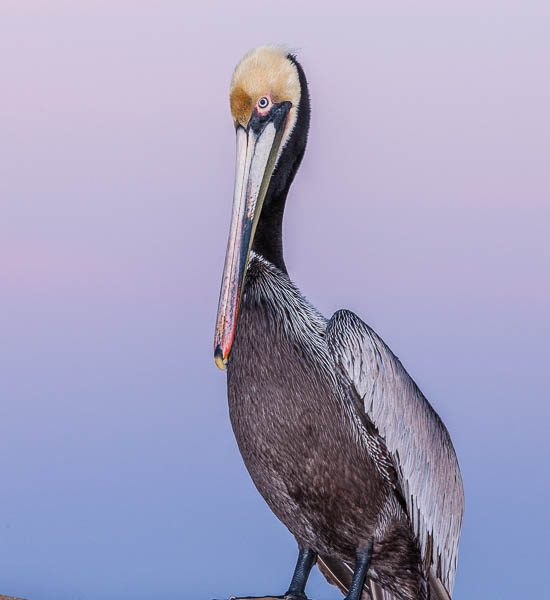
On a recent winter morning I found this adult California brown pelican (Pelecanus occidentalis californicus) displaying the species’ characteristic winter breeding plumage (note the chestnut hindneck) posing nicely as the distant sky took on the pre-sunrise purple glow. This is basically straight out of the camera. I did not adjust the white balance nor did I bump up the saturation. The pink in the distance is the sky, the blue below it is the ocean. La Jolla, California.
![]() |
| California brown pelican, portrait in pink-purple predawn light, rests on sandstone seabluff. The characteristic mating plumage of the California race of brown pelican is shown, with red gular throat pouch and dark brown hindneck colors. Image ID: 23646 Species: Brown pelican, Pelecanus occidentalis, Pelecanus occidentalis californicus Location: La Jolla, California, USA View this Image in Google Earth! |
Here are a few more, just a few minutes after sunrise (about 7am):
![]() |
| Portrait of California brown pelican, with the characteristic winter mating plumage shown: red throat, yellow head and dark brown hindneck. Image ID: 23647 Species: Brown pelican, Pelecanus occidentalis, Pelecanus occidentalis californicus Location: La Jolla, California, USA |
![]() |
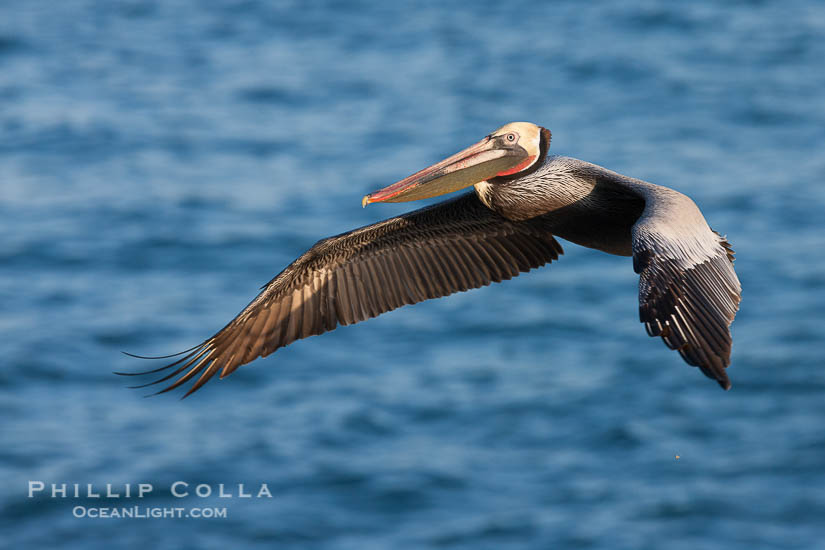
| California pelican in flight. The wingspan of this large ocean-going seabird can reach 7′ from wing tip to wing tip. Image ID: 23657 Species: Brown pelican, Pelecanus occidentalis, Pelecanus occidentalis californicus Location: La Jolla, California, USA |
I never get tired of photographing these beautiful birds. See a Guide to Photographing Pelicans in La Jolla.
California Pelican with Identification Tag
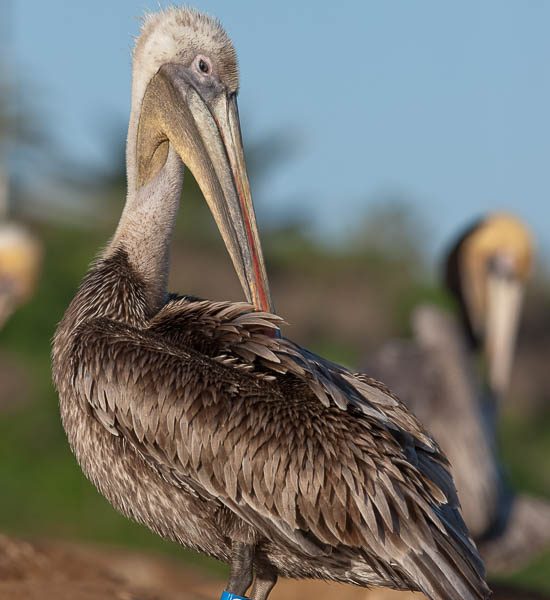
Garry McCarthy forwarded this link to me today, about the distress that many California brown pelicans (Pelecanus occidentalis californicus) are in this winter: 14 recovering pelicans released along Calif. coast. It appears that this year’s El Nino phenomenon is causing fish to be deeper in the ocean than normal, making it difficult for pelicans to obtain enough food. As a consequence, many are emaciated and hypothermic. The lucky ones are receiving care at various shelters along the coast, and bear identification tags when they are released. Here is one juvenile brown pelican bearing two tags (blue and gray) that I photographed yesterday. In the background are two other pelicans, both with darker hindneck plumage indicating they are breeding adults. All three of the birds are preening.
![]() |
| Brown pelican, juvenile with blue and gray identification bands on its legs. This large seabird has a wingspan over 7 feet wide. The California race of the brown pelican holds endangered species status, due largely to predation in the early 1900s and to decades of poor reproduction caused by DDT poisoning. Image ID: 23630 Species: Brown pelican, Pelecanus occidentalis, Pelecanus occidentalis californicus Location: La Jolla, California, USA |
![]() |
| Brown pelican, juvenile with blue and gray identification bands on its legs. Image ID: 23631 |
See more animal identification tag photos, photos of animals with ID tags and a Guide to Photographing Pelicans in La Jolla.
Cerro Cinco Hermanos, The Five Brothers, Tierra del Fuego, Argentina
Photo of Monte Cinco Hermanos, The Five Brothers, Ushuaia, Argentina
As we left Ushuaia and sailed down the Beagle Channel, one of the highlights was the sight of Cerro Cinco Hermanos (or Monte Cinco Hermanos, The Five Brothers, 1280m). Along with Monte Olivia, these rugged peaks rise high above Ushuaia but are often shrouded in clouds. We were fortunate to see them clearly as we departed Tierra del Fuego and motored down the Beagle Channel toward the Southern Ocean and the Falkland Islands.
![]() |
| The Five Brothers (Mount Cinco Hermanos, 1280m) in the Fuegian Andes, a cluster of peaks above Ushuaia, the capital of the Tierra del Fuego region of Argentina. Image ID: 23618 Location: Beagle Channel, Ushuaia, Tierra del Fuego, Argentina View this Image in Google Earth! |
Next: Southern Giant Petrel, Macronectes giganteus, Southern Ocean
Previous: Tierra del Fuego National Park, Argentina
Trip Index: Cheesemans Antarctica, Falklands and South Georgia
All “Southern Ocean” entries
Brown Pelicans
This morning I photographed brown pelicans (Pelecanus occidentalis californicus) in La Jolla. I really don’t need any more photos of pelicans but the setting is so beautiful that I keep returning. I’ve enjoyed these cliffs for 30 years. (We used to cliff dive off of them in college but now the wussy lawyers have made it illegal.) At this time of year the pelican’s winter plumage is in force, with deep red throat colors and dark brown hind neck on most of the adults. We moved in December, and I was gone most of the month of January, so this was my first trip down to La Jolla this winter even though it is just a few minutes down the coast. All of these were shot with Canon 1Ds Mark III, 300 f/2.8 lens, handheld or with a monopod, some with flash fill.
![]() |
| Brown pelican, winter adult breeding plumage, showing bright red gular pouch and dark brown hindneck plumage of breeding adults. This large seabird has a wingspan over 7 feet wide. The California race of the brown pelican holds endangered species status, due largely to predation in the early 1900s and to decades of poor reproduction caused by DDT poisoning. Image ID: 23622 Species: Brown pelican, Pelecanus occidentalis, Pelecanus occidentalis californicus Location: La Jolla, California, USA |
![]() |
| Brown pelican in flight. The wingspan of the brown pelican is over 7 feet wide. The California race of the brown pelican holds endangered species status. In winter months, breeding adults assume a dramatic plumage. Image ID: 23623 Species: Brown pelican, Pelecanus occidentalis, Pelecanus occidentalis californicus Location: La Jolla, California, USA |
![]() |
| Brown pelican, winter adult breeding plumage, showing bright red gular pouch and dark brown hindneck plumage of breeding adults. This large seabird has a wingspan over 7 feet wide. The California race of the brown pelican holds endangered species status, due largely to predation in the early 1900s and to decades of poor reproduction caused by DDT poisoning. Image ID: 23624 Species: Brown pelican, Pelecanus occidentalis, Pelecanus occidentalis californicus Location: La Jolla, California, USA |
![]() |
| Brown pelican in flight. The wingspan of the brown pelican is over 7 feet wide. The California race of the brown pelican holds endangered species status. In winter months, breeding adults assume a dramatic plumage. Image ID: 23625 Species: Brown pelican, Pelecanus occidentalis, Pelecanus occidentalis californicus Location: La Jolla, California, USA |
See more brown pelican photos as well as our Guide to Photographing Pelicans in La Jolla.
Tierra del Fuego National Park, Argentina
Photos of Tierra del Fuego, Argentina
We were scheduled to board the M/V Polar Star late in the day which gave us time to make a whirlwind tour of Tierra del Fuego National Park. We saw some forest, a couple of peat bogs, a beautiful lake and some of the rocky coastline along the Beagle Channel. The coastline reminded me of central California in many ways. It was obvious to me that the Park is beautiful and large, but our limited time gave us only a glance. I felt the way I imagine many day visitors to Yosemite Valley feel: “Wow, time to go already?”.
![]() |
| Lago Roca in Tierra del Fuego National Park, Argentina. Image ID: 23607 Location: Tierra del Fuego National Park, Ushuaia, Argentina |
![]() |
| Beagle Channel from Tierra del Fuego National Park, Argentina. Image ID: 23608 Location: Tierra del Fuego National Park, Ushuaia, Argentina |
Next: Cerro Cinco Hermanos, The Five Brothers, Tierra del Fuego, Argentina
Previous: Ushuaia, Tierra del Fuego, Argentina
Trip Index: Cheesemans Antarctica, Falklands and South Georgia
All “Southern Ocean” entries
Ushuaia, Tierra del Fuego, Argentina
Photo of Martial Glacier, Ushuaia, Argentina
I arrived in Ushuaia, Argentina with a couple of days to spare, to allow my luggage to catch up in case of delays. Where is Ushuaia, you say? It is a small but growing town at the southern tip of Argentina, situated on the archipelago of Tierra del Fuego. Ushuaia’s claim to fame — besides the fact that simply uttering “Ushuaia” is almost as fun as saying Mu Shu which is my favorite Chinese dish — is that Ushuaia is the southernmost city in the world! That, and the fact that it is only a two day sail from Ushuaia to the northern reaches of the Antarctic Peninsula across the notoriously rough waters of the Drake Passage and Cape Horn, means Ushuaia is on the itinerary for most people traveling in search of adventure in Antarctica.
Air travel is always unpleasant, but my connections this time were difficult for a couple reasons. I encountered crazy security screening at LAX. I flew on December 26, the day after the Christmas Day Terrorist tried — and failed! — to blow up his own underwear along with his fellow passengers. (Ma’salaama you clown. Epic fail in your plans for martyrdom and yet you still managed to make life miserable for the rest of us.) So in the wake of that event, security at LAX was seriously heightened and took a long while to navigate. It seems they always hand search my backpack, and this day was no exception. However, the TSA guy was a photographer (even able to ID my long lenses “300/2.8! 500/4!”). He was cool and made the search as pleasant as possible given the level of alert. Through Dallas then red-eye to Buenos Aires, where I joined a few others for a taxi from the international airport to the domestic airport. That’s where the fun really began. The arbitrary and capricious ticket agents at Aerolineas Argentina put several of us through the wringer for our heavy carryon bags. Jeez, folks, just charge me a fee already and let me on the plane! I was sweating it when they insisted I check my 40 pounds and $20k worth of gear through as checked luggage, knowing it would either be stolen or trashed. Eventually a “manager” let me carry it on the plane, for a “small fee”. Hey, this is South America, someone’s palm always has to be greased. Our flight to the southern tip of South America stopped in a few small places on the way, including El Calafate that climbers and trekkers use as a sending off point to reach Monte Fitz Roy and other remarkable Patagonian peaks — next time I should stop there and check out all that mountain stuff. The clouds on arrival to Ushuaia, wrapped around the towering peaks of the southern Andes mountains, were unbelievable. It was like we were flying in an IMax movie, very moving and heavenly. Eventually I reach the hotel, enjoy a nice Chilean wine, cheese and a tough hamburguesa, and hit the sack after about 40 hours of no sleep. Crashola.
![]() |
| Martial Glacier is a receding cirque glacier, located in the Montes Martial, Fuegian Andes approximately 1050m above sea level and only 4.5km outside of Ushuaia town. It is named for Captain Luis Fernando Martial, head of a French expedition, who visited the area in 1883. Image ID: 23600 Location: Ushuaia, Tierra del Fuego, Argentina View this Image in Google Earth! |
The following morning I take a cab for the short ride to Glaciar Martial (with a hard “T” in the name). It is overcast and chilly, but not too windy. I take the aerosilla (chairlift) up to the foot of a beautiful glacial valley, at the top of which is Martial Glacier. The view down the valley and out to the Beagle Channel, and beyond to what I think is Chile, is nice, and would be superb on a sunny day. Very few people are here, I like that! It is quiet. A small stream winds down the valley, melt from the glacier and snow fields above. I hike up to the glacier and look around. A few more people are here as I make my way down to the aerosilla again. I took no photos while up on the glacier, though, as the snow was falling more and more as the morning went on. It is raining hard now, so I make my way back to Ushuaia town and have lunch.
![]() |
| Dilapitated old wooden boat in Ushuaia harbor. Image ID: 23601 Location: Ushuaia, Tierra del Fuego, Argentina View this Image in Google Earth! |
The afternoon is lost to reading and wandering along the waterfront between rain squalls where I spot an interesting old scow lying dead in the water in the shallows of the harbor. Well, is this what I have to expect for our trip? Later, my roommate for the trip, Don, arrives and we get to know one another a bit. Dinner at the Albatross Hotel dining room with old friends Al and Beth, along with new friends Steve, Mary, Jay and Jackie, wraps up the day.
![]() |
| Ushuaia, the southernmost city in the world, lies on the Beagle Channel with a small portion of the Andes mountain range rising above. Ushuaia is the capital of the Tierra del Fuego region of Argentina and the gateway port for many expeditions to Antarctica. Image ID: 23603 Location: Ushuaia, Tierra del Fuego, Argentina View this Image in Google Earth! |
Next: Tierra del Fuego National Park, Argentina
Previous: Sunset Arch, Southern Ocean
Trip Index: Cheesemans Antarctica, Falklands and South Georgia
All “Southern Ocean” entries
Sunset Arch, Southern Ocean
During our crossing from Falklands to South Georgia Island we were treated to a magnificent sunset:
![]() |
| Photographer takes picture of a spectacular sunset arch, spanning the heavens from horizon to horizon, over the open sea between the Falkland Islands and South Georgia Island. Image ID: 24096 Location: Southern Ocean View this Image in Google Earth! |
A long band of rich orange-red cloud stretched across the sky nearly from one horizon to the other. The only way I could capture the entire formation was with a fisheye lens (which I used a lot on this trip!). The resulting bendo-factor of the lens makes the cloud band look almost like a rainbow or arch. If only we had some mountain peaks or an iceberg below this sunset, but alas we were far out to sea and well north of any icebergs. The photographer in this scene is Scott Davis, a pro from Moss Landing, California. Scott was on assignment gathering lifestyle and action images. His photos, some of which he shared at the end of the trip, are great.
Next: Ushuaia, Tierra del Fuego, Argentina
Previous: Black-Browed Albatross at Sunset
Trip Index: Cheesemans Antarctica, Falklands and South Georgia
All “Southern Ocean” entries
Black-Browed Albatross at Sunset
One of the unexpected joys of the trip for me was the albatrosses. Before this trip, the only albatrosses I had seen were Waved Albatross in Galapagos (but only sitting on nests) and some distant albatrosses as we motored at sea to Guadalupe Island. Now that I have had a chance to really see them, soaring as they do over the open ocean, I love these birds. On this night we had just left the enormous rookery of black-browed albatross at Steeple Jason Island in the Falklands, on our way to South Georgia Island. While eating dinner I noticed out the dining room window how the sky was growing pink, and I could see albatrosses occasionally flying by the window. I rudely chugged my wine and gobbled the rest of my dinner, made some weak excuse to my dining companions that I would be right back, and quickly made my way to the stern with my camera setup. I stood out there in the fading light and fresh air making a set of what I think of as “painterly images” of albatrosses and petrels.
![]() |
| Black-browed albatross in flight, at sea. The black-browed albatross is a medium-sized seabird at 31-37″ long with a 79-94″ wingspan and an average weight of 6.4-10 lb. They have a natural lifespan exceeding 70 years. They breed on remote oceanic islands and are circumpolar, ranging throughout the Southern Oceanic. Image ID: 23962 Species: Black-browed albatross, Thalassarche melanophrys Location: Falkland Islands, United Kingdom |
I used a Canon 1Ds Mark III camera with a 300 f/2.8 lens and 1.4x converter. The light was growing faint making it easy to match the available light of the waning dusk with the artificial light from the camera’s flash. It was about an hour after sunset, a time when the pastel colors in the sky become quite saturated. I popped a little flash on this beautiful seabird and dragged the shutter to give the shot some blur. I shot several hundred of these images and managed many keepers, each using the fading colors in the sky as a canvas ranging from pink to purple to yellow depending on which direction I pointed my camera.
Another one, about 20 minutes later, color is different since this was aimed higher and in a little different direction:
![]() |
| Black-browed albatross in flight, at sea. The black-browed albatross is a medium-sized seabird at 31-37″ long with a 79-94″ wingspan and an average weight of 6.4-10 lb. They have a natural lifespan exceeding 70 years. They breed on remote oceanic islands and are circumpolar, ranging throughout the Southern Oceanic. Image ID: 23965 Species: Black-browed albatross, Thalassarche melanophrys Location: Falkland Islands, United Kingdom |
Next: Sunset Arch, Southern Ocean
Previous: Photography Gear for Antarctica, South Georgia and Falklands
Trip Index: Cheesemans Antarctica, Falklands and South Georgia
All “Southern Ocean” entries
Photography Gear for Antarctica, South Georgia and Falklands
Recommended List of Photography Equipment for Antarctica, South Georgia and Falklands.

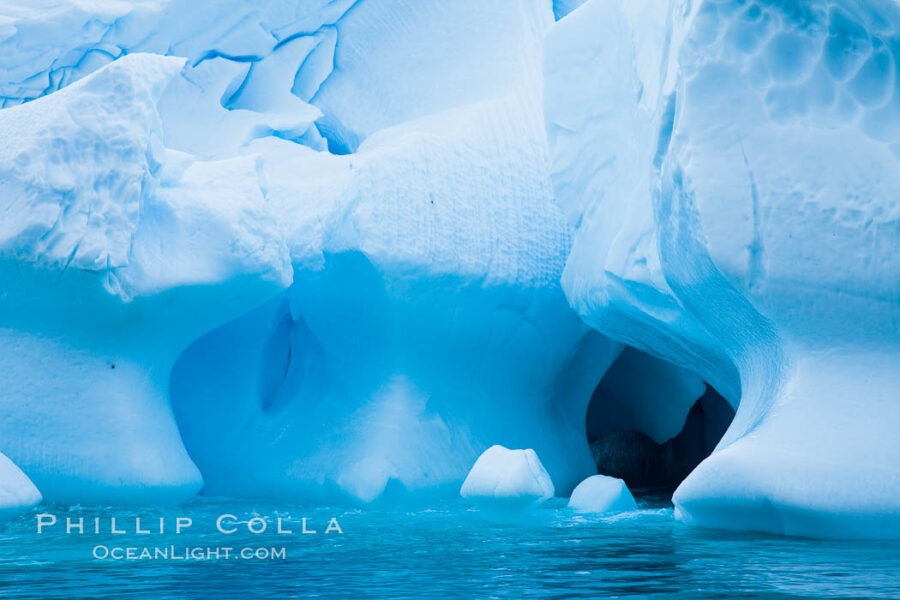
Brash Ice, Antarctic Peninsula
Following is what I took on my recent trip, along with comments about how useful it was and how I will change for my next trip. Yup, I took too much, but most people do and next time I’ll have it dialed in. Weight and bulk are an issue on this sort of trip, and one wants to be nimble on shore without too much gear. By March 2010 I should have linked to several example photos taken with each piece of gear, but as of now I am just beginning my edit. Take note of my comments about 300/500 vs. 200-400 below.
- Canon 1Ds Mark III — primary body. I love this thing. You can have it when you pry it from my cold, dead hands.
- Canon 1Ds Mark II — used for time lapse sequences, and as back up body. Just a few years ago this was the standard by which other 35mm digital cameras were judged, and mine is still going strong after probably 200,000 frames.
- Canon 5D Mark II — used for video, and as a landscape body. Attached 24-105 remained on camera the entire trip to minimize dust issues. This is something of a toy camera, it just does not feel right, too light and plasticy. It does NOT have the ability to withstand harsh weather that the 1D series bodies have, so be careful with it in the rain, snow and spray! The files, however, are quite nice and I am going to have a lot of fun with the video capabilities of this thing.
- Canon 500 f/4 — great for portraits, and for isolating subjects due to its narrow field of view (almost half of the view angle of a 300). I used this for portraits of penguins, and for many subjects in Falklands. Once at South Georgia and in Antarctica, this length was no longer needed. I even used it handheld with 1.4x (700mm equivalent) for photographing Wandering albatross in flight, since they rarely came near to the boat. Granted that is quite a load to handhold on a moving boat, but it was the only way I could fill the frame with those distant birds. The images are quite sharp.
- Canon 300 f/2.8 — most useful of the prime telephoto lenses, crazy sharp on its own and still very sharp as a handheld flight lens with the 1.4x converter (420mm equivalent). If I were to take just one prime telephoto, this is the one.
- Canon 70-200 f/4 — probably the most useful of all lenses for this trip. Great for much of the wildlife and many of the landscapes. You want the f/4 version due to its lightness since it makes handling two lenses easier. With today’s high ISO camera bodies there is little need for the f/2.8 version, which is rumored to be softer than the f/4 version anyway. I love this sharp little lens.
- Canon 24-70 f/2.8 — brought this along as a back-up in case the recently purchased 24-105 failed to live up to expectations. I only used this lens for a few time lapse experiments. For a trip on which weight is an issue, this lens is too heavy and not as versatile as the 24-105. Next time it will stay home.
- Canon 24-105 f/4 — kept it permanently attached to my 5D Mark II. It performed well, although like the 5DII this lens is not well-suited to wet or harsh environments. But it is so light, small and sharp that, provided it is cared for properly, it has a place in my gear bag in the future. It does have some barrel distortion at 24mm.
- Canon 16-35 f/2.8 II — this is often too wide but I did break it out a few times in ice or when we had clear or dramatic skies. Sharper and with less distortion than the 17-40 f/4, but heavier too.
- Canon 15mm f/2.8 fisheye — ok, if you don’t understand why you want a fisheye in Antarctica, you need to rethink being a photographer.
- Gitzo 1327 Tripod with RRS BH-55 ballhead and Wimberley Sidekick. The Wimberley Sidekick was used only for the 500 and will be left at home next time. The RRS BH-55 ballhead is strong enough to handle a 300/2.8 or 200-400/4. I may bring a light monopod next time, as many times I would have preferred that. But a tripod is needed for 500 or longer, or when shooting time lapse, video or in low light.
- Think Tank Airport Acceleration v2 Backpack — this thing performed wonderfully in the airport and in the field. I had no problems with it at all. I was able to pack even more stuff in this pack than my huge Lowepro, so much so that my pack was damn-near too heavy on the flight down to Ushuaia. This pack comes with a rain cover but I did not use it in the field since the pack sheds rain and snow so well. This is what I packed on the trip down: 1DsIII/1DsII/300/500/70-200/16-35/1.4x/harddisks/laptop/couple chargers/spare clothes. (The 5DII/24-105/15 went in a small second bag.) That’s a lot in one pack.
- NRS 3.8 Liter Heavy Duty Dry Bag. I used a really big, strong dry bag from NRS. It was large enough that I could slip my entire backpack into it, along with spare sweaters, shoes, jacket, whatever. I would leave it at the landing site and return to it if I needed to exchange gear, or remove clothes if it got too warm, etc. This thing is built like a tank, reinforced at all stress points with double thick material on the boat for abrasion resistance. Be warned: this particular bag is big. I needed a big bag to put my big backpack in, and I am big enough to heft it around. You may want to go with a smaller dry bag, especially if your camera backpack is small.
- Laptop computer, three Seagate Freeagent Go 500gb portable drives and one Hyperspace Colorspace 320gb photo storage device. My computer (a very small Sony Vaio) is used for writing, playing movies and downloading images. I do not do any serious editing while traveling. The Seagate Freeagent Go drives are great, so tiny and light and they do not require their own power source (using USB power from the computer). The “Colorspace device” is much faster at downloading images than a computer, but is less flexible when it comes to doing a quick review in the evening. The Hyperspace Colorspace, while not a full-fledged computer, is sophisticated enough that it can be configured to read/write to my 500gb external hard disks which is helpful if the computer were to die during the trip. Probably the ideal solution, for someone who did not want to bring a computer, would be to bring two Colorspace devices (two backups is safer than one).
I always had the 5DII / 24-105 with me, as well as the 70-200 mounted on a body. The only question was, do I have along a longer lens (typically in Falklands) or a wider lens (Antarctica). South Georgia had so much variety that I ended up carrying more gear there than anywhere else.
NOTE: One major change I will make next time will be to leave the 300 and 500 lenses at home in favor of the Nikon 200-400 f/4, probably on a D300 crop body (equivalent 300-600mm). I owned a 200-400 and D3 briefly and just loved that combo, but could not justify the expense at that time and sold them after one shoot. The 200-400 is so absolutely perfect for this trip that I simply must have one in spite of the fact it is not quite as sharp as a prime, and loses a bit more quality with crop bodies which I avoid whenever possible. But on this trip the versatility of the 200-400 is enough to make up for it, and it almost doesn’t matter whether it is paired with a crop body (D300) or fullframe (D3/D3x/D700). I would guess that bird photographers will want the D300 for tighter bird stuff. Carryon luggage can be an issue on this trip (special thanks to the arbitrary and capricious ticket agents at Aerolineas Argentina when flying between Buenos Aires and Ushuaia!) and exchanging two big primes for one big zoom will ease my carryon situation a lot.
Note also that I do not carry high-speed bodies. I just don’t feel a need for them. I have used most of Canon’s bodies and have never really been satisfied with the image quality of the 1.6x crop bodies after becoming accustomed to the full frame quality. And the only shooting situations I have found that absolutely required high frame rates are photographing surf and action sports. Perhaps the 1D Mark IV will tempt me if the AF is good enough, but for now the 1DsIII and 1DsII were more than enough to handle the AF and frame-rate situations I encountered on this trip.
Conclusion, the ideal setup for me would have been: 1DsIII and 5DII with 15 / 16-35 / 24-105 / 70-200, and D3/D3x with 200-400.
Next: Black-Browed Albatross at Sunset
Previous: Equipment List for Antarctica, South Georgia and Falklands
Trip Index: Cheesemans Antarctica, Falklands and South Georgia
All “Southern Ocean” entries
Equipment List for Antarctica, South Georgia and Falklands
Equipment List for Antarctica, South Georgia Island and the Falklands.
![]() |
| Adelie penguins leaping into the ocean from an iceberg. Image ID: 25005 Species: Adelie Penguin, Pygoscelis adeliae Location: Brown Bluff, Antarctic Peninsula, Antarctica |
This is what I used on my recent Antarctica, South Georgia and Falklands trip. Photo gear will be described tomorrow as that is a whole nuther issue. I’ll take virtually the same gear next time, with one small alteration.
Clothing
In general my main concern on this trip was staying dry in the rain and snow, and not overheating on longer walks. Layers and synthetics worked great. The only time I actually felt cold was on a few zodiac rides, and then putting on an extra fleece jacket under my Goretex shell did the trick.
- Goretex jacket / shell. I use North Face Goretex jackets. I took two of them, one for use ashore that soon got dirty and smelly since I often lay down on the ground to photograph. The other was for use on the ship and remained clean. Both have dual zippers that allow North Face and Marmot fleece sweaters to be zipped into the jacket. The shell does not need insulation, in fact it is better to insulate with polar fleece sweaters separate (see next). The shell should have a hood for rain and for wet zodiac rides. You will get bird guano on your outer jacket.
- Polar fleece jacket. I took three, one each of all three Polartec weights, that zip into the North Face jackets. Usually the mid-weight one was enough but a few times I wore two of them for warmth.
- Gortex Pants. I use Cabela’s GORE-TEX® Guidewear® Uninsulated Bibs - Tall. They are big, heavy duty and I am very happy with them. I have never had any rips or worn areas with these pants in spite of many hours scrambling around on rocks and the ground for photos. They are tougher than most people need, but the big pockets are great for gloves, camera stuff, hats, etc. If you use a more lightweight material don’t be surprised when they tear, in which case rubber cement or duct tape will save the day. You will get lots of bird guano on your pants.
- Waterproof Boots. I use Muckboots, the Wetlands model. Your boots absolutely must be waterproof and comfortable. I observed that NEOS overboots did not perform well for those that brought them; they eventually borrowed plain-old rubber boots provided by the Polar Star. I found my Muckboots to be quite comfortable and since they are neoprene they are very warm, I only needed to wear a single pair of athletic socks even in the coldest places we went. They do fit a little on the loose side but were still serviceable for long hikes. Wear extra layer of socks to make them fit more snugly. You will walk through vast areas of bird guano in your boots, and then you will rinse them off on deck when you return to the boat.
- Chest waders: I may use chest waders in lieu of pants and boots on my next visit, since there were a few times I wanted to wade into the water up to my waist. The key is finding a set of chest waders that are comfortable to wear for 6-10 hours at a time.
- Inner wear: Do not wear cotton. Wear synthetics to ensure that you dry quickly if you are sweating or if you get wet. Cotton does not dry well, and if you get wet you will stay wet and eventually get cold. I prefer to wear Nike quick-dry athletic shirts under my sweater, and either shorts (in Falklands) or light-insulation pants (such as REI quick-dry synthetic pants or thin fleece or pile pants) under my heavy duty waterproof pants. Long-johns, thermal underwear, are often mentioned for this sort of trip but I did not bring them nor did I need them, however, if you are old or have poor circulation you might consider thermals of some sort.
- Gloves: I took several different pairs mittens and gloves plus a sturdy pair of glove underliners that themselves can also serve as lightweight gloves. You may find you prefer lightweight gloves for time ashore when you are handling camera equipment or walking sticks, and heavier gloves (such as neoprene/wetsuite gloves or waterproof ski gloves) for the often wet zodiac rides. Your gloves will get bird guano on them.
- Hat. I took a warm ski hat for cold days and a lightweight baseball hat for sunny days. My mistake is that I forgot to pack my Sun Precautions Hat, which I use in the tropics or on my boat. In the Falklands we had sunny, dry, warm weather and my neck, face and ears got burnt even with sunscreen on.
- Shades. Bring at least one good pair of polarized sunglasses. They should be suitable for marine use since you will be wearing them around water much of the time.
- Shorts and comfortable shoes for around the boat. Flip flops if you are from California.
- Luggage. I use an REI wheeled duffel, it can carry all of my clothes, boots, tripod and loads of camera stuff.
Dry Bag / River Bag
- NRS 3.8 Liter Heavy Duty Dry Bag. I used a really big, strong dry bag from NRS. It was large enough that I could slip my entire backpack into it, along with spare sweaters, shoes, jacket, whatever. I would leave it at the landing site and return to it if I needed to exchange gear, or remove clothes if it got too warm, etc. This thing is built like a tank, reinforced at all stress points with double thick material on the boat for abrasion resistance. Be warned: this particular bag is big. I needed a big bag to put my big backpack in, and I am big enough to heft it around. You may want to go with a smaller dry bag, especially if your camera backpack is small.
Personal
- Sunscreen. SPF 1000 is good. I ran out and had to borrow. Bring plenty.
- Chapstick. Wow, I ran out and boy was I sorry. Your lips will get wind-burnt and chapped. Bring 3-4 chapsticks.
- Hand lotion. My hands got really dry and the skin cracked.
- Medications. Make sure to have proper antibiotics if you have a history of infections, as well as plenty of Advil for sore muscles. Tamiflu if you can get it and are worried about someone bringing flu onto the boat. H1N1 flu vaccine if you can get it. Seasick medication, including the prescription “patch”. I generally do not get seasick and yet I packed Bonine and the patch just in case. Hand santizer is good to have for any travel. Bring your own supply of bandaids and Neosporin ointment, the last thing you want is for a small cut to become a problem infection.
- Ear plugs. Get some good ones, the kind that are shaped (sort of) ergonomically, they can really make the difference between a good night’s sleep and sleep deprivation.
- Converter plugs. I went to a lighting and electrical shop in Ushuaia and bought two converters which I used together on the ship: one to change two-prong marine/ship outlet to South American three-prong 220V and a second to convert South American three-prong 220V to North American three-prong 220V/110V.
Next: Photography Gear for Antarctica, South Georgia and Falklands
Previous: Penguin Encounter, Paulet Island, Antarctic Peninsula
Trip Index: Cheesemans Antarctica, Falklands and South Georgia
All “Southern Ocean” entries
Penguin Encounter, Paulet Island, Antarctic Peninsula
Update: the cover of Nature’s Best Photography Spring/Summer 2010 issue came from this shot.
OK, I admit it, this post is really just an excuse to share a photo of myself. I get so few photos of me that when I receive one I like, its a big deal.

Photographing Adelie penguins at Paulet Island, Antarctic Peninsula, © Patrick Endres / AlaskaPhotographics.com
Patrick Endres made this photograph. Patrick, a full-time professional stock photographer and guide and tour leader from Fairbanks, Alaska, was on staff for my recent Cheesemans Antarctica trip. He, along with fellow pro and staff member Hugh Rose, had a few of us out zodiac cruising at Paulet Island in the northern reaches of the Antarctic Peninsula. We were sidled up beside a low, flat ice berg with some Adelie penguins on it when three of the penguins walked across the berg to us and looked at us curiously, as if they wanted to hop into our boat. We scrambled for the widest lenses we had (even 70-200 was too much, the penguins were so close) and snapped off a few photos. It wasn’t the photos but the sponteneity of the moment and the naive inquisitiveness of the Adelies that really made our face-to-face meeting with these little guys special. All of us were laughing and enjoying the moment. Another couple zodiacs came over and had the three Adelies look them over as well. You can see the icebreaker ship M/V Polar Star that was our home for a month, in the background of this photo. That was about two weeks ago. I wish I was still there among the birds and ice. Patrick sent me this photo last night. I love it, it brings back that wonderful afternoon.
Patrick Endres has a great blog, be sure to check it out since he is currently sharing some of his experiences from the Falklands, South Georgia Island and Antarctica. I really do owe Patrick and Hugh and the rest of the Cheeseman’s staff a big “thank you” This is a staff that has the experience in the field, particularly in the Southern Ocean, that enables them to find great wildlife watching and photo experiences for their guests. They worked hard in all kinds of weather and sea conditions to make such experiences happen frequently.
Next: Equipment List for Antarctica, South Georgia and Falklands
Trip Index: Cheesemans Antarctica, Falklands and South Georgia
All “Southern Ocean” entries
HOME | Online Image Search | Photo of the Day | Contact / Bio | Licensing/Pricing | Prints | Stock List | Image Hierarchy | List of Log Entries | Site Map | Blue Whale | Cetaceans | Pinnipeds | Sharks | Rays | Fishes | Kelp Forest | Sea Birds | Inverts | Man & Animal | Man & Ocean | Ocean & Light | Ocean & Motion | Portraits | About Color and Monitor Calibration | Copyright Statement | All text and photographs copyright © Phillip Colla Natural History Photography All rights reserved worldwide. The content of this site is made available for purposes of researching images offered for license by Phillip Colla Natural History Photography. No image is to be copied, duplicated, modified or redistributed in whole or part without the prior written permission of Phillip Colla Natural History Photography. Whale logo is a trademark of Phillip Colla Natural History Photography, 8021 Paseo Arrayan, Carlsbad, CA 92009, USA. 760.707.7153 Email: oceanlight@OceanLight.com Web: www.OceanLight.com Portfolios: www.Gygis.com
Updated: June 19, 2013