Kelp forest underwater photography. This story was originally published as a pictorial in Ocean Realm Magazine in the Spring 2001 issue, the last of a series of articles I contributed to Ocean Realm in the ’90s.
This blog post is now available as a downloadable PDF article.
My first experience with seaweed was as a kid combing the shores of Newport Beach where I grew up. After storms my brother and I would find clumps of the brown stuff pushed up the beach. We would pick through them to pop the small bubbles attached to the leaves. If the seaweed was fresh and still had its rootball attached, we would break it apart to reveal a mix of tiny animals: brittle stars, baby octopus, urchins, crabs, little shells and worms. The glimpses of marine life that seaweed brought to our shore triggered a childhood curiosity in the ocean and its inhabitants. Yet it was not until I began diving in kelp that I gained a fuller appreciation of the ocean world.
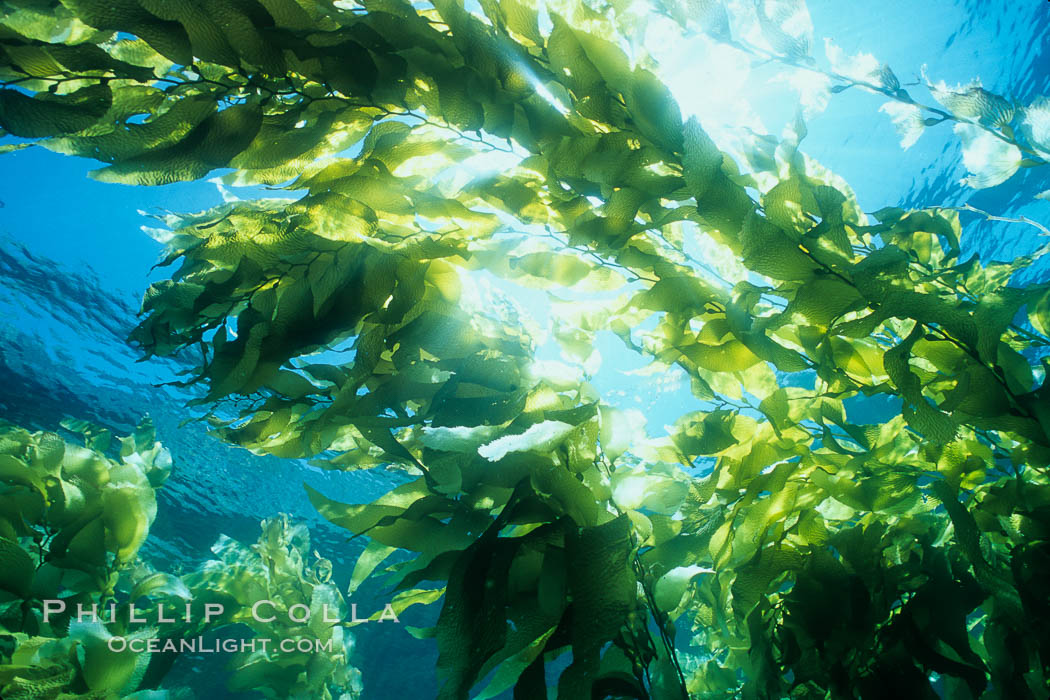
Kelp forest.
Image ID: 04651
Species: Giant kelp, Macrocystis pyrifera
Location: San Clemente Island, California, USA
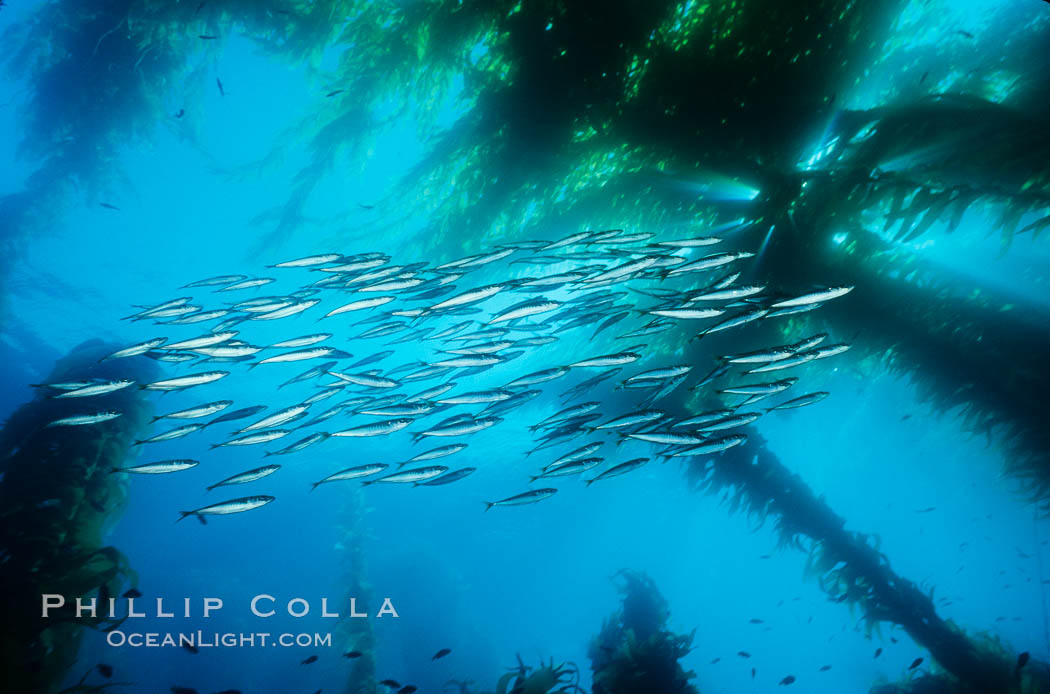
Jack mackerel schooling amid kelp forest.
Image ID: 00256
Species: Pacific jack mackerel, Trachurus symmetricus, Macrocystis pyrifera
Location: San Clemente Island, California, USA
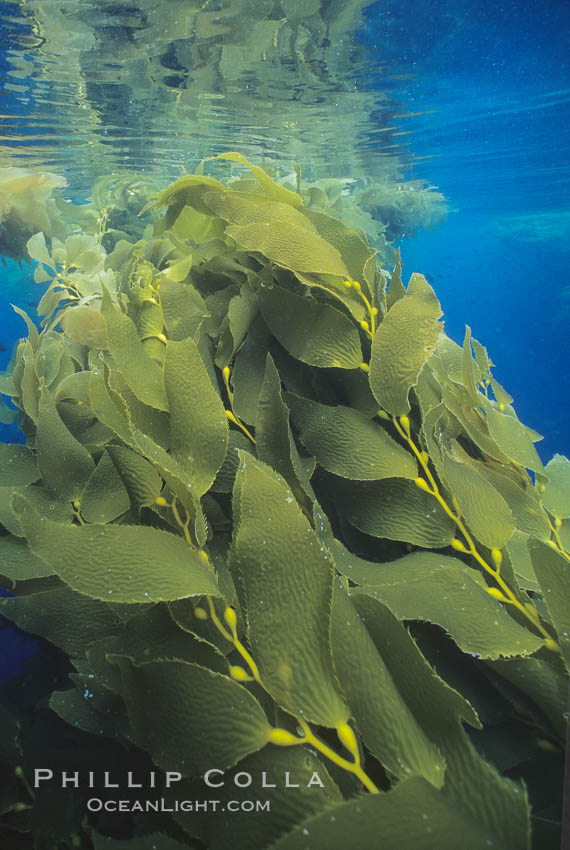
Kelp plants growing toward surface and spreading to form a canopy.
Image ID: 01293
Species: Giant kelp, Macrocystis pyrifera
Location: San Clemente Island, California, USA
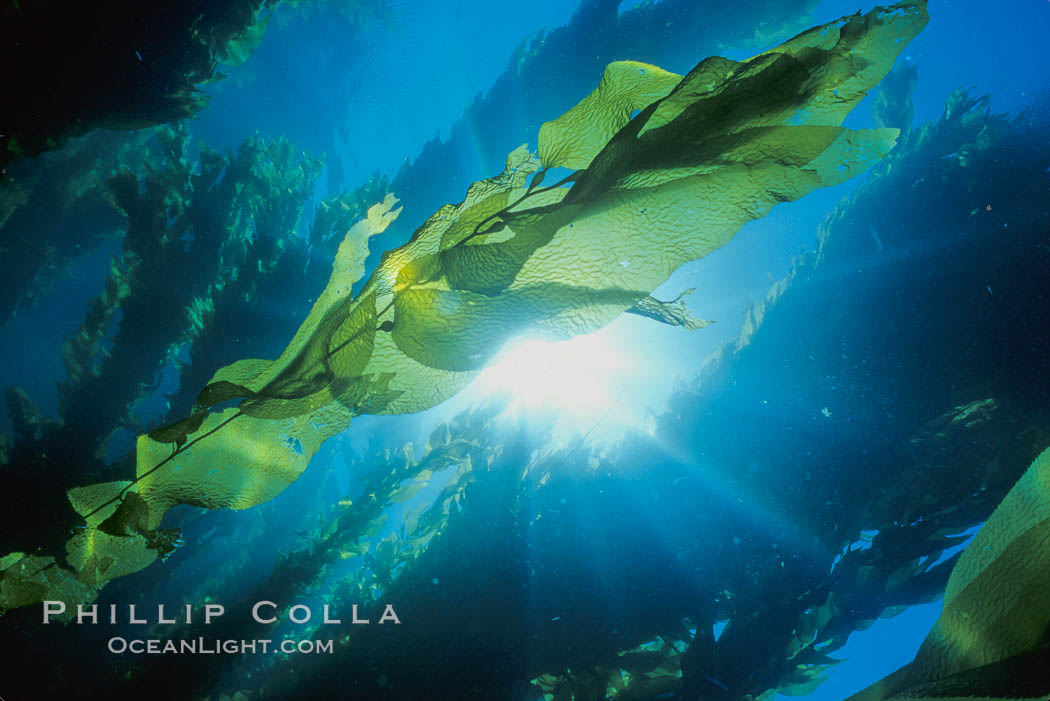
Kelp fronds and forest.
Image ID: 01497
Species: Giant kelp, Macrocystis pyrifera
Location: San Clemente Island, California, USA
It is my spirited opinion, one that I enjoy defending over a beer after a long day on the water, that diving amidst giant kelp is the most magnificent diving in the world. I am fortunate enough to have had some amazing experiences underwater — watching swarms of hammerheads soar overhead, riding the broad back of an accommodating manta, being eyeballed by an inquisitive whale. However, the diving I consider most dear is that found in the splendid kelp forests along the coast and offshore islands of California. Vast beds of giant kelp (Macrocystis pyrifera) line the shore, rising from rocky reefs nearly 100ft deep to reach the surface before spreading out to form a thick floating canopy. Underneath this canopy, the sensation of swimming amid the columns of kelp plants is akin to flying through a terrestrial forest. Corridors between kelp stalks lead to wide openings in the forest in which schools of fish hover. Shafts of light filtered by the canopy above fall across kelp to the reef below. When the current shifts and bends the kelp stalks in a new direction the topology of the forest changes, creating new avenues and rooms to explore.
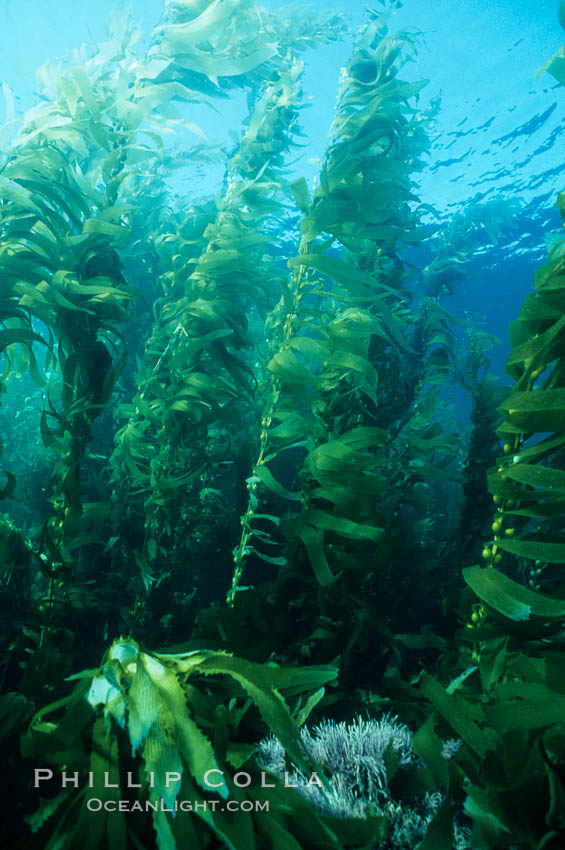
Kelp canopy.
Image ID: 02118
Species: Giant kelp, Macrocystis pyrifera
Location: San Clemente Island, California, USA
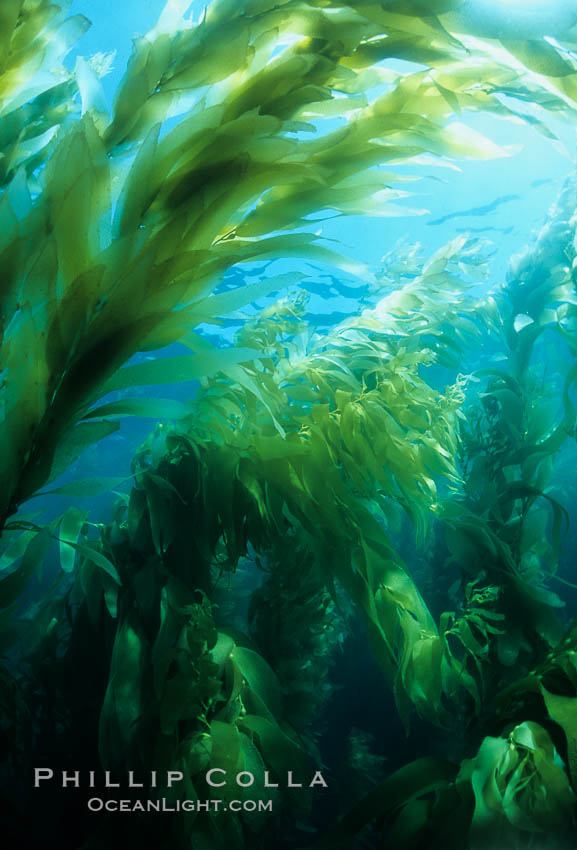
Kelp forest.
Image ID: 02409
Species: Giant kelp, Macrocystis pyrifera
Location: San Clemente Island, California, USA

Kelp bed. Giant macrocystis kelp is anchored on the ocean floor and grows to reach the ocean surface.
Image ID: 02502
Species: Giant kelp, Macrocystis pyrifera
Location: San Clemente Island, California, USA
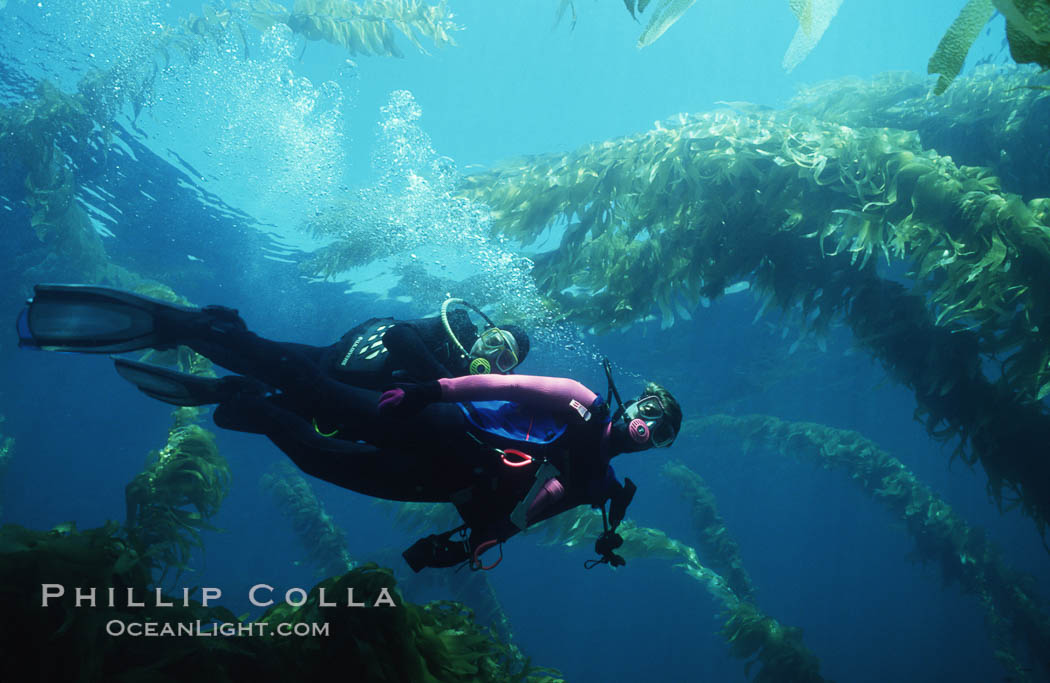
Divers and kelp forest.
Image ID: 02988
Species: Giant kelp, Macrocystis pyrifera
Location: San Clemente Island, California, USA
Central and Northern California kelp forests are bathed by cold, nutrient-laden currents. The waters here are generally not clear but are rich with animal life. Invertebrate displays on the rocks below the kelp forest are some of the most profuse and interesting in the world and it is common to see large schools of rockfish and pelagic jellies hovering among the kelp. Kelp forests here breed some of the world’s hardiest divers, those who manage year-round dry suits, beach entries and surface swims, winter swells and the distinct possibility of meeting great white sharks in murky water just to dive in Macrocystis.
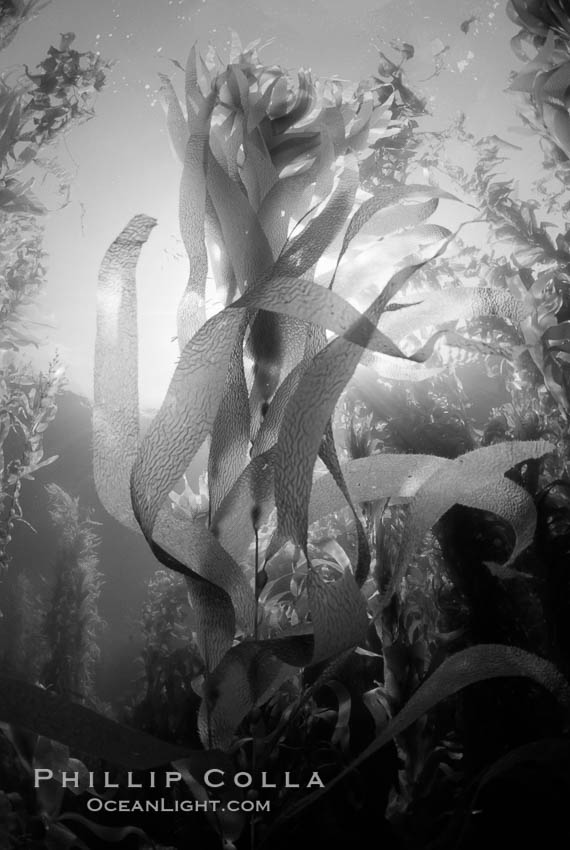
Kelp canopy.
Image ID: 06119
Species: Giant kelp, Macrocystis pyrifera
Location: San Clemente Island, California, USA
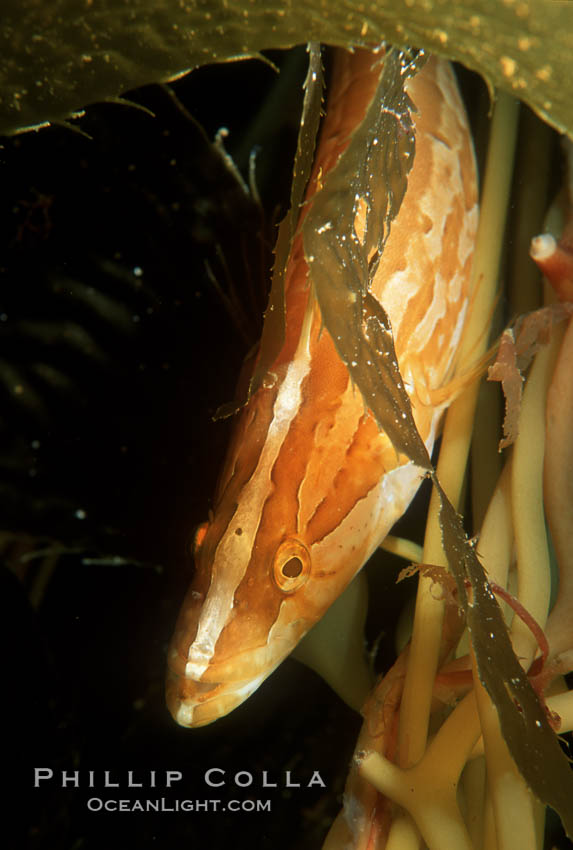
Giant kelpfish in kelp.
Image ID: 05141
Species: Giant kelpfish, Heterostichus rostratus, Macrocystis pyrifera
Location: San Clemente Island, California, USA
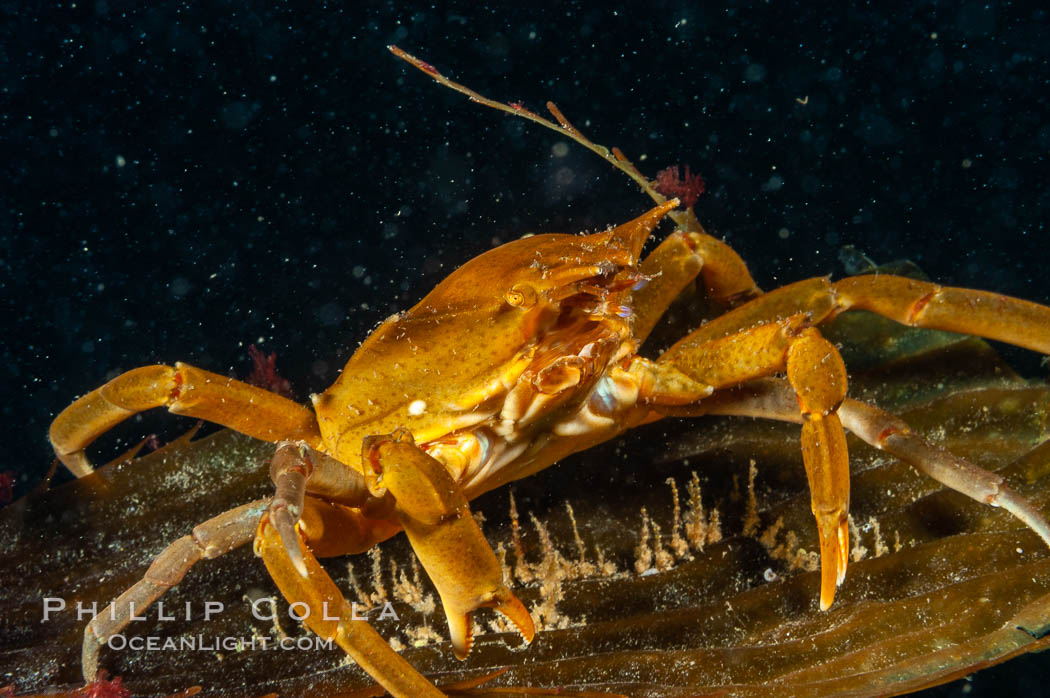
Northern kelp crab crawls amidst kelp blades and stipes, midway in the water column (below the surface, above the ocean bottom) in a giant kelp forest.
Image ID: 10215
Species: Northern kelp crab, Pugettia producta, Macrocystis pyrifera
Location: San Nicholas Island, California, USA
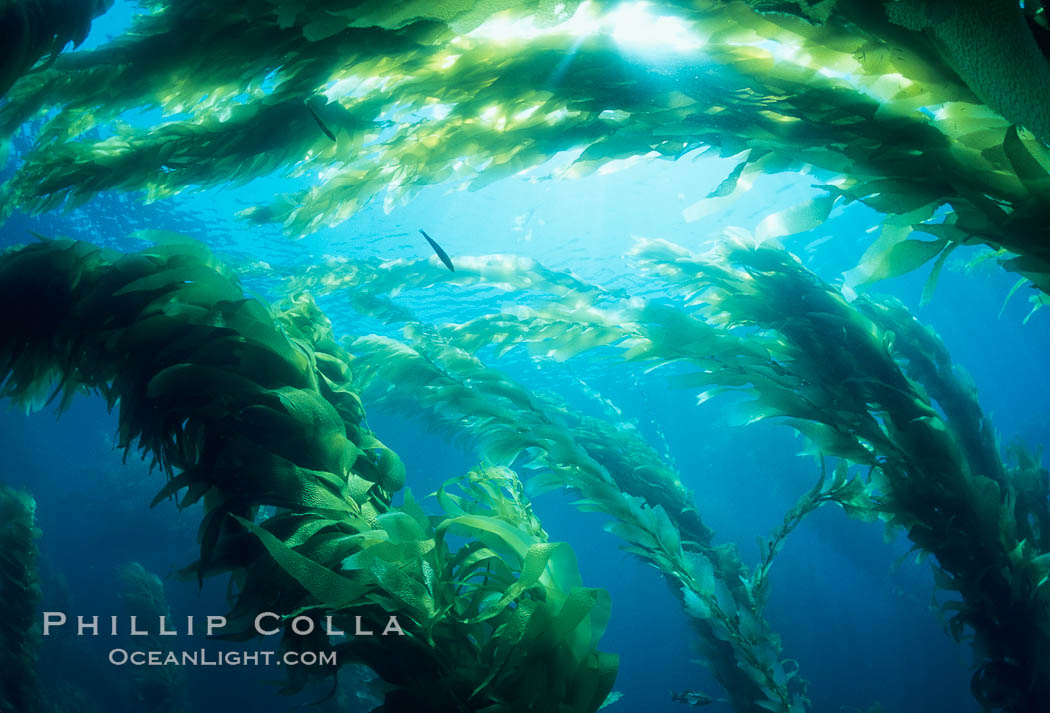
Kelp forest.
Image ID: 04675
Species: Giant kelp, Macrocystis pyrifera
Location: San Clemente Island, California, USA
Further to the south, Santa Barbara and Catalina Island kelp forests offer somewhat less profuse animal life but warmer and clearer waters. While I don’t dive these two islands often anymore, I do dive kelp originating from these islands throughout the summer: drift kelp. I was introduced to the notion of seeking out floating paddies of kelp by bluewater photographer Mike Johnson and have been hooked ever since. It is a strange pursuit, driving miles of open ocean in search of drifting kelp in the hope of finding something under it. You see, kelp plants that lose their hold on the reef continue to float and grow, drifting with the winds and currents until they are beached or reach warm water. Along the way they gather a variety of passengers including juvenile fish, Medialuna eggs, barnacles and pelagic nudibranchs. Paddies and their passengers further attract a variety of open ocean life: diving birds, bait fish, yellowtail, tuna and marlin, blue and mako sharks. Perhaps the oddest of these visitors is the ocean sunfish (Mola mola), which recruits small fishes at paddies to clean it of parasites — a cleaning station for the largest bony fish in the world, miles from shore in deep oceanic water, circling a scrap of drifting seaweed.
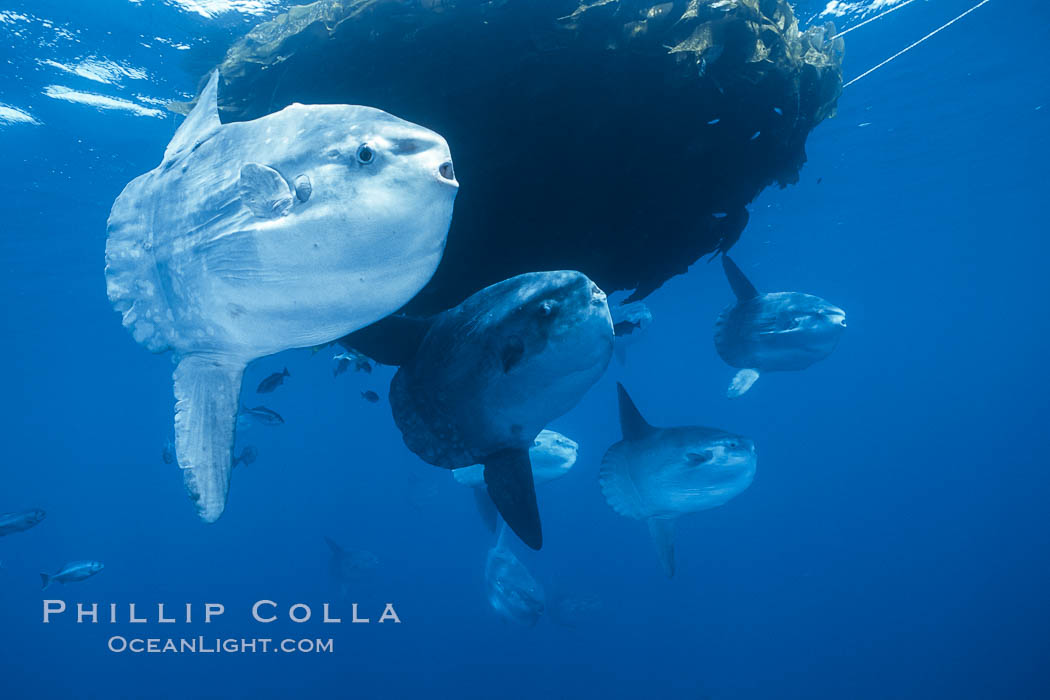
Ocean sunfish schooling near drift kelp, soliciting cleaner fishes, open ocean, Baja California.
Image ID: 06308
Species: Ocean sunfish, Mola mola
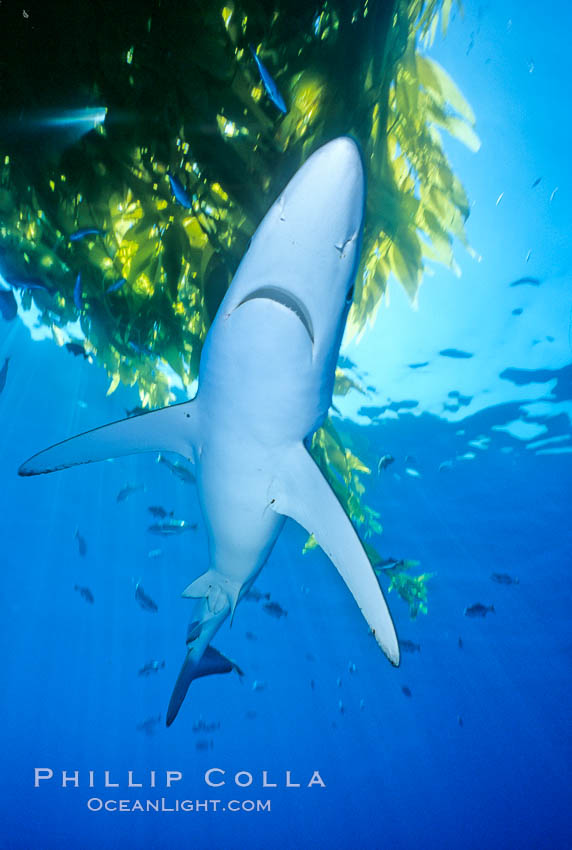
Blue shark underneath drift kelp, open ocean.
Image ID: 01006
Species: Blue shark, Prionace glauca
Location: San Diego, California, USA
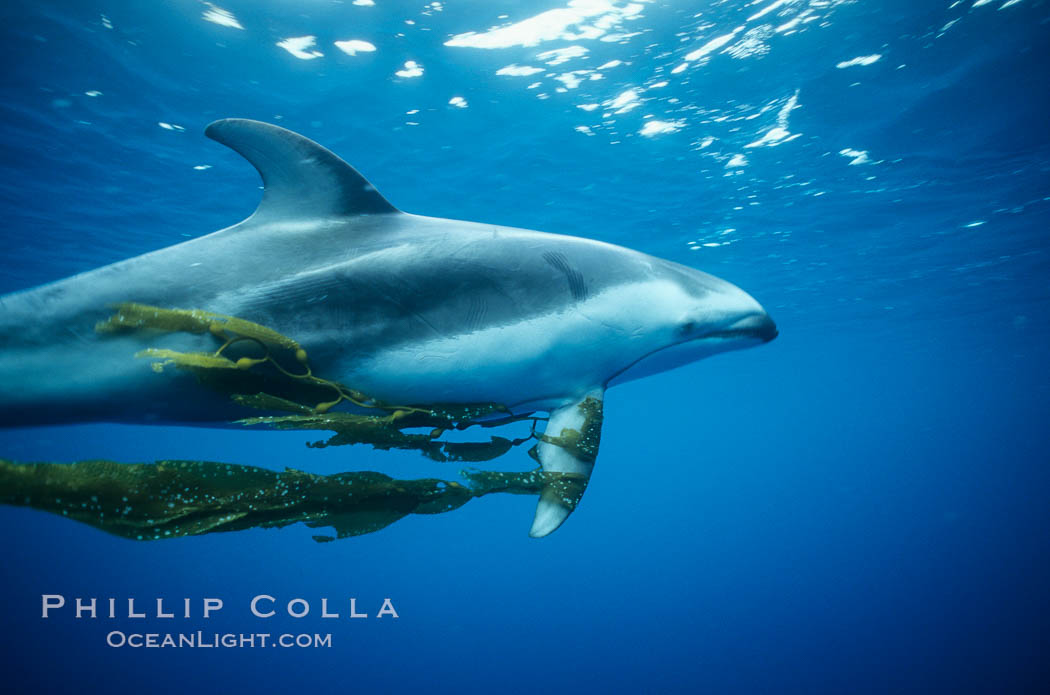
Pacific white sided dolphin carrying drift kelp.
Image ID: 00043
Species: Pacific white-sided dolphin, Lagenorhynchus obliquidens
Location: San Diego, California, USA
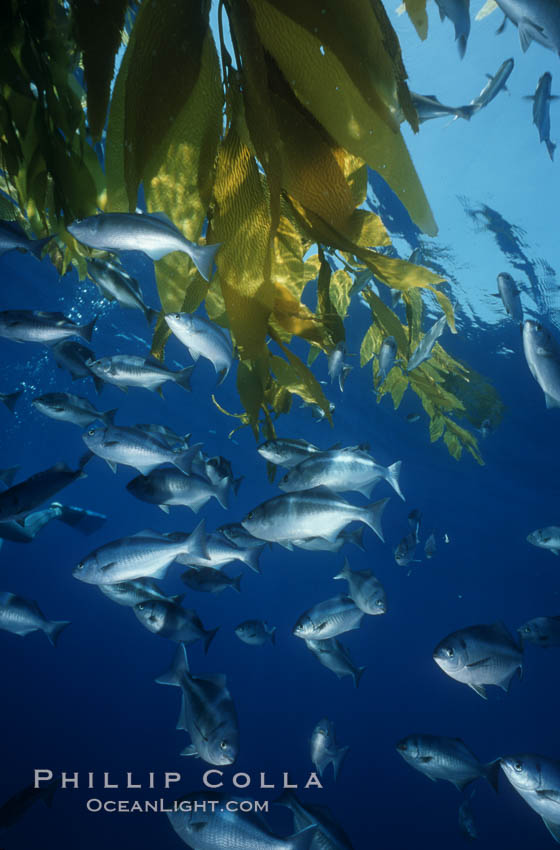
Half-moon perch, offshore drift kelp.
Image ID: 01933
Species: Halfmoon perch, Medialuna californiensis
Location: San Diego, California, USA
When the goal is simply to swim in and admire a kelp forest, nothing beats the (relatively) warm clear waters of Southern California’s San Clemente Island in late summer. On a good day the panorama at San Clemente is stunning: kelp in all directions reaching from seafloor to surface, summer sun and canopy shadow constantly changing, fish swimming the avenues of the forest and visible over a 100′ away. One is enveloped — literally — by life as far as one can see, an effect I have experienced only a few times, and fleetingly, elsewhere in the ocean. On a day like this I will spend as much time in the water as possible, staying just below the surface to take advantage of the wonderful quality and variety of sunlight in the canopy, waiting for subjects to photograph against a backdrop of kelp. There are always garibaldi, kelp bass, various wrasses and juvenile fish hidden among kelp fronds to photograph year-round. It is September and October — the magical Indian summer months at Clemente — that are my favorite as they have brought torpedo and bat rays, seals and sea lions, huge schools of salema and mackeral and enormous sea bass though the forest in front of my lens: wonderful animals in a spectacular setting to spite my limited ability to capture them on film.
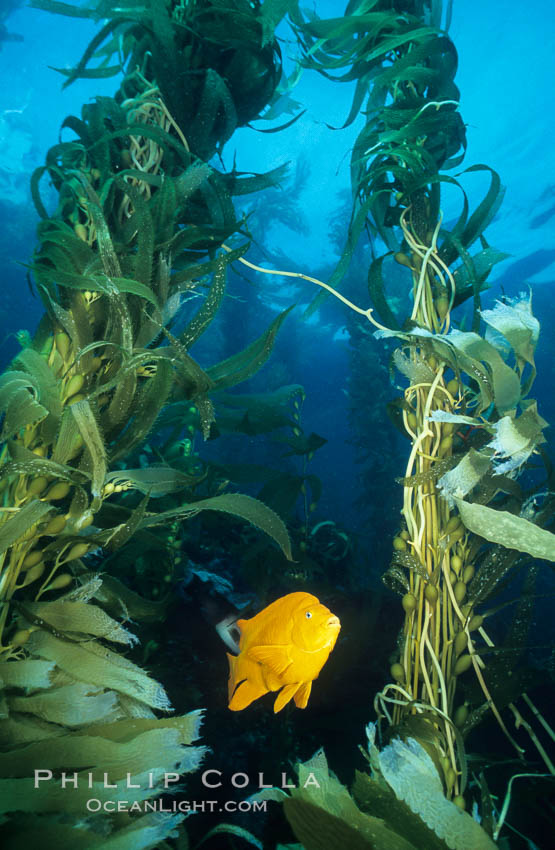
Garibaldi in kelp forest.
Image ID: 01055
Species: Garibaldi, Hypsypops rubicundus, Macrocystis pyrifera
Location: San Clemente Island, California, USA
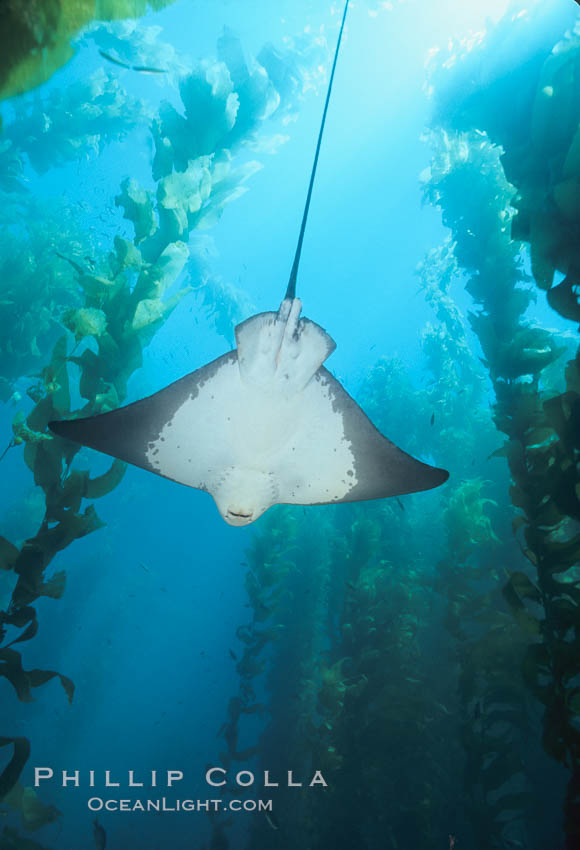
California bat ray in kelp forest.
Image ID: 00267
Species: California bat ray, Myliobatis californica, Macrocystis pyrifera
Location: San Clemente Island, California, USA
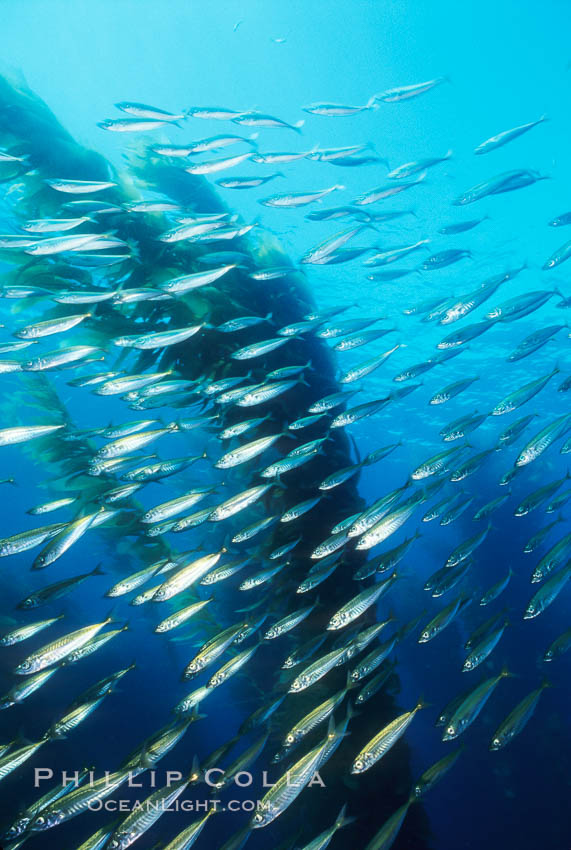
Jack mackerel and kelp.
Image ID: 00380
Species: Pacific jack mackerel, Trachurus symmetricus, Macrocystis pyrifera
Location: San Clemente Island, California, USA
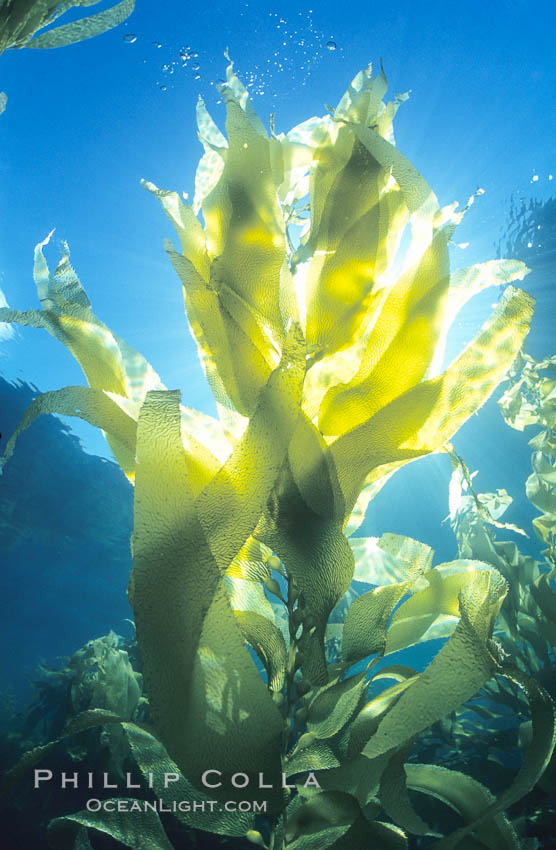
Kelp fronds.
Image ID: 03423
Species: Giant kelp, Macrocystis pyrifera
Location: San Clemente Island, California, USA
See more kelp forest photos.
Keywords: kelp forest, macrocystis pyrifera, photography, stock photo, california


