2005 March, Phillip Colla Photography

Lemon Shark Photo, Northern Bahamas

Filed under: Photo of the Day on 3/21/2005

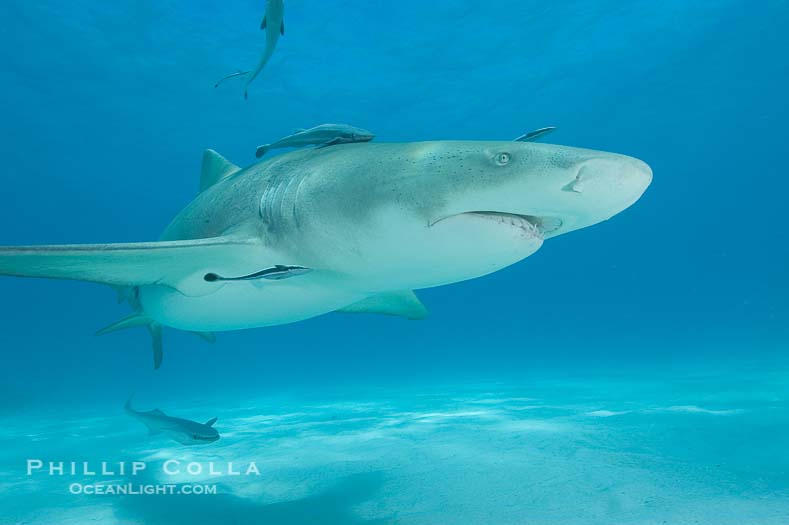
On our recent trip to the Northern Bahamas in search of sharks, we encountered lots of lemon sharks (Negaprion brevirostris) alongside the tiger sharks (Galeocerdo cuvier). The lemon sharks were comfortable coming in for a close look and afforded literally hundreds of good photo opportunities on a single 90 minute dive. Some of the lemons were accompanied by up to a dozen live sharksuckers (Echeneis naucrates), a type of remora. Once in a while one of the sharksuckers would peel of its lemon shark host and swim around us for a while. After a while we began to ignore the lemons in an effort to keep our eyes on the considerably more impressive tiger sharks. Here are a few shots of the lemons:

Lemon shark with live sharksuckers., Negaprion brevirostris, Echeneis naucrates,  Copyright Phillip Colla, image #10754, all rights reserved worldwide.
Lemon shark with live sharksuckers. Bahamas.
Image: 10754  
Species: Negaprion brevirostris, Echeneis naucrates
 
Lemon shark with live sharksuckers., Negaprion brevirostris, Echeneis naucrates,  Copyright Phillip Colla, image #10752, all rights reserved worldwide.
Lemon shark with live sharksuckers., Negaprion brevirostris, Echeneis naucrates,  Copyright Phillip Colla, image #10753, all rights reserved worldwide.
Lemon shark with live sharksuckers., Negaprion brevirostris, Echeneis naucrates,  Copyright Phillip Colla, image #10756, all rights reserved worldwide.
Lemon shark with live sharksuckers. Bahamas.
Image: 10752  
Species: Negaprion brevirostris, Echeneis naucrates
 
Lemon shark with live sharksuckers. Bahamas.
Image: 10753  
Species: Negaprion brevirostris, Echeneis naucrates
 
Lemon shark with live sharksuckers. Bahamas.
Image: 10756  
Species: Negaprion brevirostris, Echeneis naucrates
 
Lemon shark with live sharksuckers., Negaprion brevirostris, Echeneis naucrates,  Copyright Phillip Colla, image #10757, all rights reserved worldwide.
Lemon shark., Negaprion brevirostris,  Copyright Phillip Colla, image #10758, all rights reserved worldwide.
Lemon shark and photographer Jim Abernethy., Negaprion brevirostris,  Copyright Phillip Colla, image #10760, all rights reserved worldwide.
Lemon shark with live sharksuckers. Bahamas.
Image: 10757  
Species: Negaprion brevirostris, Echeneis naucrates
 
Lemon shark. Bahamas.
Image: 10758  
Species: Negaprion brevirostris
 
Lemon shark and photographer Jim Abernethy. Bahamas.
Image: 10760  
Species: Negaprion brevirostris
 

Keywords: lemon shark photo, Negaprion brevirostris, Northern Bahamas, lemon sharks, lemon shark pictures, underwater photos.

Add a comment

Subscribe to this feed - Subscribe via Feedburner - Stumble it! - Digg this! - Add to Del.icio.us - Share on Facebook

Red Barrel Cactus Photos, Anza Borrego Desert State Park

View This Blog Post in Google Earth (How Cool Is That?)  View this blog entry in Google Earth
Latitude: 33° 11' 16.76" N, Longitude: 116° 23' 13.92" W, Coord: 33.187989°, -116.3872°
Filed under: Photo of the Day on 3/18/2005

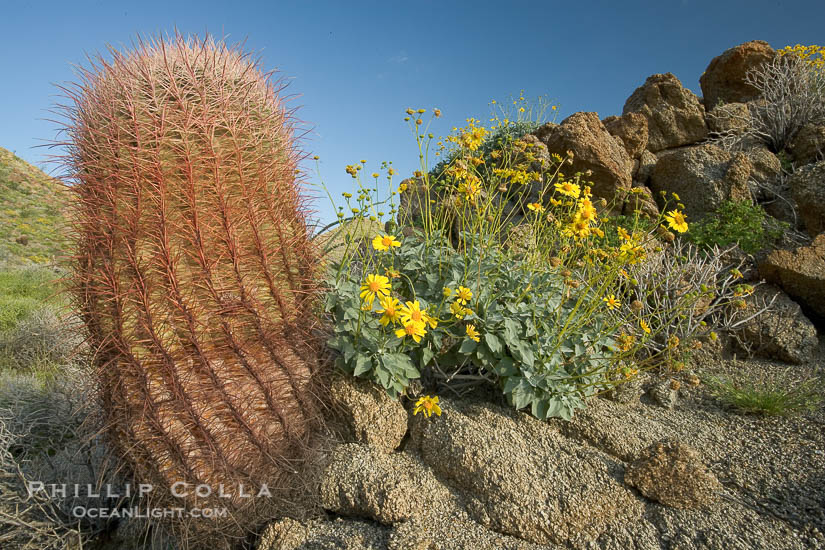
Thanks to John Dougherty for kindly helping us to correctly identify a number of flowering plants from recent visits to Anza-Borrego Desert State Park. One of our favorite subjects was the Red Barrel Cactus (Ferocactus cylindraceus) which were just beginning to show their blooms.

Barrel cactus, brittlebush and wildflowers color the sides of Glorietta Canyon.  Heavy winter rains led to a historic springtime bloom in 2005, carpeting the entire desert in vegetation and color for months., Ferocactus cylindraceus, Encelia farinosa,  Copyright Phillip Colla, image #10899, all rights reserved worldwide.
Barrel cactus, brittlebush and wildflowers color the sides of Glorietta Canyon. Heavy winter rains led to a historic springtime bloom in 2005, carpeting the entire desert in vegetation and color for months. Anza-Borrego Desert State Park, Anza Borrego, California, USA.
Image: 10899  
Species: Ferocactus cylindraceus, Encelia farinosa
Location: Anza-Borrego Desert State Park, Anza Borrego, California, USA
Click To View This Location in Google Earth.  You must have Google Earth installed for this feature to work correctly. View this Image in Google Earth!

 
Barrel cactus, Glorietta Canyon.  Heavy winter rains led to a historic springtime bloom in 2005, carpeting the entire desert in vegetation and color for months., Ferocactus cylindraceus,  Copyright Phillip Colla, image #10906, all rights reserved worldwide.
Barrel cactus, Glorietta Canyon. Heavy winter rains led to a historic springtime bloom in 2005, carpeting the entire desert in vegetation and color for months. Anza-Borrego Desert State Park, Anza Borrego, California, USA.
Image: 10906  
Species: Ferocactus cylindraceus
Location: Anza-Borrego Desert State Park, Anza Borrego, California, USA
Click To View This Location in Google Earth.  You must have Google Earth installed for this feature to work correctly. View this Image in Google Earth!

 
Barrel cactus, Glorietta Canyon.  Heavy winter rains led to a historic springtime bloom in 2005, carpeting the entire desert in vegetation and color for months., Ferocactus cylindraceus,  Copyright Phillip Colla, image #10905, all rights reserved worldwide.
Barrel cactus, Glorietta Canyon. Heavy winter rains led to a historic springtime bloom in 2005, carpeting the entire desert in vegetation and color for months. Anza-Borrego Desert State Park, Anza Borrego, California, USA.
Image: 10905  
Species: Ferocactus cylindraceus
Location: Anza-Borrego Desert State Park, Anza Borrego, California, USA
Click To View This Location in Google Earth.  You must have Google Earth installed for this feature to work correctly. View this Image in Google Earth!

 
Barrel cactus, brittlebush, ocotillo and wildflowers color the sides of Glorietta Canyon.  Heavy winter rains led to a historic springtime bloom in 2005, carpeting the entire desert in vegetation and color for months., Ferocactus cylindraceus, Encelia farinosa, Fouquieria splendens,  Copyright Phillip Colla, image #10919, all rights reserved worldwide.
Barrel cactus, brittlebush, ocotillo and wildflowers color the sides of Glorietta Canyon. Heavy winter rains led to a historic springtime bloom in 2005, carpeting the entire desert in vegetation and color for months. Anza-Borrego Desert State Park, Anza Borrego, California, USA.
Image: 10919  
Species: Ferocactus cylindraceus, Encelia farinosa, Fouquieria splendens
Location: Anza-Borrego Desert State Park, Anza Borrego, California, USA
Click To View This Location in Google Earth.  You must have Google Earth installed for this feature to work correctly. View this Image in Google Earth!


Keywords: barrel cactus photo, flowering cactus, cacti, red barrel cactus, ferocactus, desert Anza-Borrego desert state park.

Add a comment

Subscribe to this feed - Subscribe via Feedburner - Stumble it! - Digg this! - Add to Del.icio.us - Share on Facebook

Canyon Sunrise, Anza Borrego Desert State Park

View This Blog Post in Google Earth (How Cool Is That?)  View this blog entry in Google Earth
Latitude: 33° 11' 15.19" N, Longitude: 116° 23' 16.13" W, Coord: 33.187553°, -116.38781°
Filed under: Photo of the Day on 3/16/2005

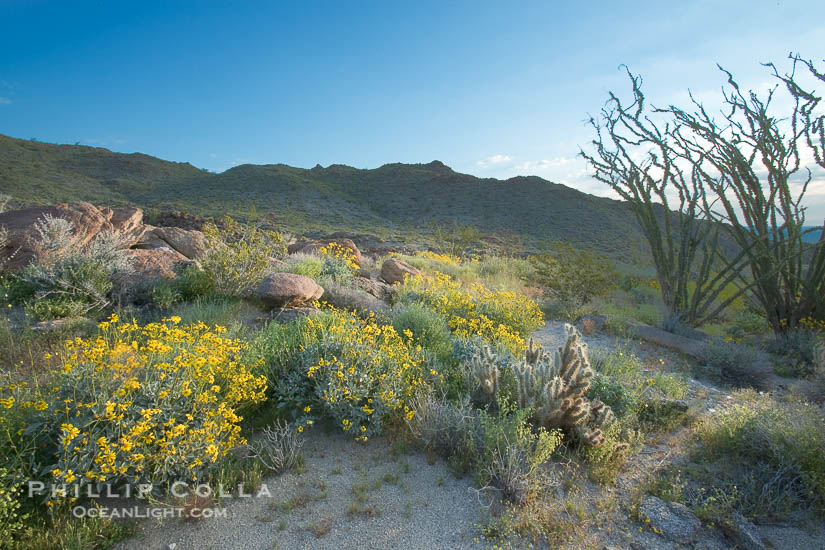
Anza Borrego Desert State Park is currently experiencing an epic, once-in-a-lifetime bloom of desert wildflowers, bushes and cacti. The sand verbena and desert primrose flowers that had covered the valley floor so spectacularly in places in February seem to be receding or largely gone, replaced with poppies and lupine. However, the principal attraction now is a profusion of brittlebush filling the canyons and coloring the hillsides on the east side of the valley with yellow. The slopes along the Montezuma Grade leading down to Borrego Springs from the west are bright with brittlebush, so that they appear entirely yellow and green from afar. The density of brittlebush continues down toward the valley and into the canyons, washes and alluvial fans. Barrel and cholla cactus and ocotillo are just now beginning to bloom, so desert color in Anza Borrego should continue to improve for at least a few more weeks. There are many small assorted flowers still, along with caterpillers (munching the flowers) and butterflies. The following is a blended exposure shot at sunrise, composed of three images blended to account for the extreme range of light that neither film nor digital sensor can adequately capture in a single exposure:

Brittlebush, ocotillo and various cacti and wildflowers color the sides of Glorietta Canyon.  Heavy winter rains led to a historic springtime bloom in 2005, carpeting the entire desert in vegetation and color for months., Encelia farinosa, Fouquieria splendens,  Copyright Phillip Colla, image #10895, all rights reserved worldwide.
Brittlebush, ocotillo and various cacti and wildflowers color the sides of Glorietta Canyon. Heavy winter rains led to a historic springtime bloom in 2005, carpeting the entire desert in vegetation and color for months. Anza-Borrego Desert State Park, Anza Borrego, California, USA.
Image: 10895  
Species: Encelia farinosa, Fouquieria splendens
Location: Anza-Borrego Desert State Park, Anza Borrego, California, USA
Click To View This Location in Google Earth.  You must have Google Earth installed for this feature to work correctly. View this Image in Google Earth!


See all the photos from this shoot.

Keywords: Anza Borrego Desert State Park, photo, photographs, wildflower.

Add a comment

Subscribe to this feed - Subscribe via Feedburner - Stumble it! - Digg this! - Add to Del.icio.us - Share on Facebook

California Sea Lions, Baja California

View This Blog Post in Google Earth (How Cool Is That?)  View this blog entry in Google Earth
Latitude: 32° 26' 14.15" N, Longitude: 117° 17' 52.86" W, Coord: 32.437264°, -117.29802°
Filed under: Mexico, Photo of the Day, Sea Lion, Wildlife on 3/15/2005

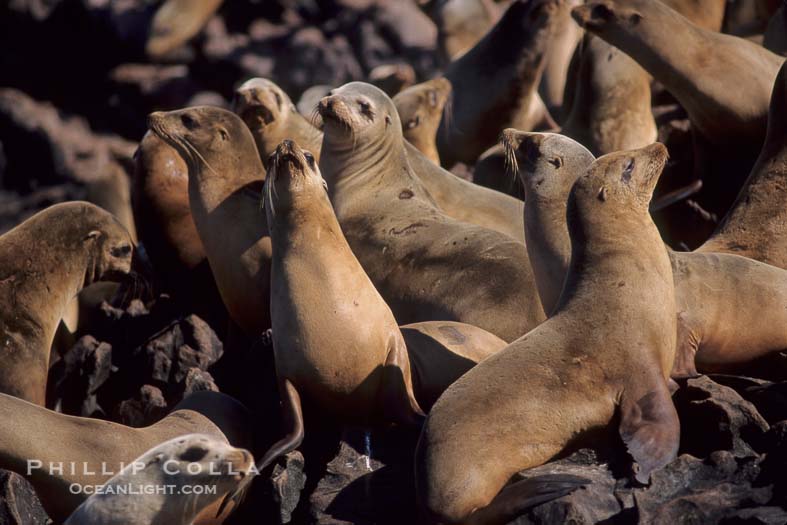
Each winter California sea lions (Zalophus californianus) gather in the hundreds on the rock slopes of North Coronado Island, just south of the US/Mexico border. The bottom diving is unremarkable here the remainder of the year, but when the sea lions are gathered in such numbers it is worth making the short boat trip for a dive with them.

California sea lions, hauled out at rookery/colony, Baja California., Zalophus californianus,  Copyright Phillip Colla, image #05042, all rights reserved worldwide.
California sea lions, hauled out at rookery/colony, Baja California.
Image: 05042  
Species: Zalophus californianus
Click To View This Location in Google Earth.  You must have Google Earth installed for this feature to work correctly. View this Image in Google Earth!


Keywords: California sea lion photo, rookery, colony, Zalophus californianus, Coronado Islands, Islas Coronado.

Add a comment

Subscribe to this feed - Subscribe via Feedburner - Stumble it! - Digg this! - Add to Del.icio.us - Share on Facebook

Tiger Shark and Keith Grundy, Northern Bahamas

View This Blog Post in Google Earth (How Cool Is That?)  View this blog entry in Google Earth
Latitude: 26° 56' 59.53" N, Longitude: 79° 6' 35.66" W, Coord: 26.949872°, -79.109906°
Filed under: Photo of the Day on 3/12/2005

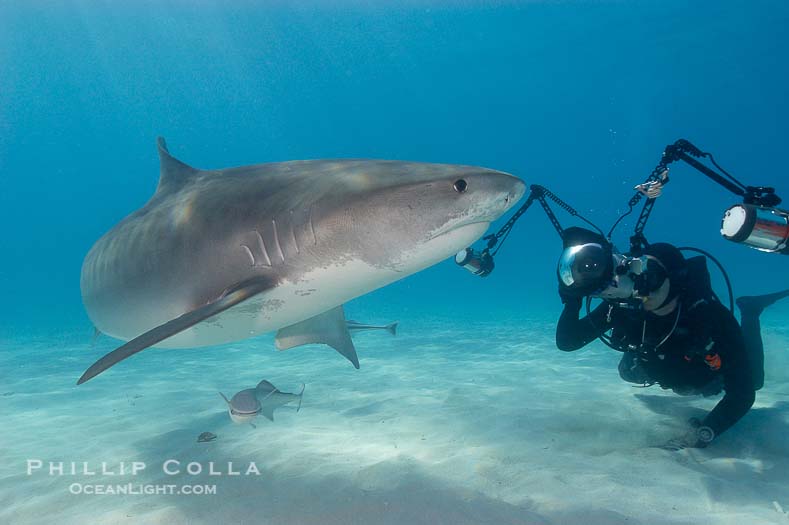
We recently spent 8 days on the MV Shearwater in the Northern Bahamas, in search of various species of sharks to swim with and photograph. The most impressive of the ones we encountered were the tiger sharks (Galeocerdo cuvier). They ranged in size from 9 feet to perhaps 14 feet, big enough to be quite intimidating. One large one in particular made a good photo subject as it was willing to approach the divers closely. Here is underwater photographer Keith Grundy being treated to a close look at a 13 foot tiger shark that Shearwater skipper and owner Jim Abernethy named “Emma”:

Tiger shark and photographer Keith Grundy., Galeocerdo cuvier,  Copyright Phillip Colla, image #10649, all rights reserved worldwide.
Tiger shark and photographer Keith Grundy. Bahamas.
Image: 10649  
Species: Galeocerdo cuvier
Location: Bahamas
Click To View This Location in Google Earth.  You must have Google Earth installed for this feature to work correctly. View this Image in Google Earth!


Keywords: tiger shark photo, Keith Grundy, Bahamas, underwater photograph, Caleocerdo cuvier.

Add a comment

Subscribe to this feed - Subscribe via Feedburner - Stumble it! - Digg this! - Add to Del.icio.us - Share on Facebook

Linanthus Dianthiflorus, Batiquitos Lagoon

View This Blog Post in Google Earth (How Cool Is That?)  View this blog entry in Google Earth
Latitude: 33° 5' 34.1" N, Longitude: 117° 17' 54.34" W, Coord: 33.092806°, -117.29843°
Filed under: Photo of the Day on 3/11/2005

We found a great spread of Linanthus dianthiflorusin a small canyon leading off of Batiquitos Lagoon in South Carlsbad:

Ground pink blooms in spring, Batiquitos Lagoon, Carlsbad., Linanthus dianthiflorus,  Copyright Phillip Colla, image #11486, all rights reserved worldwide.
Ground pink blooms in spring, Batiquitos Lagoon, Carlsbad. Batiquitos Lagoon, Carlsbad, California, USA.
Image: 11486  
Species: Linanthus dianthiflorus
Location: Batiquitos Lagoon, Carlsbad, California, USA
Click To View This Location in Google Earth.  You must have Google Earth installed for this feature to work correctly. View this Image in Google Earth!

 
Ground pink blooms in spring, Batiquitos Lagoon, Carlsbad., Linanthus dianthiflorus,  Copyright Phillip Colla, image #11489, all rights reserved worldwide.
Ground pink blooms in spring, Batiquitos Lagoon, Carlsbad. Batiquitos Lagoon, Carlsbad, California, USA.
Image: 11489  
Species: Linanthus dianthiflorus
Location: Batiquitos Lagoon, Carlsbad, California, USA
Click To View This Location in Google Earth.  You must have Google Earth installed for this feature to work correctly. View this Image in Google Earth!

 
Add a comment

Subscribe to this feed - Subscribe via Feedburner - Stumble it! - Digg this! - Add to Del.icio.us - Share on Facebook

Photo of Old Faithful Geyser, Yellowstone National Park

View This Blog Post in Google Earth (How Cool Is That?)  View this blog entry in Google Earth
Latitude: 44° 27' 36.29" N, Longitude: 110° 49' 36.8" W, Coord: 44.460081°, -110.82689°
Filed under: Yellowstone on 3/10/2005

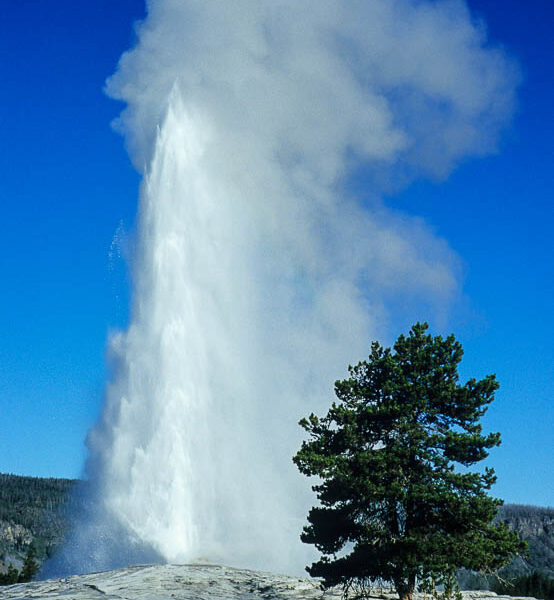
Old Faithful geyser in Yellowstone National Park is such an icon that photos of it have become cliche. It is the most accessible and watched of all the geysers in the park. However, it is still a wonderful sight to behold regardless of how many people have seen it before or how many are standing next to you viewing it now. We awoke early one morning, just after dawn, and strolled 50 yards from our room at the Old Faithful Inn to have this clear, early morning view of Old Faithful geyser erupting at first light. There were perhaps 10 other people sharing the view with us, a refreshing change from the hundreds that gather later in the day.

Old Faithful geyser, peak eruption.,  Copyright Phillip Colla, image #07179, all rights reserved worldwide.
Old Faithful geyser, peak eruption. Upper Geyser Basin, Yellowstone National Park, Wyoming, USA.
Image: 07179  
Location: Upper Geyser Basin, Yellowstone National Park, Wyoming, USA
Click To View This Location in Google Earth.  You must have Google Earth installed for this feature to work correctly. View this Image in Google Earth!


Keywords: Old Faithful Geyser photo, Yellowstone National Park, photograph, picture, erupting, eruption, steam.

Add a comment

Subscribe to this feed - Subscribe via Feedburner - Stumble it! - Digg this! - Add to Del.icio.us - Share on Facebook

Butterfly Cove at Sunrise, Guadalupe Island

View This Blog Post in Google Earth (How Cool Is That?)  View this blog entry in Google Earth
Latitude: 28° 53' 24.6" N, Longitude: 118° 14' 52.4" W, Coord: 28.890167°, -118.24789°
Filed under: Guadalupe Island, Mexico on 3/9/2005

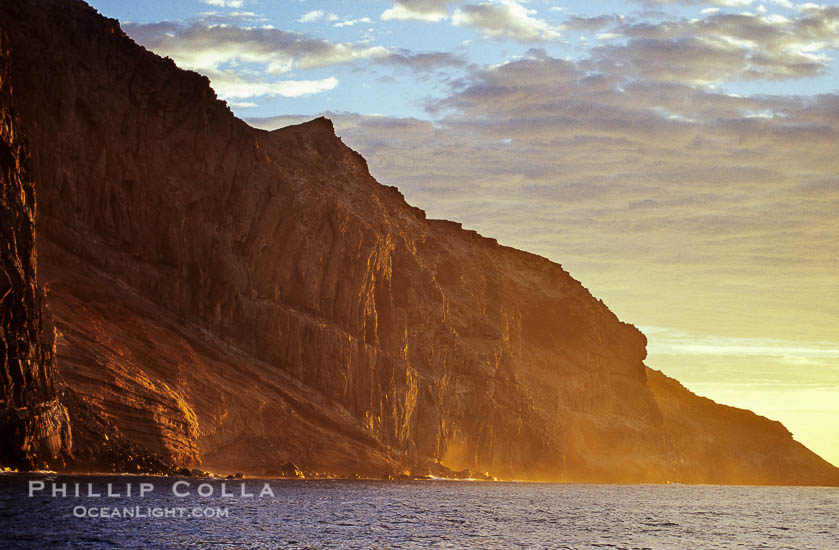
The evening anchorage at the south end of Guadalupe Island (Isla Guadalupe) is Melpomene Bay. Early in the morning we raise anchor and move to take a look at the water conditions at nearby Isla Adentro, Isla Afuera and Church Rock. On this morning, none of those spots offered us what we were looking for, so we motored around the southeastern corner of the island to dive at Abalone Point. As we passed by the morro and cliffs above Butterfly Cove, the sun cleared the horizon and hit the island with a rich golden light.

East face and shoreline of southernmost morro, daybreak.,  Copyright Phillip Colla, image #06152, all rights reserved worldwide.
East face and shoreline of southernmost morro, daybreak. Guadalupe Island (Isla Guadalupe), Baja California, Mexico.
Image: 06152  
Location: Guadalupe Island (Isla Guadalupe), Baja California, Mexico
Click To View This Location in Google Earth.  You must have Google Earth installed for this feature to work correctly. View this Image in Google Earth!


Keywords: Isla Guadalupe, Guadalupe Island, Mexico, photo, photograph, sunrise, Butterfly Cove, Westies.

Add a comment

Subscribe to this feed - Subscribe via Feedburner - Stumble it! - Digg this! - Add to Del.icio.us - Share on Facebook

Photos of Boat Strikes of Marine Animals

Filed under: Photo of the Day, Wildlife on 3/8/2005

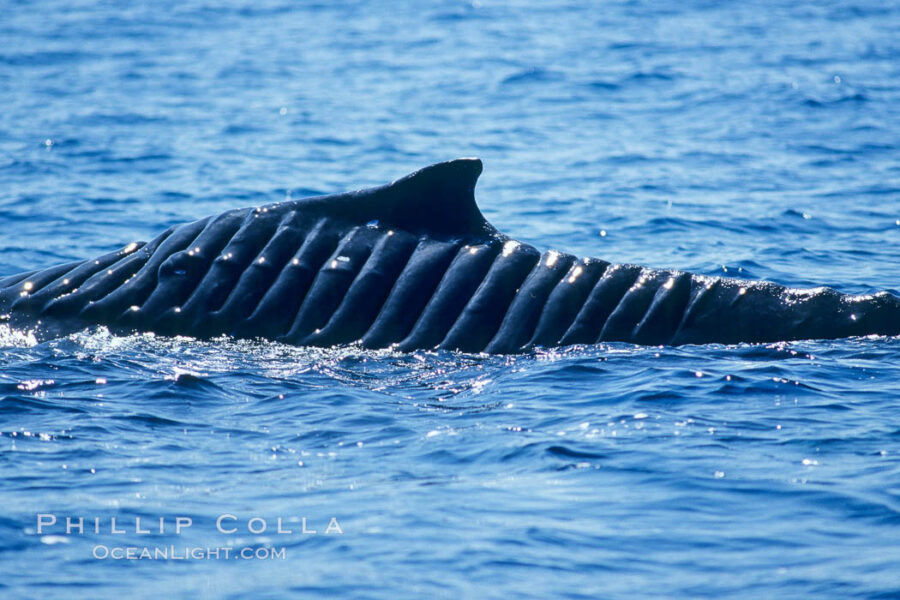
Boat strikes of marine animals are increasingly common, for obvious reasons. It is disappointing to observe a marine animal severely or mortally wounded by a collision with a boat. We have encountered several marine animals bearing unmistakable boat propeller scars:

North Pacific humpback whale showing extensive scarring, almost certainly from a boat propeller, on dorsal ridge., Megaptera novaeangliae,  Copyright Phillip Colla / HWRF, image #05910, all rights reserved worldwide. This photograph was taken during Hawaii Whale Research Foundation research activities conducted under NOAA/NMFS and State of Hawaii permit.  Its use is subject to certain restrictions.  Please contact the photographer for more information.
North Pacific humpback whale showing extensive scarring, almost certainly from a boat propeller, on dorsal ridge. Maui, Hawaii, USA.
Image: 05910  
Species: Megaptera novaeangliae
See usage restrictions
 
Ocean sunfish injured by boat prop with cleaner fishes, open ocean, Baja California., Mola mola,  Copyright Phillip Colla, image #06410, all rights reserved worldwide.
Gray whale dorsal aspect showing injury/wound/indentation likely caused by boat, Laguna San Ignacio, Baja California., Eschrichtius robustus,  Copyright Phillip Colla, image #06426, all rights reserved worldwide.
West Indian manatee., Trichechus manatus,  Copyright Phillip Colla, image #02651, all rights reserved worldwide.
Ocean sunfish injured by boat prop with cleaner fishes, open ocean, Baja California.
Image: 06410  
Species: Mola mola
 
Gray whale dorsal aspect showing injury/wound/indentation likely caused by boat, Laguna San Ignacio, Baja California.
Image: 06426  
Species: Eschrichtius robustus
 
West Indian manatee. Three Sisters Springs, Crystal River, Florida, USA.
Image: 02651  
Species: Trichechus manatus
 

See more boat strike and propeller scar photos.

Keywords: propeller scar photo, boat strike, injury, photograph, boat collision.

The humpback whale photograph was taken during Hawaii Whale Research Foundation research activities conducted under provisions of NOAA / NMFS and State of Hawaii scientific research permits.

Add a comment

Subscribe to this feed - Subscribe via Feedburner - Stumble it! - Digg this! - Add to Del.icio.us - Share on Facebook

Photos of Batiquitos Lagoon in Spring

Filed under: California, Carlsbad, Photo of the Day on 3/7/2005

Batiquitos Lagoon, bordering Carlsbad and La Costa in northern San Diego County, is experiencing a fantastic display of spring flowers and plants. The hills bordering the lagoon are as verdant as we can ever recall seeing them, covered with lots of yellow flowers and deep green foliage. Now is a good time to check out any of the lagoons in north county. For more information: Batiquitos Lagoon, San Elijo Lagoon, Aqua Hedionda Lagoon, and San Dieguito Lagoon.


Keywords: Batiquitos lagoon photos, wildflowers, spring, photograph.

Add a comment

Subscribe to this feed - Subscribe via Feedburner - Stumble it! - Digg this! - Add to Del.icio.us - Share on Facebook

Waterspout Photo — Tornado Over Water

View This Blog Post in Google Earth (How Cool Is That?)  View this blog entry in Google Earth
Latitude: 26° 1' 59.99" N, Longitude: 79° 5' 59.99" W, Coord: 26.033333°, -79.1°
Filed under: Photo of the Day on 3/5/2005

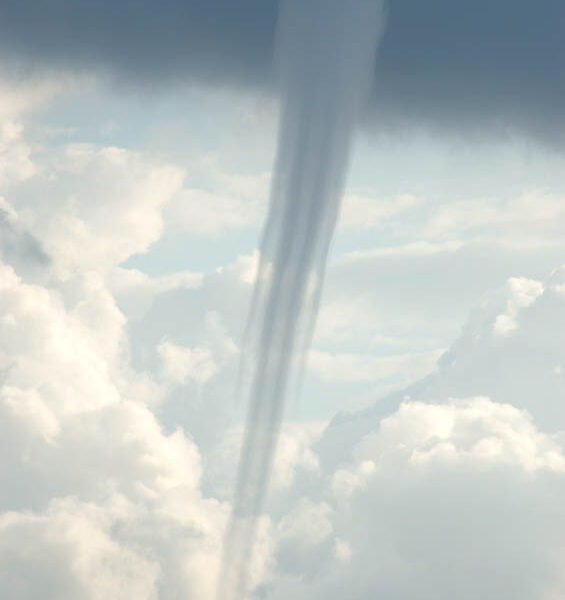
We were recently in the Bahamas, enjoying a week of diving with sharks. We were treated to tornado watching as a bonus. The weather was windier and cooler than I was used to, not having been to the Bahamas in winter before. One morning we awoke at anchor at Great Isaac Island surrounded by brooding skies and lots of towering clouds. Some sort of front (a cold front?) was passing by taking the clouds along with it, and there was a distinct edge to the cell of weather, with clear skies meeting a ridge of clouds. As the morning passed we watched at least 10 waterspouts form along the edge of the weather cell. Waterspouts are simply tornados that form over water. Instead of tossing farm animals and mobile homes about as tornados do, waterspouts just grab the ocean and pull it upward in a great column. You don’t want to be part of the ocean that is grabbed.

The mature vortex of a ocean waterspout, seen against cumulus clouds in the background.  Waterspouts are tornadoes that form over water.,  Copyright Phillip Colla, image #10846, all rights reserved worldwide.
The mature vortex of a ocean waterspout, seen against cumulus clouds in the background. Waterspouts are tornadoes that form over water. Great Isaac Island, Bahamas.
Image: 10846  
Location: Great Isaac Island, Bahamas
Click To View This Location in Google Earth.  You must have Google Earth installed for this feature to work correctly. View this Image in Google Earth!


First a funnel would form in the sky: a vortex created when two conflicting winds shear at each other. The vortex might not be vertical initially, but eventually it would orient vertically and the funnel would begin to extend downward. Gradually the vortex would touch the ocean surface, causing a visible disturbance on the water and drawing water vapor upward into the vortex until the entire vortex was visible from water to sky. Most of the waterspouts were too distant to photograph well, but a couple passed by within range of 200mm and 400mm lenses (thanks Ken for loaning me the big lens). In one of the waterspouts, the vortex structure was clearly apparent in which a thick wall outer surrounded a inner cylinder. It was great, sort of like what the tornado chasers in Kansas and Nebraska see except that we had the advantage of watching them just off the stern while eating breakfast in the comfort of Jim Abernethy’s MV Shearwater, waiting for our sharks to arrive. It was a remarkable morning.

A mature waterspout, seen extending from clouds above to the ocean surface.  A significant disturbance on the ocean is clearly visible, the waterspout has reached is maximum intensity.   Waterspouts are tornadoes that form over water.,  Copyright Phillip Colla, image #10851, all rights reserved worldwide.
Two simultaneous waterspouts.  Waterspouts are tornadoes that form over water.,  Copyright Phillip Colla, image #10854, all rights reserved worldwide.
A mature waterspout, seen extending from clouds above to the ocean surface. A significant disturbance on the ocean is clearly visible, the waterspout has reached is maximum intensity. Waterspouts are tornadoes that form over water. Great Isaac Island, Bahamas.
Image: 10851  
 
Two simultaneous waterspouts. Waterspouts are tornadoes that form over water. Great Isaac Island, Bahamas.
Image: 10854  
 

Keywords: waterspout photo, tornado photo, vortex, waterspout picture.

Comments (1)

Subscribe to this feed - Subscribe via Feedburner - Stumble it! - Digg this! - Add to Del.icio.us - Share on Facebook

Caribbean Reef Shark Photo

View This Blog Post in Google Earth (How Cool Is That?)  View this blog entry in Google Earth
Latitude: 27° 0' 27.82" N, Longitude: 79° 9' 14.75" W, Coord: 27.007728°, -79.1541°
Filed under: Photo of the Day on 3/4/2005

These Caribbean reef sharks (Carcharhinus perezi) were photographed a few weeks ago in the northern Bahamas:

Caribbean reef shark, ampullae of Lorenzini visible on snout., Carcharhinus perezi,  Copyright Phillip Colla, image #10550, all rights reserved worldwide.
Caribbean reef shark, ampullae of Lorenzini visible on snout. Bahamas.
Image: 10550  
Species: Carcharhinus perezi
Location: Bahamas
Click To View This Location in Google Earth.  You must have Google Earth installed for this feature to work correctly. View this Image in Google Earth!

 
Caribbean reef shark., Carcharhinus perezi,  Copyright Phillip Colla, image #10549, all rights reserved worldwide.
Caribbean reef shark swims over a coral reef., Carcharhinus perezi,  Copyright Phillip Colla, image #10552, all rights reserved worldwide.
Caribbean reef shark., Carcharhinus perezi,  Copyright Phillip Colla, image #10555, all rights reserved worldwide.
Caribbean reef shark. Bahamas.
Image: 10549  
Species: Carcharhinus perezi
 
Caribbean reef shark swims over a coral reef. Bahamas.
Image: 10552  
Species: Carcharhinus perezi
 
Caribbean reef shark. Bahamas.
Image: 10555  
Species: Carcharhinus perezi
 

Nikon D100, 12-24mm f/4 lens, submersible housing, two Sea and Sea YS90 strobes, bait.

Keywords: Caribbean reef shark photo, Carcharhinus perezi, underwater photo.

Add a comment

Subscribe to this feed - Subscribe via Feedburner - Stumble it! - Digg this! - Add to Del.icio.us - Share on Facebook

Photo of Hermissenda Crassicornis Nudibranch

Filed under: California, Monterey, Photo of the Day on 3/3/2005

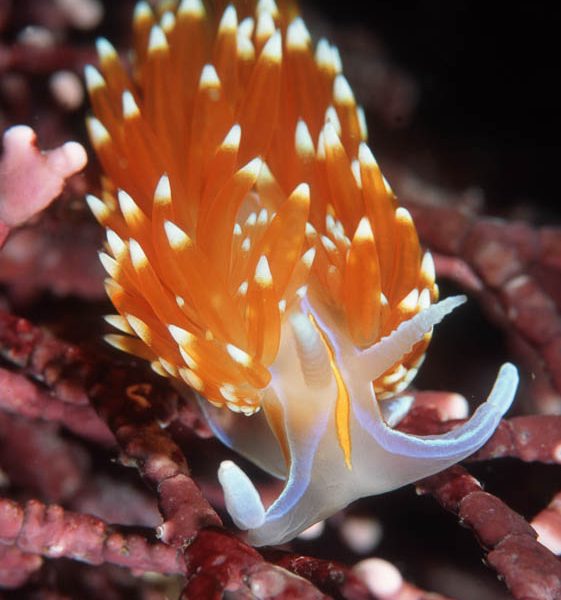
This photo of a Hermissenda crassicornis, also known as an “Opalescent nudibranch”, was shot in the early 90’s near Carmel on the Monterey Peninsula. We rented a house in the town of Carmel for a week. Anticipating foggy skies and cold murky water, we did not expect to do much diving. However, surprised with sunny weather and clearer-than-normal water, we made a number boat dives and a few beach dives not far from the house, resulting in a nice variety of invertebrate images including some nudibranchs. This is one of those images.

Nudibranch on calcareous coralline algae., Hermissenda crassicornis,  Copyright Phillip Colla, image #01064, all rights reserved worldwide.
Nudibranch on calcareous coralline algae. Monterey, California, USA.
Image: 01064  
Species: Hermissenda crassicornis
Location: Monterey, California, USA
 

The Sea Slug Forum has a great fact sheet page on this species. Also, the SlugSite has an excellent species description of Hermissenda crassicornis.

Keywords: nudibranch photo, sea slug, Hermissenda crassicornis, underwater, photograph, Monterey, California, Carmel.

Add a comment

Subscribe to this feed - Subscribe via Feedburner - Stumble it! - Digg this! - Add to Del.icio.us - Share on Facebook

Boobie Photos

View This Blog Post in Google Earth (How Cool Is That?)  View this blog entry in Google Earth
Latitude: 0° 23' 55.88" S, Longitude: 90° 17' 34.77" W, Coord: -0.39885556°, -90.292992°
Filed under: Photo of the Day on 3/2/2005

For some reason many visitors to this web site have been searching for boobie photos. We simply do not understand the intense interest in photos of boobies, or in boobies in general. Boobies are just a bunch of seabirds and not even particularly rare. The blue boobies seem to elicit the most interest — visitors seem amazed that they come in a deep blue color, naturally with no cosmetic alteration necessary. (They also come in brown and red, and some even have masks!) In spite of all the boobie traffic, however, nobody buys the boobie photographs, they just furtively look and move on. We have yet to license one of our boobies to anyone, until today when we finally sold a boobie photo, a fine art print in fact. So we are no longer amateur boobie photographers. We can honestly say that we proudly photograph boobies all over the world, professionally. You know the look: beautiful boobies, endless white sand beaches and glamorous island settings. Big ones, small ones, perky ones, drab ones, bodacious ones. We’ve been thinking of starting up a specialty website, www.firstclassboobies.com or www.worldsbestboobies.com.

Blue-footed booby, courtship display., Sula nebouxii,  Copyright Phillip Colla, image #01791, all rights reserved worldwide.
Blue-footed booby, courtship display. North Seymour Island, Galapagos Islands, Ecuador.
Image: 01791  
Species: Sula nebouxii
 
Blue-footed booby, courtship display, Punta Suarez., Sula nebouxii,  Copyright Phillip Colla, image #01797, all rights reserved worldwide.
Blue-footed booby with chick., Sula nebouxii,  Copyright Phillip Colla, image #01808, all rights reserved worldwide.
Blue-footed booby, Punta Suarez., Sula nebouxii,  Copyright Phillip Colla, image #01801, all rights reserved worldwide.
Blue-footed booby, courtship display, Punta Suarez. Hood Island, Galapagos Islands, Ecuador.
Image: 01797  
Species: Sula nebouxii
 
Blue-footed booby with chick. North Seymour Island, Galapagos Islands, Ecuador.
Image: 01808  
Species: Sula nebouxii
 
Blue-footed booby, Punta Suarez. Hood Island, Galapagos Islands, Ecuador.
Image: 01801  
Species: Sula nebouxii
 

Was it good for you too?

Keywords: boobies, boobie photos, boobie pictures, boobie photographs, bodacious.

Add a comment

Subscribe to this feed - Subscribe via Feedburner - Stumble it! - Digg this! - Add to Del.icio.us - Share on Facebook

Late Light and Clouds

Filed under: Photo of the Day on 3/1/2005

This image of clouds lit from below by the setting sun over the ocean was shot from our back yard:

Clouds and sunlight.,  Copyright Phillip Colla, image #04819, all rights reserved worldwide.
Clouds and sunlight. La Jolla, California, USA.
Image: 04819  
Location: La Jolla, California, USA
 

I’ve had a surprising amount of interest in abstract photos such as this one, or shots of the underside of the surface of the ocean and sandy ocean floors, etc.

Keywords: cloud photo, sunset, abstract, pattern.

Add a comment

Subscribe to this feed - Subscribe via Feedburner - Stumble it! - Digg this! - Add to Del.icio.us - Share on Facebook

Arabian Gulf or Persian Gulf?

Filed under: Uncategorized on

It appears my humble website has caught the eye of people who are concerned with the historical and modern naming of the Persian Gulf, also known as the Arabian Gulf. Certain political interests would like to see the body of water bordering Iran, Saudi Arabia, Kuwait, the United Arab Emirates, Oman, Qatar and Bahrain referred to only as the “Persian Gulf”. However, National Geographic has updated their atlas to include “Arabian Gulf” as an valid alternate name. Apparently this development is threatening to Iranian interests. One group of interested individuals appears to be searching the web for references to “Arabian Gulf” and then contacting the authors of any offending pages to request that the term “Arabian Gulf” be corrected to “Persian Gulf”. I am one of those offending authors, by virtue of some entries in my photographic database that use the term “Arabian Gulf” as the source for some mollusk specimens.

The following three emails from arrived in my inbox last night in what seems to be a concerted effort to politely clear up my confusion on the matter of the naming of the “Persian Gulf”. I’ll try to correct the database soon, changing the reference to Arabian Gulf to Persian Gulf.

Dear Sir/Madam,
I noted that you have used the wrong term of “Arabian Gulf”  instead of the historical and internationally recognized term of the Persian Gulf in your Web site;
http://www.oceanlight.com/lightbox.php?lr=Arabian_Gulf

I would like to point out that according to all historical/geographical documents, also United Nations’ directives, the name of this waterway which separates Iran (Persia) from Arabian Peninsula is the PERSIAN GULF :

UN Links :
http://www.un.org/Depts/Cartographic/map/profile/westasia.pdf
http://www.un.org/Depts/Cartographic/map/profile/iran.pdf
http://www.un.org/depts/dhl/maplib/docs/escwa.pdf

PERSIAN GULF is also the only term used by the U.S. Department
of State:
http://www.state.gov/p/nea/ci/c2422.htm
or http://www.state.gov/p/nea/ci/c2404.htm

You can visit this page for some maps & documents and see even Arab scholars until 1960s used “Al-Khalij Al-Farsi” (Arabic name of the “Persian Gulf”);
http://www.persiangulfonline.org/maps.htm

“Arabian Gulf” in fact is the ancient name of the present-day “Red Sea” (located between Arabia and Africa).

Please imagine  that all nations start to rename the historical and legal names of seas and oceans: African people try to change the name of Indian Ocean to African Ocean, American people rename Gulf of Mexico to Gulf of America or Pakistani people try to use Pakistani Sea instead of the Arabian Sea !….

Also please be aware that Persian (Iranian) people never tried to use “Gulf of Iran”/”Gulf of Persia” instead of “Gulf of Oman” and never tried to chnage the name of “Arabian Sea” into “Persian Sea”.

May I ask you to kindly use the proper term in that article?
Thanks so much for your attention.


Dear Sir/Madam,

“The Persian Gulf” separates Iran(Persia) from the Arabian Peninsula.Please, use the proper name of this body of water.Unfortunately, you have used the ancient name of the “Red Sea” for the Persian Gulf:

http://www.oceanlight.com/lightbox.php?lr=Arabian_Gulf

I look forward to your positive reaction.


According to all historical, geographical and international documents, such as United Nation’s directives, the body of water between Iran and Arabian Peninsula is only called “Persian Gulf”.

For more information, please visit:

http://www.persiangulfonline.org/maps.htm

Let me remind you that “Arabian Gulf” is the old name of “Red Sea”:

http://www.jpmaps.co.uk/images/24552.jpg

Please only use its real and full name.

Thanking you in anticipation.

Here is yet another one that just arrived. It appears that once a web site has been identified that contains the term “Arabian Gulf”, many individuals associated with the Persion Gulf Task Force send emails to the website’s author to persuade him to change “Arabian Gulf” to “Persian Gulf”.

Dear Distinguished Members,

The reference to the invented term “Arabian Gulf” is historically and legally incorrect. The correct designation for the body of water is the Persian Gulf. The Arabian Gulf is the ancient designation of the present-day Red Sea:
http://www.jpmaps.co.uk/images/24552.jpg

The term “Arabian Gulf” is as arbirary and invalid as re-naming the English Channel as the “French Channel”, the Indian Ocean as “the Pakistan Ocean”, or the Thames River of London as the “Celtic River”. Think of the social, political, economic and historical chaos that would ensue from unwarranted actions, or should I say “arbitrary labeling”?

Iranians certainly do not refer to the Arabian Sea as “The Persian Sea”. This is as historically and legally invalid as using “Arabian Gulf” to refer to the Persian Gulf.

In legal terms, the United Nations has twice recognized the legality of the term “Persian Gulf” (UNAD 311/March 5, 1971 and UNLA 45.8.2 (c) on August 10, 1984). It is significant that all Arab countries have signed the UN documents. For further information consult the following links:
http://www.un.org/Depts/Cartographic/english/htmain.htm
http://www.un.org/Depts/Cartographic/map/profile/westasia.pdf
http://www.un.org/Depts/Cartographic/map/profile/iran.pdf
http://www.un.org/depts/dhl/maplib/docs/escwa.pdf

Note that U.S. Department of State also refers to the correct legal and historically valid term Persian Gulf. For reference please consult:
http://www.state.gov/p/nea/ci/c2422.htm
http://www.state.gov/p/nea/ci/c2404.htm

Arab scholars up to the 1960s have also referred to the body of water as per its correct name “Kahleej-ol-Faris” (Persian Gulf) (see George Hourani’s “Arab Seafaring: In the Indian Ocean in Ancient and Early Medieval Times”, Princeton University Press, 1995). For further information you may consult:
http://www.persiangulfonline.org/maps.htm

As noted above, the “Arabian Gulf” actually referred to the present-day Red Sea in antiquity (see Herodotus). The invention of “Arabian Gulf” with respect to its historically incorrect reference to the Persian Gulf was initiated by Sir Charles Belgrave (advisor to the Emir of Bahrain in 1926) who made the formal proposal to change the name of Persian Gulf in 1937 - the initiative was rejected by the British government at the time. For a popular reference regarding Sir Belgrave’s activities, see TIME Magazine’s August 27, 1956 entitled “The Uncontrollable Genie). Sir Belgrave’s failure did not restrain Mr. Roderic Owen (an employee of British Petroleum in the 1950s) from reviving the project of name change for the Persian Gulf.

The misapplication of terms, such as using the old term for the Red Sea (Arabian Gulf) instead of Persian Gulf, was an ingenious step in creating geopolitical and popular friction between Arabs and Iranians.

The term “Arabian Gulf” is a geopolitical invention devoid of historical context or meaning; it is also illegal (see aforementioned UN actions). 

Note that the CBC (Canadian Broadcasting Corporation) has removed all references to “Arabian Gulf” and now correctly refers to the body of water as The Persian Gulf. This is the result of a contact made to Russ Germain (Broadcast Language advisor, CBC Radio Canada) almost 3 years ago. On Monday Feb.11, 2002, Mr. Germain recommended that all references to “Arabian Gulf” be removed from CBC broadcasts in favour of the legal and correct term, Persian Gulf. I can forward a transcript of that communication to you upon request.

To quote Russ Germain with regard to the aforementioned letter, the incorrect Belgrave-Owen term “Arabian Gulf” is mainly the result of a “successful public relations campaign undertaken in the name of geopolitical interests”.

It would be appreciated that the geographical error be rectified as soon as possible. Your attention to this matter is most appreciated.

Comments (1)

Subscribe to this feed - Subscribe via Feedburner - Stumble it! - Digg this! - Add to Del.icio.us - Share on Facebook


HOME | Online Image Search | Photo of the Day | Contact / Bio | Licensing/Pricing | Prints | Stock List | Image Hierarchy | List of Log Entries | Site Map | Blue Whale | Cetaceans | Pinnipeds | Sharks | Rays | Fishes | Kelp Forest | Sea Birds | Inverts | Man & Animal | Man & Ocean | Ocean & Light | Ocean & Motion | Portraits | About Color and Monitor Calibration | Copyright Statement | All text and photographs copyright © Phillip Colla Natural History Photography   All rights reserved worldwide. The content of this site is made available for purposes of researching images offered for license by Phillip Colla Natural History Photography.  No image is to be copied, duplicated, modified or redistributed in whole or part without the prior written permission of Phillip Colla Natural History Photography.  Whale logo is a trademark of Phillip Colla Natural History Photography, 7302 Azalea Place, Carlsbad, CA 92011, USA.  (760) 804-0731.  Email: oceanlight@OceanLight.com    Web: www.OceanLight.com      Portfolios: www.Gygis.com

Updated: November 7, 2009