Alaska, Phillip Colla Photography

Bald Eagle Catches a Fish, Alaska

View This Blog Post in Google Earth (How Cool Is That?)  View this blog entry in Google Earth
Latitude: 59° 33' 50.14" N, Longitude: 151° 16' 54.62" W, Coord: 59.56393°, -151.28184°
Filed under: Alaska, Bald Eagle, Wildlife on 4/21/2009

A bald eagle (Haliaeetus leucocephalus) pulls a fish from the water on the fly, leaving a splash in its wake. The fish can be seen in the eagle’s talons.

Bald eagle makes a splash while in flight as it takes a fish out of the water., Haliaeetus leucocephalus, Haliaeetus leucocephalus washingtoniensis,  Copyright Phillip Colla, image #22584, all rights reserved worldwide.
Bald eagle makes a splash while in flight as it takes a fish out of the water. Kenai Peninsula, Alaska, USA.
Image: 22584  
Common name: Bald eagle
Species: Haliaeetus leucocephalus, Haliaeetus leucocephalus washingtoniensis
Location: Kenai Peninsula, Alaska, USA
Click To View This Location in Google Earth.  You must have Google Earth installed for this feature to work correctly. View this Image in Google Earth!


Curious how this photo was made? I used to wonder how photographers captured amazing images of predators taking prey. Naive, I know. As I gained experience and spoke with other photographers I learned that food is the key to photos like these. Naturally, most wildlife behavior involves the subject’s search for or acquisition of food. What viewers often don’t realize is that surprisingly many wildlife images are made when people provide food, or some suggestion of food, in order to attract the subject near enough for a photograph or to entice the animal to carry out some behavior. Some photographers and filmmakers have made their careers this way. In the case of bird photography, food is used in a high proportion of images since, in general, birds have no inate interest in being near people. I have heard comments suggesting that 90% of the bald eagle photographs appearing in print in recent years were made in Homer in winter, and after visiting Homer and seeing how photography works there I don’t doubt that statistic. Fundamentally, eagle photography in Homer is based on the fact that food is regularly provided to the birds, attracting them in great numbers and with surprising proximity. From what I understand, recorded bird calls are often used to attract certain bird species that are otherwise difficult to approach, although I have not seen or heard them used as far as I know. Spectacular photos of snowy owls and other raptors taken in snow are often created by photographers who place store-bought mice on the snow and photograph the birds as they swoop to take the mice. Analogous situation exist underwater as well, most notably with shark photography. Typically, sharks want nothing to do with people. However, judicious use of bait makes good shark photography possible. For instance, virtually all photographs of great white sharks involve some use of bait and/or chum, mine included.

Most members of the photography and natural history publishing community are aware of how bait is used in the production of photographs, and there are ethical conversations going on continually in the online photography forums about it. Some photographers are quite open about their use of bait to bring subjects close, sometimes publishing their secrets or teaching others in workshops, while other photographers keep quiet about it either out of embarassment or to maintain a competitive edge. Most pros and stock agencies indicate somewhere in the metadata that accompanies an image whether food was introduced in its making. Photo editors generally know as soon as they view an image whether there was baiting involved, but typically this information is not included with the photo when it appears in print. Some of the top publishers in the natural history world simply rule out from consideration any photos that involve manipulation or captivity of the animals pictured.

In the interest of disclosure, I note that the fish that the above-pictured eagle was pulling from the water was put their by us. We would toss frozen herring from our boat and watch as eagles descended from the trees along the water’s edge to swoop and scoop the fish.

Here is a short list of some other wildlife photography scenarios where the introduction of food is crucial to even having a subject to shoot.

You will note that I am really not offering much opinion about the practice of baiting, rather I am relating something about wildlife photography about which you may be unaware. It is good I have comments turned off in my blog because I might get a few zingers from photographers who don’t like the practice of baiting among photographers to be mentioned.

If you liked this image, see more bald eagle photos.

Photo of a Bald Eagle in Flight, Homer, Alaska

View This Blog Post in Google Earth (How Cool Is That?)  View this blog entry in Google Earth
Latitude: 59° 35' 59.56" N, Longitude: 151° 24' 57.7" W, Coord: 59.59988°, -151.41603°
Filed under: Alaska, Bald Eagle, Wildlife on 4/17/2009

See the new bald eagle photos.

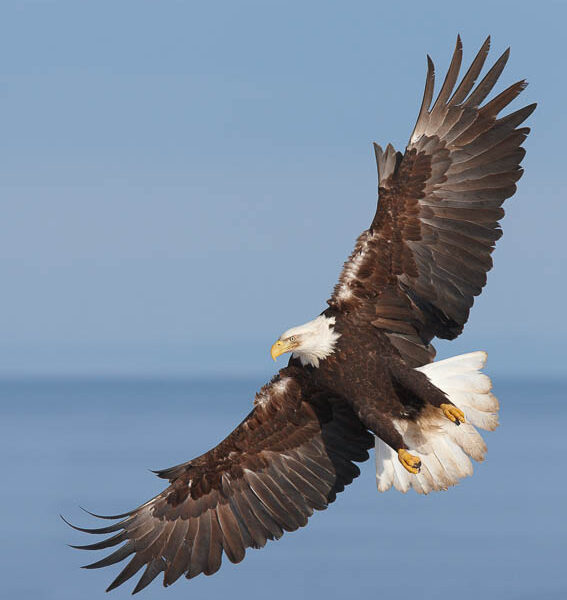
This photo of a bald eagle (Haliaeetus leucocephalus) is quite simply composed but was not quite so simple to execute. The wind was blowing steadily parallel to the sun angle which led to the eagles banking and circling in front of me. But often the underside of the wings were not fully illuminated, or worse, the bird’s gaze was directed a bit too far out of the frame. I’m happy I got one shot where the light, bird and focus all lined up nicely. And room for text as well. :)

Bald eagle in flight, wing spread, soaring., Haliaeetus leucocephalus, Haliaeetus leucocephalus washingtoniensis,  Copyright Phillip Colla, image #22604, all rights reserved worldwide.
Bald eagle in flight, wing spread, soaring. Kachemak Bay, Homer, Alaska, USA.
Image: 22604  
Species: Haliaeetus leucocephalus, Haliaeetus leucocephalus washingtoniensis
Location: Kachemak Bay, Homer, Alaska, USA
Click To View This Location in Google Earth.  You must have Google Earth installed for this feature to work correctly. View this Image in Google Earth!


A few more photos of bald eagles will be posted in coming days then onto something else!

Bald Eagle on the Beach, Alaska

View This Blog Post in Google Earth (How Cool Is That?)  View this blog entry in Google Earth
Latitude: 59° 35' 59.56" N, Longitude: 151° 24' 57.7" W, Coord: 59.59988°, -151.41603°
Filed under: Alaska, Bald Eagle on 4/6/2009

See the new bald eagle photos.

This adult bald eagle (Haliaeetus leucocephalus) was observed foraging for bits of food in a shallow tidal stream on a broad sand beach. The bits of white in the air are snowflakes — it was a wet snow and made the eagle look pretty miserable.

Bald eagle forages in tide waters on sand beach, snow falling., Haliaeetus leucocephalus, Haliaeetus leucocephalus washingtoniensis,  Copyright Phillip Colla, image #22609, all rights reserved worldwide.
Bald eagle forages in tide waters on sand beach, snow falling. Kachemak Bay, Homer, Alaska, USA.
Image: 22609  
Species: Haliaeetus leucocephalus, Haliaeetus leucocephalus washingtoniensis
Location: Kachemak Bay, Homer, Alaska, USA
Click To View This Location in Google Earth.  You must have Google Earth installed for this feature to work correctly. View this Image in Google Earth!


More bald eagle photos from my recent trip to Homer will be posted in the coming days.

Bald Eagle Landing, Alaska

View This Blog Post in Google Earth (How Cool Is That?)  View this blog entry in Google Earth
Latitude: 59° 35' 59.56" N, Longitude: 151° 24' 57.7" W, Coord: 59.59988°, -151.41603°
Filed under: Alaska, Bald Eagle on 4/5/2009

See the new bald eagle photos.

A large group of bald eagles (Haliaeetus leucocephalus) was gathered on the snow-covered ground when periodically another eagle would arrive, in flight, and join the group by skimming just over their heads, slowing with wings outstretched, finding a suitable spot amid the crush, and landing with talons scratching across the ice and a clash of raised wings. I got this shot by laying down on the snow directly upwind and waiting for one eagle to land into the wind right at me. I crossed my fingers that the focus on the camera would work. It did.

Bald eagle spreads its wings to land amid a large group of bald eagles., Haliaeetus leucocephalus, Haliaeetus leucocephalus washingtoniensis,  Copyright Phillip Colla, image #22588, all rights reserved worldwide.
Bald eagle spreads its wings to land amid a large group of bald eagles. Kachemak Bay, Homer, Alaska, USA.
Image: 22588  
Species: Haliaeetus leucocephalus, Haliaeetus leucocephalus washingtoniensis
Location: Kachemak Bay, Homer, Alaska, USA
Click To View This Location in Google Earth.  You must have Google Earth installed for this feature to work correctly. View this Image in Google Earth!


More bald eagle photos from my recent trip to Homer will be posted in the coming days.

Two Bald Eagles on a Perch, Alaska

View This Blog Post in Google Earth (How Cool Is That?)  View this blog entry in Google Earth
Latitude: 59° 35' 59.56" N, Longitude: 151° 24' 57.7" W, Coord: 59.59988°, -151.41603°
Filed under: Alaska, Bald Eagle on 4/4/2009

See the new bald eagle photos.

There were several perches that the bald eagles (Haliaeetus leucocephalus) would use each morning. The broad wooden perches could typically accomodate several eagles each. In this image the eagle on the left, which has been on the perch for a while, throws its head back and vocalizes at the sudden appearance of the eagle on the right which has just landed and is finding its balance with wings outstretched.

Two bald eagles on perch, one with wings spread as it has just landed and is adjusting its balance, the second with its head thrown back, calling vocalizing., Haliaeetus leucocephalus, Haliaeetus leucocephalus washingtoniensis,  Copyright Phillip Colla, image #22583, all rights reserved worldwide.
Two bald eagles on perch, one with wings spread as it has just landed and is adjusting its balance, the second with its head thrown back, calling vocalizing. Kachemak Bay, Homer, Alaska, USA.
Image: 22583  
Species: Haliaeetus leucocephalus, Haliaeetus leucocephalus washingtoniensis
Location: Kachemak Bay, Homer, Alaska, USA
Click To View This Location in Google Earth.  You must have Google Earth installed for this feature to work correctly. View this Image in Google Earth!


More bald eagle photos from my recent trip to Homer will be posted in the coming days.

Two Bald Eagles in Flight, Alaska

View This Blog Post in Google Earth (How Cool Is That?)  View this blog entry in Google Earth
Latitude: 59° 35' 59.56" N, Longitude: 151° 24' 57.7" W, Coord: 59.59988°, -151.41603°
Filed under: Alaska, Bald Eagle on 4/3/2009

See the new bald eagle photos.

Having over 200 bald eagles (Haliaeetus leucocephalus) nearby would seem to make it easy to gather a variety of photos. But I was tempted to shoot the same few compositions repeatedly and had to make an effort to look for different compositions and angles to ensure I did not end up with a 100 versions of the same shot when I finally got home. The sun came out two mornings and offered the opportunity of really strong, well lit flight shots. So, for a few hours on each of those mornings, I concentrated on flight shots only. It was easy to shoot single birds but shooting an appealing image with multiple eagles was considerably more difficult. This is one of the frames I was happiest with:

Two bald eagles in flight, wings spread, soaring, aloft., Haliaeetus leucocephalus, Haliaeetus leucocephalus washingtoniensis,  Copyright Phillip Colla, image #22590, all rights reserved worldwide.
Two bald eagles in flight, wings spread, soaring, aloft. Kachemak Bay, Homer, Alaska, USA.
Image: 22590  
Species: Haliaeetus leucocephalus, Haliaeetus leucocephalus washingtoniensis
Location: Kachemak Bay, Homer, Alaska, USA
Click To View This Location in Google Earth.  You must have Google Earth installed for this feature to work correctly. View this Image in Google Earth!


More bald eagle photos from my recent trip to Homer will be posted in the coming days.

Bald Eagle and Kenai Mountains, Alaska

View This Blog Post in Google Earth (How Cool Is That?)  View this blog entry in Google Earth
Latitude: 59° 35' 59.56" N, Longitude: 151° 24' 57.7" W, Coord: 59.59988°, -151.41603°
Filed under: Alaska, Bald Eagle, Wildlife on 3/31/2009

See the new bald eagle photos.

During two of the mornings that I was in Homer, I was fortunate to be inside Jean Keane’s yard as the bald eagles (Haliaeetus leucocephalus) gathered to eat herring. This was quite something, to be so close to so many eagles. Unnatural perhaps, as the eagles were being fed, but fun and impressive nonetheless. The sounds of the large birds, vocalizing just a few feet away from me, their talons scratching on the ice as they landed to take fish, squawking at each other as they jostled for space — it was really memorable. This photo was taken on one of those mornings. The eagle is lit from the side, not optimal for photography but it is what it is. I spent most of that morning trying to frame up an eagle with the snow covered Kenai Mountains in the background, and found that it was harder to do that I anticipated. This is the one I found most appealing.

Bald eagle in flight, sidelit, cloudy sky and Kenai Mountains in the background., Haliaeetus leucocephalus, Haliaeetus leucocephalus washingtoniensis,  Copyright Phillip Colla, image #22596, all rights reserved worldwide.
Bald eagle in flight, sidelit, cloudy sky and Kenai Mountains in the background. Kachemak Bay, Homer, Alaska, USA.
Image: 22596  
Species: Haliaeetus leucocephalus, Haliaeetus leucocephalus washingtoniensis
Location: Kachemak Bay, Homer, Alaska, USA
Click To View This Location in Google Earth.  You must have Google Earth installed for this feature to work correctly. View this Image in Google Earth!


More bald eagle photos from my recent trip to Homer will be posted in the coming days.

Juvenile Bald Eagle, Alaska

View This Blog Post in Google Earth (How Cool Is That?)  View this blog entry in Google Earth
Latitude: 59° 35' 59.56" N, Longitude: 151° 24' 57.7" W, Coord: 59.59988°, -151.41603°
Filed under: Alaska, Bald Eagle, Wildlife on 3/30/2009

See the new bald eagle photos.

This is a juvenile bald eagle (Haliaeetus leucocephalus). The speckled brown and white coloration is highly variable among juvenile bald eagles which can sometimes resemble golden eagles. It is typically not until the fourth year that juveniles mature and assume the characteristic brown body and white head of the adult bald eagle.

Juvenile bald eagle, second year coloration plumage, closeup of head and shoulders, looking directly at camera, snowflakes visible on feathers.    Immature coloration showing white speckling on feathers., Haliaeetus leucocephalus, Haliaeetus leucocephalus washingtoniensis,  Copyright Phillip Colla, image #22589, all rights reserved worldwide.
Juvenile bald eagle, second year coloration plumage, closeup of head and shoulders, looking directly at camera, snowflakes visible on feathers. Immature coloration showing white speckling on feathers. Kachemak Bay, Homer, Alaska, USA.
Image: 22589  
Species: Haliaeetus leucocephalus, Haliaeetus leucocephalus washingtoniensis
Location: Kachemak Bay, Homer, Alaska, USA
Click To View This Location in Google Earth.  You must have Google Earth installed for this feature to work correctly. View this Image in Google Earth!


More bald eagle photos from my recent trip to Homer will be posted in the coming days.

Photographing Bald Eagles in Homer, Alaska

Filed under: Alaska, Bald Eagle, How To, Photography, Wildlife on 3/29/2009

Photographing Bald Eagles in Homer AK — What Worked and What Didn’t

Bald eagle in flight, banking over beach with Kachemak Bay in background., Haliaeetus leucocephalus, Haliaeetus leucocephalus washingtoniensis,  Copyright Phillip Colla, image #22613, all rights reserved worldwide.
Bald eagle in flight, banking over beach with Kachemak Bay in background. Kachemak Bay, Homer, Alaska, USA.
Image: 22613  
Species: Haliaeetus leucocephalus, Haliaeetus leucocephalus washingtoniensis
Location: Kachemak Bay, Homer, Alaska, USA
Click To View This Location in Google Earth.  You must have Google Earth installed for this feature to work correctly. View this Image in Google Earth!


If you have seen much of this web site, you probably know that I gravitate toward subjects that have some connection to the ocean. I have tried my hand at photographing birds, most notably pelicans since they are so accessible to me, but for the most part bird photography is so maddeningly difficult that I avoid it. Recently, though, I decided to try photographing bald eagles (Haliaeetus leucocephalus) in Homer, Alaska. Bald eagles inhabit much of North America, including the scenic coastal areas of the Pacific Northwest, which offers the connection to the ocean that I seek. Homer in particular has a large wintertime population of eagles, so they are quite easy to photograph. I offer some comments about what worked for me, and what did not, from an experienced photographer’s point of view. Note that I do not consider myself a true bird photographer, which is an important distinction as bird photographers tend to have a perspective about photography, and bird images, that I do not share. I joined Charles Glatzer’s workshop in Homer, which was a new experience for me. In 20 years of photography I have never had any instruction, so it was great to have access to Chas and his technical knowledge. I asked him a lot of questions and received insightful answers to each, and had fun with the other workshop participants the entire time.

A Bit of History

For some time I have seen great photos of bald eagles that were taken in Homer. It seems the really skilled bird photographers have spent time there photographing eagles. Indeed, I have heard on several occasions that a large percentage of published bald eagle photos were taken in Homer. Naturally, there is a good explanation for this.

Since about 1977, Jean Keene fed bald eagles beside the trailer where she lived on the Homer Spit, primarily in the winter. Her offerings of frozen herring led to a reliable gathering of bald eagles during these months, sometimes hundreds on a given morning, as the eagles grew to anticipate and rely on this source of food. Photographers have long known of this gathering and have exploited it to produce superb images of bald eagles. In 2006 the Homer city council adopted a regulation forbidding anyone from feeding the eagles, with the exception that Jean Keane was permitted to continue feeding through 2010. When Ms. Keene passed away in January 2009, her friend Steve Tarola was authorized to continue feeding the eagles in her stead through the end of March 2009, at which point (presumably) no further feeding will be permitted. This change will almost certainly bring about a profound change in the way bald eagles utilize the Homer area in winter, probably resulting in a winter dispersal of the eagles that must now forage for their own food in a more natural way. I think the days of easy eagle photography in Homer are over.

Cameras and Lenses

I am currently using a Canon 1Ds Mark III as my primary camera, with a 1Ds Mark II as a close alternate, full-frame bodies both. Occasionally I use a 50D, but I have found it difficult to use and am preparing to sell it.

I am aware of the online discussions about the effectiveness of the autofocus in the Canon Mark III bodies (1D and 1Ds both). While I had plenty of images that did not have the critical focus on the eye that I try to achieve, I was happy with the number of truly sharp images I did produce. Honestly, if I shoot 10 really strong images on a trip like this, the effort is a success. I am not sure where I fit into the experience of Canon users when it comes to the AF challenges that bird photography offers, but I am not about to switch camera brands anytime soon, being pretty happy with the gear I use at present.

Eagles are, relative to most birds, rather slow moving and thus easy to track with a camera, especially once one has factored in the angle of the wind and their reasons for approach (e.g., perch or food). The Canon AF locked onto the birds in flight quite well. Sometimes the first or second image in a sequence would be soft, but it would usually snap into sharp focus by the third image. Occasionally, in heavily overcast light or when it was snowing, the low contrast caused the AF system to respond sluggishly. But in full sun with strong contrast the AF was pretty good. I typically use center-point with nine-point expansion when shooting birds in flight. For static subjects, the AF performance of the 1DsIII and 1DsII bodies was excellent as usual, producing images that are so sharp it hurts, a testiment to the razor optics of the 500mm and 300mm prime lenses. For static subjects I use single point but I move it about to place it on the subject’s eye.

The most useful lenses for the compositions I was seeking were the 300 f/2.8 (with and without 1.4x teleconverter) and 70-200 f/4. The former was most useful for shooting the morning feedings, with the quality of the 300/1.4x combination proven to be excellent provided my technique was suitably rigorous. In particular, full-body flight images were best with the 1.4x converter in place, while images in which the eagles were spreading their wings to land on nearby perches were best without the converter. On the two mornings when I was invited to shoot from within Ms. Keane’s yard, the 70-200 worked best as the birds and perches were so close that anything longer was unable to frame an entire bird.

While shooting eagles hitting fish on the water, which we did from small boats, the 70-200 and 300 were both equally useful, and we could easily compensate for which lens we would choose to use by how far from the boat we tossed the fish. I prefer the look of the 300, but the group was using 70-200 most of the time so I did as well, and the images with that lens are pretty good.

On a few occasions I used a 500mm f/4 lens, primarily to produce tight images of eagles on perches, taking fish off the ground or together in dense groups. I often clipped wings with this long focal length, but this was by design. Indeed, the bald eagle is what Galen Rowell referred to as a “mature subject”, one the viewer is quite familiar with from years of seeing basic images of it. For this reason, images of portions of bald eagles can often be highly effective, whereas this is not as often the case with subjects that are unfamiliar to the viewer.

For head shots, I used a 500/1.4x combination from Jean’s yard. These were shot at virtually the lens’ minimum focus distance. Stopping down to f/11 with this combo produced critically sharp images. In fact, the f/11 was not so much for depth of field, which is notoriously shallow at such long focal lengths and near distances, but rather to produce adequate sharpness, since the 500/1.4x combo is not sharp enough in my opinion at f/5.6 or f/8. (The 500 alone is, of course, crazy sharp even wide open.)

Autofocus seemed to perform reasonably well, at least as much as I have experienced with other bird subjects. My criteria for keeping a bird photo is that the eye be razor sharp. If it is not, there must be something quite compelling about the image to justify keeping it, which is uncommon. I shot about 8000 images during six days of photography of eagles, about 75% of them flight images (the most demanding and enjoyable kind). I have kept about 175 images for my files, which is a keeper rate of about 2%. I have plenty of images that look great in Breezebrowser based on the jpg embedded in the raw file but that, upon checking the critical focus at 100% with capture sharpening in place, are not up to snuff. These get tossed. I could keep these images and restrict them to web use or 1/4 or 1/2 page reproduction but for now I am discounting them.

What Worked: 1DsIII, 1DsII, 300, 70-200.
What Didn’t Work: 500 (too long)

Lighting

Much of the time the light was overcast, or heavily overcast with falling snow. These are tough conditions in which to shoot a pleasing photo, but it can be done, and the falling snow can really add a special mood to the image. But the exposure must be done right, and the image must be treated properly in the raw converter, bring up shadows to expose detail but not so much as to be unnatural. This last part is a fine line. Many digital photographers are quite agressive about bringing up shadows, either in the raw conversion or in Photoshop, using a variety of tools, but the results can be unsettling. Its highly subjective and I guess all I can say is that, for photos where too much shadow lightening has been done, “I’ll know it when I see it”. With low light or flat light situations, it helps to have enough confidence in your camera that you can shoot with a high ISO, such as 800 or more. Here the 1Ds Mark III really shone, the high ISO images are clean and sharp. Not so with the 50D. I shot about 800 images with the 50D. What I found most lacking about these was how poorly the 50D performed in overcast light. Exposing properly to the right (biasing as much of the exposure to the right of the histogram as sensible, to better separate detail from noise in the darker areas of the image when converting the image later), the 1DsIII was able to produce many quality images in flat and snow-filled lighting with proper treatment in the raw converter. However, I was not able to pull the same quality from the 50D files. The noise in the 50D files was simply too much.

What Worked: Heavy overcast (snowing), light overcast, clear with thin high clouds
What Didn’t Work: Direct sun (except when bird is in perfect sun angle), 50D

Batteries

I found that the 1Ds Mark III batteries lasted phenomenally in the cold (8-15 degree) conditions, much longer than the Mark II batteries. This was a pleasant surprise. I did not have to change batteries on my 1Ds III once while in the middle of shooting, in fact only had to change it twice all week during lulls in the action. I estimate getting 1000+ frames and still having 1/3 or 1/2 charge left in each of my 1Ds Mark III batteries, in temps below 10 degrees.

What Worked: 1DsIII batteries

Flash

One of the reasons I decided to visit Homer as part of Charles Glatzer’s workshop was to learn how to use flash on manual control for wildlife subjects. I’ve never been entirely happy with relying on the camera’s metering system to guage the amount of flash to emit, especially in situations where the background was changing often. During my underwater shooting, I always employed manual strobe control with good results. However, the exposures underwater tended to be pretty easy to determine, falling into a narrower range than what is encountered above water. I have always been a great admirer of Chas’ photography, and am happy to learn what I can from a photographer and teacher such as he. I have a four week trip later this year that will involve a lot of overcast lighting, and I want to feel confident using manual flash, so joining Chas seemed like a good chance to learn from him and shoot some photos of eagles at the same time. After a couple discussions with Chas about how he determines the proper flash power to use as shooting situations chang, I realized his approach was quite intuitive. I set about putting my 580 EX flash into play in the way he described, controlling lighting ratios by dialing the output of the flash manually to produce fill (-1 or -2 stops) or main light (0 or +1) the eagles. On overcast days I used the flash in this way on virtually every shot, including flight and fish-grab shots at high shutter speeds, and was pleased with the results. The color in the shadowed areas was much better when flash fill was used than in those using only available overcast light. Additionally, as Chas described, the consistency of the lighting from frame to frame was excellent when controlling the flash output manually. This was particularly evident when photographing eagles grasping fish from the water. The distance to the eagle was essentially constant (controlled by us) and thus the lighting of the underside of the eagle and its wings was quite consistent in spite of vastly changing backgrounds which would have probably fooled the camera’s meter.

What Worked: 580 EX flash, Better Beamer on Wimberly head and strobe bracket, manual control

Tossing Fish

In the past, photographers realized that by throwing frozen fish to the eagles gathered on the Homer spit, they could create amazing photos of eagles in flight ripping fish out of the water. With the Homer ban on feeding, this practice ended — within the city limits of Homer. However, John Wright found a couple boat captains who were happy to take us outside of Homer to try tossing fish to eagles. Since the mornings were spent photographing eagles at the feeding at Jean Keene’s trailer, we used the afternoons for tossing fish. It was a blast watching the eagles leave their tree perches high up the tall mountainsides above us, drop down to the water, swoop in with wind audibly rushing over their wings and pick a fish out of the water with their talons. The light was not the greatest though. During four afternoons on the boat, with largely overcast skies, we got a few brief breaks with good light and I managed to pick off a few nice shots of fishing eagles one at a time. Persistence pays off or, as I prefer, “Even a blind squirrel sometimes finds a nut.”

What Worked: herring, 70-200, manual flash

Geek Stuff

If that above info is not already too much geeky detail for you, read on my man for the geekiest info is yet to come…

I plan on generating many many images on a trip later this year. Four weeks of images. Which presents a problem: how to store all of those. I’ve tried using Hyperdrive’s, which are pretty nifty but don’t offer the ability to critically review the images. Plus, they are relatively expensive per GB of storage. So I had to come up with a new approach, and used the Homer trip as a test run. I picked up an ultra-lightweight Sony VAIO VGN-Z series notebook computer. It is tiny — with a 13″ screen and weighing just 3.3 lbs, I don’t even notice that it is in my backpack — but is powerful enough for me to review a day’s worth of shooting with Lightroom, converting some of the images and storing them on the computer’s main drive for further redundancy. The drive on the notebook is not for primary photo storage however — that’s what the three external drives are for. Three external drives you say? That sounds nuts. But the Seagate Freeagent Go 500gb drives are ultra tiny and light, occupying hardly any space in my carryon. Each stores 500GB of files, which is a LOT of space for photos, even the enormous raw files generated by a 1Ds Mark III. The drives are powered by the USB connection with the notebook, which means I do not have to carry power supplies for them. Three of them offer triple redundancy. The system worked great in Homer.

When first researching how I would backup images in the field, I originally considered buying a “netbook”. These low-powered, web-targeted computers are really inexpensive, small and light, but they are primarily intended for apps that do not require much in the way of compute power: email, web browsing, word processing, Facebook. Netbooks do not offer enough compute power to run Lightroom or Photoshop on large raw files. So I did not consider a netbook a viable choice, which is why I went with the lightest, reasonably powered notebook I could find.

The weak link in this backup system is the computer — what if it dies? In that case, the external drives cannot be used on the remainder of the trip, but the images that are already on them can be accessed once back home. In a pinch, someone else’s notebook can be used for downloading from flash card to external drive, but I prefer not to rely on someone else’s gear if I can avoid it. So, in the event the computer dies, I still bring two Hyperdrives with 250 GB, wrapped in bubble wrap and placed in my checked luggage. That’s a pretty good backup to my backup. I do not care to risk losing the images that I have gone to so much trouble to make.

What worked: Sony VAIO Z-series laptop, Seagate Freeagent Go 500GB drives, Hyperdrives

Kenai Mountains and Kachemak Bay, Alaska

View This Blog Post in Google Earth (How Cool Is That?)  View this blog entry in Google Earth
Latitude: 59° 35' 58.73" N, Longitude: 151° 24' 56.77" W, Coord: 59.59965°, -151.41577°
Filed under: Alaska, Landscape, Panoramas, Photography on 3/25/2009

I was up north in Homer, Alaska to photograph bald eagles (Haliaeetus leucocephalus), but I grabbed a couple landscape shots of the beautiful Kenai Mountains, which lie across Kachemak Bay from the Homer Spit. This was my view one morning, after the clouds and snow had cleared out leaving blue skies and bitterly cold temperatures. It is a panorama, click it to see it larger.

Kenai Mountains at sunrise, viewed across Kachemak Bay.,  Copyright Phillip Colla, image #22739, all rights reserved worldwide.
Kenai Mountains at sunrise, viewed across Kachemak Bay. Kachemak Bay, Homer, Alaska, USA.
Image: 22739  
Location: Kachemak Bay, Homer, Alaska, USA
Click To View This Location in Google Earth.  You must have Google Earth installed for this feature to work correctly. View this Image in Google Earth!


Also see our bald eagle photos.

Flip Flops

View This Blog Post in Google Earth (How Cool Is That?)  View this blog entry in Google Earth
Latitude: 59° 35' 59.56" N, Longitude: 151° 24' 57.7" W, Coord: 59.59988°, -151.41603°
Filed under: Alaska, Bald Eagle, Wildlife on 3/13/2009
Bald eagle in flight, sidelit, cloudy sky and Kenai Mountains in the background., Haliaeetus leucocephalus, Haliaeetus leucocephalus washingtoniensis,  Copyright Phillip Colla, image #22596, all rights reserved worldwide.
Bald eagle in flight, sidelit, cloudy sky and Kenai Mountains in the background. Kachemak Bay, Homer, Alaska, USA.
Image: 22596  
Species: Haliaeetus leucocephalus, Haliaeetus leucocephalus washingtoniensis
Location: Kachemak Bay, Homer, Alaska, USA
Click To View This Location in Google Earth.  You must have Google Earth installed for this feature to work correctly. View this Image in Google Earth!


OK, I’ve been running since I was thirteen. That’s 32 years of running. I’m not a skinny guy, which means I’ve been pounding my feet, heavily, for a long time. The nerves in my toes are now so sensitive that its hard for me to wear shoes for long. Which is why I always wear flipflops. (Unless I have to go to a wedding, and then I still try to wear them but rarely get away with it. I have to go to a wedding in a week, and I’ll try again but I am not optimistic. If I was single I could probably pull it off.) However, never before have my flipflops caused so much apparent consternation as they did flying up to Homer. The further north I got, the more incredulous people seemed to be. Come on folks, it might be snowing outside but remember we are INSIDE all day, either inside the plane, inside the terminal or inside the corridor between the plane and the terminal. Inside, inside, inside. Flipflips make strategic sense at the security checkpoint too. And yet, I was asked about 10 times “You shore yore going to the raht place with those shoes?” From Seattle north, everywhere I went people that noticed my lucky flipflops — every California guy has a pair of lucky flipflops that he saves for special occasions, mine are for travel and nice restaurants — had but one reaction: shake the head sadly, look down to avoid making eye contact and mutter something under the breath. OK, I get it, I’m supposed to wear snow boots, jeans, thick jacket and Anchorage Equipment Rentals ballcap. Well, maybe next trip, this trip I’m going with flipflops until I have to go outside.

Check out bald eagle photos.

Secondary Inspection

View This Blog Post in Google Earth (How Cool Is That?)  View this blog entry in Google Earth
Latitude: 59° 35' 59.56" N, Longitude: 151° 24' 57.7" W, Coord: 59.59988°, -151.41603°
Filed under: Alaska, Bald Eagle, Wildlife on 3/12/2009
Bald eagle, closeup of head and shoulders showing distinctive white head feathers, yellow beak and brown body and wings., Haliaeetus leucocephalus, Haliaeetus leucocephalus washingtoniensis,  Copyright Phillip Colla, image #22582, all rights reserved worldwide.
Bald eagle, closeup of head and shoulders showing distinctive white head feathers, yellow beak and brown body and wings. Kachemak Bay, Homer, Alaska, USA.
Image: 22582  
Species: Haliaeetus leucocephalus, Haliaeetus leucocephalus washingtoniensis
Location: Kachemak Bay, Homer, Alaska, USA
Click To View This Location in Google Earth.  You must have Google Earth installed for this feature to work correctly. View this Image in Google Earth!


Going to try my hand at photographing some bald eagles in the cold. Up at 4am, shower, throw the bags in the car, down I-5 to the airport, drop the car at the lot, shuttle to the terminal. At the ticket counter manage to score a seat in an row by myself, all is looking good for a day of travel! Get to the security checkpoint, the line is never very long at such an early hour, so I get to the security x-ray guy who motions me through. And, as always, the x-ray guy sees all the metal, electronics and leaded glass in my camera backpack and calls out “hand inspection please”. OK, this always happens, no problem, it will just take two minutes while they swab my gear and put the sensor swab in the computer to check for bad stuff, nothing there, pick up the cameras and look them over, place them back in the bag and tell me to have a great flight. Only this time, the alarm goes OFF. What? No problem, just check it again, must be a malfunction. The guy checks it again, fresh swab and BEEP BEEP BEEP. More alarms. OK, what the hell? Inspector Detector, giving me the half-smile-half-frown that he and all his buds learn in security inspector school, says please wait here. A few minutes later Senior Inspector Detector arrives, and they proceed to swab my gear three more times, each time setting off the alarms. By this time the crowd is checking me out, alarm guy. Oh, isn’t that special, there’s a red light that flashes with the alarm. Nervous? Hell yeah I’m nervous, I’m going to miss my flight. I’m going to have to call Tracy at 5am from some FAA cell and tell her I need a lawyer well versed in FAA-speak. This goes on for what seems like 20 minutes. I’m doing my breath exercises trying to calm my chi and get into the zen and tune all this out. It’s not working. I know these guys are going to send me to Abu Gharab or Guantanamo or something. At least Bush is not in charge anymore, so there is a limit to how bad this can get. Finally, Super Senior Master Inspector Detector arrives, suggests that perhaps the machine is malfunctioning and let’s try testing the gear at the next station. Holding my breath as they swab my gear yet again, I wait for the verdict. Alarms? Lights? Nope just “have a nice flight.” Wow, no flowers? Not even going to buy me dinner? Not sure how I am supposed to feel after that special experience.

Check out bald eagle photos.

Photo of a Brown Bear Digging For Clams

View This Blog Post in Google Earth (How Cool Is That?)  View this blog entry in Google Earth
Latitude: 59° 59' 27.21" N, Longitude: 152° 38' 21.06" W, Coord: 59.990892°, -152.63919°
Filed under: Alaska, Brown Bear, Lake Clark, National Parks, Photo of the Day, Wildlife on 8/27/2007

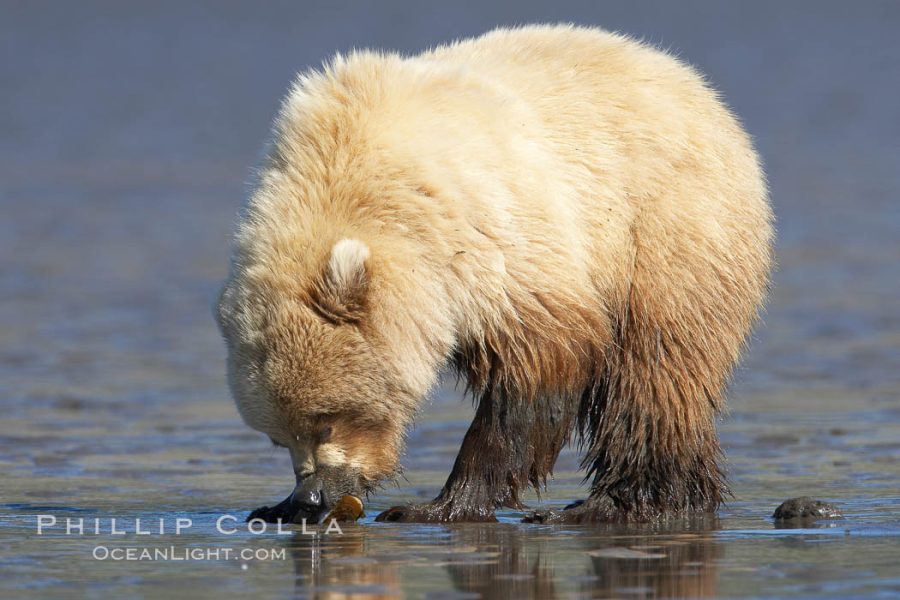
One of the interesting behaviors of coastal brown bears (Ursus arctos) is their interest in eating razor clams. Negative low tides expose broad tide flats along the Cook Inlet coast. Brown bears are quite tuned to the timing of these low tides and will arrive at the beach shortly before the tide flats are exposed. Working alone, each bear will sniff around and look for clam vents in the sand before digging up a razor clam and eating it, repeating the process for hours.

Coastal brown bear forages for razor clams on mud flats at extreme low tide., Ursus arctos,  Copyright Phillip Colla, image #19224, all rights reserved worldwide.
Coastal brown bear forages for razor clams on mud flats at extreme low tide. Lake Clark National Park, Alaska, USA.
Image: 19224  
Species: Ursus arctos
Location: Lake Clark National Park, Alaska, USA
Click To View This Location in Google Earth.  You must have Google Earth installed for this feature to work correctly. View this Image in Google Earth!


Standing Tall

View This Blog Post in Google Earth (How Cool Is That?)  View this blog entry in Google Earth
Latitude: 60° 1' 29.03" N, Longitude: 152° 37' 41.49" W, Coord: 60.024731°, -152.62819°
Filed under: Alaska, Brown Bear, Lake Clark, National Parks, Photo of the Day, Wildlife on 8/18/2007

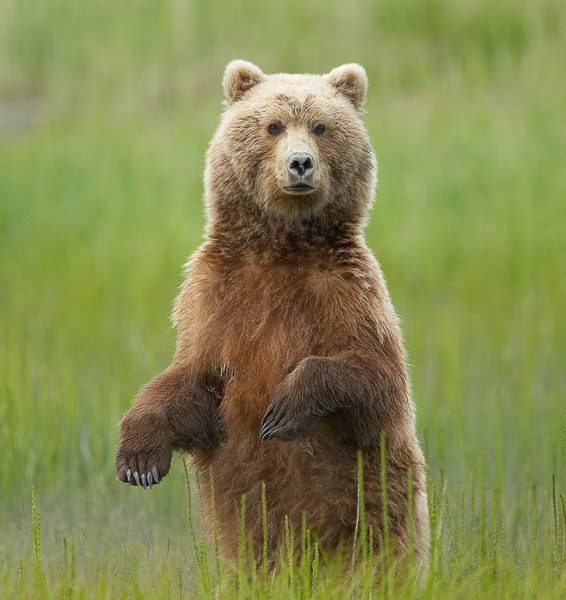
This coastal brown bear sow caught the scent of an approaching adult male. Nervous for her cubs, who could be attacked by the male, she stands in the deep sedge grass to get a better look around.

A brown bear mother (sow) stands in tall sedge grass to look for other approaching bears that may be a threat to her cubs., Ursus arctos,  Copyright Phillip Colla, image #19139, all rights reserved worldwide.
A brown bear mother (sow) stands in tall sedge grass to look for other approaching bears that may be a threat to her cubs. Lake Clark National Park, Alaska, USA.
Image: 19139  
Species: Ursus arctos
Location: Lake Clark National Park, Alaska, USA
Click To View This Location in Google Earth.  You must have Google Earth installed for this feature to work correctly. View this Image in Google Earth!


Silver Salmon Creek Lodge, Lake Clark National Park, Alaska

View This Blog Post in Google Earth (How Cool Is That?)  View this blog entry in Google Earth
Latitude: 59° 59' 18.61" N, Longitude: 152° 39' 31.84" W, Coord: 59.988503°, -152.65885°
Filed under: Alaska, Brown Bear, How To, Lake Clark, National Parks, Wildlife on 8/16/2007

In 2005 I received a recommendation to visit Silver Salmon Creek Lodge to see bears. I already had a trip planned to Brooks Camp so I didn’t look into SSCL for a while. A week at Brooks in July 2006, with superb weather, company and bears, helped me to realize that I enjoyed the “Alaska thing” much more than I had anticipated. I was eager to do it again. About the same time we were put on notice that we might be making a family trip in Alaska in 2008, complete with cousins, grandparents, aunts and uncles. If indeed we were making the effort of taking the kids to Alaska, it was inconceivable to me that we would not include a good close look at coastal brown bears (Ursus arctos) in the wild. Brooks Camp was a known quantity at this point, and while it would be ok for my family it was not ideal; the younger kids would get bored waiting on the viewing platforms and the crowds that Brooks Camp attracts (lodge, campers and day visitors alike) conflicted with the quieter experience I wanted Tracy and the kids to have their first time in Alaska. I needed to find an alternative place to take them. I got in touch with David Coray, longtime owner of Silver Salmon Creek Lodge, and arranged to spend a week there in July 2007. I had a great time.

Silver Salmon Creek Lodge, spruce trees and Chigmit Range.,  Copyright Phillip Colla, image #19064, all rights reserved worldwide.
Silver Salmon Creek Lodge, spruce trees and Chigmit Range. Lake Clark National Park, Alaska, USA.
Image: 19064  
Location: Lake Clark National Park, Alaska, USA
Click To View This Location in Google Earth.  You must have Google Earth installed for this feature to work correctly. View this Image in Google Earth!


Silver Salmon Creek Lodge, part of a private parcel of 160 acres in Lake Clark National Park, lies at the edge of a spruce forest and is fronted by broad flat sedge grass meadows. The view from the lodge is wonderful: the meadows stretch left and right several miles and out about a half mile, beyond which are the sandy beaches and tide flats of Cook Inlet. Tidal sloughs slice across the meadows in many places. About a mile to the south lies Silver Salmon Creek, while three miles to the north is Johnson River. Both of the rivers open directly to Cook Inlet and are host to runs of spawning salmon in late summer. Bears constantly stroll about the meadows while bald eagles can be seen often flying or perched on trees. A short distance behind the lodge, through the trees, is a large pond covered with lilies and surrounded by green peaks with patches of snow. Access to Silver Salmon Creek Lodge is by plane or boat only, and the vast majority of visitors come by air. Those arriving on float planes will land on the pond while those coming on wheeled planes land on the beach.

Brown bears graze among sedge grass meadows at Silver Salmon Creek Lodge.,  Copyright Phillip Colla, image #19067, all rights reserved worldwide.
Brown bears graze among sedge grass meadows at Silver Salmon Creek Lodge. Lake Clark National Park, Alaska, USA.
Image: 19067  
Location: Lake Clark National Park, Alaska, USA
Click To View This Location in Google Earth.  You must have Google Earth installed for this feature to work correctly. View this Image in Google Earth!


On a clear Sunday morning I met our pilot Mark Madura at Lake Hood, along with five fellow guests also spending the week at the lodge: John, Kent and Jenny, father, son and daughter who were set to fish Silver Salmon Creek and Copper River, and Dennis and Denny, father and son who were planning to shoot photos like myself. After an hour in the air Mark announced we would be waylaid by thick clouds over the lodge and could not land, so he landed on a pond at Homer, told us to cross our fingers for a change in the weather and set us free onshore to kill some time at the local brewery while he topped off the fuel and waited for word from David that all was clear to land. This turned out to be a fortunate diversion as we got a chance to get to know another a bit and buy a bunch of growlers of Homer Brewing Company’s finest to take with us. After a lunch of bratwurst and onion rings, we squeezed the beer in the few remaining bits of room on the plane and took off again, spotted a few whales crossing Cook Inlet, had a magnificent view of Mt. Redoubt rising above the clouds, and finally landed on the lily-covered pond behind the lodge.

Float plane, water lilies and pond lie beneath the Chigmit Range near Silver Salmon Creek.,  Copyright Phillip Colla, image #19092, all rights reserved worldwide.
Float plane, water lilies and pond lie beneath the Chigmit Range near Silver Salmon Creek. Lake Clark National Park, Alaska, USA.
Image: 19092  
Location: Lake Clark National Park, Alaska, USA
Click To View This Location in Google Earth.  You must have Google Earth installed for this feature to work correctly. View this Image in Google Earth!


Naturally, before bothering to see if my cameras, clothes and money had arrived on the other plane, I had to check out the kitchen and dining room. I’ve learned from many liveaboard boat trips that the cook and his menu are crucial to the success of the trip! As luck would have it chef Steve had saved some lunch for us latecomers. I will state without reservation that mealtime at Silver Salmon Creek Lodge is superb. The view from the dining room is beautiful. David’s daughter Dorian makes her baked treats fresh daily, the veggies come from the lodge’s own garden and the fish that is served is from the river and ocean one sees right out the window. The clams are the same ones the bears are after! It is all delicious and served in generous quantities. I ate really well and put on a few well-earned pounds. OK, enough said.

Kitchen and chef Steve, Silver Salmon Creek Lodge.,  Copyright Phillip Colla, image #19070, all rights reserved worldwide.
Kitchen and chef Steve, Silver Salmon Creek Lodge. Lake Clark National Park, Alaska, USA.
Image: 19070  
Location: Lake Clark National Park, Alaska, USA
Click To View This Location in Google Earth.  You must have Google Earth installed for this feature to work correctly. View this Image in Google Earth!


While bear viewing has in recent years been the major draw at SSCL, historically fishing is the pursuit of choice. Guests at the lodge can spend time fishing the rivers for salmon, sea kayaking, canoeing on the pond, or halibut fishing on the ocean. Or chilling at the lodge, napping or just enjoying the fresh air and fantastic views. One of the days at Silver Salmon Creek Lodge involved a boat trip up the coast a ways to a small island loaded with seabirds. Murres, puffins, gulls, and I think some terns and a hawk were all spotted there. I am not a bird photographer — I don’t have the patience or skill for it — so I just napped and watched the flocks of birds wheeling about above us. For the most part I chose to spend my time in the sedge grass meadows and on the beach and tide flats watching the bears and photographing them. My guide, Dawn, not only has guided in the area for years but has a formal biology education so she was able to keep me appraised of the natural history around us and answer my many questions. Dawn was willing to get out early and stay out late to give us ample opportunities to photograph the bears in the best light. Her husband John has worked even longer at SSCL and has some outstanding photographs to show for it, ones that would make the pros visiting the lodge envious. The staff at SSCL are both professional and personable (i.e., fun!), and are an important part of the success of SSCL.

Johnson River, side waters and tidal sloughs, flowing among sedge grass meadows before emptying into Cook Inlet.,  Copyright Phillip Colla, image #19063, all rights reserved worldwide.
Johnson River, side waters and tidal sloughs, flowing among sedge grass meadows before emptying into Cook Inlet. Johnson River, Lake Clark National Park, Alaska, USA.
Image: 19063  
Location: Johnson River, Lake Clark National Park, Alaska, USA
Click To View This Location in Google Earth.  You must have Google Earth installed for this feature to work correctly. View this Image in Google Earth!


Summer days are quite long in Alaska, and there was plenty of time to shoot. Granted, I was blessed with nearly perfect weather: lots of sun with high overcast to soften it punctuated by two days of darker skies and a tad of light rain. We (my fellow photographers, Dawn and I) would make several outings each day to see bears. Sometimes we would head north, with three miles of beaches and meadows to explore before reaching Johnson River. Other times we would head out to the beach at low tide, hoping to see bears digging for clams on the broad tide flats. A mile to the south is Silver Salmon Creek, with a tidal slough and grass meadows along the way. Bears were found throughout these areas, at nearly all times, while I was there. Getting around was done almost entirely by ATV, with a rugged and simple trailer on the back. When I first learned we would get around by ATV I was confused (why not just walk?) but given the distances involved using an ATV really allows one to make the most of one’s time. We found large male boars, juveniles alone and in pairs, solitary sows as well as mothers with one, two and even three cubs. Some cubs were “spring cubs”, quite small and born just months earlier, who are totally dependent on their mother for survival. Others were born the previous winter and are now a year and a half old, much more gregarious and able to venture further from their mother and act more independently.

Coastal brown bear forages for razor clams on mud flats at extreme low tide., Ursus arctos,  Copyright Phillip Colla, image #19221, all rights reserved worldwide.
Coastal brown bear forages for razor clams on mud flats at extreme low tide. Lake Clark National Park, Alaska, USA.
Image: 19221  
Species: Ursus arctos
Location: Lake Clark National Park, Alaska, USA
Click To View This Location in Google Earth.  You must have Google Earth installed for this feature to work correctly. View this Image in Google Earth!


The lodge itself and its operations are just the right size: large enough to be comfortable while small enough to feel private and uncrowded. About 12 to 16 guests were present while I was there, a handful coming or going every few days. We had three different parties from Switzerland (two fishing, one bear viewing) during just the week I was there — the Swiss love Alaska it seems. Professional photographer David Cardinal was conducting one of his two annual tours at SSCL, leading a group of five serious photographers. David has been photographing the bears and leading tours to SSCL for eight years, and has some fine images on his web site to show for it. Occasionally we would see David and his group while out in the field, but the area is so large that everyone has plenty of space. Other tour groups led by Charles Glatzer, Arthur Morris and Jess Lee were coming soon after or had left before I arrived. Another lodge, Alaska Homestead Lodge, lies a short distance from SSCL and hosts primarily day fly-in visitors whom we would see on the trails once in a while.

Photographers and brown bear.,  Copyright Phillip Colla, image #19075, all rights reserved worldwide.
Photographers and brown bear. Lake Clark National Park, Alaska, USA.
Image: 19075  
Location: Lake Clark National Park, Alaska, USA
Click To View This Location in Google Earth.  You must have Google Earth installed for this feature to work correctly. View this Image in Google Earth!


At low tide we went out to the tide flats to watch the bears digging for clams. We saw up to about 9 or 10 bears at once, spread widely over the flats. Each bear worked alone and had its own technique for shelling the clams once they were pulled from the sand. Some bears were clearly less skilled than others as their clams would be essentially destroyed as the bear tried to shell them. These bears would also end up covered with more sand and mud than their more skiller counterparts. A couple old pros we saw were able to lay the razor clam on the back of one paw and slide the claws of its other paw between the shells, opening the clam with little damage. Their dexterity is surprising.

Coastal brown bear forages for razor clams in sand flats at extreme low tide.  Grizzly bear., Ursus arctos,  Copyright Phillip Colla, image #19140, all rights reserved worldwide.
Coastal brown bear forages for razor clams in sand flats at extreme low tide. Grizzly bear. Lake Clark National Park, Alaska, USA.
Image: 19140  
Species: Ursus arctos
Location: Lake Clark National Park, Alaska, USA
Click To View This Location in Google Earth.  You must have Google Earth installed for this feature to work correctly. View this Image in Google Earth!


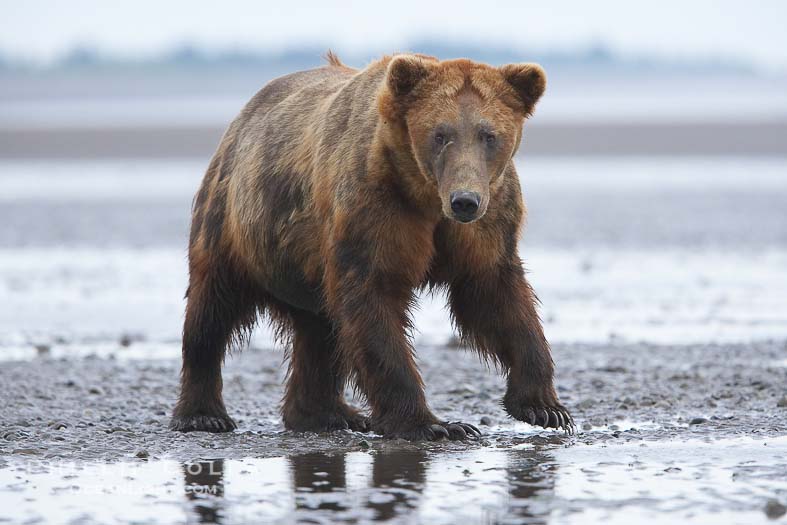
My goal visiting Silver Salmon Creek Lodge was to shoot simple portraits of large brown bears. Coastal brown bears are considerably larger than brown bears living in the interior of North America because they have access to salmon coming in from the ocean to spawn in the rivers and lakes. I am told by bear experts that interior brown bears are often referred to as grizzly bears or grizzlies, while it is generally agreed that coastal brown bears are not grizzlies. This distinction seems silly to me, however. Coastal brown bears are the largest bears in the world, surpassing polar bears and peaking in size with the Kodiak Island race. The best opportunities for portraits were in the meadows, with bears eating sedge grass. Being essentially pure fiber, sedge grass is not very nutritious for the bears but they are hungry as they wait for the salmon to arrive and so will eat lots of it. I even tried a little of it, and didn’t get sick, ok. The bears can eat up to 30 lbs of sedge grass each day and will spend hours in the meadows resting and grazing. Below are a couple of portraits of the bear that I thought was most impressive of those I saw during my stay. His eyes appear beady small because his head has grown so large and thick over the years, his shoulders were monstrously broad and thick and he walked with a swagger that suggested there was nothing that concerned him. He bears a recent scar over his right eye presumably from a fight with another male for territory or mating rights. I hope my kids get a chance to see him next year.

Full grown, mature male coastal brown bear boar (grizzly bear) in sedge grass meadows., Ursus arctos,  Copyright Phillip Colla, image #19134, all rights reserved worldwide.
Full grown, mature male coastal brown bear boar (grizzly bear) in sedge grass meadows. Lake Clark National Park, Alaska, USA.
Image: 19134  
Species: Ursus arctos
Location: Lake Clark National Park, Alaska, USA
Click To View This Location in Google Earth.  You must have Google Earth installed for this feature to work correctly. View this Image in Google Earth!

 
Mature male coastal brown bear boar waits on the tide flats at the mouth of Silver Salmon Creek for salmon to arrive.  Grizzly bear., Ursus arctos,  Copyright Phillip Colla, image #19149, all rights reserved worldwide.
Mature male coastal brown bear boar waits on the tide flats at the mouth of Silver Salmon Creek for salmon to arrive. Grizzly bear. Lake Clark National Park, Alaska, USA.
Image: 19149  
Species: Ursus arctos
Location: Lake Clark National Park, Alaska, USA
Click To View This Location in Google Earth.  You must have Google Earth installed for this feature to work correctly. View this Image in Google Earth!


Brown Bear Portrait

View This Blog Post in Google Earth (How Cool Is That?)  View this blog entry in Google Earth
Latitude: 59° 59' 46.51" N, Longitude: 152° 38' 43.51" W, Coord: 59.996253°, -152.64542°
Filed under: Alaska, Brown Bear, Lake Clark, National Parks, Photo of the Day, Wildlife on 8/11/2007

My goal in July was to shoot portraits of bears. I scheduled my visit before the arrival of salmon so that the bears would be in the meadows eating sedge grass and staging in the area, waiting for salmon to arrive. Next trip will be a bit later to coincide with salmon and look more for interesting behaviour oriented around salmon predation and territoriality between adult bears.

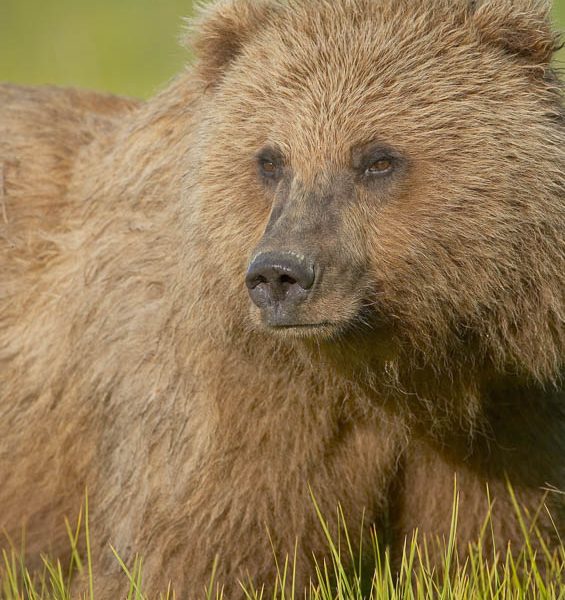
This young coastal brown bear (Ursus arctos) was resting and eating sedge grass.

Portrait of a young brown bear, pausing while grazing in tall sedge grass.  Brown bears can consume 30 lbs of sedge grass daily, waiting weeks until spawning salmon fill the rivers., Ursus arctos,  Copyright Phillip Colla, image #19157, all rights reserved worldwide.
Portrait of a young brown bear, pausing while grazing in tall sedge grass. Brown bears can consume 30 lbs of sedge grass daily, waiting weeks until spawning salmon fill the rivers. Lake Clark National Park, Alaska, USA.
Image: 19157  
Species: Ursus arctos
Location: Lake Clark National Park, Alaska, USA
Click To View This Location in Google Earth.  You must have Google Earth installed for this feature to work correctly. View this Image in Google Earth!


Pretty Young Thing

View This Blog Post in Google Earth (How Cool Is That?)  View this blog entry in Google Earth
Latitude: 59° 59' 46.51" N, Longitude: 152° 38' 43.51" W, Coord: 59.996253°, -152.64542°
Filed under: Alaska, Brown Bear, Lake Clark, National Parks, Photo of the Day, Wildlife on 8/10/2007

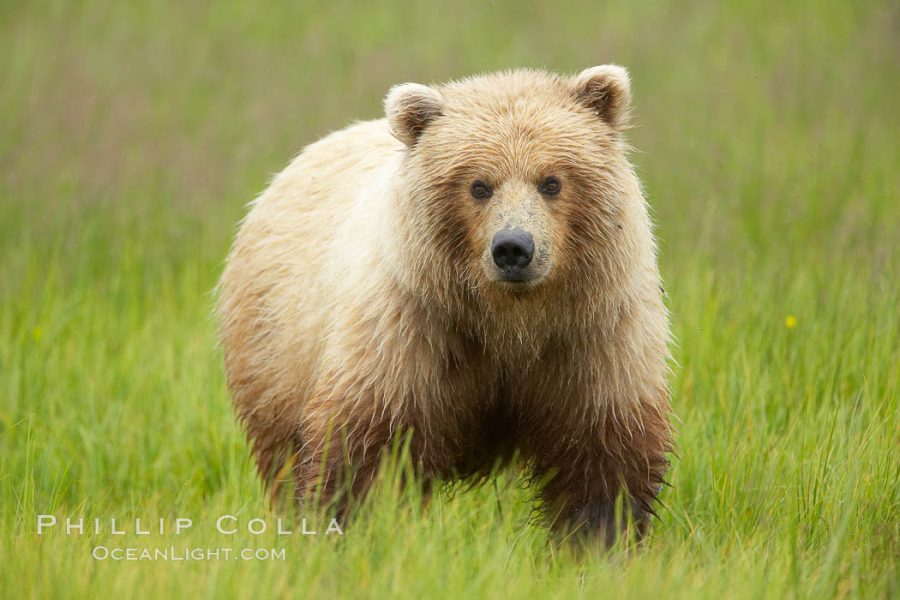
This young female coastal brown bear (Ursus arctos) was often around when I was visiting Lake Clark National Park in Alaska. We saw her clamming on the tide flats and grazing on sedge grass in the meadows. She is a really good looking bear, with a thick blond coat and none of the scars around her muzzle that the older bears typically have.

Juvenile female coastal brown bear (grizzly bear) grazes on sedge grass., Ursus arctos,  Copyright Phillip Colla, image #19137, all rights reserved worldwide.
Juvenile female coastal brown bear (grizzly bear) grazes on sedge grass. Lake Clark National Park, Alaska, USA.
Image: 19137  
Species: Ursus arctos
Location: Lake Clark National Park, Alaska, USA
Click To View This Location in Google Earth.  You must have Google Earth installed for this feature to work correctly. View this Image in Google Earth!


Lazy Bear

View This Blog Post in Google Earth (How Cool Is That?)  View this blog entry in Google Earth
Latitude: 59° 59' 46.51" N, Longitude: 152° 38' 43.51" W, Coord: 59.996253°, -152.64542°
Filed under: Alaska, Brown Bear, Lake Clark, National Parks, Photo of the Day, Wildlife on 8/4/2007

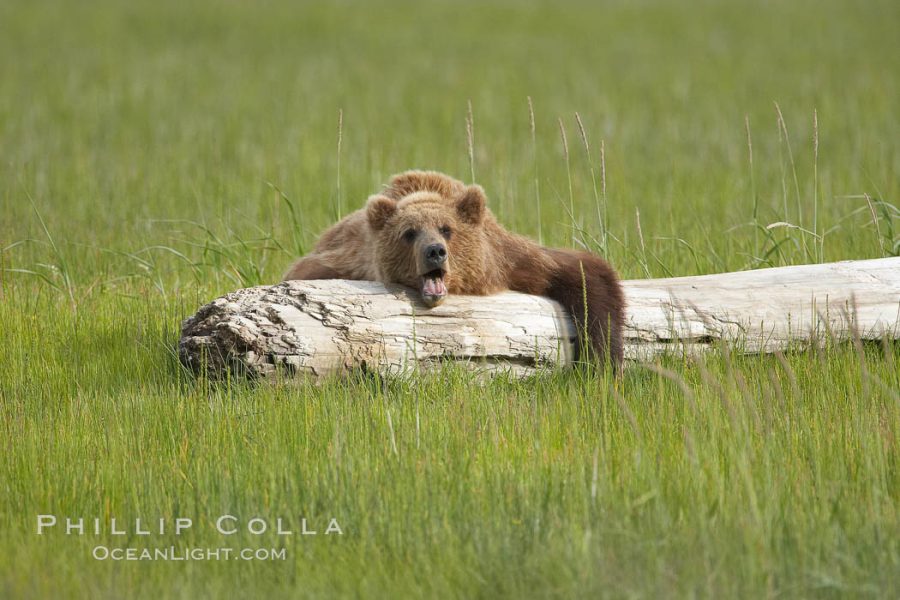
On my recent trip to photograph coastal brown bears (Ursus arctos) in Lake Clark National Park, I experienced nearly perfect weather for a full week, with just one day of light drizzle and only a few overcast days. About half the time we had full sun, with hardly a cloud in the sky, and warm. Great for us, but it can be tiring for the bears to hang in the sun with their thick fur coats. This guy found a comfy log in the center of a sedge grass meadow on which to nap, and gave us hardly a glance as we walked by him.

Lazy brown bear naps on a log., Ursus arctos,  Copyright Phillip Colla, image #19251, all rights reserved worldwide.
Lazy brown bear naps on a log. Lake Clark National Park, Alaska, USA.
Image: 19251  
Species: Ursus arctos
Location: Lake Clark National Park, Alaska, USA
Click To View This Location in Google Earth.  You must have Google Earth installed for this feature to work correctly. View this Image in Google Earth!


Exit Glacier Panoramic Photo

View This Blog Post in Google Earth (How Cool Is That?)  View this blog entry in Google Earth
Latitude: 60° 10' 53.33" N, Longitude: 149° 38' 10.75" W, Coord: 60.181481°, -149.63632°
Filed under: Alaska, Panoramas, Photography on 8/3/2007

While visiting Kenai Fjords National Park recently, I spent the morning taking an easy hike up to the terminal end (terminus?) of Exit Glacier. This is a popular spot, since it is a gentle hike and it is the main attraction of the only road that enters the national park. I think that I was the first person on the trail that morning, since there were no cars in the parking lot and I saw nobody else until I was nearly done with my walk. The weather was great: full sun, warm and quiet. I was hoping to see a bear or moose or something, but the only wildlife I saw was a fat old marmot who hung out until I got my camera at which point he ditched me. This is a panoramic photograph, composed of 10 separate images stitched (on the computer) into a single, enormous image. Note that this is actually a double-self-portrait, as I appear there twice in a manner of sorts. How’d he do dat?

Self portrait, panorama of Exit Glacier.  Exit Glacier, one of 35 glaciers that are spawned by the enormous Harding Icefield, is the only one that can be easily reached on foot.,  Copyright Phillip Colla, image #19112, all rights reserved worldwide.
Self portrait, panorama of Exit Glacier. Exit Glacier, one of 35 glaciers that are spawned by the enormous Harding Icefield, is the only one that can be easily reached on foot. Exit Glacier, Kenai Fjords National Park, Alaska, USA.
Image: 19112  
Location: Exit Glacier, Kenai Fjords National Park, Alaska, USA
Click To View This Location in Google Earth.  You must have Google Earth installed for this feature to work correctly. View this Image in Google Earth!

Pano dimensions: 4298 x 17211
 

Click the image to see it larger.

Brooks Lodge Bear Viewing, Katmai, Alaska

Filed under: Alaska, Brown Bear, How To, Katmai, National Parks, Wildlife on 3/30/2007

Some Thoughts on Visiting Brooks Camp, Katmai National Park, Alaska to See Coastal Brown Bears (Ursus arctos)


Coastal brown bear (Ursus arctos), near the bridge, Brooks Camp, Katmai National Park, Alaska

Brooks Camp is located in the heart of Katmai National Park, Alaska. Long famous for its world-class fishing, spectacular volcanic and geologic features and beautiful countryside, Brooks Camp is now widely known for its remarkable bear viewing. Each July, during the height of the salmon run upriver, and again in September when the “spawned-out” salmon return downriver, dozens of brown bears (grizzly bears, Ursus arctos) congregate in the Brooks River, its surrounding forests and meadows, and along the shores of Brooks Lake and Naknek Lake to feast on the salmon. Brooks Camp is one of the finest places in the world to view wild brown bears. I spent a week at Brooks Camp in July 2006 with Keith Grundy and his wife and two sons. We had a great time watching and photographing the bears, walking around the woods and wondering if we would stumble across one of Timothy Treadwell’s favorites, and just enjoying this wonderful Alaska setting. We even awoke one morning to a bat buzzing around inside our cabin room, that was cool, four men hiding under their covers from a 4-oz. flying vampiric squirrel.


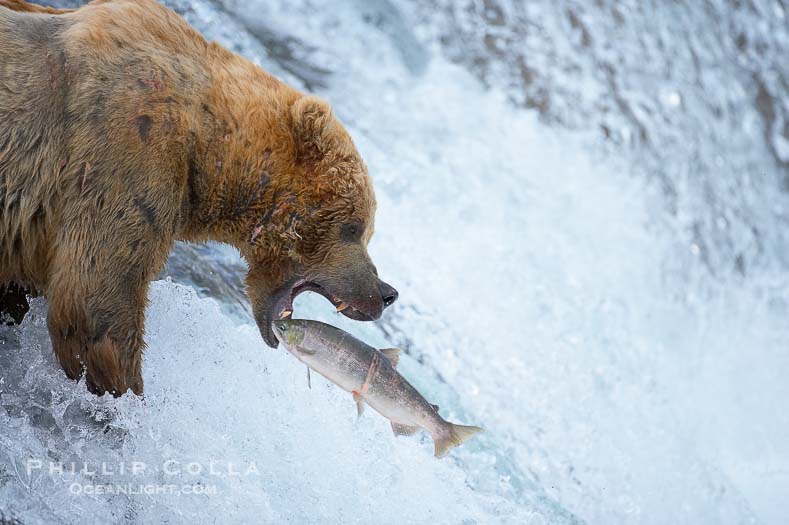
Coastal brown bear (Ursus arctos), catching a spawning salmon atom Brooks Falls, Katmai National Park, Alaska

Arrangements. We made arrangements to stay at Brooks Lodge, which included flights from Anchorage to King Salmon (by turboprop) and King Salmon on to Brooks Camp (by float plane) through Katmailand, the concessionaire operating Brooks Lodge. In particular, the float plane rides are really fun. The Katmailand folks were pleasant to deal with. Since stays at Brooks Lodge during the prime bear viewing weeks are limited to three nights, and I wanted additional time there, I made further arrangements to stay in the campground at Brooks Camp through the National Park Service. Brooks Lodge may seem expensive but it isn’t by Alaskan lodge standards, and the campground is dirt cheap. There are many tour companies and individual tour group organizers that will get you to Brooks Lodge for a multi-night stay, or just to Brooks Camp for the day. Many of these tours will offer some sort of photography instruction. You will pay a bit of a premium for this, but many visitors feel its worth it as the tour groups I encountered there were full and quite satisfied. I remember Natural Habitat had a group there, and I spoke with their tour guide a few times, and it seemed like a top-notch operation. I rarely join tour groups, preferring to have more control over my itinerary and spend less money by making my own arrangements. If you do too then Brooks Camp will be straightforward for you to arrange on your own. If you are pursuing photography, I definitely recommend that you stay at Brooks Camp, either in the lodge or campground, rather than visiting for the day by float plane, since you will forego precious morning and evening photography opportunites if you choose to visit only for the day.


Coastal brown bear (Ursus arctos), spring cub, stands to see above the tall grass near the bridge, Brooks Camp, Katmai National Park, Alaska

Brooks Camp. Visitors to the Brooks Camp area, after arriving by float plane, walk to Brooks Lodge and the ranger station to check in (if staying overnight) and to receive a brief, manditory lesson on how to behave around brown bears, especially when hiking or camping in the area and particularly when handling food or scented gear. Brooks Lodge itself is relatively small and simple, offering a fireplace and comfortable sitting chairs for relaxing and a dining room with simple yet satisfying buffet-style breakfast, lunch and dinner. I particularly took advantage of the bar at the end of the day, toasting my good fortune to be in such a great place before retiring for the evening. Cabins at the Lodge are spread over several acres, are spartan but comfortable, and offer bunk-style sleeping arrangements for a maximum of four per cabin. I am told the lodge manager tries to organize guests in such a way as to leave at least one bunk empty in each cabin but it may not be possible in July, especially for single travellers or odd-sized groups. The campground, an inexpensive alternative to the lodge, is a half-mile walk from the lodge on the shore of Naknek Lake. An electric “fence”, which looks like two lines of bungy cord with an electric conductor woven in each, is stretched around the perimeter of the campground. I camped in the center of the campground to ensure that any hungry bears that were not put off by a little shock would encounter someone else’s tent before mine. Some campers brought cooking gear with them and made fires and all that stuff each night. I choose instead to go light, relying on the lodge for meals and the lodge’s bar for entertainment, bringing only a tent, sleeping bag and some beef jerky.


Coastal brown bear (Ursus arctos), lifts its head from the water after snorkeling for salmon, near the Riffles section of Brooks River, Katmai National Park, Alaska

The Experience. Brooks Camp is about bear viewing, salmon fishing and visiting the nearby and spectacular Valley of 10,000 Smokes. Brooks Camp is a simple, no frills place. During my brief week-long stay I experienced weather ranging from warm, blue sky days with pleasant breezes to overcast days so windy the day-visitor float planes could not land on Naknek Lake, to cold and rainy weather. I did not experience much of a problem with mosquitoes, gnats or other bugs, although you are well advised to prepare for that anywhere in Alaska. You will NOT be alone at Brooks Camp in July, unless you choose to go hiking. Most visitors to the lodge and campground during that time are there to see bears and/or go fishing, so if you are too then you will see one another at meals in the lodge and out on the trails to and from the places where the bears gather or the fishing takes place. However, in mid-summer the days are long and, if you rise and leave the lodge/campground areas early in the morning, you can find solitude easily enough. There are no distractions from television, radio or any of that crap offered at the Brooks Lodge, which is great and helps one to reset the mindset and really absorb the smells and sights that the lakes, river, meadows and forest have to offer. Your cell phone won’t work but your satellite phone will. It should be noted that it is stupid to hike there with an iPod jammed in your earholes, for obvious reasons. Also, leave your computer at home. Don’t bring the damn thing to Brooks Camp, its just plain wrong not to mention tasteless, we must maintain some limits on technology in the outdoors.


Two coastal brown bears (Ursus arctos), fight after one attempted to steal the other’s salmon, in the pools below Brooks Falls, Katmai National Park, Alaska

Brooks Falls. Once visitors have been briefed on the bears and checked in to the lodge or campground, it’s off to the falls … Brooks Falls that is. Brooks Falls, roughly midway on the Brooks River between Brooks Lake and Naknek Lake, is the most popular spot in the Brooks Camp area for viewing bears, and with good reason. It is at Brooks Falls that salmon swimming upriver must navigate their only significant vertical challenge on their way to spawn in Brooks Lake. And it is at Brooks Falls that brown bears wait, both below and above the falls, to catch and eat the salmon. I spent six full days and two partial days at Brooks Camp, and allocated 3-7 hours each day to being at the falls, just to enjoy the show and try to shoot some photographs of the bears catching the salmon in midair and ripping them apart sashimi-style. The National Park Service has built an enormous, sturdy 10-foot elevated boardwalk, originating in the woods about 150 yards from the falls, and ending in two large viewing platforms where visitors can hang out and watch the bears in safety and without distracting them from their feeding, resting needs and socialization. The first platform overlooks the Riffles, a stretch of the very mild rapids about 100 yard below the falls. If a group of bears is occupying the falls, some of the smaller or less aggressive bears may move down into the Riffles stretch to fish. We found the Riffles was the best place to observe mothers and cubs and yearling bears, since it was dangerous for these younger bears to spend time around the large males (who might kill them). The Riffles platform tended to be the less crowded of the two platforms, by far, and on occasion actually offered the better opportunities for viewing — it all depends on the vagueries of the bears and the numbers of salmon passing through on any given day.


This large, mature male coastal brown bear (Ursus arctos), moved slowly around the Brooks Falls area. It was apparently atop the hierarchy of bears at the falls, to the extent that it did not even need to expend energy on posturing or threatening the other bears at the falls. It would simply walk out to the prime spot in the middle of the river above the falls when it was ready to catch salmon, and any other bears in its way would move aside at its approach. Katmai National Park, Alaska

Falls Platform. The primary viewing platform is the Falls Platform, naturally situated alongside Brooks Falls itself. This is the best place in the world to capture the classic bear catching salmon photograph, such as the one made famous by the superb photographer Thomas Mangelsen. All you need is a bear or two atop the falls, a school of salmon moving through with individuals periodically attempting to leap up the falls, and a quick trigger finger on the camera. I managed to get a few shots of this myself, and look forward to trying it again sometime. It should be noted that the Falls Platform can get crowded, to the point where the park service will institute a waiting list and limit stays on the platform to an hour per person. I had heard horror stories about visitors being very frustrated by crowds at the Falls Platform and not feeling that they were able to spend enough time there, so I deliberately scheduled twice as many days at Brooks Camp as I thought I would need to account for this possibility. In my experience the crowds were not a great problem, and I only observed a waiting list in the afternoons, when day visitors (those who fly in by float plane to view bears and fly out again the same day) were present. By about 6pm all day visitors have left, and the crowds are no longer an issue. I found that there was plenty of light for viewing bears at the falls and shooting photos until at least 8pm in the evening unless it was really overcast or raining, and as a consequence I returned home with many more frames that I expected. I found that, on a full frame camera (Canon 1DsII) that a 500mm f/4 was my most used lens, followed by 100-400mm and 70-200mm lenses. I think a 600mm lens would have been too limiting, although I did see a few guys using them, perhaps framing up tight portrait shots. I think I broke out a 24-70mm lens just once on the platform.


Coastal brown bear (Ursus arctos), waits motionless for salmon to leap up the falls, long shutter speed blurs the water movement, Brooks Falls, Katmai National Park, Alaska

Etiquette. It should be mentioned that there is some etiquette required for the platforms, particularly the Falls Platform, for photographers. The platform is well suited for 40-50 visitors but is standing room only. Once photographers, with their bulky tripods and ginormous telephoto lenses, start occupying spots on the platform it starts feeling crowded in a hurry. It is important for photographers to remember that, regardless of how awesome their gear is or how much money their tour group cost, they are no more entitled to a spot on the platform than Aunt Bessie from Wisconsin with her point-and-shoot instamatic. Indeed, for Aunt Bessie, time spent on the platform is likely even more of a thrill than it is for the travel-hardened, experienced photographer. Photographers, go ahead and spend time on the front row of the platform — for you will naturally weasel your way up there, you’ll see — and then voluntarily back off and allow others (especially kids) to have your spot, even if they care nothing for photos. You will find that shooting from the rear of the platform will give you somewhat different angles on the bears on the falls. I know, its hard to do, and I was as tempted as any other photographer to hog the front of the platform with my megacamera setup, but I realized moving around and shooting from the back of the platform actually allowed me to shot compositions I would have missed up front. I found during my stay that, in spite of afternoon waiting lists at the Falls Platform, everyone on the platforms was quite polite and pleasant — indeed very happy just to be in such a wonderful place. Even the most serious photographers eventually smiled and gave up their prime shooting spots for others who had been waiting a while. Only one notable incident involving platform crowding took place while I was there, on the Riffles platform. One of the National Park Service rangers, who pursues photography (apparently professionally) as well, was off-duty and shooting from the rear of the empty Riffles platform as a group of others, myself included, arrived. He asked us to stay out of his line of sight, stating that since he was shooting with a prime (fixed focal length) lens he did not have freedom to move from his position at the rear of the platform for his chosen composition. This request effectively made the entire platform inaccessible to the rest of us, until he was finished with his shot. Now, while his request would have been reasonable in a situation where everyone had reasonable freedom of movement, on the platform such a request was ridiculous, especially so coming from a ranger who we assume spends weeks, if not seasons, at Brooks Camp. We allowed him to have a few more minutes to his shot, but since his request kept the rest of the visitors from even using the platform we eventually had to tell him so and step on to the platform so that we could have a look at the bears ourselves. The moral of the story, which this experienced ranger certainly must have known, is: bring a zoom when shooting from the platforms. This is stating the obvious: you are on a platform with limited ability to move about. While primes are sharper and faster, on a platform you may (will) find yourself constrained in ways that only a zoom can solve.


A float plane, having just landed on Naknek Lake, taxies to the shoreline in front of Brooks Camp, while a young coastal brown bear (Ursus arctos), walks near the mouth of Brooks River near the bridge, Katmai National Park, Alaska

Bridge. The platforms are on the opposite side of the Brooks River from the lodge and campground. A floating bridge exists, near the mouth of the Brooks River at Naknek Lake. A raised platform has been built on one side of the bridge which is a great spot for viewing bears in the surrounding meadow and along the banks of the Brooks River. The bridge is a natural pinch point, since anyone staying at the lodge or campground really must cross the bridge during the course of a typical day of bear viewing. Therein lies the rub. If a bear is hanging around either end of the bridge, or has chosen to lay down for a nap near the bridge, the rangers may close the bridge until the bear has left, a closure that could last for hours resulting in the famous Brooks Camp “bear jam”. Bears have right of way through the park, and visitors are limited in how close to a bear they may be. Bear jams can occur anywhere in the park that a narrowing exists (road, trail, bridge, etc.). Since the brush underneath the bridge platform happens to be a natural place for bears to bed down (especially sows with cubs), bear jams at the bridge occur fairly often. I was lucky and not subjected to any that lasted more than a few minutes. Anyone with a flight out of Brooks Camp is advised to factor the possibility of a bear jam into their schedule and return early to the camp so as not to miss their flight. On our final day at Brooks, we were in a sense beneficiaries of a long bear jam. We hit the trail immediately after breakfast and spent the entire morning on the Falls Platform. For several hours the platform was nearly empty and very quiet with just a small group of us there, and we felt as if we had the falls to ourselves, a rarity in July. We all had lots of space to move about the platform. Just as we were leaving, many more people began to arrive — people who had been held up at the bridge for nearly the entire morning due to a napping bear, one we had missed by just a few minutes on our way out after breakfast.


“Spa bear”, a mature male coastal brown bear (Ursus arctos), has an intriguing technique for catching salmon. He waits motionless in the bubble-filled pools below Brooks Falls until a salmon happens to bump against him. More quickly than the fish can flee, spa bear snags the fish between his forepaws and his body. Only then does he bother to get his head wet, leaning down to grasp the doomed salmon in his mouth, and slowly exits the water to eat it. Brooks River, Katmai National Park, Alaska

See: grizzly bear photos.

Older Posts »

HOME | Online Image Search | Photo of the Day | Contact / Bio | Licensing/Pricing | Prints | Stock List | Image Hierarchy | List of Log Entries | Site Map | Blue Whale | Cetaceans | Pinnipeds | Sharks | Rays | Fishes | Kelp Forest | Sea Birds | Inverts | Man & Animal | Man & Ocean | Ocean & Light | Ocean & Motion | Portraits | About Color and Monitor Calibration | Copyright Statement | All text and photographs copyright © Phillip Colla Natural History Photography   All rights reserved worldwide. The content of this site is made available for purposes of researching images offered for license by Phillip Colla Natural History Photography.  No image is to be copied, duplicated, modified or redistributed in whole or part without the prior written permission of Phillip Colla Natural History Photography.  Whale logo is a trademark of Phillip Colla Natural History Photography, 8021 Paseo Arrayan, Carlsbad, CA 92009, USA.  (760) 652-5350.  Email: oceanlight@OceanLight.com    Web: www.OceanLight.com      Portfolios: www.Gygis.com

Updated: March 14, 2010