Yellowstone :: Photo Of The Day and Natural History Commentary

12/6/2007

Elk Flehmen Response

Filed under:  

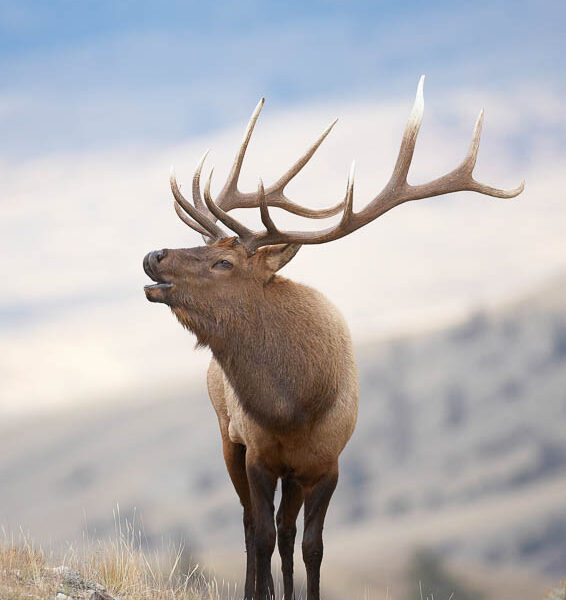
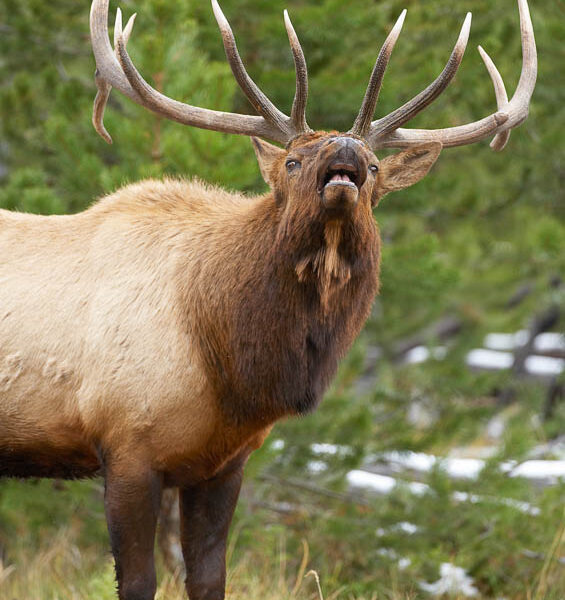
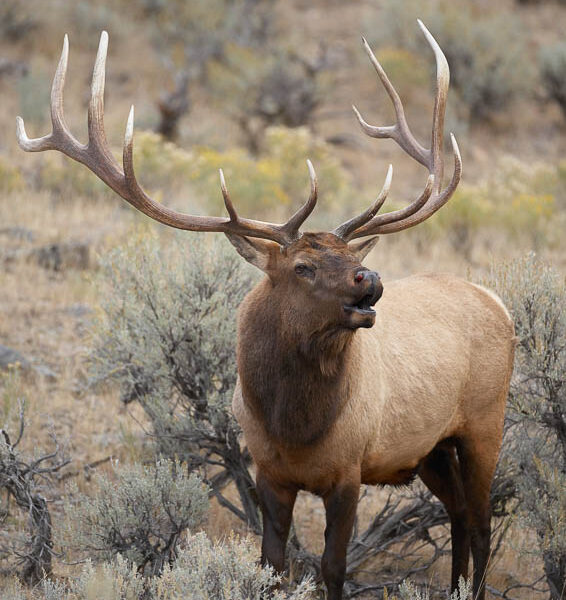
This bull elk (Cervus candensis) had a fine harem of females along the Madison River. He was bugling often and loudly, raising his head and lowering his antler rack behind him as he did so. Note how the bull’s upper lip is curled back. This is an example of the flehmen response (from German flehmen, meaning to “curl the upper lip"). The flehmen response is a particular type of curling of the upper lip in ungulates, felids, and many other mammals, which facilitates the transfer of pheromones and other scents into the vomeronasal organ, also called Jacobson’s Organ. In the flehmen response, animals draw back their lips , particularly the upper lip which curls towards the nostrils. The action, which is used when examining scents left by other animals, helps to expose the vomeronasal organ and draws scent molecules back toward it. This behavior allows animals to detect scents, for example from urine, of other members of their species or clues to the presence of prey. The flehmen response also allows the animals to determine, among other things, the presence or absence of estrus, the physiological state of the animal, and how long ago the animal passed by.

Male elk bugling during the fall rut. Large male elk are known as bulls. Male elk have large antlers which are shed each year. Males engage in competitive mating behaviors during the rut, including posturing, antler wrestling and bugling, a loud series of screams which is intended to establishe dominance over other males and attract females., Cervus canadensis,  Copyright Phillip Colla, image #19708, all rights reserved worldwide.
Male elk bugling during the fall rut. Large male elk are known as bulls. Male elk have large antlers which are shed each year. Males engage in competitive mating behaviors during the rut, including posturing, antler wrestling and bugling, a loud series of screams which is intended to establishe dominance over other males and attract females. Yellowstone National Park, Wyoming, USA.
Image: 19708  
Species: Cervus canadensis
Location: Yellowstone National Park, Wyoming, USA
Click To View This Location in Google Earth.  You must have Google Earth installed for this feature to work correctly.


12/1/2007

Yellowstone Elk

Filed under:  

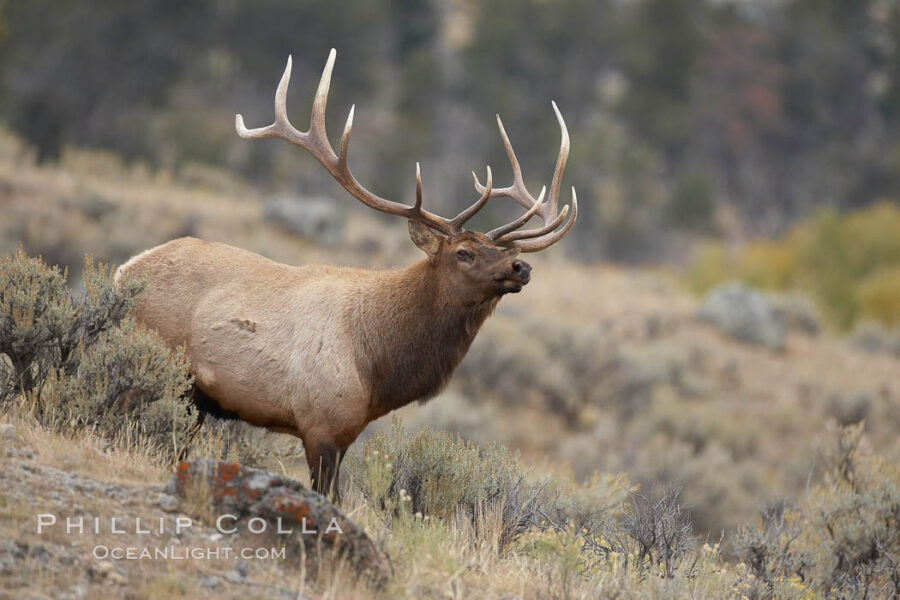
Ok, here is the last photo of the bull elk (Cervus candensis) that I photographed just outside Mammoth Hot Springs.

Bull elk in sage brush with large rack of antlers during the fall rut (mating season).  This bull elk has sparred with other bulls to establish his harem of females with which he hopes to mate., Cervus canadensis,  Copyright Phillip Colla, image #19745, all rights reserved worldwide.
Bull elk in sage brush with large rack of antlers during the fall rut (mating season). This bull elk has sparred with other bulls to establish his harem of females with which he hopes to mate. Mammoth Hot Springs, Yellowstone National Park, Wyoming, USA.
Image: 19745  
Species: Cervus canadensis
Location: Mammoth Hot Springs, Yellowstone National Park, Wyoming, USA
Click To View This Location in Google Earth.  You must have Google Earth installed for this feature to work correctly.


11/30/2007

Bull Elk in Sage

Filed under:  

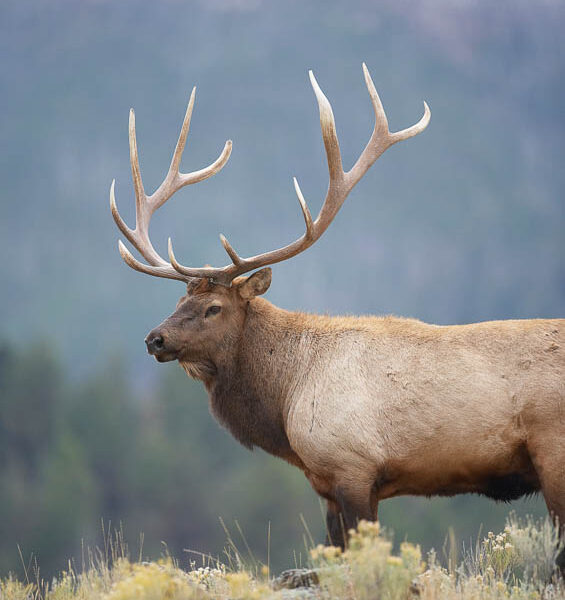
Here is another look at the fine bull elk (Cervus candensis) I spent an afternoon photographing near Mammoth Hot Springs.

Bull elk in sage brush with large rack of antlers during the fall rut (mating season).  This bull elk has sparred with other bulls to establish his harem of females with which he hopes to mate., Cervus canadensis,  Copyright Phillip Colla, image #19718, all rights reserved worldwide.
Bull elk in sage brush with large rack of antlers during the fall rut (mating season). This bull elk has sparred with other bulls to establish his harem of females with which he hopes to mate. Mammoth Hot Springs, Yellowstone National Park, Wyoming, USA.
Image: 19718  
Species: Cervus canadensis
Location: Mammoth Hot Springs, Yellowstone National Park, Wyoming, USA
Click To View This Location in Google Earth.  You must have Google Earth installed for this feature to work correctly.


11/29/2007

Bugling Elk at Mammoth Hot Springs

Filed under:  

The bull elk (Cervus candensis) I photographed one afternoon near Mammoth Hot Springs is seen here bugling, an audible cue and a form of posturing intended for both his harem of females and nearby males, meant to establish his dominance and access rights to the females and warn other males interested in breeding away. In fact, there was another bull with harem only a few hundred yards away. The two bulls bugled back and forth for hours, their sounds echoing over the otherwise quiet hills as evening set in.

Male elk bugling during the fall rut. Large male elk are known as bulls. Male elk have large antlers which are shed each year. Males engage in competitive mating behaviors during the rut, including posturing, antler wrestling and bugling, a loud series of screams which is intended to establishe dominance over other males and attract females., Cervus canadensis,  Copyright Phillip Colla, image #19698, all rights reserved worldwide.
Male elk bugling during the fall rut. Large male elk are known as bulls. Male elk have large antlers which are shed each year. Males engage in competitive mating behaviors during the rut, including posturing, antler wrestling and bugling, a loud series of screams which is intended to establishe dominance over other males and attract females. Mammoth Hot Springs, Yellowstone National Park, Wyoming, USA.
Image: 19698  
Species: Cervus canadensis
Location: Mammoth Hot Springs, Yellowstone National Park, Wyoming, USA
Click To View This Location in Google Earth.  You must have Google Earth installed for this feature to work correctly.


11/28/2007

Mammoth Elk

Filed under:  

After spending a few days in the Madison River area looking at the elk (Cervus candensis) herds there, I drive over to Mammoth Hot Springs. The bulls are bigger and have nicer antler racks there, so I have heard, but they need to be outside of town to get good images. (Many of the elk in Mammoth are literally in town, among the buildings, cars and people. A curiosity but not what I am looking for when taking photos.) I get there in late afternoon after having spent an hour with a inquisitive coyote at Sheepeater Cliffs. I spot some guys with long camera lenses on a hill just east of the town, so I park and walk up to say hello and see what they are looking at. I am the Yellowstone National Park version of a barney: bright red jacket, bright blue rain cover on my telephoto lens, flip flops, jeans (almost chose shorts) and a Diet Coke. Might as well paint “California” across my back in giant letters. These guys are all dressed in camo jackets, khaki or camo pants, hunter-looking boots, with camo covers for the long lenses. They look like this is their back yard (probably is). They tell me they are keeping tabs on a nice 6x6 bull with a harem, all of which are resting in some nearby sage. I say thanks, sit down near them, read my book and wait on the wind blown hill for something to happen. After a half hour or so the bull rises, as does his harem. They spend a few hours moving around the area, toward the NPS housing for a while, back towards us, then across the road and up onto some hills rising above us. The bull elk bugles frequently, and loud. He has some small, fresh wounds around his neck, probably acquired in a confrontation with another bull for rights to claim the harem. I listen to the experienced photographers discuss the bull’s behavior, where they think it will go, etc. – they clearly have been watching him for some time. One photographer in particular seems to know, just by watching the bull’s posturing in relation to the harem and the location of other nearby bulls (some bachelors for the moment), where it will move next, and consistently puts himself in position for good photography angles. By paying attention to him I manage to snag some nice images, elk portraits I have never had an opportunity to shoot before. He kindly offers me a few tips. Once the sun has dipped enough to end the shooting I offer him my thanks and get back to my car to get some food at the hotel in town.

Male elk bugling during the fall rut. Large male elk are known as bulls. Male elk have large antlers which are shed each year. Males engage in competitive mating behaviors during the rut, including posturing, antler wrestling and bugling, a loud series of screams which is intended to establishe dominance over other males and attract females., Cervus canadensis,  Copyright Phillip Colla, image #19693, all rights reserved worldwide.
Male elk bugling during the fall rut. Large male elk are known as bulls. Male elk have large antlers which are shed each year. Males engage in competitive mating behaviors during the rut, including posturing, antler wrestling and bugling, a loud series of screams which is intended to establishe dominance over other males and attract females. Mammoth Hot Springs, Yellowstone National Park, Wyoming, USA.
Image: 19693  
Species: Cervus canadensis
Location: Mammoth Hot Springs, Yellowstone National Park, Wyoming, USA
Click To View This Location in Google Earth.  You must have Google Earth installed for this feature to work correctly.


11/27/2007

Moose in Snow

Filed under:  

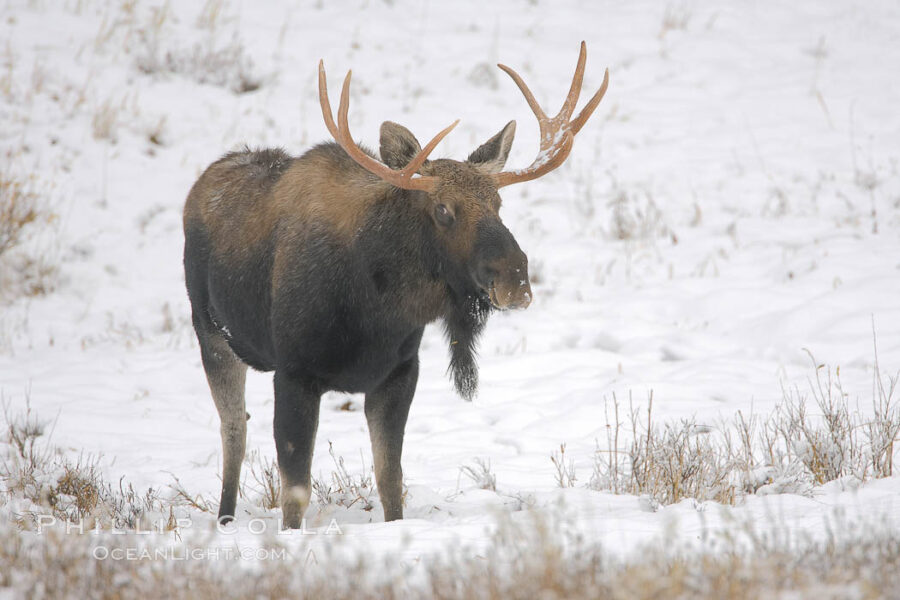
We found this moose (Alces alces) beside Soda Butte Creek, between the Lamar Valley and the Northeast entrance to Yellowstone National Park.

A male moose, bull moose, on snow covered field, near Cooke City., Alces alces,  Copyright Phillip Colla, image #19680, all rights reserved worldwide.
A male moose, bull moose, on snow covered field, near Cooke City. Yellowstone National Park, Wyoming, USA.
Image: 19680  
Species: Alces alces
Location: Yellowstone National Park, Wyoming, USA
Click To View This Location in Google Earth.  You must have Google Earth installed for this feature to work correctly.


11/26/2007

Madison River Coyote in Snow

Filed under:  

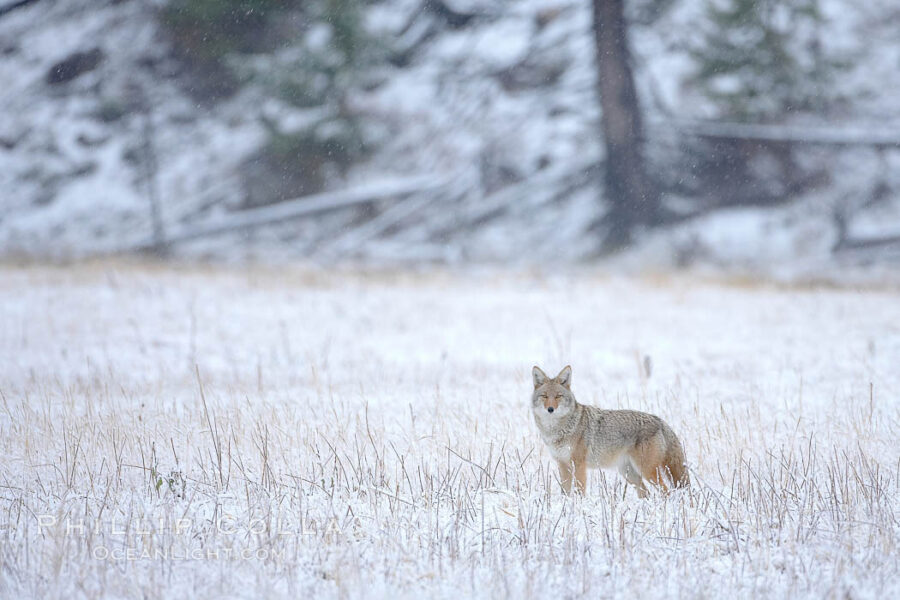
I spotted this coyote (Canis latrans) before sunrise one morning along the Madison River on the western edge of Yellowstone National Park. I was looking for elk but the bulls with their harems were not out in the meadows, preferring the cover of the trees. This fellow caught my eye however. Amid the falling snow I spotted some movement on the far side of the meadow, just along the river – a coyote foraging. He would move along slowly, pause after hearing a small animal under the snow, jump up only to drop and pounce on the poor creature through the snow. He caught a few while I was watching, but too distant and too dark to photograph clearly. There was just enough light to get a sharp photograph of it only when it went still, which it did just once.

Coyote in snow covered field along the Madison River., Canis latrans,  Copyright Phillip Colla, image #19635, all rights reserved worldwide.
Coyote in snow covered field along the Madison River. Yellowstone National Park, Wyoming, USA.
Image: 19635  
Species: Canis latrans
Location: Yellowstone National Park, Wyoming, USA
Click To View This Location in Google Earth.  You must have Google Earth installed for this feature to work correctly.


11/7/2007

Norris Geyser Basin

Filed under:  

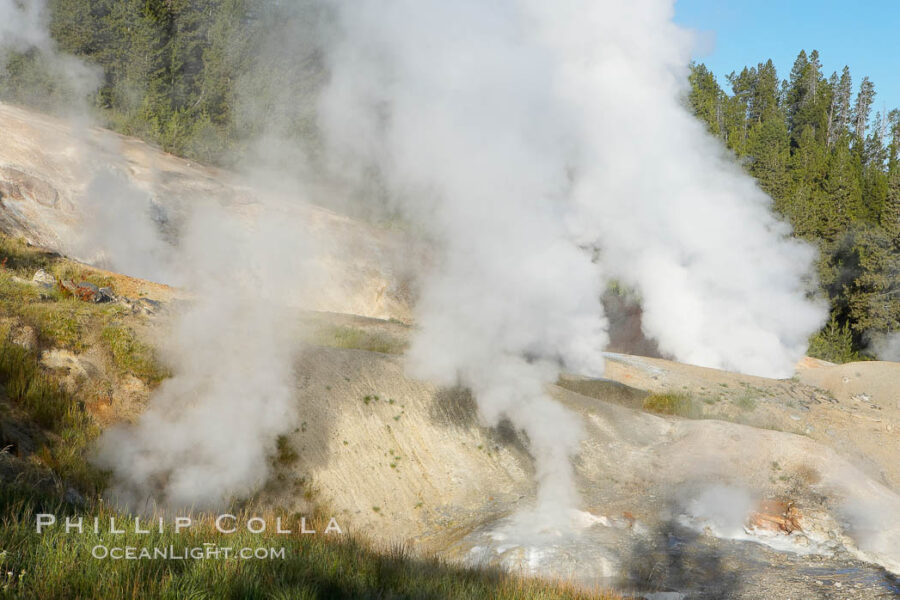
Norris Geyser Basin is one of the principal geothermal areas of Yellowstone National Park. Loaded with fumeroles, steaming hot springs, geysers and other generally hot-as-hell nasty holes in the ground, Norris Geyser Basin is best seen on a cool morning when it billows forth steam. The two photos below are from the Porcelain Basin trail.

Ledge Geyser, vents releasing steam, in the Porcelain Basin area of Norris Geyser Basin.,  Copyright Phillip Colla, image #13483, all rights reserved worldwide.
Ledge Geyser, vents releasing steam, in the Porcelain Basin area of Norris Geyser Basin. Norris Geyser Basin, Yellowstone National Park, Wyoming, USA.
Image: 13483  
Location: Norris Geyser Basin, Yellowstone National Park, Wyoming, USA
 
Steam rises in the Porcelain Basin.,  Copyright Phillip Colla, image #13490, all rights reserved worldwide.
Steam rises in the Porcelain Basin. Norris Geyser Basin, Yellowstone National Park, Wyoming, USA.
Image: 13490  
Location: Norris Geyser Basin, Yellowstone National Park, Wyoming, USA
 

See more photos from Norris Geyser Basin.


11/6/2007

Coyote Hunting Voles

Filed under:  

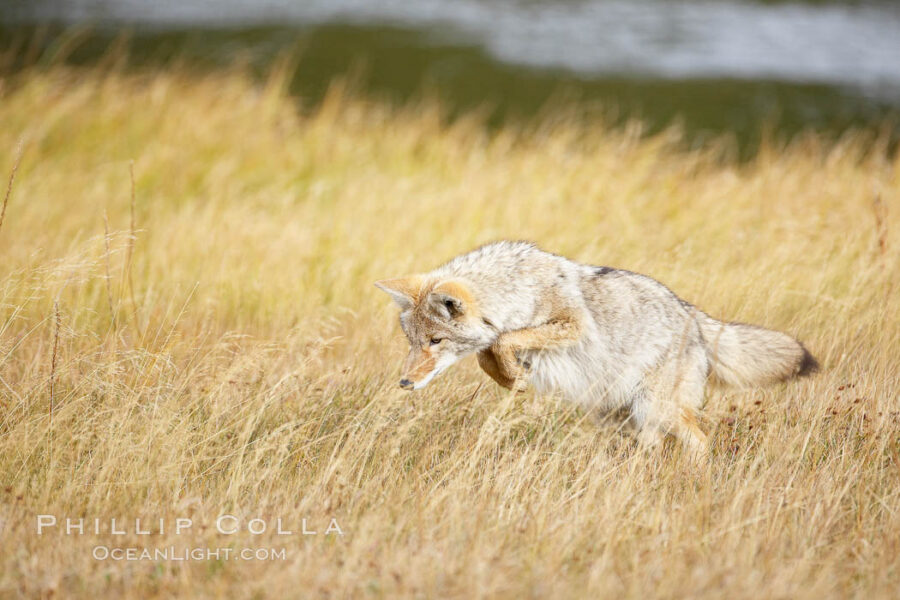
The meadows around Norris Geyser Basin in Yellowstone National Park are a good place to look for coyotes (Canis latrans) hunting voles. This coyote was found working the tall grass. He would stalk quietly through the grass, stop and listen, poise, leap high and and drop on his prey. Brutally effective.

A coyote hunts for voles in tall grass, autumn., Canis latrans,  Copyright Phillip Colla, image #19638, all rights reserved worldwide.
A coyote hunts for voles in tall grass, autumn. Yellowstone National Park, Wyoming, USA.
Image: 19638  
Species: Canis latrans
Location: Yellowstone National Park, Wyoming, USA
Click To View This Location in Google Earth.  You must have Google Earth installed for this feature to work correctly.


11/5/2007

Coyote at Sheepeater Cliffs

Filed under:  

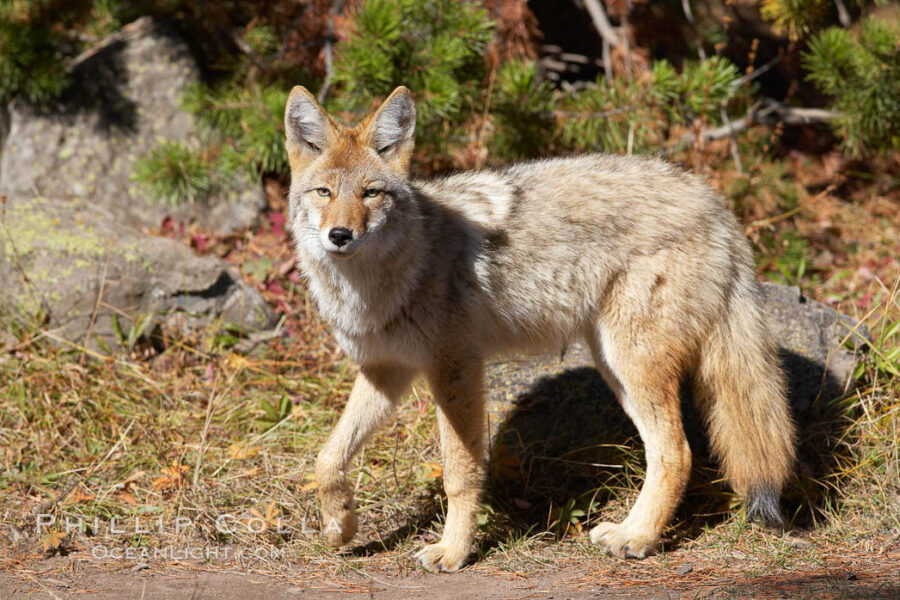
I usually stop once or twice at Sheepeater Cliffs while in Yellowstone National Park, hoping to photograph the yellow-bellied marmots that are found there. This time I was disappointed: it was too late in the year and they had gone to ground for the winter, and I could not find any of them. As I was kicking back and eating my lunch before continuing on to Mammoth Hot Springs for the afternoon, a coyote (Canis latrans) strolled by and started working in the brush along the river, presumably for voles or other small varmits. He was pretty comfortable with my presence, so I walked along and watched him for a while, taking photos.

Coyote., Canis latrans,  Copyright Phillip Colla, image #19634, all rights reserved worldwide.
Coyote. Yellowstone National Park, Wyoming, USA.
Image: 19634  
Species: Canis latrans
Location: Yellowstone National Park, Wyoming, USA
Click To View This Location in Google Earth.  You must have Google Earth installed for this feature to work correctly.


11/4/2007

Watching Wolves with Laurie Lyman

Filed under:  

Update 12/28/07: Wow! This morning Laurie was pictured and quoted in an Associated Press article about the trend of people moving to western states such as Montana and Wyoming, appearing in newspapers throughout the United States. [AP Photo][AP article]

Our main motivation for visiting Yellowstone National Park this past October was to find an opportunity for my daughter to see wolves, in the wild, with our friend Laurie Lyman. Laurie taught at the Rhoades School for many years. Our daughter was part of her swan song class, the 3rd graders of ‘04-’05. Following each vacation, which Laurie would spend in Yellowstone, she would entertain her class with stories of the Druids and Sloughs, of the alpha and beta wolves in each pack, which packs were faring well and not-so-well, and of the pups that would appear in spring. She was so loved that her class donated a radio collar, in her name, to be placed on one of the Yellowstone wolves so that it could be tracked using radio telemetry. I believe the collar is still transmitting. Immediately after retiring from teaching, Laurie moved to Cooke City, Montana to study wolves in the northern part of Yellowstone National Park, including the Slough Creek pack (which she has known since its inception in 2002) as well as the Druid Peak, Agate, Hayden and Molly packs. Her husband Dan splits time between Montana and California but is often with her in the field when he is in Montana. During the past few years, having rarely missed a day in the field, Laurie has gathered volumes of detailed field notes and considerable understanding of the complex social dynamics within and between various wolf packs in the Yellowstone area, including the roles played by key individual wolves and movements of individuals between packs. She can often be found in the field with noted wolf researcher Rick McIntyre.

On my several visits to Yellowstone, when I decide I want to see a wolf, I start by finding Laurie. Each time I have met with her, she has shown me wolves, so I have a perfect record so far! (I have seen a few wolves without her help, but honestly I am much better at spotting whales than wolves. I am well out of my element in Wyoming and need all the help I can get.) This year we spent two mornings with Laurie in the Lamar Valley and were treated to some fantastic wolf action. On our final day there we saw the Druid Pack cross a broad snow-covered field to pursue a bull (male) elk, a big fellow with an intimidating rack of antlers. This was the real thing, Wild Kingdom-esque, right there in front of us. Laurie made it clear that we should pay close attention and appreciate this special sight, so we did. Both elk and wolves were running at full speed through snow, across a river bed and over a number of small hills. For a while it appeared the wolves would catch the elk and make a kill, but eventually it seemed either the wolves grew tired, lost interest or perhaps concluded that they were not ready to tackle such a formidable adversary; the elk got away. What was particularly intriguing was that the chase was also watched by a grizzly who was positioned on the far side of the wolves. The bear seemed put off by the commotion and moved away into the trees, but stopped several times to watch the action. Much of the time we were with them, Laurie and Rick were in frequent radio communication with others elsewhere in the Lamar who were watching the same wolves from different vantage points or other wolf packs in the area. Rick kindly offered his scope to a few people who just happened by so they could get a glimpse, and patiently answered all of our questions.

Most wolf observation is done through high powered field scopes, Swarovskis and the like. Only once have I had a good look at a wild wolf without a scope. I have no real interest in trying to photograph wolves, at least not in any serious way with high end photo equipment, preferring to leave them to their business. Checking on them from afar through a scope is satisfying enough for me. Wolves receive enough attention already, from wolf lovers who just want to watch them to ranchers who believe that the only good wolf is a dead wolf, that they do not need to be further pursued by yet another photographer looking to shoot yet another wolf photo. We stayed high up on a hill with a great view of the entire Lamar Valley, listening to the howling of the wolves and watching them do their thing. Laurie’s friend Pauline, an accomplished digiscoper (what’s that you say?), allowed me to take a few photos by pressing my super-duper-ultra-mini-pocket digicam to the tiny viewfinder on her field scope. I even managed to get a shot of 10 Druid Peak wolves in one frame. It turns out that the simple act of aiming a point-and-shoot camera through a field scope and pressing the trigger, which even a simpleton like myself can do, is considered a “technique” and has a name: digiscoping. So there you have it, we were digiscoping the wolves. Photography for the masses: all you need is a scope and a point and shoot camera, and it’s pretty fun to boot. No strenuous hiking around either. I thought our digiscope shot was pretty good for a first wolf photo, and a fine souvenir of our morning watching the wolves with Laurie.

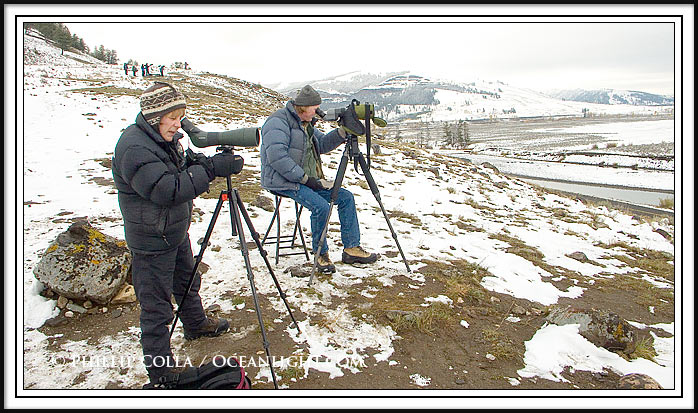
We meet Laurie Lyman on a cold but beautiful morning in the Lamar Valley, Yellowstone.  Wolves are in the distant background.

We meet Laurie Lyman on a beautiful but cold morning in the Lamar Valley, Yellowstone.

Ten members of the Druid Peak wolf pack cross the Lamar Valley in snow.

Ten members of the Druid Peak wolf pack cross the Lamar Valley in snow.

Laurie and Rick McIntyre observe the Druids.

Laurie and Rick McIntyre observe the Druids.


11/3/2007

Grand Prismatic Spring in Winter

Filed under:  

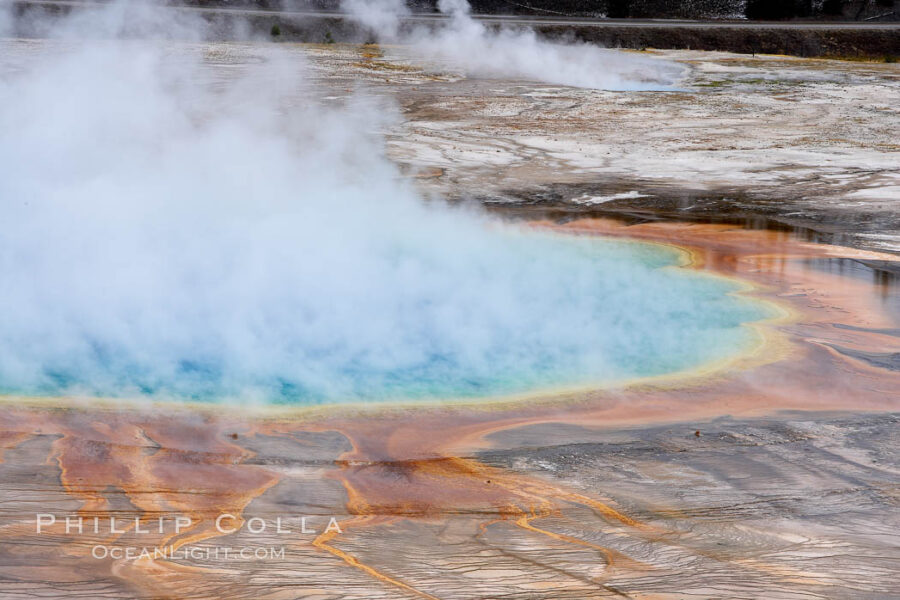
One of my favorite places in Yellowstone National Park is Midway Geyser basin. Here two of the largest geothermal features in the entire world lie just yards from one another: Grand Prismatic Spring and Excelsior Geyser. These two huge holes in the ground are filled with superheated water, direct links to hot underworld not far below. The huge columns of steam rising over Midway Geyser basin on cool mornings is striking. I usually make a hike to my favorite vantage point to check out the colors in Grand Prismatic Spring. This time around, though, there was snow on the ground and freezing air from a autumn snowstorm passing through. The dense steam from Grand Prismatic almost obscured it from sight altogether. I waited a while until the sun peeked through and the wind blew the steam away from me and snapped this shot. Grand Prismatic Spring is in the foreground, Excelsior Geyser in the back left.

Grand Prismatic Spring steams in cold winter air.,  Copyright Phillip Colla, image #19593, all rights reserved worldwide.
Grand Prismatic Spring steams in cold winter air. Midway Geyser Basin, Yellowstone National Park, Wyoming, USA.
Image: 19593  
Location: Midway Geyser Basin, Yellowstone National Park, Wyoming, USA
Click To View This Location in Google Earth.  You must have Google Earth installed for this feature to work correctly.

 
Grand Prismatic Spring steams in cold winter air.,  Copyright Phillip Colla, image #19594, all rights reserved worldwide.
Grand Prismatic Spring steams in cold winter air. Midway Geyser Basin, Yellowstone National Park, Wyoming, USA.
Image: 19594  
Location: Midway Geyser Basin, Yellowstone National Park, Wyoming, USA
Click To View This Location in Google Earth.  You must have Google Earth installed for this feature to work correctly.


The only way to see how large Grand Prismatic Spring is is to have a few people alongside it for scale. This was shot in summer when steam does not form as thickly over the spring:

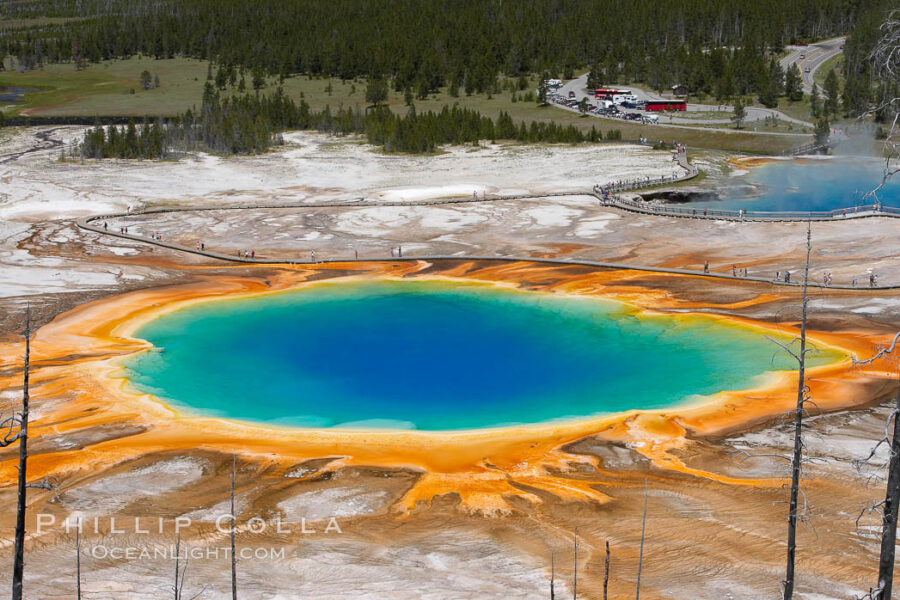
Grand Prismatic Spring displays a stunning rainbow of colors created by species of thermophilac (heat-loving) bacteria that thrive in narrow temperature ranges.  The blue water in the center is too hot to support any bacterial life, while the outer orange rings are the coolest water.  Grand Prismatic Spring is the largest spring in the United States and the third-largest in the world.  Midway Geyser Basin.,  Copyright Phillip Colla, image #13573, all rights reserved worldwide.
Grand Prismatic Spring displays a stunning rainbow of colors created by species of thermophilac (heat-loving) bacteria that thrive in narrow temperature ranges. The blue water in the center is too hot to support any bacterial life, while the outer orange rings are the coolest water. Grand Prismatic Spring is the largest spring in the United States and the third-largest in the world. Midway Geyser Basin. Midway Geyser Basin, Yellowstone National Park, Wyoming, USA.
Image: 13573  
Location: Midway Geyser Basin, Yellowstone National Park, Wyoming, USA
Click To View This Location in Google Earth.  You must have Google Earth installed for this feature to work correctly.


Note the lack of snow on the ground. The entire place is, if not steaming hot, at least warm enough to melt snow as soon as it hits the ground. Our glasses were fogging up just walking around.


11/2/2007

Grizzly Bear in Snow

Filed under:  

A few days into my Yellowstone National Park trip I found the ursine suspect into a double murder. I was not looking for bears, rather just cruising around and admiring all parts of the park, and I was lucky to stumble upon him and get off a few good photos . I continued to explore the park on my own for another week but saw no more bears. My dad and daughter then arrived and I shifted the emphasis to wolves and bears after having spent the better part of a week watching the elk rut. We made several trips together through the Lamar hoping to see bears and wolves but were not having much luck, although we had seen most of the other charismatic animals including coyote, moose, elk, geese and swan. Finally, on our last full day in the park, before sunrise as we drove to the Lamar from Mammoth, at exactly the same place that I had seen it previously, we found the fratricidal grizzly. Snow had been falling the previous two days so he was quite easy to spot from far away even in the dim light, otherwise I might have missed him entirely (my co-pilot and navigator were both half asleep and of no help in spotting wildlife that early in the morning). He was strolling up from the river again, across a broad open field of white snow-frosted sage. We got a very good look at him, the best view my dad and daughter had ever had of a grizzly. This photo was taken only a few hundred yards from the other one. The entire time we were watching this fellow, the Agate wolf pack was above us on the ridge howling. A few minutes after this bear had sauntered off into the woods, we drove a short way up the road and saw the Slough Creek pack, howling back at the Agates. All this in the space of perhaps 2 hours. It was quite a morning.

Grizzly bear in snow., Ursus arctos horribilis,  Copyright Phillip Colla, image #19616, all rights reserved worldwide.
Grizzly bear in snow. Lamar Valley, Yellowstone National Park, Wyoming, USA.
Image: 19616  
Species: Ursus arctos horribilis
Location: Lamar Valley, Yellowstone National Park, Wyoming, USA
Click To View This Location in Google Earth.  You must have Google Earth installed for this feature to work correctly.


11/1/2007

Yellowstone Deer

Filed under:  

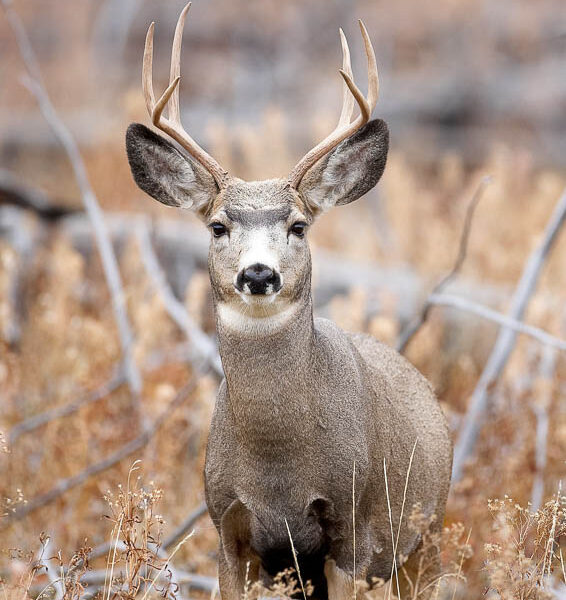
In October I was in Yellowstone National Park primarily to see and photograph the elk rut. However, my daughter’s 3rd grade teacher now lives in Gardner, MT and spends her time studying the wolves, so I made a several drives up to the Lamar Valley to see her and check out wolves. Each time I passed through the burned tree area before Tower I saw small groups of what I believe are mule deer (Odocoileus hemionus). They seem awfully small compared to the much larger elk. This buck – only males grow antlers, which will be shed in late December or January – was in the company of three other deer, presumably females, who seemed comfortable grazing in high grass near me. It was near sunset and raining, so for the most part I just hung out and watched them, not getting many photos.

Mule deer in tall grass, fall, autumn., Odocoileus hemionus,  Copyright Phillip Colla, image #19577, all rights reserved worldwide.
Mule deer in tall grass, fall, autumn. Yellowstone National Park, Wyoming, USA.
Image: 19577  
Species: Odocoileus hemionus
Location: Yellowstone National Park, Wyoming, USA
Click To View This Location in Google Earth.  You must have Google Earth installed for this feature to work correctly.


10/31/2007

Snow, Grass and Fire Trees

Filed under:  

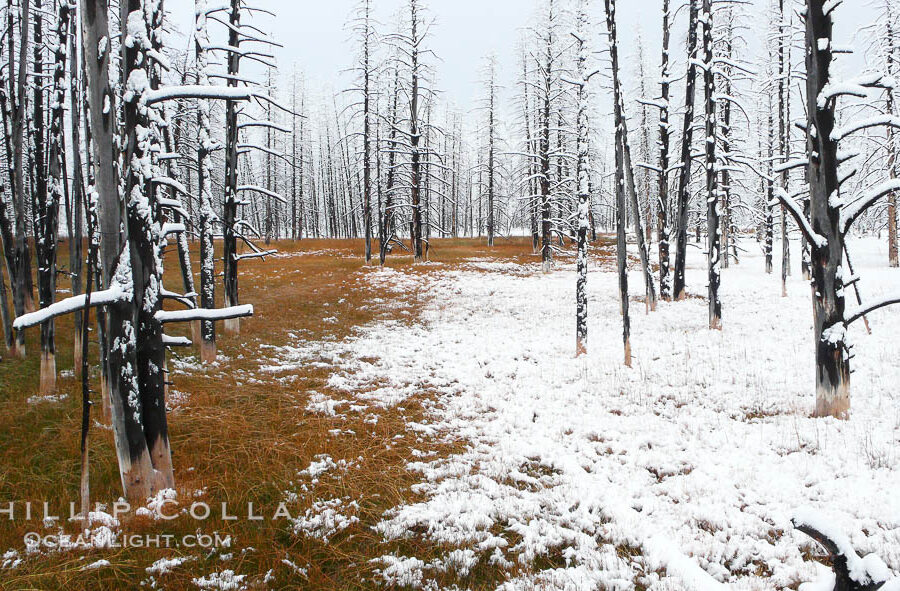
Near the Lower Geyser Basin in Yellowstone National Park is a stand of fire-scorched trees, or “fire trees” as our younger daughter named them during her first visit to the park five years ago. The ground surrounding a section of these trees is often steaming, hinting at the subterranean warmth and runoff from springs on Firehole Lake Drive nearby. Following a snow fall this phenomenon was illustrated nicely with a sharp delineation between cool and hot ground. This is another 16x9 photograph taken with our cool little Panasonic Lumix DMC-LX2.

Burned trees in grass meadow in Lower Geyser Basin.  Grass on the left has hot runoff from nearby thermal springs, keeping it free of snow.,  Copyright Phillip Colla, image #19789, all rights reserved worldwide.
Burned trees in grass meadow in Lower Geyser Basin. Grass on the left has hot runoff from nearby thermal springs, keeping it free of snow. Yellowstone National Park, Wyoming, USA.
Image: 19789  
Location: Yellowstone National Park, Wyoming, USA
 

10/30/2007

Mammoth Hot Springs Terraces and Dead Trees

Filed under:  

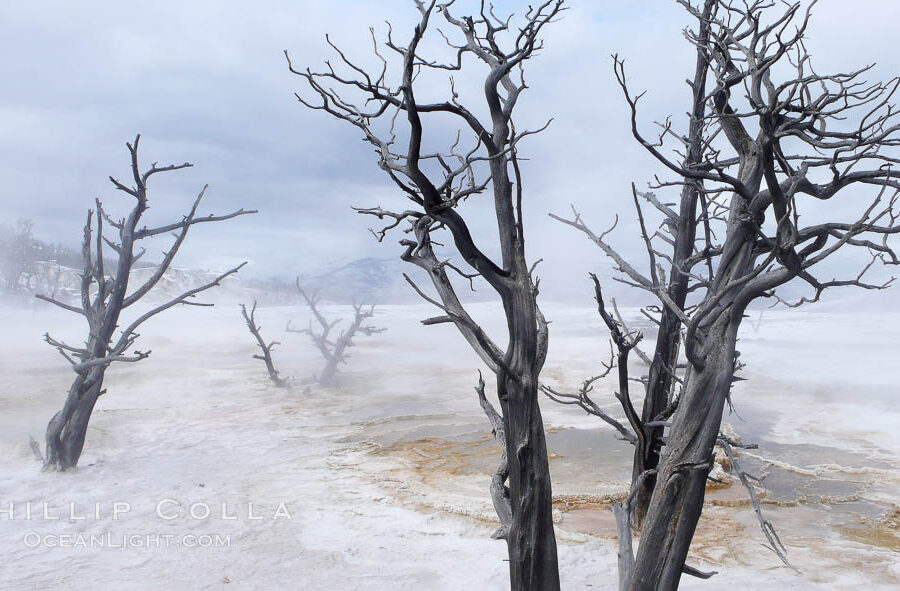
We spent time checking out the travertine terraces at Mammoth Hot Springs, in the northwestern corner of Yellowstone National Park. Several thousand pounds of calcium carbonate, carried in solution from the hot springs that bubble up through thick limestone, are deposited onto the enormous terraces each day. As the terrace complex spreads and grows, surrounding vegetation is overtaken. In this photo several dead trees are seen embedded in calcium carbonate, with steaming water flowing around them, a ghostly scene. This was photographed with our tiny Panasonic Lumix DMC-LX2. While probably considered a simple point-and-shoot camera by most people, it produces surprisingly high quality images (when used properly, including low ISO). Among other features, the camera allows full manual exposure (f-stop, shutter speed, ISO), auto-bracketing and RAW file format, all of which are uncommon in the point-and-shoot market. A number of the photos we shot with this fun camera while in Yellowstone are sufficiently sharp and clean to be posted for hopeful stock sales.

Dead trees embedded in calcium carbonate deposits in the travertine terraces of Mammoth Hot Springs, near Minerva terrace .  Over two tons of calcium carbonate (in solution) is deposited each day on the terraces, gradually killing any vegetation that had managed to be growing.,  Copyright Phillip Colla, image #19796, all rights reserved worldwide.
Dead trees embedded in calcium carbonate deposits in the travertine terraces of Mammoth Hot Springs, near Minerva terrace . Over two tons of calcium carbonate (in solution) is deposited each day on the terraces, gradually killing any vegetation that had managed to be growing. Mammoth Hot Springs, Yellowstone National Park, Wyoming, USA.
Image: 19796  
Location: Mammoth Hot Springs, Yellowstone National Park, Wyoming, USA
Click To View This Location in Google Earth.  You must have Google Earth installed for this feature to work correctly.


10/29/2007

Yellowstone Grizzly Kills Two Other Bears

Filed under:  

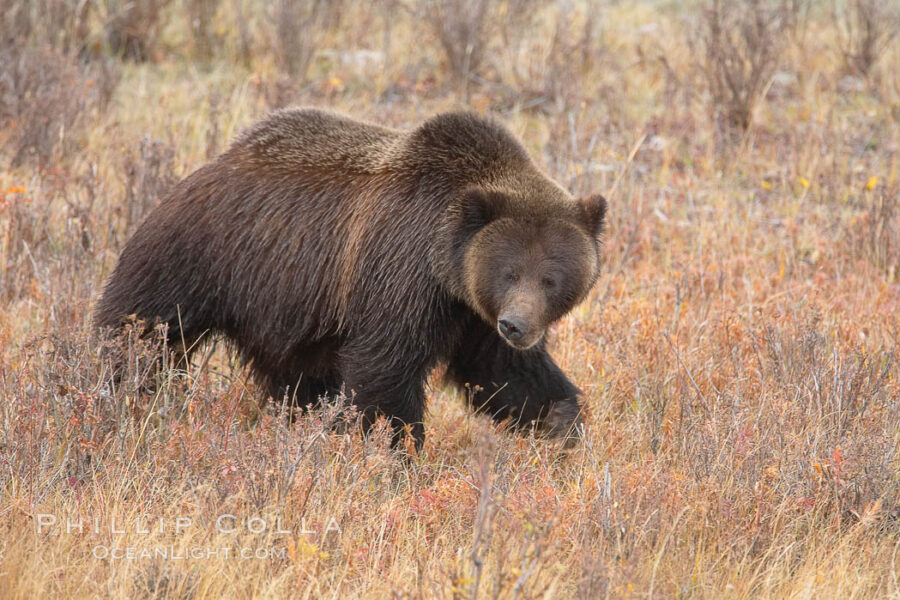
Shortly before my visit to Yellowstone National Park this fall to photograph elk, I learned that not one but two female grizzly bears had been killed, presumably by other bears. Fratricide among adult grizzlies is not particularly unusual, but two killings within days of one another is strange. Since both females were killed in the same part of the park, it is natural to presume they met their demise from the same cause: a male grizzly bear (Ursus arctos horribilis). When I arrived in the Lamar Valley, I spoke with a few photographers and animal watchers who told me that indeed the conventional wisdom, based as it was on circumstancial evidence in the absence of any witnesses to the killings, was that a single large male grizzly was probably responsible for the killings. I was fortunate to spot the bear as I was passing through Little America near the distinctive stand of aspens on the north side of the road, not far from the river. By the time the bear had made his way up from the river to cross the road near me quite a crowd had formed. I was told that a “bear researcher” was among those watching, and that this researcher had confirmed the bear as being the one suspected of the killings in the preceding weeks. The bear was bending his nose, perhaps to get a better scent of the people watching him.

Grizzly bear, autumn, fall, brown grasses., Ursus arctos horribilis,  Copyright Phillip Colla, image #19614, all rights reserved worldwide.
Grizzly bear, autumn, fall, brown grasses. Lamar Valley, Yellowstone National Park, Wyoming, USA.
Image: 19614  
Species: Ursus arctos horribilis
Location: Lamar Valley, Yellowstone National Park, Wyoming, USA
Click To View This Location in Google Earth.  You must have Google Earth installed for this feature to work correctly.


“Grizzly bears” and brown bears are one and the same species. Perhaps they are best thought of as distinct races of the same species, differing in size primarily due to diet. Some refer to grizzlies as Ursus horribilis or Ursus arctos horribilis but that is a distinction without a difference and I suspect would be discounted by modern taxonomists. The scientific name is Ursus arctos and I only include the horribilis on my web site to help distinguish between the two races. “Coastal” brown bears, which inhabit coastal regions in Alaska and Canada and include the famous Kodiak Island, Katmai and Kenai populations of brown bear, have access to vast amounts of fat rich salmon and thus grow considerably larger than interior grizzlies. Indeed, coastal brown bears are the largest bears found in the world. Grizzlies are found further inland in Alaska through Canada and into the northern United States and are often seen in Yellowstone, Grand Teton, Glacier and Waterton Lakes National Parks.


10/28/2007

Poor Table Manners

Filed under:  

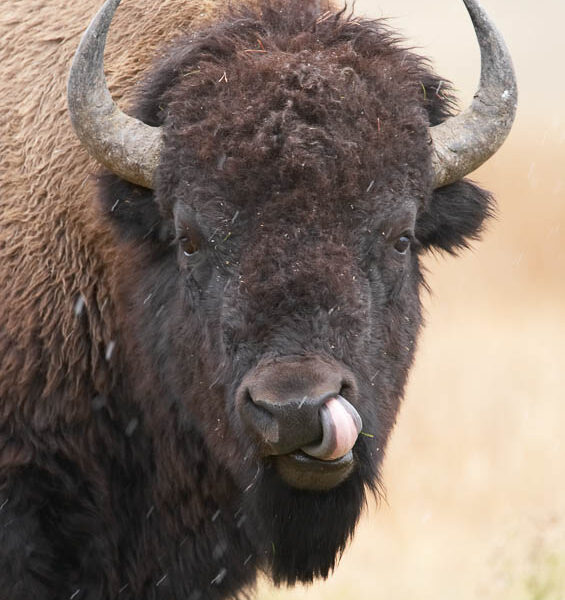
Never went to finishing school:

Bison., Bison bison,  Copyright Phillip Colla, image #19610, all rights reserved worldwide.
Bison. Yellowstone National Park, Wyoming, USA.
Image: 19610  
Species: Bison bison
Location: Yellowstone National Park, Wyoming, USA
 

Because its there.
A lick in time saves nine.
A boog in hand is worth two in the nose.


4/15/2006

Crested Pool, Yellowstone National Park

Filed under:  

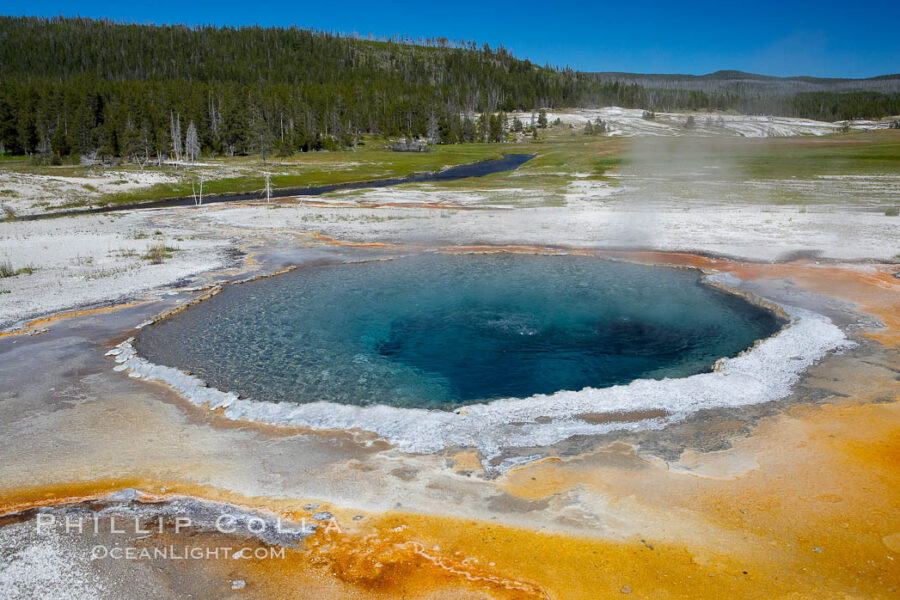
Crested Pool, in the Upper Geyser Basin of Yellowstone National Park, lies just steps away from Castle Geyser. Crested Pool extends 42 feet deep and is constantly superheated, achieving temperatures to at least 237°F. Crested Pool is always at least boiling and occasionally domes to heights of 10 feet. In 1970 a young visitor, not realizing how hot the water in Crested Pool was, ran into the stream and pool and was killed. A railing now keeps visitors back.

Crested Pool is a blue, superheated pool.  Unfortunately, it has claimed a life.  It reaches a overflowing boiling state every few minutes, then subsides a bit before building to a boil and overflow again.  Upper Geyser Basin.,  Copyright Phillip Colla, image #13357, all rights reserved worldwide.
Crested Pool is a blue, superheated pool. Unfortunately, it has claimed a life. It reaches a overflowing boiling state every few minutes, then subsides a bit before building to a boil and overflow again. Upper Geyser Basin. Upper Geyser Basin, Yellowstone National Park, Wyoming, USA.
Image: 13357  
Location: Upper Geyser Basin, Yellowstone National Park, Wyoming, USA
 

Keywords: Crested Pool, Yellowstone National Park


4/14/2006

Morning Glory Pool, Yellowstone National Park

Filed under:  

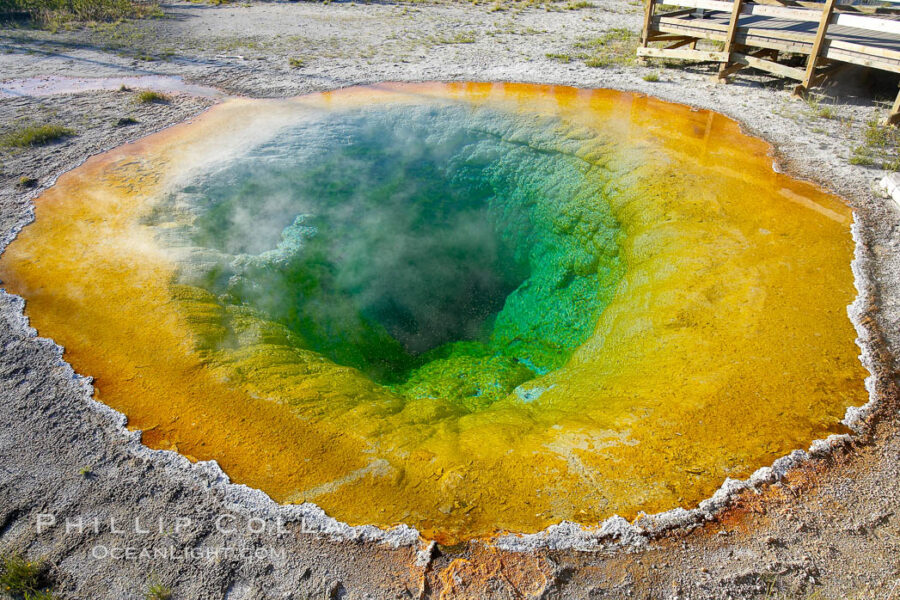
Morning Glory Pool, one of the most popular and beautiful pools in Yellowstone National Park, earned its name in the 1880’s due to its deep blue coloration and likeness to the Morning Glory flower. Morning Glory Pool was once reached by car, bringing it fame as one of the first features visitors would see entering the Upper Geyser Basin. Over the years visitors tossed coins, trash, sticks and rocks into the pool, causing its vent to clog and the flow of water to decrease. This prompted the temperature in the pool to lessen, causing the pool’s deep blue color to fade and allowing the red and yellow algae that formerly only survived at the fringe of the pool to grow toward the center. The road has since been removed and now Morning Glory Pool is reached by a flat 1.5 mile flat walk from the Old Faithful Inn area. According to the folks at GOSA, Morning Glory Pool has on rare occasions been known to erupt as a geyser, leading to some failed efforts in the past to deliberately induce eruptions in an effort to clear the pool’s vent. Morning Glory Pool is part of the Morning Glory / Riverside group of geothermal features. A visit to Riverside Geyser, which is one of the most predictable geysers in Yellowstone National Park, can be easily combined with a viewing of Morning Glory Pool.

Morning Glory Pool, Yellowstone National Park / Oceanlight.com

Morning Glory Pool has long been considered a must-see site in Yellowstone. At one time a road brought visitors to its brink. Over the years they threw coins, bottles and trash in the pool, reducing its flow and causing the red and orange bacteria to creep in from its edge, replacing the blue bacteria that thrive in the hotter water at the center of the pool. The pool is now accessed only by a foot path. Upper Geyser Basin, Yellowstone National Park, Wyoming.

Keywords: Morning Glory Pool, Yellowstone National Park


3/3/2006

Visiting Yellowstone National Park

Filed under:  

Following are some thoughts about a first visit to Yellowstone National Park.

Avoid Mid-Summer If Possible

I recommend avoiding the summer crowds by visiting before school lets out in June or after Labor Day. While I have not found summer crowds at Yellowstone to be a major problem (like they can be at Yosemite), I do make an effort to avoid them simply to have a more pleasant visit. Two areas that do tend to get crowded in summer months are Old Faithful and Canyon areas from about 11am to 3pm or so. My visits have been during the height of summer (July) to accommodate the kids vacation schedules, but if I could have scheduled them for after Labor Day I would have. Also, many animals avoid the summer heat by ascending into the surrounding mountains or retreating into shade during the day. By visiting when it is cooler, when the animals are more likely to be at lower elevations, you may have better luck seeing them. This is particularly true of elk which are more numerous and easily seen around the park in Fall.

Appreciate The Morning Hours

The absolute best time to be out and about in Yellowstone is sunrise to 9am. Hands down, no argument. So the best thing you can do is adjust your body clock to get up with the sun. Yellowstone in the morning, without crowds or traffic noise and in the cool morning air, is magic. The wildlife is more visible, steam from geysers and hot springs is thicker and more dramatic in the cold air, there are few cars on the roads and the walking paths and trails are nearly empty. Many times I have been the only viewer of a geyser erupting at this time of the morning, or the only photographer observing a group of elk. If you want to find solitude in the commonly visited Yellowstone sights, you simply must make use the morning hours. At 7:30am most visitors are either asleep in their hotel/rv/tent or contemplating breakfast and are not interested in being outside touring the park; this is particularly true of families. In addition the buses of day visitors won’t arrive for several hours. If you are out and about shortly after the sun rises, you will feel like you have the park to yourself. I make a practice of getting up with the sun every single day that I can while in Yellowstone, and it gives me several hours where I feel I have the place to myself. (The same is not true of sunset, however.) The Geyser Hill boardwalk near Old Faithful is very quiet before 8am, walking it with a camera or cup of coffee and pastry in hand at that time of day is tranquil indeed and the many columns of steam rising around you are pretty neat. There are usually fewer than a dozen people on the Old Faithful benches when it makes its first post-sunrise eruption of the day – contrast that with the hundreds or thousands filling the benches when it erupts in the midday or afternoon. The Artist Point and Lookout Point overlooks for viewing Yellowstone Falls in Canyon may have just a few people, most of them quietly sipping coffee and enjoying the tranquil canyon view, listening for raptors crying and the sound of the falls tumbling. Lamar Valley will have a few wildlife watchers, those who realize morning and evening offer the best chances for sighting bear and wolves. The geothermal hotspots are at their best in early morning, particularly Midway Geyser Basin, with its towering columns of steam rising from Excelsior and Grand Prismatic geysers, and Mammoth Hot Springs.

For wildlife, the early morning rule applies to sunset too. Many animals are more easily observed just after sunrise and before sunset, so if your goal is to see wildlife you would do well to be out looking at those times.

Visit Grand Teton National Park Too

Grand Teton National Park is just minutes to the south of Yellowstone National Park, yet very different. The morning hours in Grand Teton, with the rising sun illuminating the Teton Range and Mount Moran over the Snake River and Jackson Lake, are simply sublime. Hiking is good in Grand Teton, people are few, and your chance of seeing a moose is pretty good if you drive slowly and look carefully. If you are entering or leaving Yellowstone via its south entrance, I highly recommend spending two nights in Grand Teton National Park at the Jackson Lake Lodge or Jenny Lake Lodge, or if on a budget, the Colter Bay Cabins. You can also stay south of the park in Jackson Hole, which offers plenty of nightlife, hotels and motels, but you are missing something by staying there in my opinion. If you do one thing in Grand Teton National Park, it should be to watch the sunrise hit Mount Moran from Oxbow Bend.

A Suggested Whirlwind Tour of Yellowstone National Park

It is true that many people try to “do Yellowstone” in a day or two, especially those from overseas who are on a very tight schedule. Ok, if you must do it that way, in 24 hours you can see Old Faithful and a few other geysers, several waterfalls, herds of bison and probably some elk. But the pace and timing of seeing these things will be less than ideal and you probably won’t experience the real Zen of the place by moving so fast.

If you are making the effort to visit Yellowstone you really owe it to yourself to spend a minimum of four nights there, and even that is really only a whirlwind glance at Yellowstone given that it is such a huge park. I prefer a minimum of 7-8 nights, but that is unrealistic for some people. Following is an itinerary that I suggest if you are tight on time and can manage only four nights in the park. It focuses on the Old Faithful and Canyon areas. By the way, I recommend that you avoid shifting from hotel to hotel (or campground to campground) each night since it is a poor use of your time and ties you to the hotel/campground for checkout/check-in each day, which is a serious constraint. By staying in the Old Faithful area for two nights and the Canyon area for two nights you can see all the best spots in Yellowstone from these two locations, especially if you are willing to get going early in the morning to make the most of the daylight.

Day 1

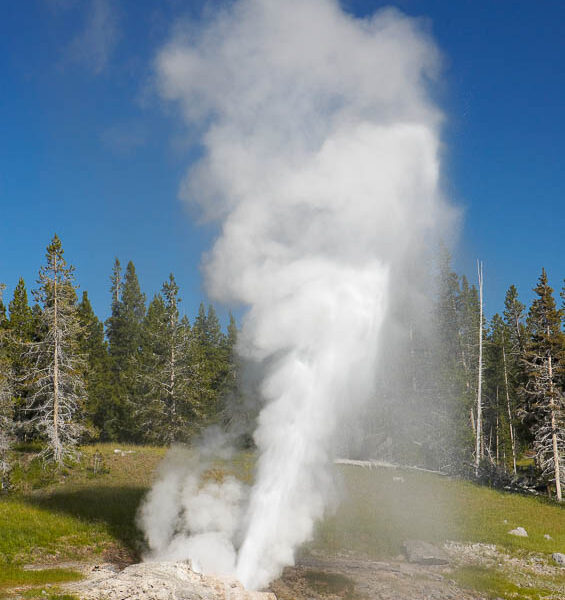
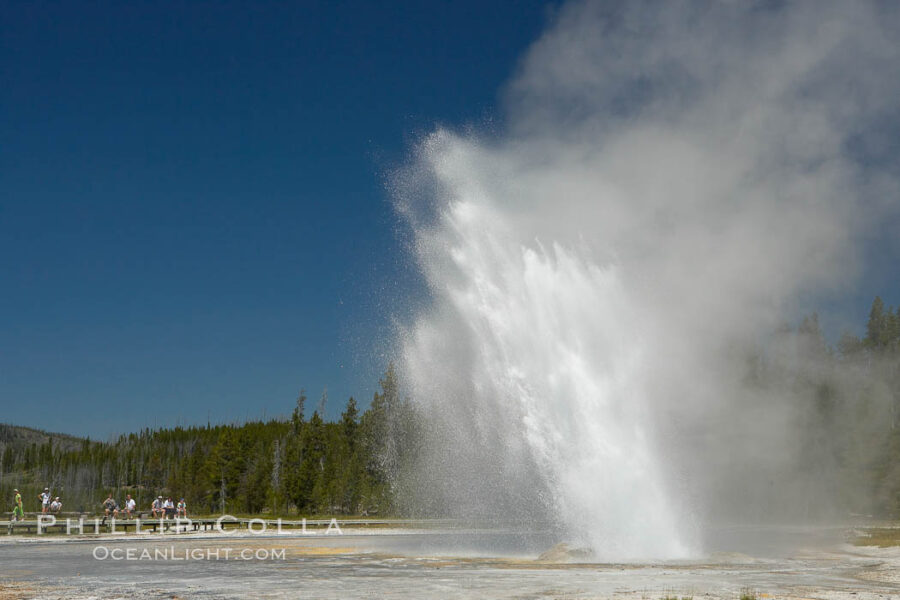
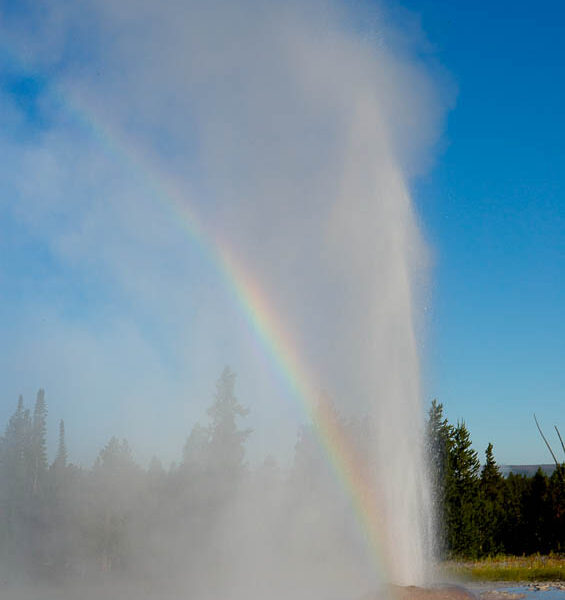
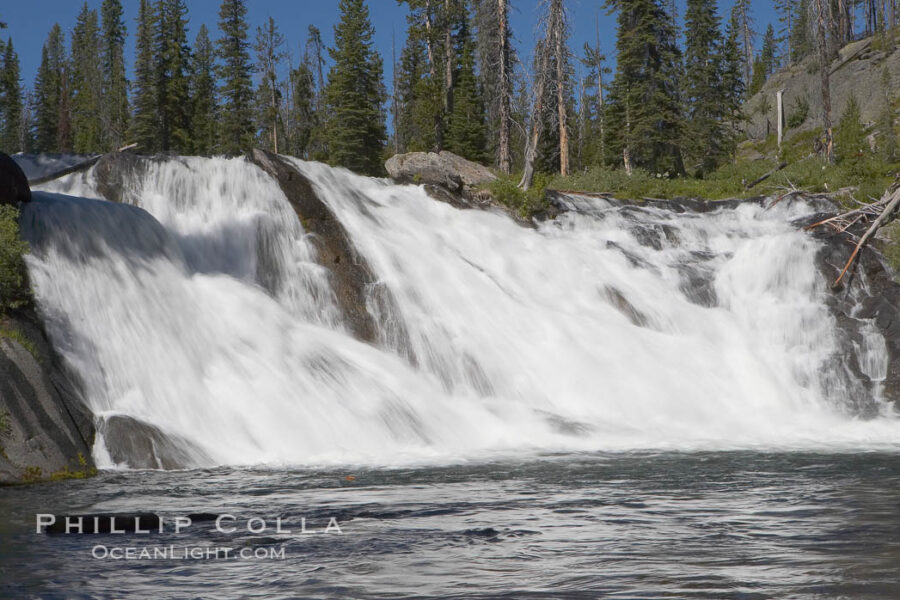
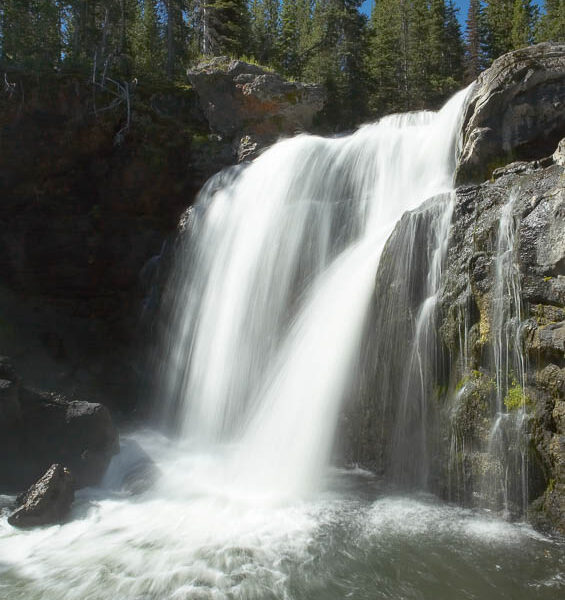
Arrive at Old Faithful area early afternoon. I recommend staying at Old Faithful Inn (ask for a room facing east so you can watch the geyser from your bedroom) or in one of the Old Faithful Lodge cabins. If you are coming from Grand Teton National Park through Yellowstone’s south entrance, be sure to make brief stops at Moose Falls and Lewis Falls. After getting checked in, spend the afternoon walking Geyser Hill, the centerpiece of the geothermally rich area known as the Upper Geyser Basin. You will probably see a few geysers go off while you do. The five “predictable” geysers in the Upper Geyser Basin – Old Faithful Geyser, Riverside Geyser, Daisy Geyser, Castle Geyser and Grand Geyser – are described in the visitor center near the Old Faithful Inn along with their next expected eruption times. Old Faithful goes off about one an hour, is quite predictable, and you can work it in around your other siteseeing. Don’t make a big deal about it, get away from Old Faithful Geyser and see the others for a much richer experience. Check the times for Riverside Geyser and Castle Geyser particularly. Make your way from the Old Faithful geyser area along the boardwalk and down to Morning Glory Pool at the far end. In between you will pass by the predictable geysers along with many smaller and/or unpredictable geysers as well as springs and vents. For this first afternoon I suggest trying to photograph two geysers in particular. Riverside Geyser, which is beautiful in and of itself, is lit perfectly and has the likelihood of a striking rainbow during its late afternoon eruptions making for one of my favorite Yellowstone pictures. You will need to position yourself “downriver” a little to see the rainbow. (Use a polarizing filter but only turn it part way to maximize the rainbow against the geyser.) Riverside’s eruptions last for 20 minutes or more but the first five minutes are the best. Castle Geyser is another easily photographed geyser provided its expected eruption is convenient for your afternoon tour of the area. Since Castle’s eruptions last so long (30 minutes or more) it is a simple matter to walk around its periphery and find the best angle given the sun, clouds and time of day once it has started. Perhaps end the day by photographing Old Faithful erupting in the final hour of sunlight.

Day 2

What’s planned: Old Faithful eruption sunrise / Midway Geyser Basin / Firehole Lake Drive / Fountain Paint Pots / Gibbon Falls & Gibbon Meadows / Geyser Hill sunset.

Day 2 – Morning

This is a big day, lots to see, so get going early. Don’t worry if you get tired, you will be done by sunset and can go to bed early.

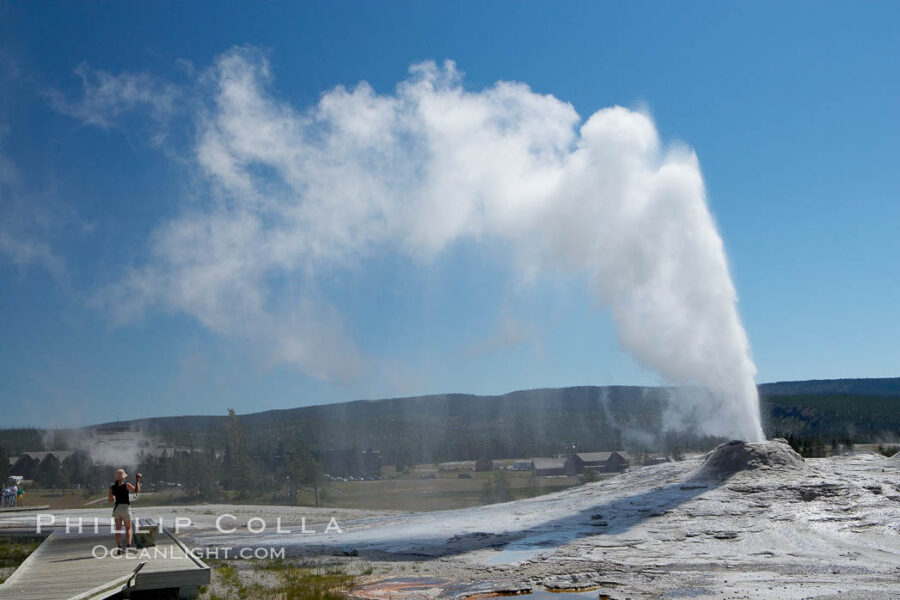
Start by day off by watching / photographing Old Faithful at its first eruption after sunrise. Position yourself by the Old Faithful Lodge, making sure to get a coffee and pastry in the lobby before you sit down outside to wait. The light is super on Old Faithful at this time of day, and with it coming over your shoulder you will see something like this and there will be very few other people out with you so see and hear it go off. Other than sunset, this is the best time to really admire the eruption.

After Old Faithful’s eruption, hop in the car and venture down the road to Midway Geyser Basin. If the air is cool you will see the steam rising from Midway Geyser Basin well before you arrive, towering hundreds of feet in the air. Spend 30-45 minutes walking the path in Midway Geyser Basin, taking you past Excelsior Geyser and the amazing colors of the bacteria mats of Grand Prismatic Geyser.

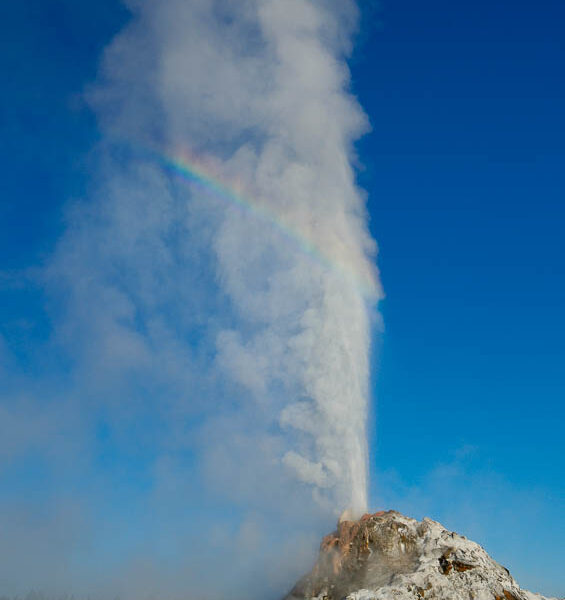
Leave the Midway Geyser Basin and continue down the road to Firehole Lake Drive. Take this drive slowly, stopping often and lingering. Since Firehole Lake Drive is a one-way loop, if you want to see something again you must repeat the entire circuit. You will pass Great Fountain Geyser, which is predictable but has a very long interval; pass it by unless someone who knows geysers confirms that an eruption is imminent, in which case stick around for the show. The most easily photographed geyser on Firehole Lake Drive is just a few yards down the road: White Dome Geyser. It erupts frequently but unpredictably. I think I have waited perhaps 20-30 minutes at most for it to go off. Pink Cone Geyser and Firehole Lake are ahead, the last notable stops on Firehole Lake Drive.

After completing the Firehole Lake Drive, continue down the road to the Fountain Paint Pot area, and walk the boardwalk. You’ll see several geothermal features including a constantly erupting geyser (Clepsydra), hot springs and paint pots.

Day 2 – Midday

Depending on your energy and what time it is, you have a few options. Either return to the Old Faithful area for lunch, rest, or walking Geyser Hill, continue down the road. If you choose to keep going for a while, or if elk interest you, I suggest doing the following before you return to the Old Faithful area. Continue on the road to Madison, bear right toward Norris, you will be following the Gibbon River now. You will come to Gibbon Falls after five miles after Madison; it is usually crowded here during midday, perhaps difficult to find a parking spot. The view of the falls from the road on the bluff is poor. If you are adventurous, instead do this: park a few hundred yards downriver from the main viewing area, hop over the wall, descend the dirt slope to the river, walk up the river along the fisherman’s trail to the foot of the falls, and enjoy this view. It is fine.

Once you are done with Gibbon Falls, continue to Gibbon Meadows, which is a broad meadow area about five miles north of Gibbon Falls. The hope here is that you will see elk, they are often in the meadow. If you arrive to a line up of cars, elk are likely the cause of the traffic. If there are elk here, great, stop and admire them while you can. You will likely see more during your visit to Yellowstone but in the event you do not, you want to get a good look now.

Once you are done with Gibbon Meadows, return to the Old Faithful area.

Day 2 – Late Afternoon

On the return to Old Faithful you will pass Firehole Canyon Drive, a one way drive. You are now going the “right” way to take it, since taking it earlier in the day would have required you to double back. Whatever, if you have not taken Firehole Canyon Drive yet do it now. There is a waterfall and swimming hole near the end of it, with parking, if you are hot enough to want a swim.

Also on the return to Old Faithful are two small geothermal areas that might be worth visiting depending on your time: Biscuit Basin and Black Sand Basin. Biscuit Basin has several nice features such as Sapphire Pool, Shell Spring and Jewel Geyser. Black Sand basin has Emerald Pool and Sunset Lake. However, if it is within two hours of sunset I would suggest skipping both Black Sand Basin and Biscuit Basin.

Get back to Old Faithful with at least two hours of sunlight left, and make your last walk around Geyser Hill, hopefully seeing one or two geysers erupt that you have not seen yet. This will give you a second chance to see Riverside in late afternoon light. Plus it is a good way to end your stay in the Old Faithful area, with a final walk among the many hot spots on Geyser Hill, winding up at sunset with just a short stroll back to your hotel.

Day 3

What’s planned: Old Faithful eruption sunrise / Gibbon Meadows / Norris Geyser Basin / Hayden Valley / Grand Canyon of the Yellowstone sunset.

Day 3 – Morning / Midday

If you didn’t get a good look at Old Faithful’s sunrise eruption yesterday, you have another shot at it this morning. So get up, watch and photograph it, then pack up and leave pronto. You are on your way to Canyon this morning, and will pass by many of the places you saw yesterday. If there are any that pique your interest, you can make a quick stop to see them again, but keep moving if you can. In particular, spend some time at Gibbon Meadows if you are there early, look around the periphery of the meadow for elk.

Once past Gibbon Meadows you reach the Norris area. Here you have a chance to visit Norris Geyser Basin. Norris Geyser Basin is worth a visit as it has pleasant boardwalk paths, some pretty springs and a nice open area of geysers, vents and fumeroles. I suggest that you walk through the Norris Geyser area this morning (now), since the features are more attractive in the morning air. If it is, say 11am or later, you may wish to pass it by and visit it tomorrow morning.

On the way from Norris to Canyon is the Kepler Cascades side road (one way). It is worth driving but if you miss it there is no great loss. The cascades (falls) are distant and not too dramatic.

After Norris Geyser Basin and Kepler Cascades drive you will arrive in the Canyon area. Save your first look at the actual Grand Canyon of the Yellowstone for later today, or better yet tomorrow morning. Your first view of the canyon should be in morning or late afternoon light for the most visual impact. If it is too early to check in to your hotel/campground in Canyon, then simply grab a picnic lunch in the Canyon village shop, pass through Canyon and head south towards Yellowstone Lake, to spend the afternoon in the Hayden Valley.

Day 3 – Afternoon

After leaving Canyon you will drive along the Yellowstone River (above where it drops into Yellowstone Canyon). Look for swans and pelicans here, and fly fishermen. Eventually the drive opens up into the Hayden Valley, where bison herds are typically seen. Drive slowly, stop at the turnouts, use binoculars to look for bison, elk, coyote, antelope and perhaps wolf or bear. Some